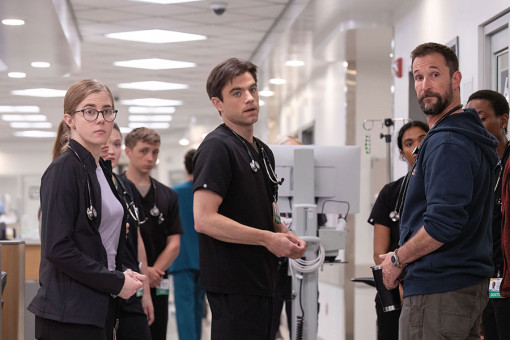

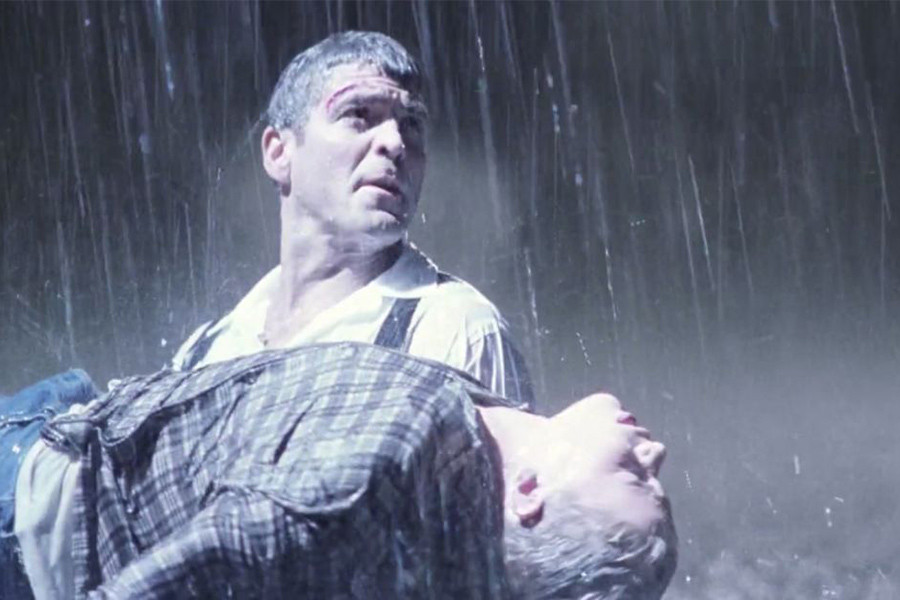
Thirty years ago, George Clooney emerged from the depths of a torrential deluge and became a star.
ER's "Hell and High Water," which aired during Sweeps on November 8, 1995, finds Clooney's charming pediatrician with a severe allergy to authority, Dr. Doug Ross, contemplating an impulsive career change from Chicago's Cook County Hospital to private practice. After exhausting what seems to be the last of his last chances to curb his more self-destructive tendencies at work, or simply growing tired of tripping over the hospital's obstacle course of bureaucratic red tape, Ross flees the hospital in his sports car — en route to an opera wearing a tux, because reasons. A flat tire during an unrelenting storm forces him to come to the aid of young boy Ben (Erik von Detten), who is trapped in a flooding storm drain.
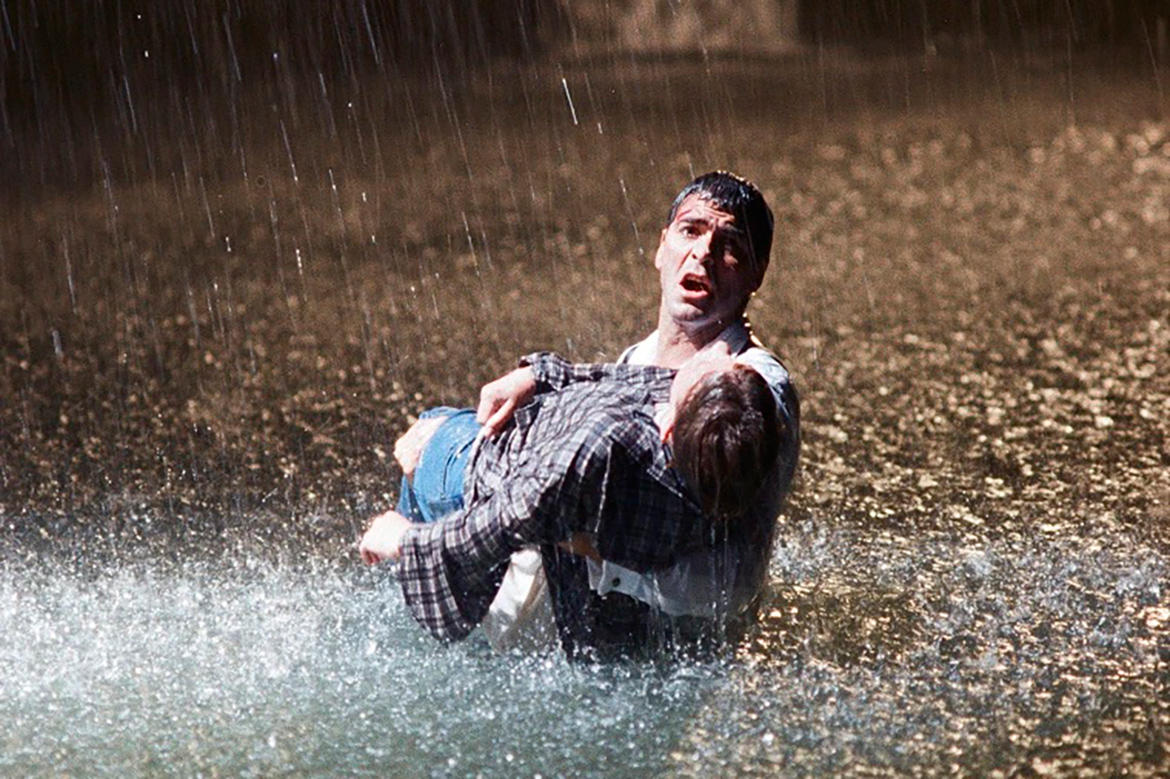
As the water levels rise, Ross runs out of options to save Ben before he drowns. Soon, after diving into a culvert to look for the unconscious boy, Ross breaches the water's surface cradling his young patient — all under the watch of a hovering news chopper’s bright searchlight. Such heroic imagery was by design.
"It was intended early on for this episode to make Doug Ross a hero," the episode's writer, Neal Baer, tells the Television Academy. "This episode was designed to do for Doug Ross what 'Love's Labor Lost' did for Mark Greene."
Baer — who was a doctor before writing on ER and Law & Order: SVU — is referring to the first season's riveting installment that aired eight months before "Hell and High Water." "Love's Labor Lost” centers on Ross’s best friend — and head of the ER — Dr. Mark Greene (Anthony Edwards) as he fails to save an expectant mother during her complicated pregnancy. Coming off the creative and critical success of that episode, NBC and the writers went into season two with a mandate to replicate that success by giving Ross a similar standout episode.
Released at the height of the NBC drama's popularity, "Hell and High Water" scored ER its biggest ratings ever — 48 million viewers — while becoming a (no pun intended) watershed moment for Clooney's career. It launched this promising leading man into the rarified air of super-stardom.
"George was already blowing up and becoming a big deal," Baer explains, "but this really made him George Clooney."
In honor of his episode's 30th anniversary, Baer takes the Television Academy behind the scenes of how he conceived the story and what it was like being present for the filming of its most iconic scene. He also reveals the surprise visitor he met on set: Cameron Diaz.
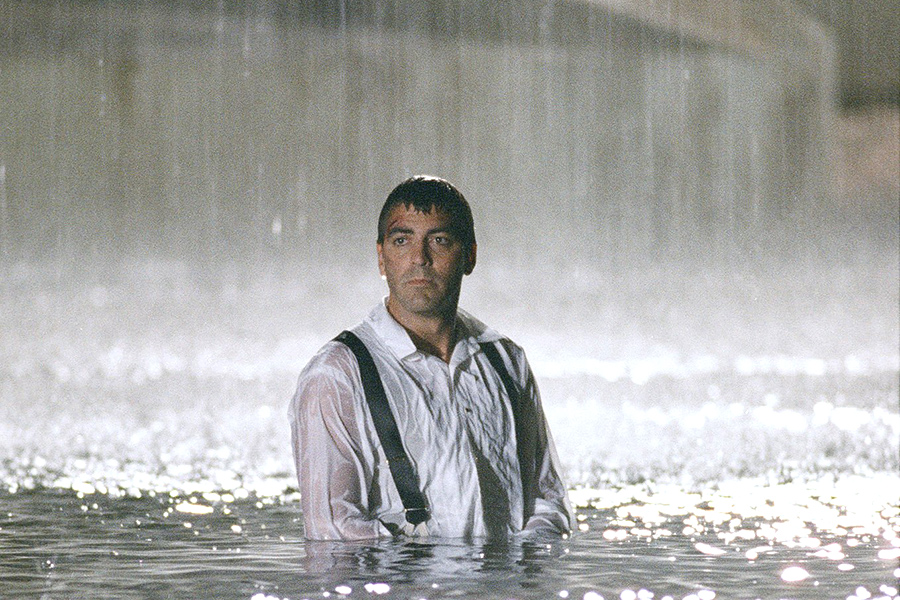 Photo credit: NBC
Television Academy: Fans know that you came aboard ER through your relationship working with showrunner John Wells, when the two of you worked on ABC’s China Beach. So, before we get into how you found yourself tasked with writing “Hell and High Water,” how did you go from being a doctor to TV writer?
Neal Baer: John and I have been friends since fourth grade in Denver, Colorado.
I was getting my master’s in sociology at Harvard. I left Harvard and went to AFI in Los Angeles to pursue filmmaking. On ER, there were four of us, including me, who went to AFI: [director] Mimi Leder, [writer] Lydia Woodward and the late [writer-producer] Paul Manning, my mentor. He was a wonderful person and writer. None of us went the way that we ended up. Mimi was a DP at AFI, or cinematography fellow. She became a director. And Lydia was a producer. And I was a director who became a writer.
Anyway, after AFI, I did an ABC Afterschool Special called “Private Affairs,” which led to me pitching [stories] to and writing on China Beach. Then, after China Beach, my son was born, and I left Hollywood. After that, I didn’t know if I was going to make it, if I was really going to have a career. So, I went back to Harvard for medical school.
In my fourth year, John Wells sent me the pilot for ER that Michael [Crichton] had written 25 years or so before — it lay dormant in a trunk in Spielberg's office for 25 years, I think. And Spielberg was like, "Hey, I was going to make this as a movie. I think it'll be a cool TV series." Which NBC did not like, even though they have said that they did. So I said to John, "This is like my life, only we don't use glass IV bottles. We don't use the same medicines." And he said, "Well, do you want to come out and pitch stories?” And I was like, "Sure, I have two months of vacation accrued." I left in 1994 and came to ER as a staff writer.
After two months, I said: "John, I want to stay." And he goes, "Well, will Harvard let you?" And I said, "Yeah, they said I can come back and forth and finish up [school] because I'm almost done." So, I finished medical school. I started my residency at Children's Hospital in L.A., and that continued into my SVU years. [Baer was an executive producer-writer on the Law & Order spinoff after his time on ER.] Now that we got some of the background out of the way [laughs]…
How did you get assigned writing “Hell and High Water?” Did you lobby for it, or was it just your turn in the rotation?
Luck of the draw. [Anthony Edwards] got the big show the first year. So, the thinking was, it was now George’s turn. We were doing this whole [storyline] with Ross where he's on the skids. He's screwing up. It's always about the kids, and he's always putting the hospital second. And Julianna [Margulies]'s character, Hathaway, is going to marry another guy, Taglieri, played by Rick Rossovich. And so, luckily, just on the board, there was my name and this episode, and it was like, “Oh, we’re doing George’s episode.”
So the intention was to give Ross a standout episode from the jump? And to make it a November Sweeps episode?
Yeah, because Sweeps were everything. It was intended early on for this episode to make Doug Ross a hero. This episode was designed to do for Doug Ross what "Love's Labor Lost" did for Mark Greene. The year before, [writer] Lance Gentile won the Emmy for writing “Love’s Labor Lost,” and Mimi won [for directing it]. But [“Hell and High Water” director] Chris Chulack won the DGA Award for this show, whereas “Love’s Labor Lost” did not win the DGA. That was a big shock. I remember we were at the DGA Awards that year, and it was like, “Oh!” Because everyone thought “Love’s Labor Lost” was going to win.
But the visual theatrics of "Hell and High Water" are — I mean, Chulack is brilliant. I mean, it's written in the script, the iconic lifting of Ben up to the light is very powerful imagery. Heroic imagery. Which, again, was by design. George was already blowing up and becoming a big deal, but this really made him George Clooney.
The story could have been anything you wanted, so why saving a child stuck in a flooding culvert?
When I was 5, I had a dream that my father saved me in a tunnel. That was the impetus for the episode. I also got to write a lot for George because I'm a pediatrician, and George's character is, obviously, a pediatrician.
Let’s talk about the filming of the show’s iconic shot and the circumstances leading up to it. You got Ross, wearing a tux, in the rain. Why that particular choice?
Because when I did the season one episode "The Gift,” [Ross] goes to a Christmas party dressed in a tuxedo and he has a fistfight with Taglieri. And people said to me, “Oh, we loved your episode, but oh my God, we really loved Clooney in a tuxedo!” So, I constructed this hero story for George and I put him in a tuxedo. I wanted him to be an action hero in the water.
I just saw Clooney recently when I saw Good Night, and Good Luck [on Broadway]. And he's the sweetest person in the world. I went backstage, and he took my face in his hands, and he said, “Neal, what happened to your curls?” I was like, “George, that was 30 years ago.” But he is just the sweetest and very charming.
Can you talk a bit about breaking the story for this episode? Did the whole staff break down the major beats together before you went to script?
We broke story in the room. It's amazing, because we only met three times a week in the afternoons. We would do these beats on the board and know what the emotional stuff was. Then, people would come up with their beat sheets. And then we'd bring what beat sheets we had back to the room and go through them before going off to write the script.
After [writing] the script, you’d bring it back to the room and get notes, then go back to working on a new draft. Then, we cast it, produce it and work with the director. But for this one, I kind of knew the major beats, and John just signed off on it.
 Doug Ross (Clooney) saves the day, and Ben's life, in "Hell or High Water" / Photo credit: NBC
Was there a particularly challenging scene for you to write?
Well, coming up with that parallel storyline [for Noah Wyle’s Dr. Carter] with the little girl with the blood clot, and her parents who were separated and fighting. That was tricky, because I had to integrate it. And then make the fourth act trauma scenes — which we were famous for — how to make that back and forth between George’s kid and Noah’s patient.
The famous shot of Ross cradling the kid out of the water is done very close to how you scripted it. Minus the dissolves between each of Ross’s attempts to look for the kid.
That was all Chulack and the editor. Chulack is great; he came up with that choice. And it works. And, like you said, it’s very close to what I scripted, but I think he made it better. Visually, his choice made it better.
Were you on set for that scene?
Yes. I remember when we were shooting — it was the Waltons’ Pond [on the Warner Bros. backlot]. They were putting debris in the water, and it’s rushing out with all that debris in it. It was like 2 a.m., and we shot it over a number of nights. George was into it. They were trying to warm up the water and take breaks to do that, but he was like, “No, let’s keep doing it.” I’m pretty sure it was our most expensive ER to date. It wasn't the longest shoot; that was [season one’s] "Blizzard." I remember Cameron Diaz came to set.
Was she shooting something on the lot at the time? Or was it just a random visit from a future Charlie’s Angel?
She was “a friend of George.” Friends with Clooney. She was standing by me, and I was like, “Holy shit!” I'm this kid from Denver, and it’s like, here's Cameron Diaz coming for a visit to say hi. It was when we were shooting the big water scene.
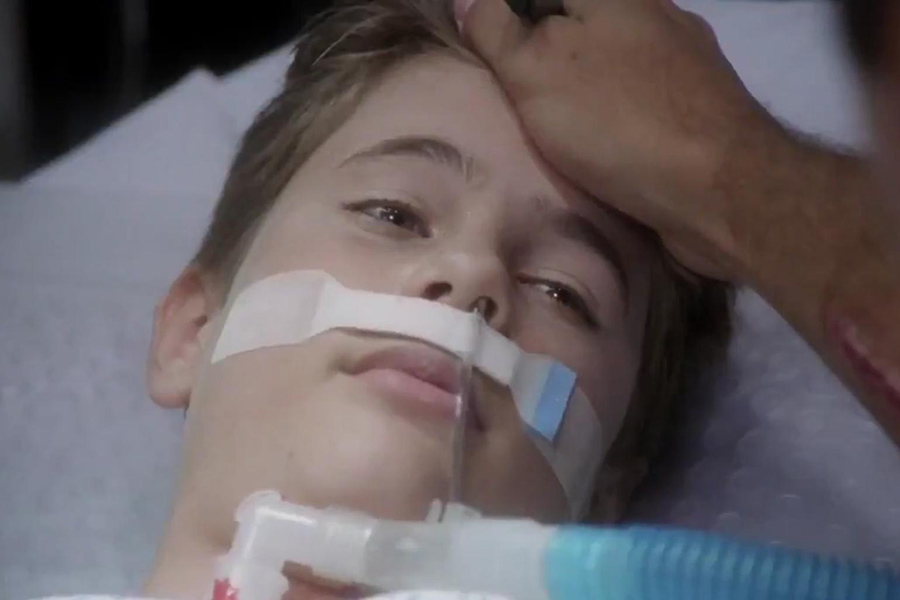 Doug's patient, Ben (Erik von Detten), takes a trip to the ER / Photo credit: NBC
All of the exteriors were shot in Chicago, correct?
Correct. The kid knocking on the car window to ask George to help Ben, I think we did that on the lot. And when he knocks on the window, George is about to light up a blunt. The only reason why that exists is to drag out some time before that knock comes.
I set that up earlier by having that elderly patient they see in the ER who is smoking marijuana, and the desk clerk [Jerry, played by Abraham Benrubi] has her blunt and gives it to George before he leaves in his car. I constructed this opera because I needed him in a tuxedo, and then I created the elderly patient so that George could have that moment.
The episode is interesting in that it gives Ross a character arc, like a movie would. He goes from wanting to leave the ER and work in private practice to ultimately realizing why he — and his patients — are better off if he stays at Cook County. How did the idea of Ross wanting to go into private practice come about?
[Ross] was butting heads at work. He was having some issues there. So, the structure of that episode had to be the reluctant hero; obviously, we weren't going to kick George Clooney out of the show. So he does that job interview, and it goes well. But, private practice — that’s the real hell. Then we have the two children in jeopardy: Ben, Doug’s patient, and the little girl with divorced parents that [Dr. Carter] has to save. Of course I’m not going to kill Ben. We killed the mother in “Love’s Labor Lost” so weren’t going to go down that road again. But I have to have something tragic, so that’s why we killed Noah’s patient.
The episode does subvert expectations there a bit, but when she gives Carter that bracelet …
[Laughs] Never accept a bracelet or a gift from a child. It's like, that child will go. And that was a shock for people. And there was never any pushback [from the network] on that. She fell, she had this blood clot that burst and nobody would have known.
And, just as an aside — can we go back to the tuxedo?
Sure.
On SVU, we decided to make an episode [Season 7’s “911”] where Mariska [Hargitay]’s character gets a phone call, and she is going out on a date in a nice, black cocktail dress. But she gets a phone call from a little girl who is calling the police to say that she's trapped in a room, and this guy's been sexually abusing her. So I put her in that dress because I put George in a tux; I was borrowing from [“Hell and High Water”].
Now, for “Hell and High Water,” George and I both got nominated for Emmys that year. We didn’t win; George should have. The X-Files won that year, and I think we won for effects for the episode.
Now, that’s important, because I said to Mariska, who had doubts about wearing this dress for three acts: “Choose a dress that you want.” It cost, like, some crazy amount of money. I said, “Get a dress that you want. You’re going to be [trying to save this little girl] just like George did in a tux with this kid in the tunnel and the helicopter.”
While filming a key scene in that episode — directed by the late Ted Kotcheff, who was wonderful — she said to me, “Neal, I don't know what he's doing. He's shooting my mouth and my eyes, and it's all these close-ups. I don’t know if this is going to work.” And I said, “Oh, it will. It's great.” So Mariska is having this important scene, and all you see is her mouth. You don’t usually see that on TV, and Mariska won the Emmy and the Golden Globe.
Wow. So George didn’t win the Emmy in a tux, but —
Mariska won it in a cocktail dress. All thanks to this episode. The lesson is: Dress them up. Put them in cocktail wear.
This interview was edited for length and clarity.
ER is streaming on Hulu.