"This is not a superhuman. This is a normal person who got faced with super not-normal circumstances."
Rhea Seehorn may be underselling the circumstances that her Pluribus character, the cynical romance novelist Carol, must face and endure on Vince Gilligan’s new sci-fi drama.
The Apple TV series — which premiered November 7 with its first two episodes — trades the tension of Breaking Bad and Better Call Saul’s unique take on the drug trade for the high-stakes survival that comes from being one of a few survivors of an alien conquest at the microscopic level. The Albuquerque-set series, which was greenlit with a two-season pickup, finds the misanthropic writer on her way home from a book signing for another one of her Outlander-esque novels when she and her manager/life partner, Helen (Miriam Dior), realize their town is being taken over by a virus that spreads an alien collective intelligence capable of possessing all human life on Earth. Well, save for Carol and 12 others.
When Helen fails to survive the assimilation process, Carol is forced to bring her lover’s corpse home (after painfully loading it into a stranger’s pick-up truck). She also must navigate a world full of smiling faces being manipulated by alien puppet masters in what is best described as Vince Gilligan’s take on I Am Legend, but with a strong dose of the quirky, grounded sci-fi that became his trademark as a writer on The X-Files. But, unfortunately for Carol, Mulder and Scully can’t help her. Hell, Carol’s not sure how she can even help herself — let alone help the world go back to "normal." But that aspect of the character is one of the things Seehorn finds so compelling about Pluribus, especially with Carol serving as the audience’s surrogate POV.
"There’s a lot of information presented [in the first two episodes]," Seehorn tells the Television Academy. "I am, for the most part, the audience’s access point to this information and what is going on in this world. It becomes asking questions for the character, like: What kind of prior knowledge does Carol have about science? The things she has guessed or surmised, versus what is being confirmed versus completely brand-new information. From there, I’m adding in that layer or obstacle of her being under incredible duress."
Carol’s duress is manifested in two key scenes from the premiere episodes — one involving a surprise appearance from an actor best known for his role in the long-running CBS soap opera, The Young and the Restless. That scene appears near the end of the first episode, and it’s full of twists as well as a ton of emotional beats and exposition. It sets the tone for both the world of the show and Carol’s journey through it. Seehorn walks the Television Academy through the challenges of filming those scenes and how they helped her shape her nuanced performance.
Television Academy: I’m going to start with the end of the series premiere. Carol. via her television, addresses the government’s designated survivor, played by Peter Bergman from The Young and the Restless. How did the production achieve that scene? Was his side pre-recorded, or was he on set with you feeding you lines?
Rhea Seehorn: I'm glad you asked, because it's a major hats off to our ace team and crew for that. And I, unfortunately, will not be able to name all the people that were involved. But Phil Palmer, who's our sound mixer with his award-winning, amazing sound design, helped us — along with other engineers. They tried to figure out how we could help both my performance and Peter’s work best for the scene, so they had Peter on a sound stage next door to the one I was on. The elephant doors were open between the two stages, and then we had earwigs in so that we could hear each other and do [the dialogue] in real time. [Editor’s note: Earwigs are audio receivers, the size of hearing aids, that actors sometimes use when the dialogue in a scene requires it.]
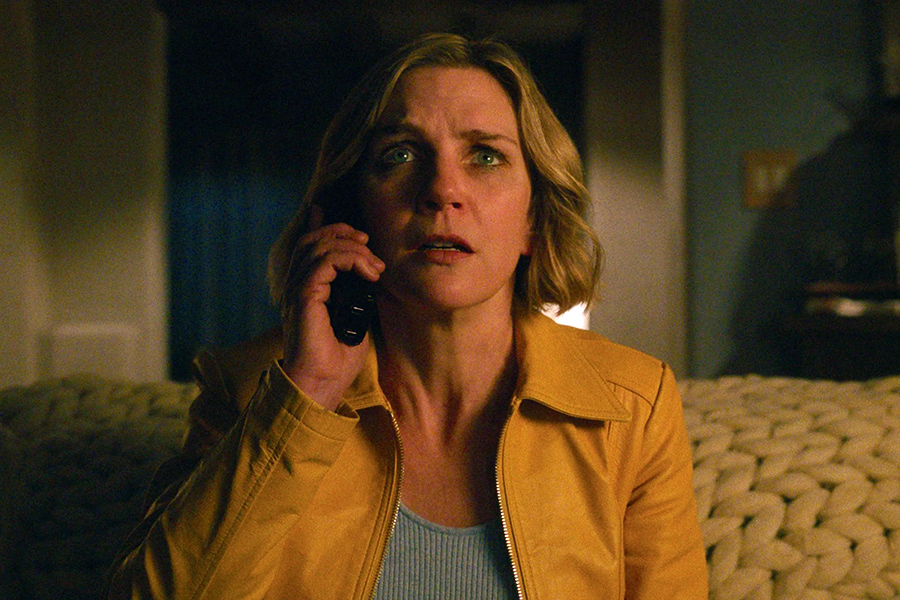 Seehorn wore an earpiece in this scene so she could hear Peter's dialogue in real-time / Photo credit: Apple TV
So you’re watching him perform as his character, on the TV, in real time?
I’m watching him on the TV, yes. The additional thing they had to figure out is — and I don’t know exactly, technically, how they did it — but normally my lav mic is going to pick up hearing [Peter’s dialogue], being that close to it. So, if I've got this earwig there with Peter's voice coming in, and he has the same set up with my voice coming through on his end, there could be feedback and delay issues. I’m also watching him on the television, and somehow they worked it all out with the regular hours that these people have to do it. It’s just one of the many examples where the crew cares so deeply to go above and beyond for the excellence of their work — but often in support of my work, which was just lovely.
That’s great. And that scene, from an acting standpoint, is a big “info dump” for both Carol and us. We learn a lot about the rules of this unique alien invasion and feel what Carol feels when she hears this shocking stuff. How challenging was it for you to juggle the emotional and expositional geography of this scene?
A lot of that specific work, for me, is done during prep and doing the script analysis — not pre-planning the reaction as much as really drilling down on what information is brand new to [Carol] versus what she has seen so far that night. The things she has guessed or surmised on her own versus what is being confirmed versus what is completely brand new information.
It becomes asking questions for the character, like: What kind of prior knowledge does Carol have about science? And all of this is so that [Carol] can have a variety of reactions and go on a journey because I am, for the most part, the audience's access point to this information and what's going on in this world. Then, from there, I’m adding in that layer or obstacle of her being under incredible duress. So, her mind is not thinking as it normally would. I am also working all of that out with Vince, and doing multiple takes, where we tried it going more towards Carol shutting down. She feels like getting smaller and smaller, wanting to hide, versus wanting to fight or blow up. The more we would play with it, the more these very organic, natural, comedic moments started coming out of the scene when she's trying to describe how [the humans taken over by the virus] are walking around.
And Carol has this bit of comedic business doing a physical impression of that walk when trying to describe it.
Yes! I still don't know what that motion is, but Vince started laughing when I did it. There was a part of me that felt the absurdity of some of the moments, and the neighbor's kids outside talking to me and stuff like that. This is the part most of us can identify with; if you have someone who's acting like everything is totally fine and normal, but you’re like, “No, it isn’t. Please stop saying that.” This situation is very bonkers out there, for Carol, and there are very natural and organic comedic moments that come out of that. They were key to some of the scenes that Vince and I started seeing as a way to thread some hilarious moments through some very dark scenes.
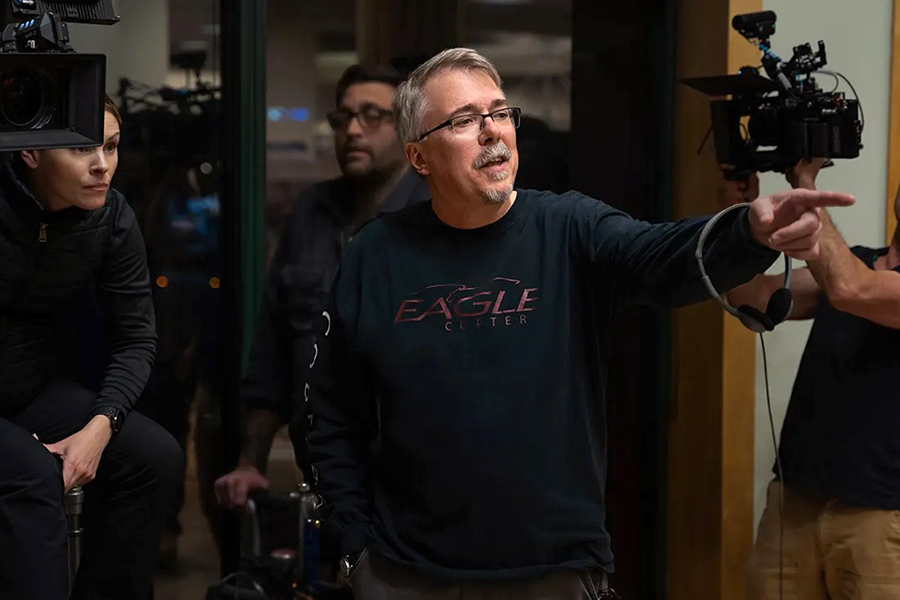 Vince Gilligan on the set of Pluribus / Apple TV
One of those dark scenes proves to be a pivotal one for Carol, when her partner, Helen, dies and she’s trying to load her body into a pick-up truck. How did you pull off that tricky, and very physical, scene?
First, I must give a shout out to an incredible stunt woman and artist and performer, Heather Bonomo. She not only helped me throughout the series, but helped the series. I did a lot of that scene. Vince had told me that much of what you see me physically do in the show is going to be me often doing it. And that’s because his shots, when he is directing, are going to have my face in it. We didn't do any CG facial replacement stuff there.
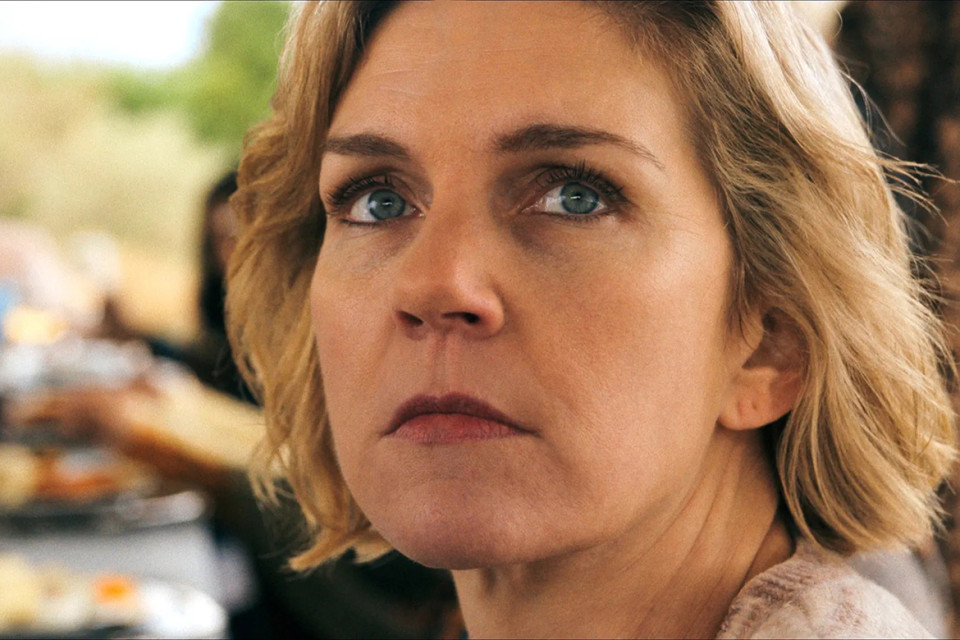
But Heather would help me tremendously with things that have to be repeated, because they can't have me not be able to walk tomorrow because of my back. The sandwich board that we put Helen’s body on weighed a lot because it had to be steel. It had to be reinforced in a way that it could never be unsafe for Miriam Shor's body to fall through, or for it to break in any way — even though I'm using it as a lever to push into this truck. It had to be very heavy, actually. Miriam is a slight, petite little thing, but the board had to be sturdy and safe enough to hold her. We would practice and run through many stunt rehearsals, being in a full squat all the way to the ground, and then lifting something very heavy with just your fingertips is not easy on the back — no matter how hard you try to lift the legs. Also, Vince also didn't want it to look easy for Carol to do. He wanted to not shy away from the physical struggle that Carol would be going through, on top of the emotional pain. I think part of that really helps you maintain the texture of Carol as the reluctant hero. This is not a superhuman. This is a normal person who got faced with super not-normal circumstances.
"Not-normal circumstances" seems to be Carol’s default after her fellow human beings are taken over by a collective intelligence and she has this long drive home with Helen’s body, all in one take. How challenging was that to film? Were there any stitches from other shots?
I'd have to watch it again to see exactly, but I know that we had parts of it that were definitely oners. And then parts of the driving sequence were done with a couple of different ways of doing it, on an apparatus. There was — I don't even what it's called — but one portion we did had me on a rig, mounted quite low, so that it was seamless. I think [the rig] is called a seamless, actually.
I had this volume-type thing, a large screen, in front of me in the truck, shooting back. So, it would be very dangerous for me to drive [unaided] because I couldn’t see what I was actually looking at. I realized that it was a bad idea to keep my eyes open when production went back to one, because the video on that screen reverses playback on what we just saw live as you’re going backwards, in reverse, in the physical truck as they are rewinding what they just shot. I thought I was going to throw up, actually.
This interview was edited for length and clarity.
Pluribus is streaming now on Apple TV.