
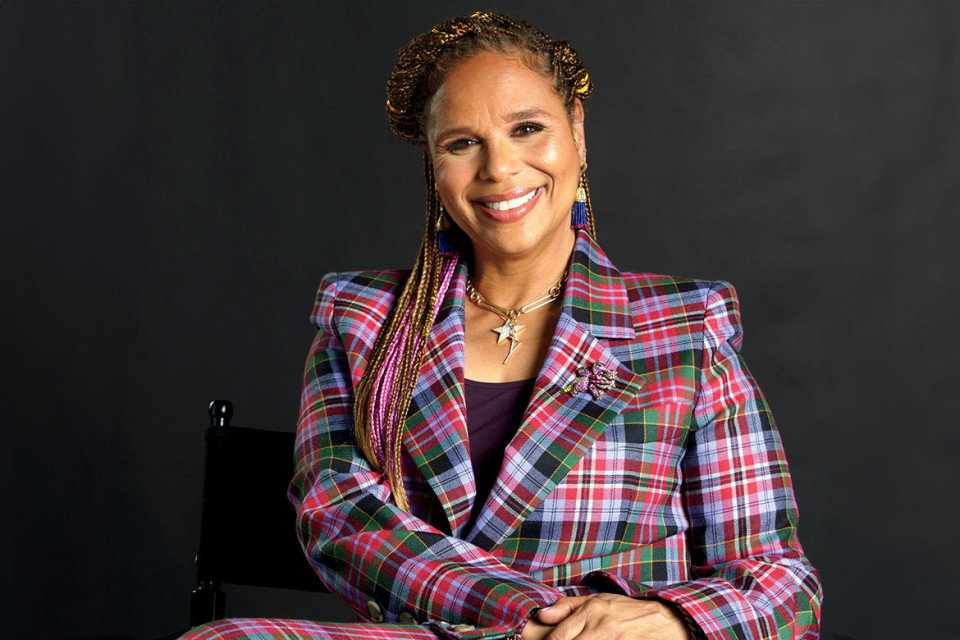
In 1993, Living Single premiered on Fox, and its creator, Yvette Lee Bowser, made history as the first Black woman to create, run and produce her own primetime series. She didn't recognize the significance of her achievement at first: "When it happened, I wasn't even aware that it hadn't been achieved before,"she says. "But it's a source of pride, for sure, to have broken a glass ceiling. What a privilege."
Bowser, who grew up in Los Angeles, got her start in television as an unpaid apprentice writer on NBC’s A Different World, eventually becoming a staff writer and producer on the show. From there she moved to ABC’s Hangin’ with Mr. Cooper, then created her own production company, SisterLee Productions, and Living Single. She went on to create For Your Love (NBC, The WB), executive-produce Half & Half (UPN), consult on black-ish (ABC) and executive-produce Dear White People (Netflix), Run the World (Starz) and UnPrisoned, an Onyx Collective series on Hulu.
Bowser was also showrunner on the programs she executive-produced and is a firm believer in mentorship. She’s been an integral part of the Showrunner Training Program sponsored by the Writers Guild of America since its inception 20 years ago.
Bowser was interviewed in August 2023 by Adrienne Faillace for The Interviews: An Oral History of Television, a program of the Television Academy Foundation. The following is an edited excerpt of their conversation. The entire interview can be screened at TelevisionAcademy.com/Interviews.
Did you watch much television growing up?
I was raised by television. I was a latchkey kid, so Laverne & Shirley was my babysitter. I loved Maude. Maude was my girl; she was everything I wanted to be: self-possessed, bold, vocal, a feminist. I really leaned into those images that I saw on television for inspiration and entertainment. Laverne and Shirley were like the OG best friends; they were my beacons for sisterhood. I wanted to have adult friends like that when I grew up. They very much informed what I was looking to emulate later on in my life and in television, in my storytelling.
Where did you go to college?
I went to Stanford University.
What did you study?
Poli-sci and psych, so of course I’m a comedy writer. [Laughs] In the spring quarter of my senior year, I was headed to USC Law School and derailed myself by having a little bit of a pity party with my best friend Kimberly. We were watching The Cosby Show, and for the first time I recognized the name of someone I knew in the credits, so I tracked him down.
I told him that I was supposed to be going to law school but had this creative energy that I thought needed to be tapped, and I wanted to know if there was anything he could tell me or anyone he could introduce me to that might illuminate a path in television. It just so happens that his friend, Bill Cosby, was shooting a movie in Oakland. So I got introduced to Dr. Cosby and he said, “There’s nothing for you out here; go to law school.” I said, “But no, you have to read these creative stories. There aren’t even any creative writing classes at school, but I’ve been writing.” He acquiesced and said, “Okay, I’ll set you up on the spinoff of my show that’s going to be shooting in Los Angeles [A Different World]. But I’m going to set you up as an apprentice writer, and the pay is zero.”
Did you join the show when it was just ramping up?
I joined the show on August 4, 1987. The show was very much finding itself. There wasn’t a creator involved in the show day-to-day, so there was a group of us who were left there to fill that creative chasm, and collaboratively we were able to develop and create what that show became over the first few seasons. One of the beautiful things about being an unpaid apprentice was that I didn’t have any defined responsibility. So there were times when I was able to float throughout the production, soaking up whatever I wanted or needed to soak up. I was taking lunch orders. I was making posters for [Jasmine Guy’s Whitley character] running for dorm monitor. I was pitching story ideas, character ideas. We used a lot of stories and characters from my college experience on that show, because I was fresh out of college.
It was worth it, because I was paving a path to my ultimate goal, which was to be on staff, and then ultimately to become a valued producer on the number two show on television. That was quite a feeling. So when I left there after five seasons, I felt like, “I can do that.”
Why did you decide to leave the show?
It was time. I'd really told all the stories I felt I had to tell. I felt like I wasn't really going to be able to fly as high as I could if I stayed in that exact same environment. I got my master's there. I got my Ph.D. on Living Single.
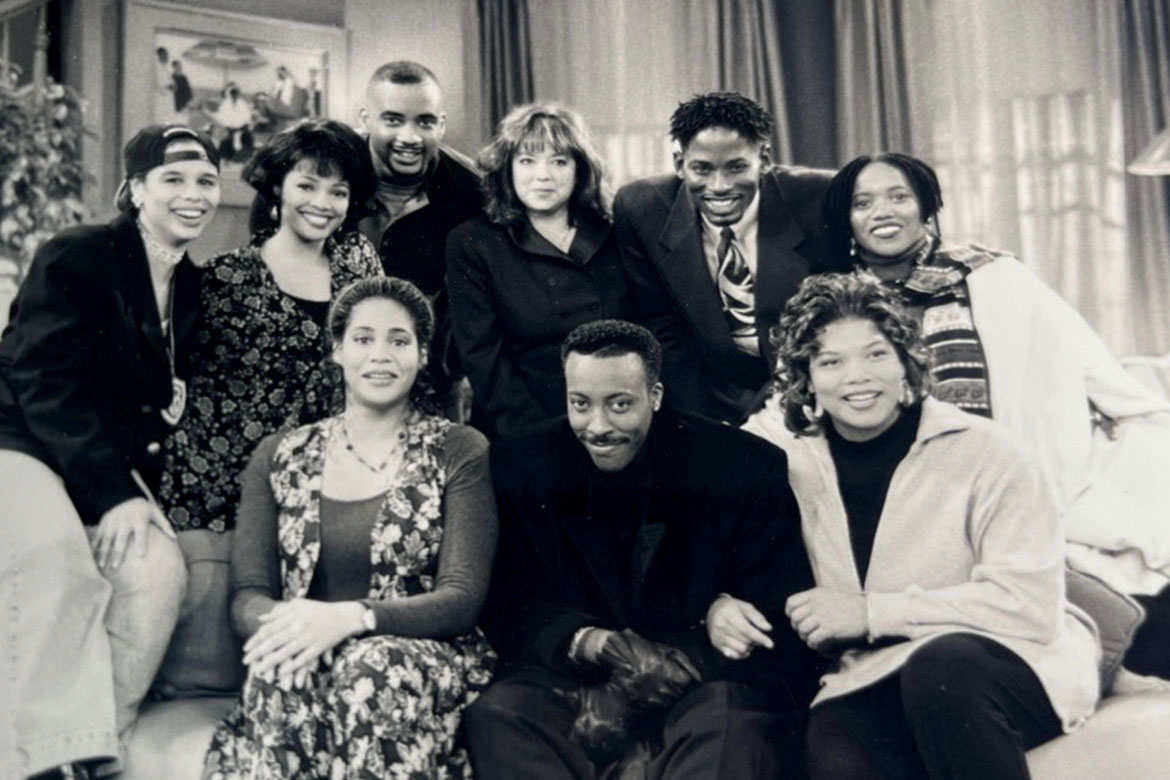 On the set of Living Single / Courtesy of Yvette Lee Bowser
Let's talk about that road to the Ph.D. Your next stop was Hangin' with Mr. Cooper.
Yes. Which was a lovely opportunity to work with my high-school girlfriend Holly Robinson Peete. But it was short-lived. The writers’ room was filled with people who didn’t know anything about the people or the place the show pretended to be about. I am not a person who comes charging in being an expert, but you know what you know. Also, at that point I had been a valuable contributing member of the number two show on television, so I didn’t necessarily expect all of my ideas would be utilized, but I didn’t expect everything I said to be rejected. I also was the only woman and the only Black person in the room when the room opened. I dealt with a lot of racism — not necessarily conscious — and misogyny.
So I doubled down on my desire to create my own show, so that I could create my own work environment where people like me who were marginalized could feel comfortable and safe saying anything. I reiterated to my agent that I was really interested in pursuing development opportunities, and God answered the call.
Fox Network and Warner Bros. Studios made a talent-holding deal with Queen Latifah and Kim Coles to develop a show. Both of them had failed pilots in the past, written by non-Black writers, so they had teamed up and were determined to advocate for a Black writer to get an opportunity to write a show for them. I was the beneficiary of their advocacy.
What was your idea for a show for them?
Going back to my own personal agenda of depicting stories that feel organic and authentic to me, and also wanting to have that sisterly energy and enviable female relationships like I saw in Laverne & Shirley, like I had in my own real life, I thought, “I can write a hundred episodes about me and my friends.” That’s where the show idea came from.
It took place in Brooklyn, because they were both — Latifah in particular — definitely East Coast energy. I also love New York. Kim Coles and I had some really great, honest conversations that led to Synclaire, this very simple and whimsical dreamer character. Latifah — she’s very Maude-adjacent. Khadijah is very much who I aspired to be: an entrepreneur ... to have my own business. I gave those attributes to her.
Figuring out who those two were forced me to figure out how to round out the energy in terms of the storytelling. Max, brilliantly played by Erika Alexander, is very much who I was just before I met my husband. And I reached out to Kim Fields and said, “I think I have a role for you [Regine]. You will be the perfect piece to fill out this puzzle I’m putting together.”
It was really important for me that the show be female-centered. But I think when you have something that’s got those four strong females, you have to have that male energy to balance it. Enter the guys. That’s how we ended up with an ensemble of six. [Kyle, played by T.C. Carson, and Overton, played by John Henton, rounded out the main cast.]
Was Living Single your first experience pitching?
That was my first pitch. Which is wild, right?
Yeah. What was that like for you?
There was — of course, as there always is — a plot twist. I pitched the premise, and everybody bought in. I pitched the pilot story, and everybody bought in. Then I wrote the pilot script, and everyone at the studio loved the script, and then we turned it into the network, and they loved the script. But they had a couple notes, and they weren’t all small.
For some executives at the network, the character of Maxine Shaw was a little intimidating on paper. That was a tough note. And I was young enough, naïve enough and bold enough to say, “To take Max out of the show is to take a big part of me out of the show, and I’d rather not do the show at all.” So they let me figure out a workaround. The workaround was for Maxine Shaw, who was an attorney and could afford her own apartment, to live across the street and come over all the time and get more comedy from the fact that she was always there, helping herself to their food, their closets, their ex-boyfriends, whatever it was. Max just became bolder and funnier, as far as I’m concerned. So it was a good compromise for them, a good creative exercise for me.
Talk a little bit about crafting the look of the show — what the home interiors looked like, the characters' costumes, makeup, hair ...
It was so much fun to be able to build all of that from the ground up. My sorority, Alpha Kappa Alpha Sorority, Inc., our colors are pink and green. There’s lots of pink and green on that set, and people peep that out and just feel that extra connection. There’s lots of Black art in all of the sets, and that’s very, very intentional. Infusing as much of us into the fabric of the show as possible has been a trademark of mine.
And when actors looked a certain way, we worked that into the show. We did this great episode where Kyle receives some criticism because of his very ethnocentric hairstyle. I didn’t write that character as having locks. But he [T.C. Carson] did have locks. Kyle was always a stockbroker. So what is that like? Today we are talking about the Crown Act, because it’s really important that we wear our hair in a style that is comfortable to us, that makes us feel beautiful and good in our own skin. So it was great to do episodes like that, that speak very specifically to a culture. Because the characters are human first. But they’re also not just happenstance Black and African-American. They’re decidedly Black and living the duality of what that means to be Black in America, to be a minority in these certain environments where you can’t just do whatever you want, whenever you want.
With Living Single you were the first Black woman to create, run and produce your own primetime series in the United States. What doe that mean to you?
A super special place in history that I don't usually take the time to step back and savor or acknowledge. In fact, when it happened, I wasn't even aware that it hadn't been achieved before. But it's a source of pride, for sure, to have broken a glass ceiling. What a privilege. What a privilege from someone who did not grow up with privilege, who does not embrace privilege now, but what a privilege to be that person, to have made history with a groundbreaking show. Because there wasn’t a show like it before it. It is the blueprint.
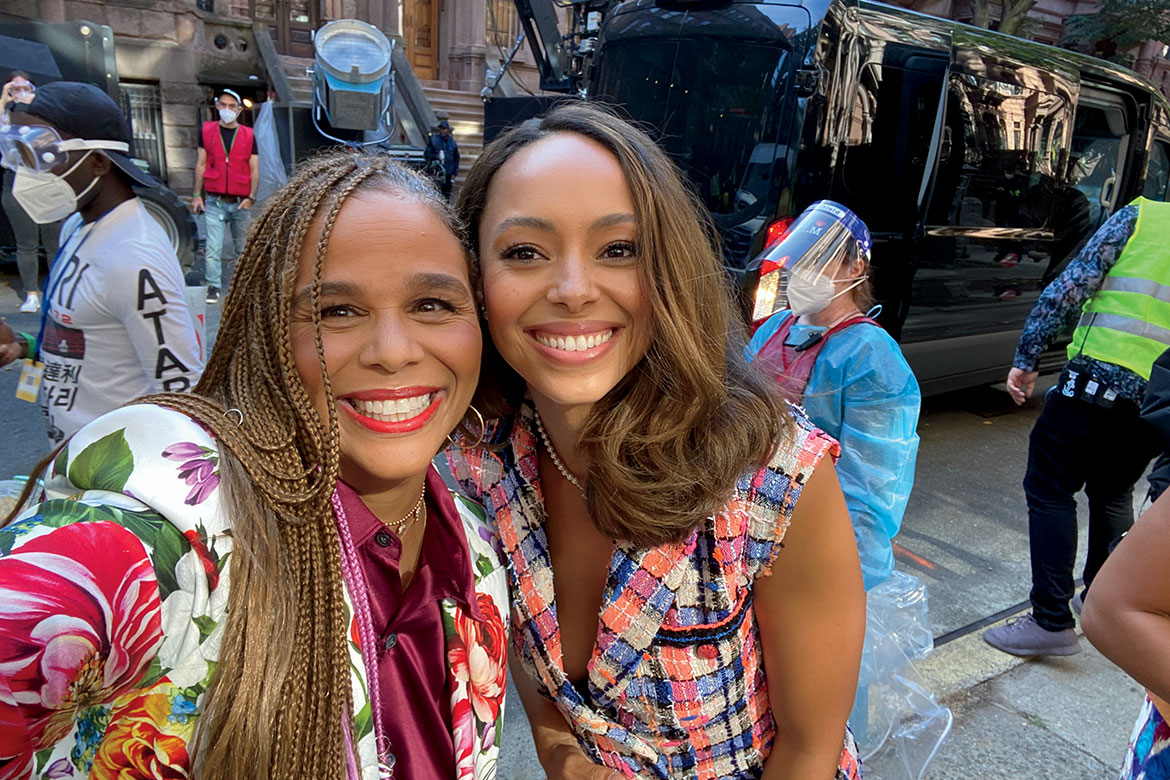 On location with Run the World's Amber Stevens West / Courtesy of Yvette Lee Bowser
In 1998, you created For Your Love.
Yes. Honestly, just ripping those pages out of my diary. I chronicled my life in college on A Different World; I chronicled my life as a young single person in the city on Living Single; and [by '98] hads evolved into this life of coupledom. It was a very simple pitch: three couples, three different stages of love. We had such a blast on that show.
What was your experience of being a consulting producer on black-ish?
I had mentored Kenya [Barris, the show’s creator] in the Writers Guild Showrunner Training Program the year before, when he was working on the concept for black-ish. So, before it was sold, I was having conversations with him. My role on that show was really like his consigliere.
How did you get involved with Dear White People?
The person slated to run the show had some conflict by the time the show got picked up. [Creator] Justin Simien and I worked together incredibly well. There was a tonal shift that he wanted to make at some point in season one, the specifics of which he wasn’t really sure he wanted to do. I could tell he wasn’t sure, and I was like, “We can find another way to give you what you’re looking for.” That became episode five, where Reggie [Marque Richardson] had a gun pulled on him at a campus party. That episode was directed by Barry Jenkins, and it was daring. We had to shut down production for about an hour and a half after shooting that scene. We were all impacted by it, because it was just so real and so terrifying. But we felt a responsibility to depict that reality.
I remember in the writers' room when someone suggested that he be asked for his ID, and my blood ran cold, like he was being asked for his papers. Like he was a slave. And I'm like, "We can't do that." Then I was like, "No, this is that moment where it scares and excites me in equal doses. We have to do it. And that absolutely would happen." Because that cop doesn't believe that Black man should be here. How dare he be here, in this ivory tower, in this bastion of higher education? How dare he be there being his free Black self? But you can be there, and then you cannot be there just that fast. That's the reality we live with.
That show, as wonderful as it was, its ratings were okay but went up 300% after the tragic death of George Floyd, in the summer of 2020. It took that for people on their own to go find the show, looking for answers. They're not going to find all the answers there, but it tells you something about our society. Tells you the power of the medium. It tells you that people look to the medium for information, for answers, for understanding. I'm really fortunate to be in a position to provide some modicum of understanding for those who don't live the same existence that I live with my family and my friends.
What advice would you give to an aspiring writer?
Do the work. A lot of people say they want to write, and they have written nothing. Or they've written one thing, and they've been peddling that one thing for 10 years. Writers write, and writing is rewriting, so do the work. If you want it, that's how you get it.
This article originally appeared in emmy Magazine, issue #6, 2025.
The contributing editor for Foundation Interviews is Adrienne Faillace.
Since 1997, the Television Academy Foundation has conducted over 900 one-of-a-kind, long-form interviews with industry pioneers and changemakers across multiple professions. The Foundation invites you to make a gift to the Interviews Preservation Fund to help preserve this invaluable resource for generations to come. To learn more, please contact Amani Roland, chief advancement officer, at roland@televisionacademy.com or (818) 754-2829.