
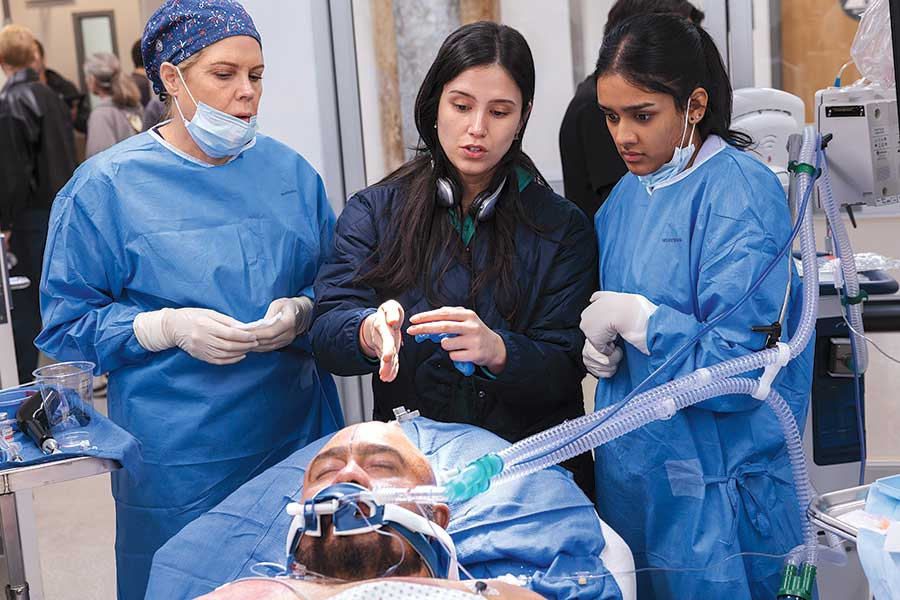
The only people more competent and capable than the fictional medical professionals on The Pitt are the real-life creatives who make them come alive. This became clear when emmy visited a Burbank set to observe what goes into making one hour of the Emmy-winning HBO Max show. Like season one, season two unfolds over one very intense 15-hour shift at the fictional Pittsburgh Trauma Medical Center.
This season features the usual gauntlet of trauma and triage, but with a twist: The threat of a cyberattack forces Dr. Michael “Robby” Robinavitch (Noah Wyle) and his staff to go analog. No Wi-Fi, smartphones or computers. Just fax machines and paper charts.
"We wanted to replicate the sort of tension that came from season one’s [mass shooting event], but we didn’t want to repeat ourselves," explains showrunner and executive producer R. Scott Gemmill. "We tried to find a timely event that we could build our emotional story around."
The 13th hour — titled "7:00 P.M." and written by former doctor and ER tech advisor–turned-writer Joe Sachs — finds PTMC’s crew on the tail end of that crisis. This day on set featured brisk location changes, crew briefings, bloody prosthetics and lots of laughs. Here’s emmy editor Phil Pirrello’s hour-by-hour breakdown.
Dr. Mohan (Supriya Ganesh, center) rushes to save a patient who suffered a cranial injury.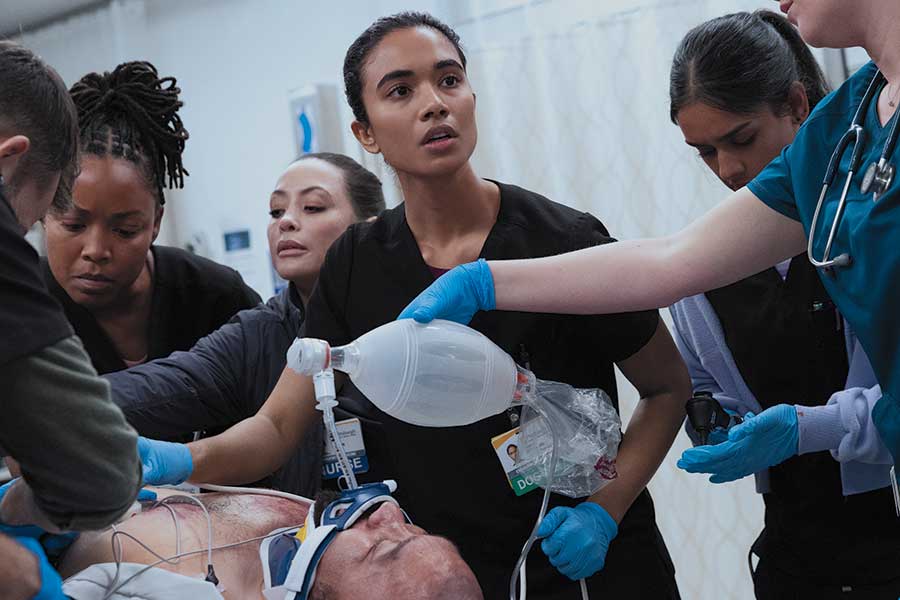
7 a.m.
Priscilla Emprechtinger (assistant to executive producer Michael Hissrich) and a Warner Bros. Television publicist lead the way to the day’s first shooting location: a decommissioned area of Providence St. Joseph Medical Center that serves as the ambulance bay and emergency entrance for PTMC. The bay has been outfitted with fake bricks and signage to mirror the real Pittsburgh hospital PTMC is based on. Opposite the bay entrance stands a tall blue screen production uses to add Pittsburgh surroundings in post. (Dr. Robby’s motorcycle is also parked nearby.)
8 a.m.
"Here, scrub in," Emprechtinger says as she hands over green scrubs. Production uses green to designate press and set visitors. On set, the crew is prepping ahead of a safety meeting led by Eric Pot, this episode’s first assistant director. After he breaks down the scene, Pot concludes with an on-set tradition: sharing some "On This Day" trivia.
As focused as the crew is, there’s talk of the day’s news: Netflix announced it will purchase Warner Bros. (or so it thinks). It’s also the expiration day for key medical subsidies under the Affordable Care Act, which makes a particular storyline in “7:00 P.M.” all the more timely.
9 a.m.
Director Damian Marcano blocks out the day’s emotionally charged scene between Dr. Dennis "Huckleberry" Whitaker (Gerran Howell) and fourth-year med student James Ogilvie (Lucas Iverson). Howell and Iverson go over their lines and adjust blocking with Marcano. On "action," Dr. Whitaker steps out of the hospital to find a sweaty Ogilvie sitting forlorn in a corner of the ambulance bay. His blue scrubs are spattered with blood — his first patient lost. As Whitaker tries to comfort him, the newcomer struggles to see a future for himself in emergency medicine. "We wanted to put Ogilvie where Whitaker was last season," Sachs says. "Whitaker lost a patient in season one, and now he’s in a place to give the new guy the pep talk he received."
10 a.m.
Tim Van Pelt, a real nurse, helps track background-actor continuity. From clothes to IV-bag levels, he keeps tabs on all the minutiae to help maintain verisimilitude, alongside two script coordinators.
Sachs shares pictures on his phone of three fake bloody tongues used for a previous storyline in which a patient had severely bitten her tongue. "The tongues vary in size — small, medium and large — for camera purposes as we ‘treat’ the lac," Sachs explains, using ER lingo for laceration. Each prosthetic tongue is attached to a retainer-like apparatus worn by the actor.
Director Damian Marcano (center) discusses blocking with Noah Wyle and Shawn Hatosy.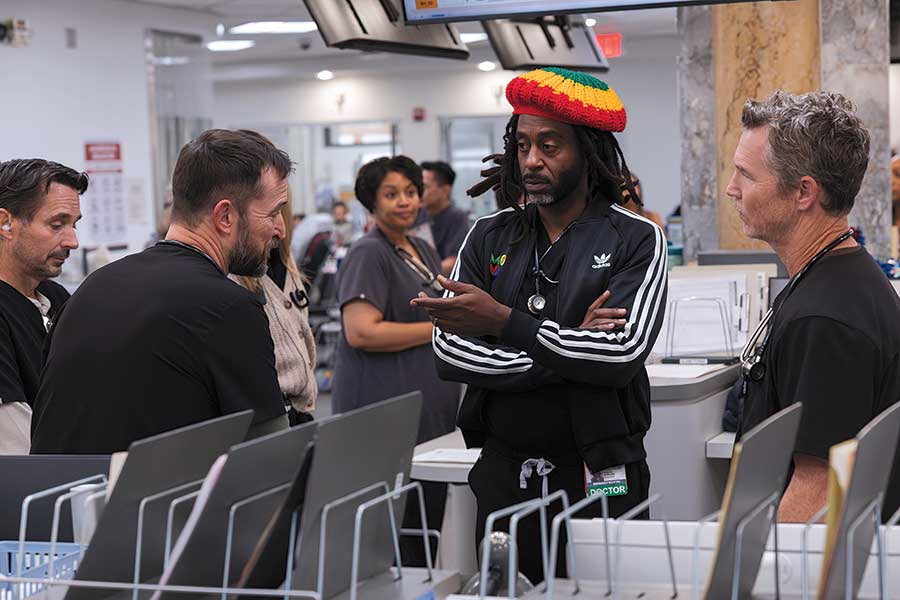
11 a.m.
A production meeting begins for episode 14, written by Wyle, who sits at a conference table with department heads, each holding a marked-up script. Gemmill joins via Zoom. During this 17-minute chat, they discuss whether a previous episode’s patient entered with a purse. After the meeting, everyone breaks for lunch.
1 p.m.
Production moves to a soundstage on the Warner Bros. lot, and Sachs reveals how he and his fellow writers chart The Pitt’s various storylines: "We call them ‘board beats.’ In the writers’ room, we are surrounded by dry-erase boards, and we use them to track every story in every episode. We [write] down the beats using very short phrases about what needs to happen in that episode."
2 p.m.
Sachs shares how rising healthcare costs (100 million Americans carry $220 billion in medical debt) informed the storyline of patient Orlando Diaz (William Guirola), which concludes in "7:00 P.M." A diabetic, he has been rationing insulin, hiding his worsening condition from his wife and daughter. When he suffers a massive cranial injury at work, he’s left in a vegetative state. "But at least he can now get free healthcare," Sachs says. "With ACA subsidies going away for millions, and healthcare costs increasing, you’ll see people having to choose between healthcare and putting food on the table." Nearby, a lifelike, full-body prosthetic of Orlando rests on a gurney, ready for a scene where he undergoes cranial surgery.
Lighting techs arrive to add a custom fixture to charge nurse Dana Evans’s (Katherine LaNasa) station. "The set is designed so we can pre-light 95% of this show," Hissrich explains. "Every surface — from countertops to the floor to the bedsheets — they’re all shades of white that we use to reflect light back up. Every inch of this set helps us be more versatile."
Director Marcano holds a private rehearsal for a scene with Dr. Samira Mohan (Supriya Ganesh) and Dr. Frank Langdon (Patrick Ball). The crew marvels at the efficiency of Marcano’s direction and camera choices, which contributes to the day’s shoot being 45 minutes ahead of schedule. "He really has become kind of a load-bearing wall in the storytelling," Wyle says. "It’s part of the vibe he brings to set."
"I try to [shoot] the show in a way that feels very real," Marcano says. "It does feel very real and relatable to us when we make it, so I want the audience to hopefully feel that, too."
3 p.m.
A trip backstage stops at "Pittstop Book Swap," the on-set library. Since phones are banned on set, cast and crew are encouraged to read during downtime. Book of the week: The Celestine Prophecy. The sound department shows off "Mintsburgh," a metal drawer full of flavored mints.
“Pittstop Book Swap,” the show’s on-set library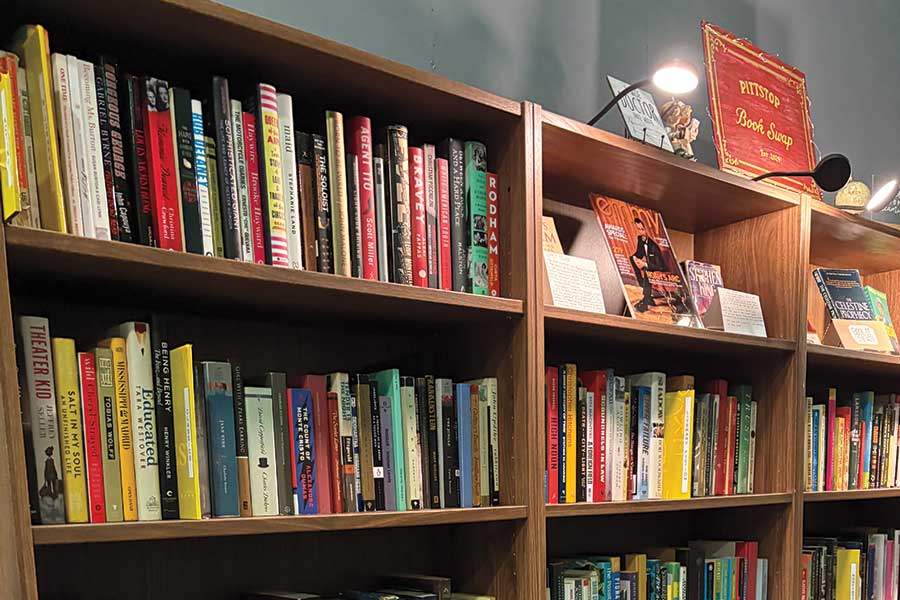
Next stop is the lighting department, where chief lighting technician–gaffer Keelan Carothers, key grip Maxwell Thorpe, lighting console programmer Brian Wallace and digital imaging technician Michael Perez-Lindsey maintain the show’s innovative setup in real time. "We watch every single image — every pixel of every image — while controlling and monitoring lighting levels," Carothers says. Using touch panels and heat-map imagery, he and his colleagues ensure that shots have the proper lighting for various skin tones. "We also look out for reflections, like if a window or monitor catches the camera’s reflection, or a crew member’s. Since the show takes place in real time over 15 hours, it’s critical that all light levels are consistent from image to image. We do shoot sequentially, which helps for the most part, but occasionally we shoot out of order and go back. So, it’s a fun puzzle to put together, keeping everything looking like it’s taking place in one day."
4 p.m.
Carothers emphasizes that Nina Ruscio’s production design is the real MVP: "She was very much involved [in lighting design] — right down to the exact millimeter placement of every single one of our lights." And Marcano praises the way cinematographer Johanna "Jojo" Coelho maintains The Pitt’s unique look: "If she goes down or misses a day, you really feel it. Her work is as integral to the show as the patients’ stories."
5 p.m.
Next up is a visit with the so-called "Wizards of Oz," the video techs responsible for controlling every screen display on set. From crashing vital signs to sonograms, they control playback so that images are perfectly synched with the actors’ actions. (Due to HIPAA rules, the show cannot use real scans or procedures, so the art department uses copyright-free sources, then manipulates the videos with postproduction tools.)
Med student Ogilvie (Lucas Iverson, left) and Dr. Whitaker (Gerran Howell) share a poignant moment.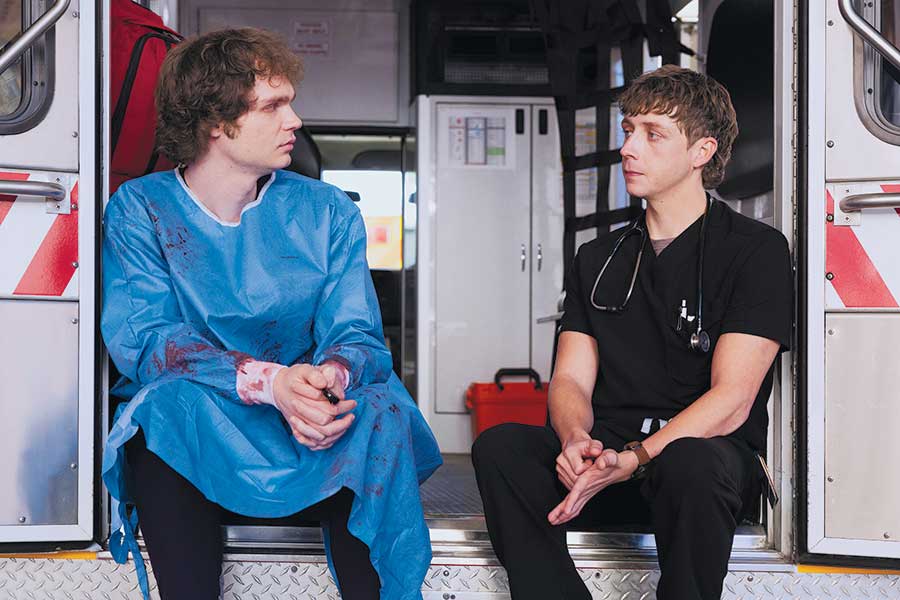
One of the more complicated gags the video techs pulled off occurred earlier in the season when a small camera traveled down a broccoli-lodged throat. "We had footage we’d been given permission to use of the forceps going in and pulling that piece of broccoli out of the windpipe," Wyle recalls. "When we shot it, we were looking at what that fiber-optic camera sees on the end of the laryngoscope, but in post we were able to put imagery from the real footage in the same frame. It’s a camera trick: I’m using a real camera in the room that’s photographing the environment right up to the point when I stick it in his mouth, and that’s the point of transition. What you’re seeing from that point forward is the recorded video. I’m particularly proud of that scene."
With applause, cast and crew wrap for the day — still 45 minutes ahead of schedule. The clock starts all over again tomorrow. As Wyle says, "The Pitt is constantly what we call a 'hot set.'"
The Pitt is streaming on HBO Max
This article originally appeared in emmy Magazine, issue #5, 2026, under the title "Pitt Stop."