


True to his reputation as a gleeful cynic who delights in ruffling feathers with his no-nonsense manner, producer and manager Gavin Polone proved to be a lively and entertaining moderator for Tuesday's Hollywood Radio and Television Society “state of the industry” luncheon at the Regent Beverly Wilshire Hotel, which was co-sponsored by the Academy of Television Arts & Sciences.
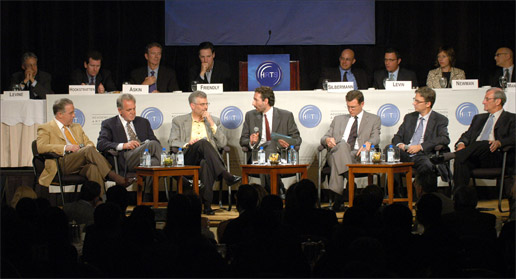 |
| Host Gavin Polone moderates the discussion among the top television industry leaders, billed as a "post-upfronts look at the state of the television industry. |
Billed as “a post-upfronts look at the state of the business,” the luncheon featured a distinguished panel of television executives, including William Cella, chairman/CEO, Magna Global Worldwide; Rich Frank, chairman, The Firm and former president of the Television Academy; Mark Pedowitz, president, Touchstone Television and EVP, ABC Entertainment TV Group and current Television Academy Foundation Board Member; Kevin Reilly, president, Entertainment, NBC Universal; Dan York, president, Programming, SBC; and Ken Ziffren, partner and co-founder, Ziffren, Brittenham, Branca, Fischer, Gilbert-Lurie & Stiffleman.
Fittingly for a man who named his company Pariah Productions, Polone, executive producer of the WB comedy Gilmore Girls, the NBC miniseries Revelations and the upcoming ABC comedy Emily’s Reasons Why Not, brought a pointedly glass-half-empty perspective to the proceedings. As the crowd tucked into their midday meal, Polone, who opened his remarks by declaring that “the television business is going to hell,” added the barbed observation that TiVo and other advances in technology are driving the industry toward “creative and financial bankruptcy—enjoy your chicken.”
For all of Polone’s gloom and doom, however, the panel was decidedly more upbeat. Cella and Reilly, for instance, shared their belief that even in light of shifts in the traditional broadcast model, commercial advertising would endure by embracing the reality of integrating advertising into programming—a trend that, if handled with discretion, need not compromise show content.
Frank, reassured by the industry’s proven ability to adapt to new paradigms in the past, expressed confidence that the latest challenges would be met with similar ingenuity.
HRTS, which has witnessed many of those changes firsthand over the course of its 48 years of existence, will host another luncheon with the Television Academy later this year.