



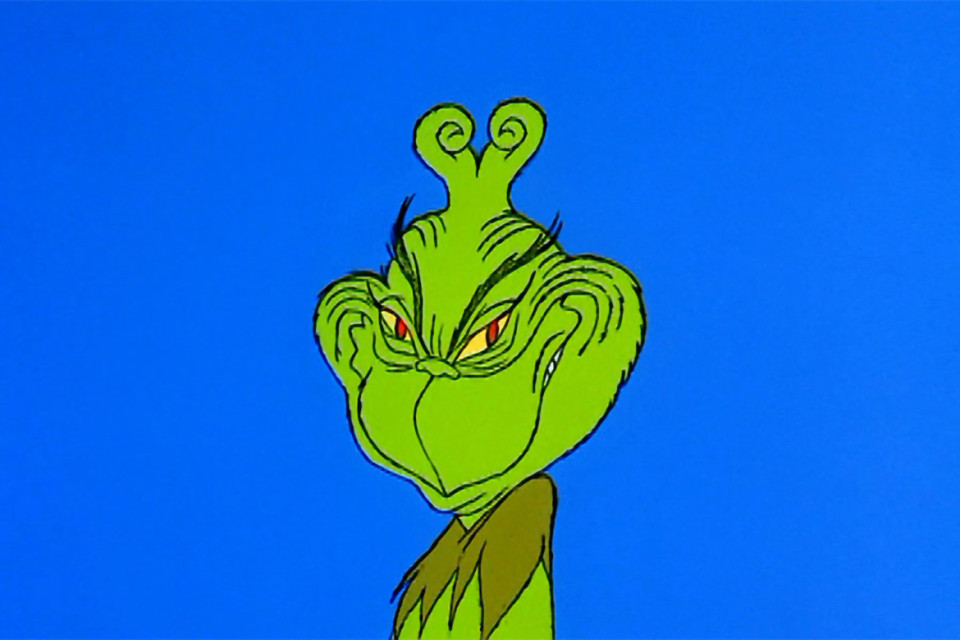

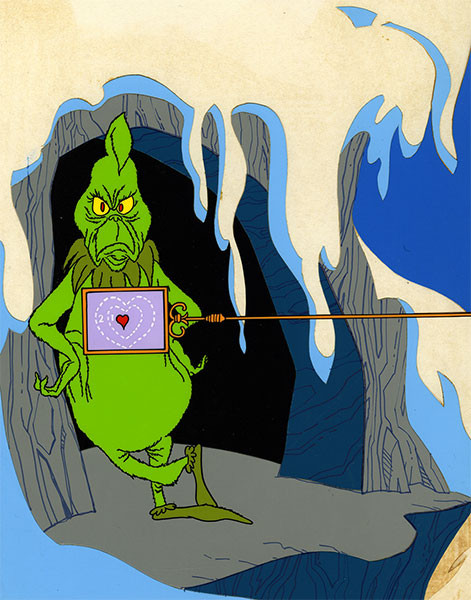


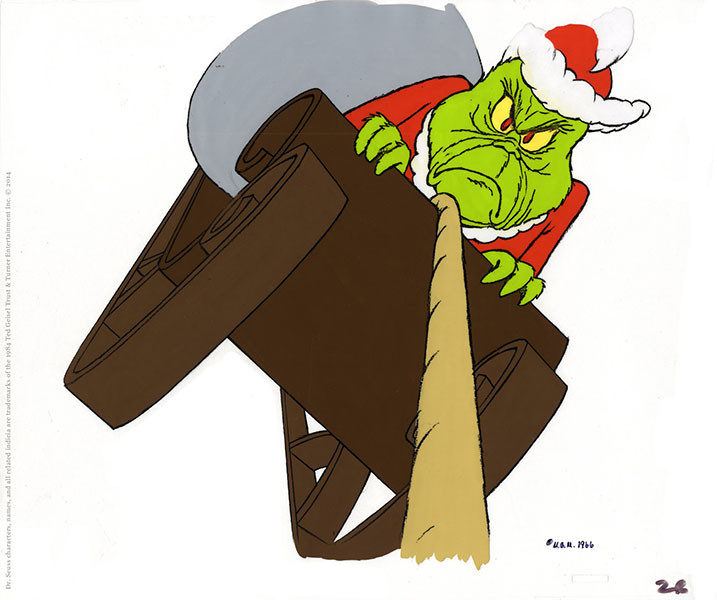


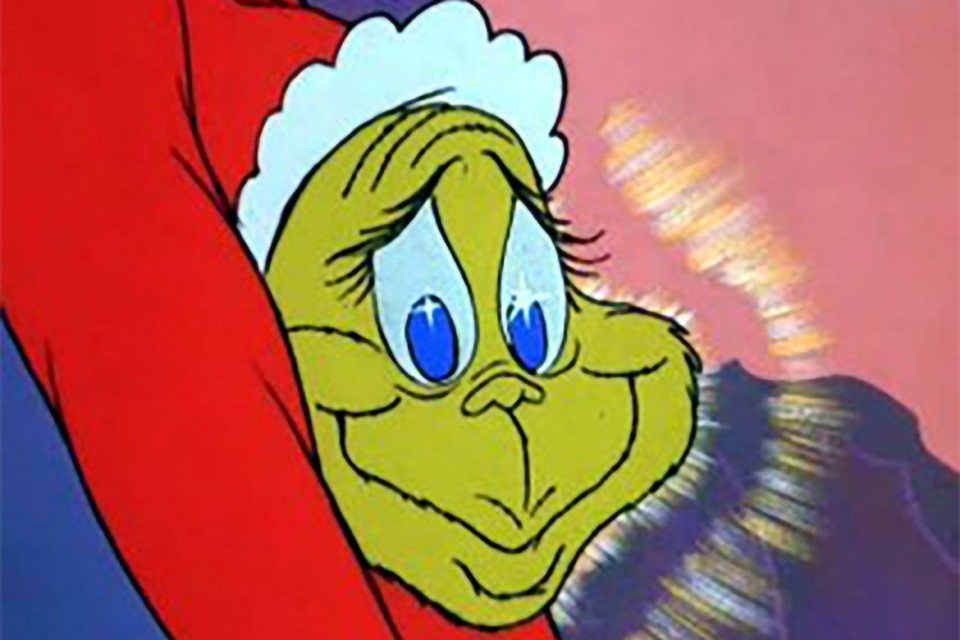
Before untraditional animated holiday media fare like Tim Burton’s full-length theatrical film The Nightmare Before Christmas was released in 1993, there was television’s mere half-hour How The Grinch Stole Christmas, an edgy, yet ultimately warm-hearted musical that debuted on CBS December 18, 1966, and which has aired every year since.
With a script by Irv Spectre and Bob Ogle, The Grinch was based on the beloved 1957 book by Dr. Seuss, a.k.a. Theodore Seuss Geisel, who passed away in 1991. Seuss had also subsequently penned lyrics to show’s tunes by Eugene Poddany and Albert Hague, primarily a Broadway-based composer who, after 1980 and until his death in 2001, was also a busy film and TV actor.
Fellow thespian Boris Karloff, a master or horror, vocalized the grumpy Grinch lead, and doubled as Narrator. June Foray, best-known as the voice of Rocky the Squirrel from TV’s Rocky & Bullwinkle cartoon (and still with us at 99 years old), spoke tiny words as little Cindy Lou Who from the depravedly-designed small town of Whoville;
Dale McKennon delivered sounds for Max, the sleigh-dog that literally helps carry out the Grinch’s evil plan to destroy the Whos’ Christmas; while Thurl Ravencroft sang the show’s theme, “You’re a Mean One, Mr. Grinch,” and also performed in the chorus for two other songs on the show.
However, the core creative force behind the animated scenes of The Grinch was none other than the Academy Award-winning Chuck Jones, who died on February 22, 2002.
As one of the directors of Warner Bros.’ animated division, the innovative Jones had for years brought to living color the adventures of Bugs Bunny, Daffy Duck, Road Runner, and Wile E. Coyote, among countless other characters from the studio’s famed Looney Toons vault.
Jones exited Warner Bros. in 1963, and began animating for Metro Golden Mayer, where he illustrated the popular Tom and Jerry shorts, and features like The Dot and the Line (1965), based on Norton Juster’s short book. Jones won an Oscar for Dot, and the following two films, both produced by Eddie Selzer, and released in 1949.
Much for So Little won in the Short-Subject Documentary division, and For Scenti-mental Reasons, a Pepe le Pew cartoon, finished first in the Short-Subject Animated Film category.
Seventeen years later, Jones captured the hearts of TV viewers the world over by animating The Grinch which has managed to cut out a unique niche of its own.
Craig Kausen is the President of Chuck Jones Companies, the Chairman of the Board for the Chuck Jones Center of Creativity nonprofit organization (based in Costa Mesa, California), and grandson to Jones. He explains the events leading up to his heralded grandfather’s guiding grasp on The Grinch:
“Chuck was the most voracious reader that I’ve ever known. He read everything from the time he was three years old. All kinds of literature found its way into his work, whether directly, as with The Grinch, or through the influence of a parody of some sort.
"Wile E. Coyote was developed in his mind when he was just seven while reading Roughing It by Mark Twain. So, it’s no surprise that Chuck continuously sought out great stories to bring to light in his mind and then on film.”
Once at MGM, Jones reunited with four men who Kausen describes as “the great animators from the WB days” and whom Jones defined as “actors with pencils”: Ken Harris, Lloyd Vaughn, Dick Thompson, and Ben Washam, who co-directed The Grinch.
“When one of Chuck’s team stepped up and took a bigger leadership role he would credit them with co-directing,” Kausen says.
“But Ben was really an animator because that is really what he did throughout his entire career. He definitely animated on The Grinch even though he was credited as co-director. In fact, he was one of the longest-running animators on Chuck’s team. He even animated on Chuck’s first film, The Night Watchman, which was released in 1938.”
A few years before his only full-length feature film, The Phantom Tollbooth, released in 1970, and following his Tom & Jerry shorts, which were written by another of his trusted colleagues from his years at Warner Bros., Michael “Mike” Maltese, Jones began to explore the idea of doing a 30-minute television special.
By then, Maltese was unavailable, but Phil Roman, who in the 1980s would establish Film Roman Studios (which is still going strong today), art director and production designer Maurice Noble, and background painter Phil Deguard, also from Warner Bros., began to work with Jones on what would become The Grinch TV special.
But first there was a visit to the doctor, as in Seuss, a.k.a. Ted Geisel. Although they had known one another for decades, Seuss was a tough customer, cynical, and quite protective of the creative license for his work, evidenced even on the license plate of his car, which read: GRINCH.
Seuss was 53 when his Grinch tome was first published in 1957 and, as Kausen tells it, the following lyrical line in the book and subsequent TV special is a direct reference to that age-not-so-old-fact which also tied into his real-life nature:
“For 53 years I’ve put up with it now, I must stop Christmas from coming, but how?”
With that one sentence, Kausen says, “Ted was ultimately expressing himself as the Grinch.”
Besides The Grinch, Jones and Seuss had worked together on such animated features as the Private Snafu series of films from the World War II period of 1943-1946, and which were designated as “for-soldiers-only” presentations produced largely by the Leon Schlesinger/WB cartoon staff.
After The Grinch, Jones drew similar Grinch-like small-screen specials based on other of Seuss’ books such as Horton Hears a Who (CBS, March 19, 1970) and The Cat in the Hat (March 10, 1971), the latter of which, along with The Grinch, were eventually adapted as live movies for theatrical release (in 2003 and 2000, respectively).
“But back in 1965,” Kausen says, “it initially took some convincing before Ted agreed to have Chuck adapt The Grinch for TV.”
Fortunately, after three different lengthy pitch sessions, with various storyboards and the general idea of how to flesh out the story, Seuss relented, trusting Jones’ quality of work and vision.
At that point, Jones approached MGM and Roger Mayer (who passed away in 2016) with a projected budget of $370,000 for 23 minutes of animation. As Kausen recalls, Mayer looked at Jones and said, “There is no way that this is going to happen.”
Says Kausen: “Animators like Hanna/Babara were making weekly half-hour television shows like The Flintstones in the low five figures. So, to do something like The Grinch for 10 times that was just simply way out of the ball park of anything that anyone had ever done before.
"And you just couldn’t green-light a project and get sponsors, automatically. You had to have sponsors already on board. But Chuck didn’t want to compromise his vision for cost.”
Consequently, Jones approached the regular suspects like cereal companies and family television supporters, all to no avail.
But he wouldn’t give up. He created somewhere between 400 and 500 colored storyboards that were hand-painted and which, as Kausen states, “really communicated what The Grinch was all about. Then he traveled along the West Coast, even went to New York, and made 25 pitches there, and received 25 rejections.”
Finally, Jones journeyed to Chicago, where he made a presentation to the Association of Community Banks, who agreed to a sponsorship, the irony of which did not go unnoticed. Kausen explains: “Commercial banks were now funding an animated TV special that was communicating to the masses the importance of a noncommercial Christmas.”
Jones and Seuss then began to collaborate on everything from basic pastels to developing dialogue. Although there was no particular hue given to the Grinch in Seuss’ book, the color green was selected for the character by animator Maurice Noble, of Disney’s Fantasia fame, and whom Kausen calls “a master of color and fine art.”
“Maurice understood colors so brilliantly,” Kausen continues. “He also understood what happens to color on television rather than on the big screen. He knew he needed to add more yellow into the green color to give it the appropriate green he wanted for TV, and Chuck trusted him, while in turn Seuss trusted Chuck.”
Although Seuss was not interested in creating new lines that deviated from his original work, Jones was adamant about needing to expand the story for a 23-minute version of the film and character development, which was ultimately implemented with Cindy Lou Who, and Max, both of which were given more to do in the TV special than originally drawn out in the book.
“It all came together so wonderfully,” says Kausen, “all the components in all cylinders.”
Entertainment historian Randy Skretvedt is the host of the popular retro radio show, Forward into the Past (heard on KSPC 88.7 FM in Claremont, California), and the author of several media tie-in books, including his latest, the heralded, The Magic of Laurel & Hardy, about the famed silent screen comedy team.
Skretvedt says Karloff “had a magnificent speaking voice and an excellent singing one. It’s ironic that he uttered only growls in two of the three movies in which he portrayed the Frankenstein monster, his most famous role [which was ignited by the 1931 big-screen gem of the same name].”
When The Grinch’s audio track is listened to carefully, the octaves in Karloff’s voice can be heard to vary slightly from Narrator to Grinch. Initially, the actor utilized the Narrator’s voice throughout the entire half-hour run. After recording was completed, the higher sounds in his performance were then mechanically removed for the more gravely Grinch deliveries heard in the final cut.
While Kausen can’t confirm rumors that Seuss had originally disputed Karloff’s casting for fear that he would make the Grinch, as a character and a TV show, too frightening, he says Jones was “adamant” about having Karloff lend his iconic voice to the project.
Ravenscroft, best known as the voice of Tony the Tiger in several Frosted Flakes' TV commercials, was then selected because of the deep baritone timbers, if receiving no screen credit for his performance, an oversight, according to www.imdb.com, Seuss attempted to rectify by informing all major journalists in America of the truth.
Rightlfully so, says Skretvedt, as Ravenscroft’s bass singing on “Mean” is “a highlight.”
Skretvedt goes on to define The Grinch as one of Seuss’s “most original and detailed stories, with a rich variety of characters populating his whimsical rhymed narrative,” all created within “a whole world of Whoville that introduced us to many colorful residents.”
With its unique music and story, Skretvedt calls The Grinch “an unusual Christmas special” because unlike fellow TV Christmas classics, such as Rudolph, the Red-Nosed Reindeer (CBS, 1964), A Charlie Brown Christmas (CBS, 1965), and Frosty the Snowman (CBS, 1969), its lead character is “anything but warm, cuddly and sympathetic.”
Even A Christmas Carol, the Charles Dickens tale off-told in animated and live form, on the small and large screens, is mainly about the redemption of its lead character; in this case, Scrooge. “But the Grinch,” says Skretvedt, “gets [to] the Christmas spirit only at the show’s end.”
Film and television archivist Rob Ray serves on the Board of the Directors for the Classic TV Preservation Society nonprofit organization based in Los Angeles. He offers his take on what makes The Grinch stand separate from Rudolph, Frosty, Charlie Brown, et al.:
“First and foremost there is the unique artistry of Chuck Jones. He brought his inimitable design to Dr. Seuss’ original illustrations, creating something done exclusively in his own style, while fully capturing the feel of Dr. Seuss, and separating The Grinch from other beloved Christmas specials of the era.
“Frosty is typical TV-style limited animation, but more than serviceable for its condensed budget. Charlie Brown has an approach and appeal all its own, accented with religious overtones that can’t be compared to other mainstream specials beyond The Little Drummer Boy (NBC, 1968), which was drawn specifically from a biblical story.”
Rudolph and Drummer Boy, along with other Christmas favorites like Santa Claus is Coming To Town (ABC, 1969), and The Year Without A Santa Claus (ABC, 1974), were from the Arthur Rankin, Jr./Jules Bass wheelhouse, mostly known for their stop-motion style of animation (save for their Frosty franchise), and each filled with what Ray calls “a truckload of hummable tunes” and “more akin to a children’s musical.”
Conversely, Skretvedt says Jones was “the perfect choice” to bring The Grinch to life in flowing animation, as his earlier work for Warner Bros., such as the 1957 Bugs Bunny feature short, What’s Opera, Doc? “had a richness and a delicate quality unlike that brought upon by other cartoon directors.”
Or as Craig Kausen concludes, Dr. Seuss’ How The Grinch Who Stole Christmas “encapsulates the essence of Christmas, which at its core, has to do with the deeper bond between people. It’s about the humanity that finally broke through the callous heart of the Grinch, how he learned to utilize the strength of ‘ten-Grinches plus two’ to change who he was for the betterment of himself and his place in Whoville, in the world and beyond.”
For more 50th Anniversary stories, click here.
Visit The Interviews for more on the voice talent and filmmakers: Chuck Jones, June Foray, Arthur Rankin, Jr.


