On December 11, 1971, All in the Family aired an episode about a visit from Edith Bunker’s cousin Maude Findlay, a liberal, outspoken feminist played by Beatrice Arthur who was the antithesis of Edith’s conservative, bigoted husband Archie. Before the show ended in the Eastern time zone, then-CBS programming chief Fred Silverman phoned executive producer Norman Lear and told him, “There’s a series in that woman!”
Recalling that night, Lear says now, “We all knew damn well there was a series in that woman. I was expecting the call.”
Accordingly, the spin-off, Maude, premiered on CBS in September 1972, and went on to become a hit in its own right, thanks in large part to its star. Tall, imposing, with impeccable timing and a voice often compared to a foghorn, Arthur was not your typical sitcom heroine. And for six seasons, the show was not your typical sitcom, taking on such hot-button topics as abortions, facelifts — Maude had one of each — women’s rights, alcoholism, racism and homophobia. Arthur won a Primetime Emmy award for the role in 1977, leaving the show the following year because she felt there was nothing more to discover. Then, in 1985, she found sitcom success again with The Golden Girls (1985-1992), a show that earned her a second Emmy in 1988 and remains popular today in cable reruns.
Lear had first seen Arthur in an off-Broadway revue, and brought her to Hollywood for the musical variety George Gobel Show, which he produced and directed. Years later, he chose her to play Maude.
“Look at three minutes of her work, and that answers the question,” he says. “There’s only one Bea Arthur. She’s utterly unique. She’s made me laugh harder, in places in my body I never knew existed. And that’s not just when she’s playing a role; it’s the whole thing.”
The object of Lear’s admiration didn’t set out to be a comedic actress, though she was once voted the wittiest girl in her class for her impressions of Mae West. Born Bernice Frankel in New York City, Arthur moved with her family as a youngster to Maryland. Having reached her full height of five-feet-nine-and-a-half inches before she was a teenager, she found escape from a gangly self-consciousness at the movies and began dreaming of a film career.
Real life intervened, though, and the budding actress first earned a degree as a medical lab technician. But the lure of the screen eventually won out, and she moved back to New York in 1947, enrolling in the Dramatic Workshop of the New School for Social Research.
“The head of the school took one look at me,” Arthur recalls. “Here was this tall lady with enormous breasts” — she gives the word just a soupçon of flourish — and a deep voice, and he cast me in all these classical roles. I wasn’t prepared for them. I wasn’t prepared for any acting, whatsoever. It was incredible. I understudied Lady Macbeth, and went on. I played Lysistrata, and Katherina in The Taming of the Shrew.
Arthur quickly began getting professional stage jobs. She also put her deep voice to use in supper clubs. At one fateful engagement, three days after she was hired, “the head of the club came to me and said, ‘Bea, I have to let you go. You’re six feet tall, and so commanding — nobody’s going to believe that your man done left and you’re going to throw yourself into the ocean. I think you ought to try comedy, with a twist.’”
Her reaction was to scoff at the idea. “I thought, ‘That’s ridiculous. I’m a leading dramatic actress!’”
But when the dramatic actress was cast in the first major U.S. production of the Kurt Weill-Bertolt Brecht musical The Threepenny Opera, in Greenwich Village in 1954, something kicked in. Playing Lucy, a girlfriend of notorious London criminal Mack the Knife, she sang a serious number that had the audience laughing. “I’m pouring my guts out, and they’re laughing?” she says. “Then I got it: Oh, that’s how it’s supposed to be.
“Once you get a laugh, you’re ruined,” she adds. “But then the parts come.”
And come they did, including that of Yente the matchmaker in the Broadway production of Fiddler on the Roof and, in 1966, her greatest Broadway triumph: Vera Charles, the acerbic, boozy best friend of Angela Lansbury in Mame. Arthur won a Tony Award for the role and later portrayed Vera in the film version; both were directed by her then-husband, Gene Saks.
Arthur and Lansbury sang a memorable comedic duet, “Bosom Buddies;” in real life, the two are still friends. “We’re comfortable with each other. We always have been,” Lansbury says. “She became my greatest support, and I, hers.
“She’s told some of the most hilarious jokes I’ve ever heard,” Lansbury continues. “She‘s an original. There’s nobody in the world like her. She’s been the key woman in every television show she’s been in; she’s held shows together with her brilliance and her originality. Audiences love her.”
Even originals have role models. The way Arthur waits to deliver a line was inspired in part by observing Sid Caesar do bits in his shows, and by watching Lotte Lenya perform in Threepenny Opera. “She had such a belief in herself,” notes Arthur. “She would take the stage and wait.”
Also paramount in her approach to comedy: finding the truth in the material. “I’ve seen very good actors who, once they’re told it’s a comedy they’re doing, turn into creatures from another planet,” she asserts. “They don’t resemble human beings. If something is truthful, and it’s funny, I take it very seriously.”
In the case of Maude, Arthur was portraying a character inspired in part by a real woman: Lear’s then-wife, Frances, an ardent feminist. “I think nobody ever dreamed that the title role in a sitcom would not be wearing pearls and earrings,” she says. “I was a force to be dealt with.”
And one key element was based on Arthur herself: her catch phrase, “God will get you for that,” with which she frequently chastised husband Walter. “Norman knew I would say that when I’m angry!” she says with a laugh.
When it comes to being true to the material, Bill Macy, who played Walter, remembers a particularly searing moment. “We did a terrific two-parter on alcoholism where I had to hit Bea across the face,” he recounts. “She said, ‘Don’t fake it, Bill.’ She wanted the play to go forward, to not be phony.”
It took years before Arthur found another series she wanted to do. In NBC’s The Golden Girls, about a quartet of mature, single women living together in Miami, she played substitute teacher Dorothy Zbornak, another outspoken character. Rue McClanahan, who had played Maude’s best friend Vivian, here portrayed man-hungry Blanche; Betty White played naïve Rose and Estelle Getty played Sophia, Dorothy’s feisty mother.
When she read the script, “I fell on the floor,” Arthur says. “I thought, ‘This is marvelously written. I have to do this.’ The story was so good, so tasty.”
Among her favorite memories: “I adored the relationship between Dorothy and her mother. I think that was one of the great comic duos ever. In one show, she enrolled us in a mother-daughter beauty contest. We did Sonny and Cher’s ‘I Got You, Babe.’ Judy Evans, our costume designer, put Estelle in a furry jacket and a moustache. And I had hair down to my rear. It went from legitimate acting to burlesque, and both were just as real.”
White says that Arthur was “the glue who held us all together. Sophia would go in one direction, Blanche in another and Rose in another, and with one line, she’d pull us back. And she didn’t even have to open her mouth — with one look, she could do it.”
To McClanahan, Arthur was the rock, the “sane one,” the calm eye of the hurricane. But it’s a personal kindness that stands out among the professional kudos. “The first year of the show, my mother died before Thanksgiving,” she says:
“It was a terrible trauma to me. I had to fly back to Oklahoma, and then I flew back to California on Thanksgiving. I walked into my empty house. It was dusk. The lights were off, and it was dark. I don’t know why, but I called Bea and told her I’d just come back from my mother’s funeral. She said, ‘You’re coming right over.’ I said, ‘Don’t you have people over?’ She said yes. I did come over, and she put me up in her guest room and brought me a tray of food in bed.”
Arthur left Golden Girls in 1992 because, as with Maude, she felt there was no more material to plumb; a spin-off with the remaining three, The Golden Palace, was short-lived. She later toured the country and the world with her own autobiographical show, touching down on Broadway in 2002. Since then she has acted occasionally, with an appearance on Malcolm in the Middle and, more recently, as Larry David’s mother on Curb Your Enthusiasm. And she continues to pursue another longtime passion, working on behalf of animal rights.
She never dreamt she’d be in two series that have left such an indelible mark on popular culture. But, she muses, “I don’t think it’s a mistake. It absolutely starts with the writing, and with truth. All you have to do is be true to it, and it’s there.”
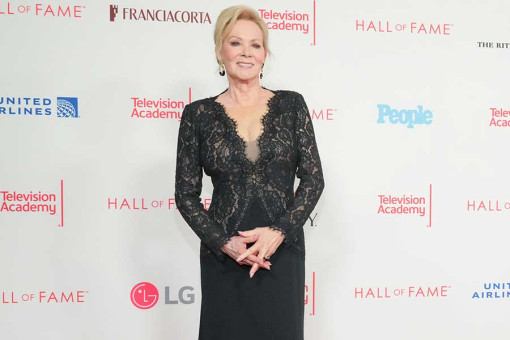
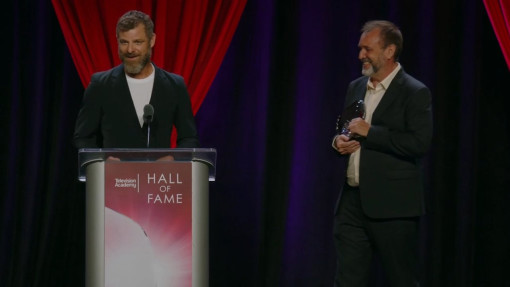
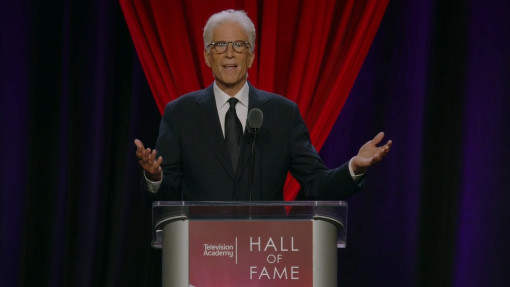
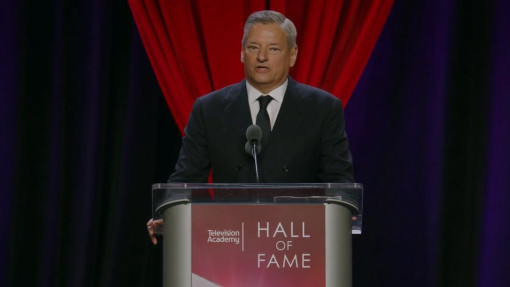
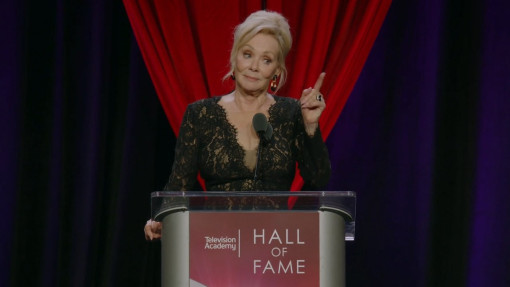
This tribute originally appeared in the Television Academy Hall of Fame program celebrating Beatrice Arthur's induction in 2008.