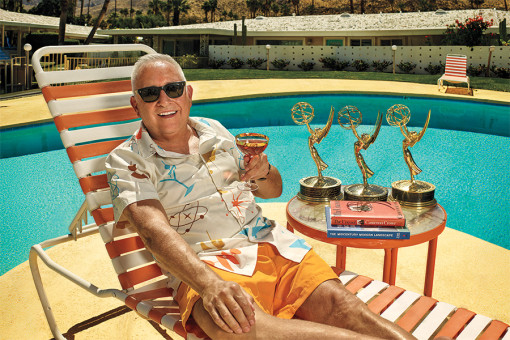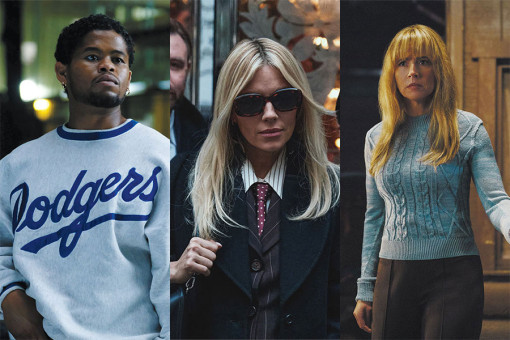


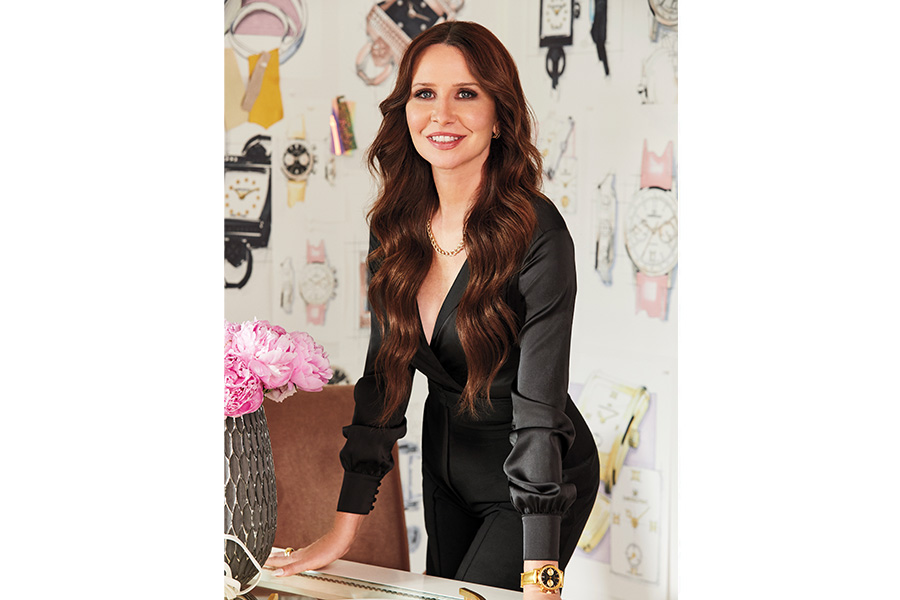
Costume designer Katherine Jane Bryant was created looks for television shows characterized by grime, glamour and everything in between: from HBO's Deadwood and AMC's Mad Men to Taylor Sheridan's Paramount+ universe of 1883, 1923 and Landman, among others. Her work has earned eight Emmy nominations, and one win.
Born in Tennessee, Bryant, who’s widely known as Janie, lived in Paris and New York before settling in Los Angeles, where she shifted from consumer fashion into costume design for film and television. For Deadwood, she explains that she wanted the clothing to tell the truth about the show’s harsh 1870s setting. The costumes had to “feel and smell and seem as dirty as they really were during that period,” she says. Her approach helped redefine the look of the Western on television and earned Bryant an Emmy Award for costume design in 2005. She also received costume design nominations for that series in 2004 and ’07.
For Mad Men, she reintroduced viewers to the power of mid-century tailoring, structured undergarments and a carefully controlled silhouette. She earned Emmy nominations for her work on Mad Men from 2009 to ’11 and again in ’14. Her 2010 book, The Fashion File, offered readers a way to take inspiration from Mad Men and use it to cultivate a personal sense of style.
Bryant returned to the Western genre with 1883 before earning another Emmy nomination in 2025 for its followup, 1923. Her most recent collaboration with Sheridan is on Dutton Ranch.
Bryant was interviewed in August 2012 by Bonnie Datt for The Interviews: An Oral History of Television, a program of the Television Academy Foundation. The following is an edited excerpt of their conversation. The entire interview can be screened here.
Q: WHAT WERE YOUR INTERESTS GROWING UP?
A: I loved to play dress-up. I loved to design clothes for my Barbies. I loved to draw. I made my first dress when I was 8 years old. I remember exactly what it looked like. It was a blue and white striped sundress and had white plastic anchor buttons with a little crisscross in the back. I wore it to school in third grade, and no one believed me that I had made it.
During high school I was still sewing and making my clothes, but I was really into illustration, drawing and painting. I thought I was going to be an artist or a businesswoman.
Q: WHERE DID YOU ATTEND COLLEGE?
A: I went to four different colleges. I started at the College of Charleston. I ended up going back to Brenau, where I had gone to boarding school; they also had an all-women’s college there. So, I went to Brenau University for a year and then transferred to Georgia State University for two years, and then I transferred again to the American College of the Applied Arts, where I ended up studying fashion design.
Q: AFTER COLLEGE, YOU WENT TO PARIS. WHAT MADE YOU DECIDE TO GO THERE?
A: I was obsessed with anything and everything French, and my favorite fashion designers were there, Christian Lacroix being one of them. I wanted to learn to speak French and live in Paris, and at that time that’s really where fashion was. I wanted to be a part of it.
Q: AND THEN WHY DID YOU MOVE TO NEW YORK?
A: Because my father said, “Janie, you need to get a job.” My family was supporting me, and it was my dream to become a famous fashion designer and to speak French all in six months, and that wasn’t reality. But I learned a lot while I was there. I spent almost every single day in the museums and grew up a little bit when I was in Paris. Then I went to Atlanta and got a job as a fashion designer. It was really my first job. I was designing for a small sportswear company. The owners of that company dissolved the business, and I knew it was time for me to go to New York. I got a job working for a fashion designer named John Scher. He was looking for an assistant designer.
Q: AT WHAT POINT DID YOU DECIDE YOU WANTED TO GET INTO COSTUME DESIGN FOR FILM AND TELEVISION RATHER THAN FASHION DESIGN?
A: I had met a lot of people in the film business and had been working in fashion for about nine months, and I was invited to this Christmas party. I met a costume designer there named Alexandra Welker, and we talked about her job. I was so curious about it because I had always been so passionate about old movies, and she was telling me about how her job involved developing and designing characters through costume. I loved that idea of the psychology of the character — reading a script and imagining what characters looked like. And I felt that if I was going to give the film industry a true chance, I needed to go to Los Angeles and be where it all happens.
Ed O'Neill and David Strathairn in Big Apple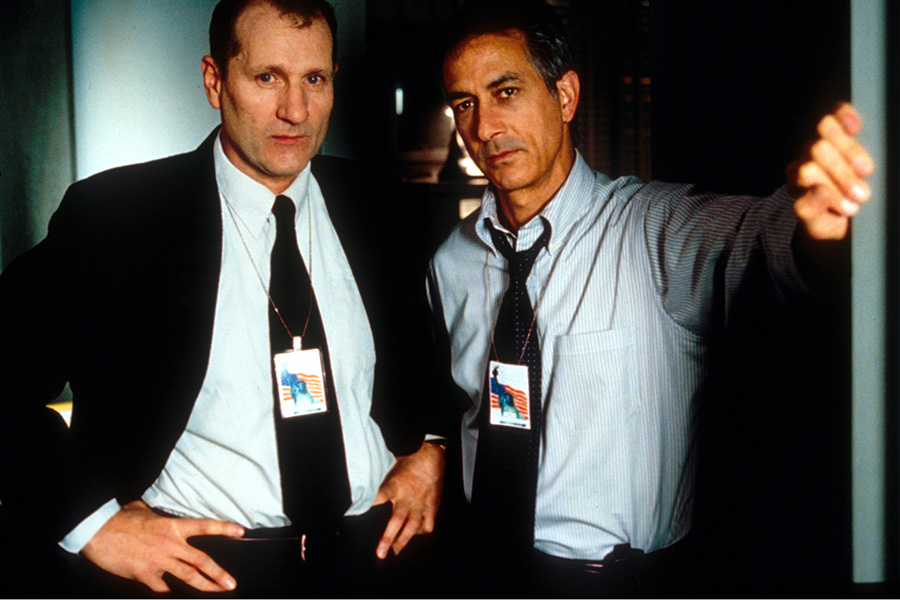
Q: WHAT WERE SOME OF YOUR EARLY JOBS IN L.A.?
A: It took me about two years to even get a job in Los Angeles. I was traveling all around America working on commercials and low-budget films. I even went to Bulgaria to work.
Q: IN 2001, YOU WORKED WITH DAVID MILCH ON A TV SERIES HE COCREATED, BIG APPLE.
A: He’s so brilliant, and he has the most amazing way to develop characters and write for them. I was totally inspired by working with him. His guidance really comes through his talk about the characters. He loves costume design and of course loves and appreciates all the different departments and the collaborative spirit of filmmaking. But his amazing talent is writing and creating these characters and being able to give the backstory on the characters — that is always so important to me. That’s how our creative process really played out.
Q: HOW WERE YOU FIRST APPROACHED ABOUT WORKING AS A COSTUME DESIGNER FOR DEADWOOD?
A: After Big Apple finished, the film business was a bit slow, and I was actually going to leave it. I always loved designing period shows, but at that time there weren’t a lot of them, and I was feeling creatively frustrated. I found designing contemporary films to be not as creatively challenging as I wanted. So many more people have opinions about what contemporary costume design is and how that character should look, and I was frustrated by that. Period design was more about the fantasy of going into a different period and being able to develop the character through costume design and build costumes from scratch.
Janie Bryant working on Kim Dickens’s look for Deadwood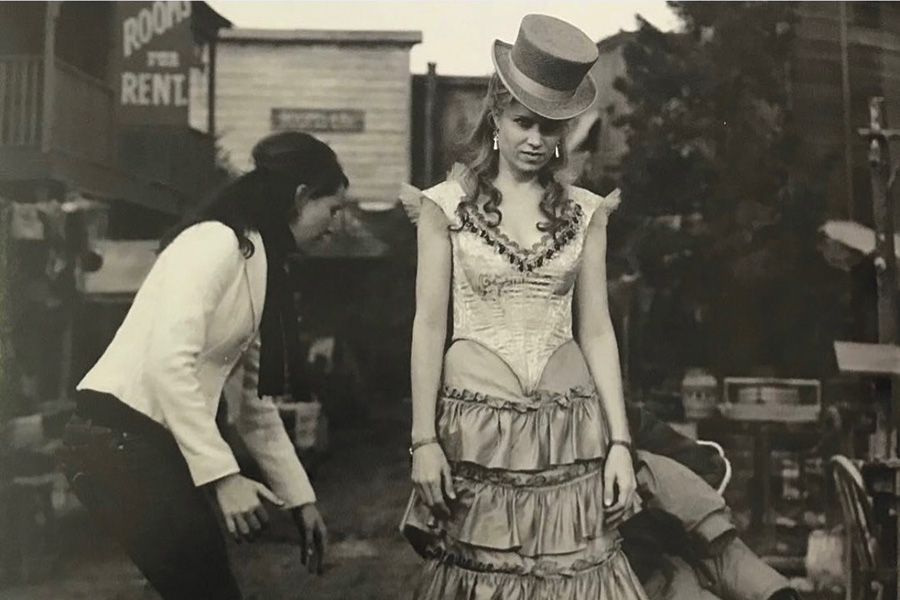
So, I was getting ready to leave the business and was working on being a photographer. I was also designing an accessories line and clothing for dogs, because I had two toy poodles and I was always designing and making clothes for them. But as fate would have it, David Milch called me and said, “Janie, I’m doing a new show.” I was like, “Well, of course I’m going to design his new show, whatever it is.” And he said, “It’s a Western. It’s period. It’s 1870s,” and I was out of my mind ecstatic. Reading that pilot script, I was like, “This is like [the 1971 film] McCabe & Mrs. Miller.” It had that total starkness and those cold elements about it. McCabe & Mrs. Miller is [set] a little bit later, but that was the film that really inspired me when I first read Deadwood.
When I started doing my research and reading about how dirty and filthy the lifestyle of that place was, that was a huge part of the storytelling. I wanted the costumes to feel and smell and seem as dirty as they really were during that period.
Q: HOW DID YOU MAKE THEM DIRTY?
A: Secrets. [Laughs] No, there was a lot of distressing with sandpaper, wire brushes, fake dirt, anything that we could get our hands on to really break down those costumes. We over-dyed; we used a lot of fuller’s earth [clay], and it was a constant laboring process to put the dirt on the costumes and maintain that. I wanted them to be dirty but have the design and influence of the Victorian period more so than the cowboy design. For me, that was the unique thing about the costume design in Deadwood.
Q: WHAT DID YOU TAKE AWAY FROM WORKING ON THE SERIES?
A: Deadwood was my first big period show, and just doing that was such a huge accomplishment. I also started working with Le Dawson, my costume supervisor. He taught me so much, because he had a lot of experience in period design and dealing with the amount of extras and understanding how much work that takes. That was a big lesson for me, because it’s different in a period show where every single person has to be fit from head to toe. I’ll never forget on the first day, we had practically every single principal actor on set, and all of the background actors on set, and just walking out on that street and feeling that feeling of accomplishment and almost disbelief that it all came together.
Q: YOU WON AN EMMY FOR OUTSTANDING COSTUMES FOR A SERIES FOR THE SHOW IN 2004. WHAT DO YOU THINK MADE YOUR COSTUMES STAND OUT?
A: The dirt. [Laughs] I really think it was about that show being so unique, in a way that people had never seen a Western before.
Q: HOW WERE YOU FIRST APPROACHED ABOUT WORKING FOR MAD MEN?
A: Alan Taylor was the director of the pilot, and I had worked with him when he directed a movie called Palookaville. Alan recommended me to [Mad Men producer] Scott Hornbacher, who I also knew from my days in New York City. My agent had called and said, “They want you to meet with the creator, Matt Weiner.” I arrived at Los Angeles Center Studios, and this place is like a maze, so I was running around trying to find the building. I run into the elevator, and I see this man. He has on this really cute sports coat, blue plaid. I love it. I say, “Oh, I really love your blazer.” And he was like, “Oh, thanks. I really love your belt buckle.” I said, “Oh, thank you.” I had my big Gold “J” flashy belt buckle on. It was Matthew Weiner that I was speaking to in the elevator, who was also running late.
We sat down and talked for about two hours. Scott was in New York on speakerphone, and we just had such a great meeting. We talked about American history, costume design, all the different characters. He went through my portfolio, and we talked about the different jobs I had worked on. We had such a great creative connection, and I remember him looking at his watch and saying, “Oh my God, we’ve been talking for two hours. I have to go write.” The next day, Scott called my agent and asked me if I wanted to design the show.
Bryant’s signature looks for January Jones, Christina Hendricks, Elisabeth Moss and Jessica Paré of Mad Men.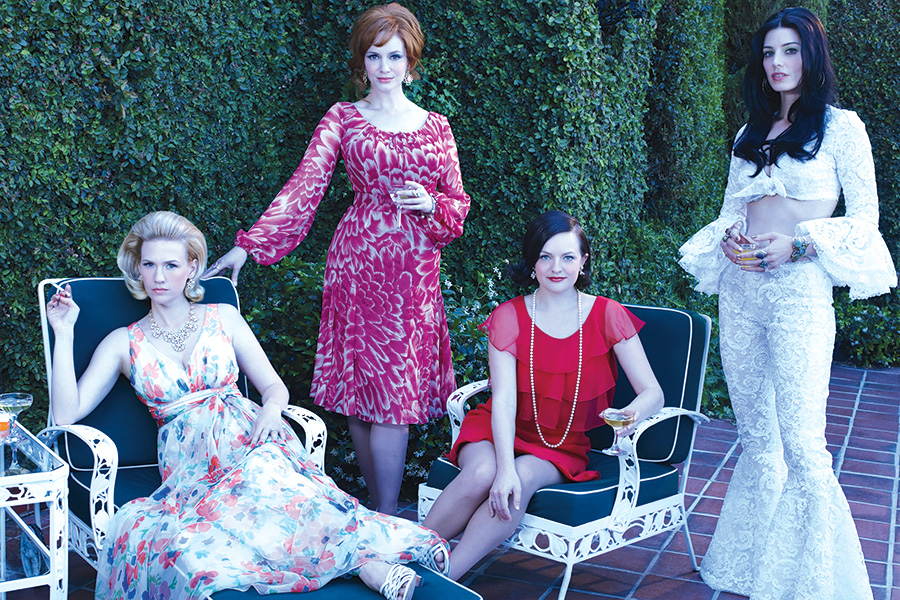
Q: WHAT DID YOU THINK WHEN YOU READ THE FIRST SCRIPT? DID YOU HAVE IMMEDIATE IDEAS OF WHAT THE CHARACTERS SHOULD LOOK LIKE?
A: I did. The show started in 1960, and Matt and I had a lot of discussions about how fashion changes slowly. People were still wearing the design of the late ’50s in the early ’60s. So that was a huge part of the costume design of the first season.
Those beginning conversations with Matt were so valuable. That’s when I really started my research process of developing the different characters. I started going through old photographs, watching old movies — movies that Matt wanted me to see to get inspired from. I also looked at old catalogs, old advertisements, vintage newspapers and vintage fashion magazines, but that was not the priority. It was looking at how people wore their clothing during that time and seeing what people looked like in advertising agencies, as secretaries, as housewives — being inspired by real life at the time.
Adrienne Faillace is the contributing editor for Foundation Interviews.
The Interviews is celebrating its 30th anniversary as it marches toward its 1,000th interview. Since 1997, the archive has conducted more than 960 interviews chronicling the evolution of television by capturing indepth conversations with the people who have transformed the industry. To make a gift to the Television Academy Foundation to help preserve this invaluable resource for generations to come, please contact Anne Vasquez, executive director, at vasquez@television academy.com or (818) 754-2801.
The complete version of this interview can be found in emmy magazine, issue #11, 2026, under the title: Janie Bryant.