
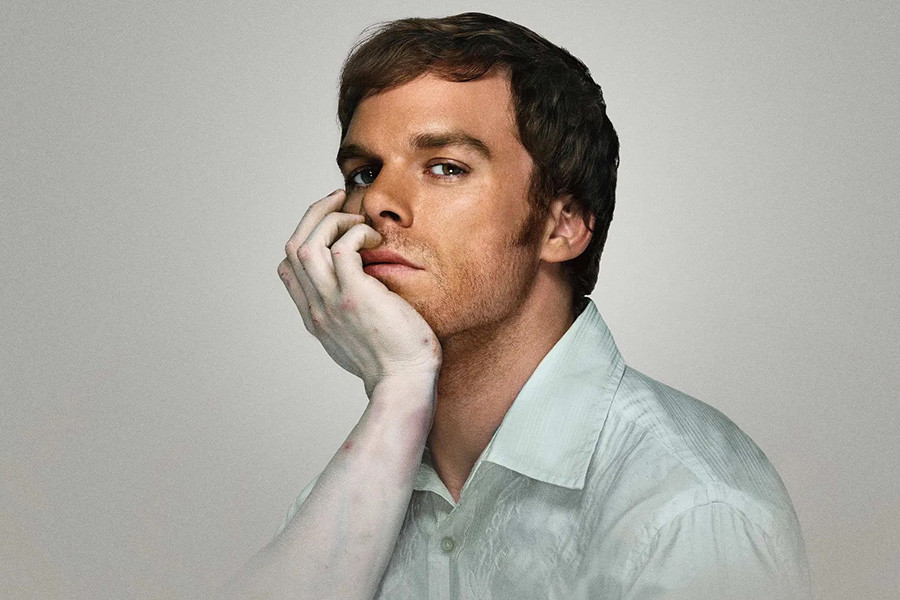
There are many solid theories about why Dexter remains so popular. Executive producer and showrunner Clyde Phillips has the most sinister one.
“I’ll bet that everybody has lied there in bed and fantasized about doing something bad to a person who deserves it,” Phillips says. “But we don’t do it because we’re not psychopaths. So they get to act it all out vicariously by watching a very appealing actor do the job for them.”
It helps that Dexter Morgan has been exceptionally good at it since day one. Premiering October 1, 2006, the Showtime drama — based on Jeff Lindsay’s 2004 novel Darkly Dreaming Dexter and developed by James Manos Jr. — chronicled a Miami-based forensic blood-splatter analyst (very appealing actor Michael C. Hall) who enjoyed boating, pork sandwiches and moonlighting as a serial killer. Not just any kind of serial killer: In adhering to The Code of Harry, instituted by his adoptive father (James Remar), Dexter only targeted criminals who escaped justice.
Even in a Peak TV era dominated by a mob boss, a drug kingpin, a dirty cop and a morally compromised ad whiz, Dexter offered viewers a unique antihero. Unmotivated by money or even a twisted sense of righteousness, this leading man believed he was a monster devoid of genuine empathy. And yet he became a family man who loved his wife, Rita (Julie Benz) — which made her murder at the hands of “The Trinity Killer” Arthur Mitchell (John Lithgow in an Emmy-winning performance) at the end of season four all the more devastating.
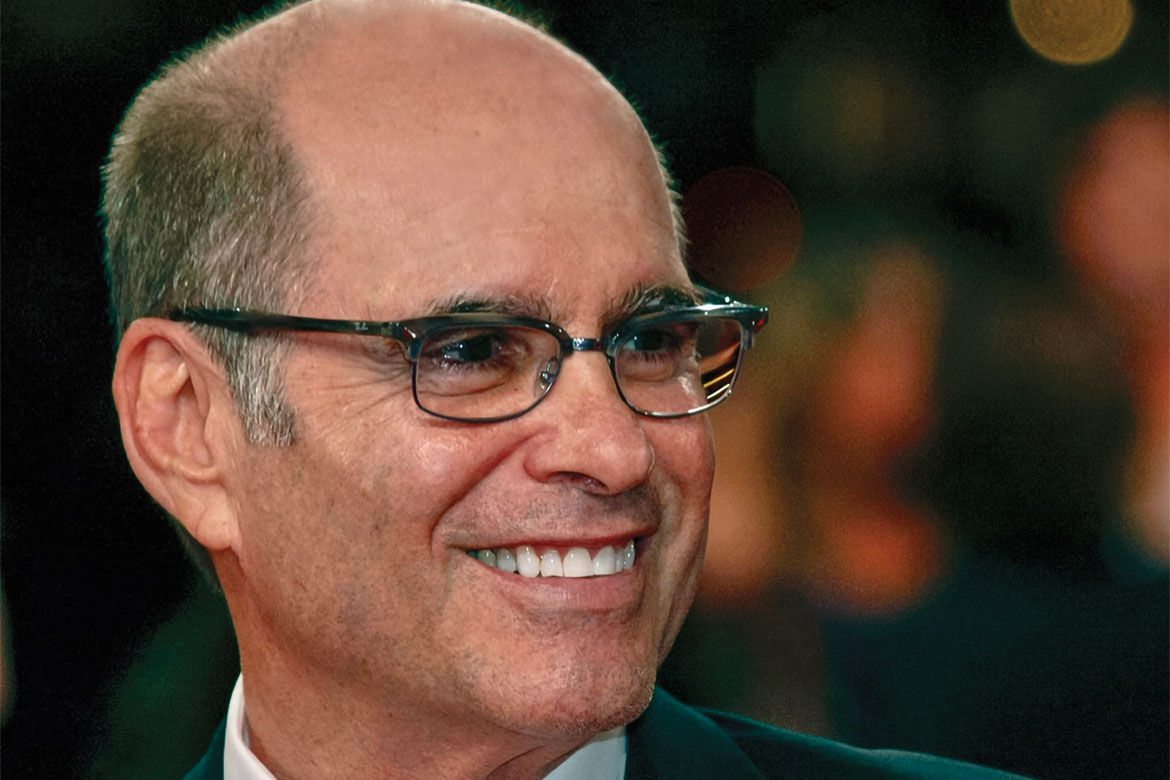
“Our goal was to always be surprising,” says Phillips, a mystery novelist who joined the show after the original pilot was filmed. “And you get to see Michael Hall, great writing and a great cast. That’s why we’re doing this interview, and why we've been around for 20 years.”
Indeed, Dexter’s knives are still out. Though the original series ended in 2013 with the character faking his death and working as a bearded lumberjack in Oregon, he rechanneled his killer tendencies in the 2021 limited series Dexter: New Blood. And for Dexter: Resurrection — which returns for its second season October 30 — Dexter tracks predators in New York City. (The 2024-25 CBS prequel series, Dexter: Original Sin, explored his early years.)
Phillips took a break from production of Dexter: Resurrection to talk to The Television Academy about the anniversary milestone.
Television Academy: How surreal is it to be doing a 20th anniversary interview about a show that you’re still actively involved in?
Clyde Phillips: We’re shooting today! I just came from the set to my office overlooking the Hudson River. I’m certainly aware of the anniversary, however. I know I’m the luckiest guy in the room. Who gets to do this for a living and have a legacy show?
Let’s go back to the beginning. You didn’t develop Dexter, but you were involved early on. How did that come to be?
The pilot was shot, but there were some problems with it. Showtime [executives] sent it to me and said it had a great cast, but one of the characters wasn’t testing well. I saw the problems — and other problems that they didn't see. To me, it was really appealing that he’s killing somebody and saving lives. There was also room for humor because it wasn’t so dark. But I knew I had to rewrite the character [that wasn’t testing well]. So I called back and said, "I'm interested in this, but there is stuff that needs to be re-shot.” We did, and that character ended up being very successful.
Which character was rejiggered?
I can’t say!
And where is that original pilot? Will it ever see the light of day?
As far as I know, you’re not going to see it. But I have no idea where it is. If you offered to buy me a house, I couldn’t find it. It’s somewhere in the salt mines in Colorado.
From the outset, did you want viewers to root for this serial killer?
Yes. In fact, his first kill is originally from Jeff’s book. I read it on the plane on the way to California. Even after we landed, I couldn’t put it down. Dexter kills a pedophile choir master and he tells him, "I should have killed you twice.” That showed me that we're dealing with somebody with power, a conscience and a code. That makes the show.
There was a big reveal at the end of the first season about the identity of “The Ice Truck Killer.” Was that planned far in advance?
I'm a big believer in knowing what the end is first. Here’s my analogy: You walk up to a wall, you put your nose against the wall, and that's the ending. But as you walk, you're in a hotel hallway. Then you walk backward, and there’s a door on either side of the room. For us, each step is an episode until you get to the beginning. But you still have to keep and service all of your characters.
Even though Dexter aired on Showtime, did you ever think you pushed the envelope too far?
No. Two writer strikes ago [in 2007], CBS ran out of content. So they took Dexter, put it on the network and made it more palatable for family viewing. The strike ended, we went back to Showtime and quadrupled our audience. People were watching each episode four or five times to debate it online. They were talking about stuff we never even intended!
Did you have a favorite killer or storyline?
If you ask anybody on our staff, it’s Trinity. John Lithgow.
John Lithgow and Hall in a scene from Dexter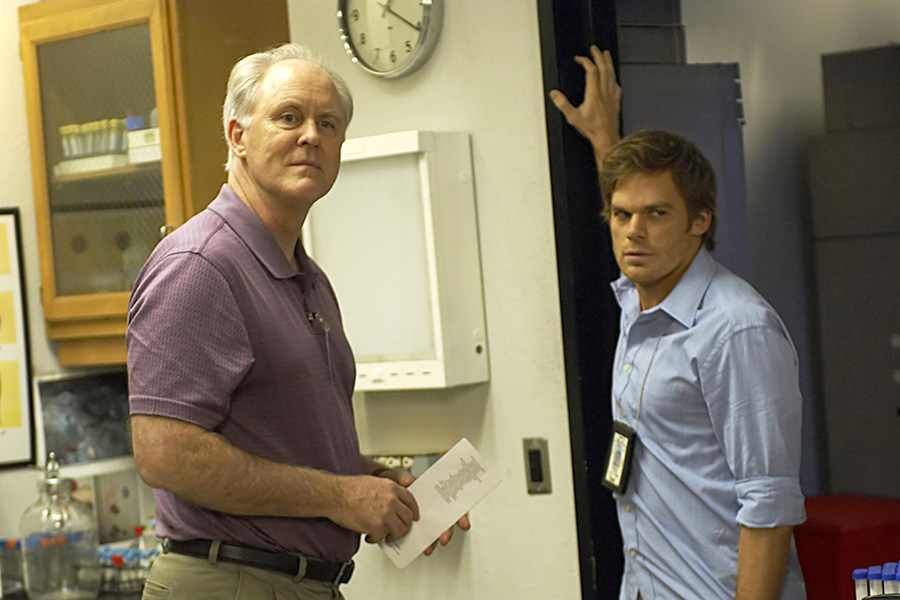
Of course it is. What’s the backstory?
I had worked with John a couple years prior; he and I used to hang out a lot and play guitar. I remember going in to pitch him. His agent was in the room, and I asked him if he could step out. Then, because I’d already put my nose against the wall, I pitched John the entire season so he would know where the character ends up. He said, “I’m in. I’ll do it.” I said, “We have to talk about the money,” and he said, “I don’t care about the money.”
He needed to do two days in Ireland for a movie — his wife was getting an award in Italy, and he was going on a cruise. He said, “Forget the cruise, I’ll go to Ireland sooner rather than later. I’ll either go with or without my wife. I want to do this.” I got in the car, called Showtime and said we had our Trinity Killer.
He won an Emmy Award for that performance, but the show only nabbed four overall out of 24 nominations. How did you process the wins and losses?
I took it partly like a pro. In the first season, we got nominated [for Outstanding Drama Series]. We were up against The Sopranos in its final season; we didn’t have a chance. Then it was Mad Men every year after that, which made me crazy. I mean, [Mad Men creator] Matt Weiner — at the Writers Guild one year — actually got up, looked at me and said, “I’m sorry, Clyde.” Now we have a joke in my own house: Whenever we get something in the mail, whether it’s an electric bill or a Christmas card, we open the envelope and say, “Mad Men.”
You left after the fourth season and didn’t work on the then-series finale. Would you have killed off Dexter in the end?
I did have an idea: Dexter opens his eyes and he’s on the execution table. He looks out the window, and he sees all the characters from the previous seasons. But had I done that, I wouldn’t have a show now. So, it’s a good thing I wasn’t there. The best thing I did for the show was leave.
Why do you think Dexter works as a franchise?
Michael C. Hall. He’s an amazing actor and an amazing person. And part of what makes us different is the voiceover. You get a serial killer talking to you, and he is telling you his thought process and what pains him — his loneliness, his vulnerability, his mistakes, his regrets. You get into the inner-mind of a psychopath. And, sometimes, the voiceover is very funny.
There will be times when we're editing, and I’ll have an idea for a voiceover. I'll pick up my phone, record it on voice memos and send it to an assistant editor. She'll cut it into the show in my voice, and then send it to Michael. And if Michael likes it, it's in the picture the next day.
Hall, director Romeo Tirone and John Lithgow on the set of season four.
There is no behind-the-scenes footage of the show on YouTube. Is that deliberate?
We don’t do bloopers. We don’t do gag reels. We don’t even do them internally at the wrap parties. Maybe we take ourselves too seriously. But everybody loves being on the set — we’re having a great time.
Dexter came of age during TV’s prime antihero era. Do you think the character is a throwback or has he evolved into something else?
People think that the time of the antihero has gone away, but it really hasn't. Look at Jason Bateman and Laura Linney in Ozark. Look at Sandra Oh and Jodie Comer in Killing Eve — they're anti-heroines, if I can coin a phrase. If you're just rooting for a hero, the story's going to get boring pretty quickly — and the last thing you can be on television is predictable. Especially when you're inviting an audience in and asking them to pay for premium cable.
My wife was in town this weekend. I showed her the first two episodes of the new season of Dexter: Resurrection, and somebody reprises [their] role. She said to me, "Wait, isn't [that character] dead?” And I said, "Babe, it's Dexter.”
We can do anything, just as long as we do it in a way that feels honest and doesn’t take advantage of the audience. As comfortable as everyone might be with the franchise and the character, our goal is to keep surprising [audiences] and make you lean forward.
This interview has been edited for length and clarity.