
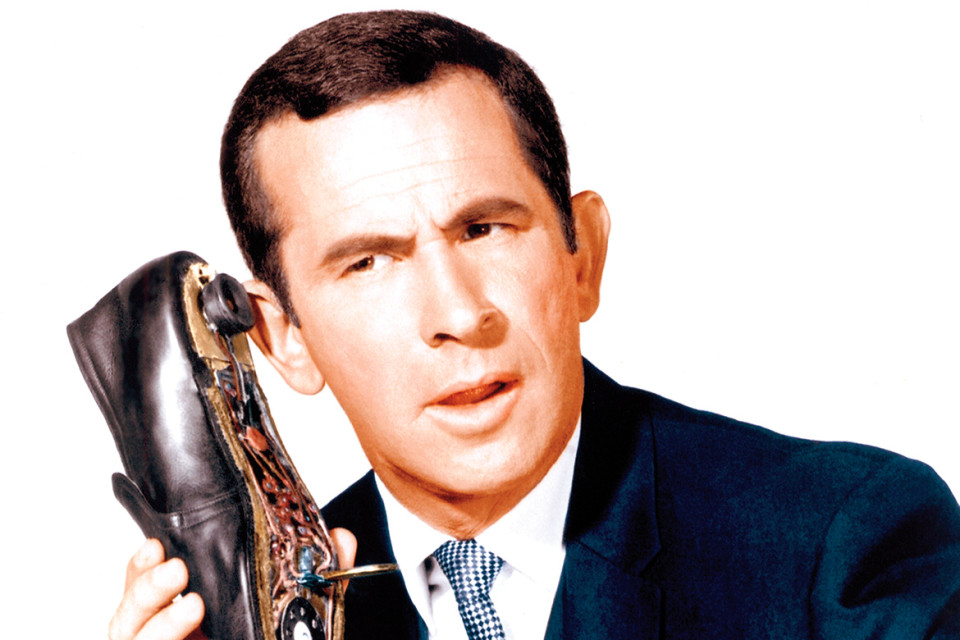
In 1964, with the James Bond franchise ascendant and Cold War anxiety embedded in the public consciousness, producer Daniel Melnick sensed the time was right for a sendup of the spy genre.
When Melnick tapped Mel Brooks — already a comedy veteran after more than a decade of working with Sid Caesar — to turn the idea into a TV series, it proved to be a smart decision. Make that Smart — as in Get Smart, the espionage farce starring Don Adams as Maxwell Smart, the earnest but imbecilic Agent 86 for CONTROL, a U.S. counterintelligence bureau constantly at odds with the "international organization of evil" known as KAOS.
If 007 was known for dazzling feats of derring-do, Max was a master of derring-don’t. Reckless, irrationally confident and oblivious to his own ineptitude, he often found himself in life-threatening jams, which he somehow managed to escape — usually thanks to the intervention of arguably the only sane characters in the series: Chief (Edward Platt), the longsuffering head of CONTROL, and Agent 99 (Barbara Feldon), Max’s brainy, beautiful sidekick — and, later, spouse.
Get Smart, which Brooks cocreated with writer Buck Henry, premiered on September 18, 1965, and aired for five seasons — the first four on NBC, the last on CBS. During its run, the show scored 14 Emmy nominations and won seven, including two for Outstanding Comedy Series and three for Adams’s lead performance.
Its greatest legacy may be the career of Mel Brooks, who went on to become a prolific filmmaker whose body of work includes a long list of classic genre parodies with undeniable Get Smart DNA, including Blazing Saddles, Young Frankenstein, Silent Movie, High Anxiety, History of the World: Part I, Spaceballs and Robin Hood: Men in Tights. And he’s still at it: In June, just days before his 99th birthday, the trades announced that Brooks, along with members of the creative team behind What We Do in the Shadows, was developing a pilot at FX currently titled Very Young Frankenstein.
Here, Brooks speaks with emmy editor-in-chief Juan Morales, sharing memories of the show that set things in motion.
How did you join forces with Buck Henry to create a spoof of the spy genre?
It all started in 1964, when I got a call from Danny Melnick, one of the partners at Talent Associates. He said, “We need a new show, and we want you to write it. Inspector Clouseau and James Bond are the biggest things in the world now. Got any ideas?”
They asked if I wanted to write it with anyone and gave me a list of suggested names. Buck Henry was on that list. I liked him a lot and really admired his talent. Buck and I did the pilot for Get Smart for ABC, but they politely said, “We pass.”
In a stroke of luck, soon after that I ran into Grant Tinker from NBC at the Beverly Hills Hotel, and he asked, “Do you have anything that fell on the floor from the Sid Caesar shows that you didn’t use?” I said, “It just so happens that we have a brand-new funny show that ABC just passed on.”
I sent him and his team at NBC the Get Smart pilot, and they loved it! And they brought in Leonard Stern [who had worked for Steve Allen, Jackie Gleason and Phil Silvers] to be the showrunner for the series.
How would you describe your collaboration with Buck?
Right away, writing the pilot, it was a pleasure to work with Buck. He was crazy and fast and different! When we both laughed, it was in. If only one of us laughed, it was out. And if neither of us laughed, it was definitely out.
But equally as important as his sense of humor was that Buck could shoot pool, and Talent Associates — where we were writing the pilot — had replaced their conference room table with a pool table. So, he was the perfect partner! I’d say it took me and Buck a few months to write the pilot. We maybe could have done it in just a couple weeks, but we really loved playing pool.
A 1965 article about Get Smart in Time magazine said that when you initially brought the show to ABC, the network wanted to include Maxwell Smart’s mother as a character, but you didn’t want to introduce such traditional homespun elements. What are your memories of the development process, and what was your vision for the project that ultimately prevailed?
If we had added his mother, it would have drifted into a typical family sitcom, and we didn’t want that. We wanted to do a spy show that was funny and had a sort of comic-strip style. No one had ever done a show about a CIA agent who was an imbecile. We wanted to be the first.

Get Smart has a buffoonish hero at its center, but with key supporting characters playing things straight — especially Edward Platt as Chief and Barbara Feldon as Agent 99. How did you land on that dynamic?
I had learned on Your Show of Shows that brilliant straight men like Carl Reiner and Howie Morris made our star, Sid Caesar, comedically shine even more. So, Buck and I knew that Ed Platt and Barbara Feldon would be the straight backboard that Don Adams could bounce off. In a gang comedy, you really need the straight characters to do the reaction takes. When someone does something funny, the audience doesn’t always laugh unless another character on the screen does the “take.”
Agent 99 was unlike most female characters of the era — strong, independent, highly competent at a complex job. How did you and the creative team conceive of her, and how did you balance her with the absurdism of Don Adams as Max?
We interviewed a lot of pretty girls, but the sharpest of all the pretty girls was Barbara Feldon. We said, "Don’t send us anymore! We’ve got our 99." She and Don had great chemistry right from the start, and he needed her to be his foil. Agent 99 was the wise and common-sensical George Burns to Max’s naïve Gracie Allen. She was the sane one!
Can you talk a bit about some of the recurring gimmicks, like the shoe phone and the Cone of Silence?
The Cone of Silence was one of Buck’s ideas: a big clear dome that would drop down to cover Max and the Chief’s top-secret conversations. It only had one small problem — they could never hear each other!
I was the mastermind behind the famous shoe phone. It came to me one day when every single phone in our office was ringing all at once, so I took off my own shoe and pretended to answer it. It was just the worst place to put a secret telephone, and I knew we could have a lot of fun with that. Don Adams told me for years after Get Smart that he couldn’t sit down to eat in a restaurant without someone taking off their shoe and saluting him!
 The show's famous Cone of Silence/NBC
Get Smart has several memorable catch phrases: “Would you believe …,” “Missed me by that much,” “And loving it,” “Sorry about that, Chief.” How did those originate, and how did you decide when and how to introduce them into scripts?
I don’t remember for all of them, but I know that some of them came directly from Don Adams himself and his stand-up act. I know he came up with “Would you believe …,” which was a series of exaggerations that kept getting progressively smaller and smaller:
Maxwell Smart: And I happen to know that at this very minute, seven Coast Guard cutters are converging on this boat. Would you believe it, seven?
Mr. Big: I find that pretty hard to believe.
Maxwell Smart: Would you believe six?
Mr. Big: I don’t think so.
Maxwell Smart: How about two cops in a rowboat?
Broad comedies aren’t typically award magnets, but Get Smart won seven Emmy Awards, including two for best comedy series and three for Don Adams’s performance as Maxwell Smart. Why do you think it appealed to Television Academy voters in the late 1960s?
I think at that time we spent a lot more money on production as a single-camera show than most of the other three-camera in-studio sitcoms. We had location shoots and wanted each weekly episode to feel like a mini-movie. And, to be honest, there are a lot of shows that pass for comedy, but Get Smart was really, really funny.
The full version of this article appeared in emmy magazine, issue #9, 2025, under the title: "Would You Believe Get Smart Is 60?"