

When Jamil Akim O’Quinn was growing up in Compton, a South Los Angeles community where he’d suffered numerous family deaths amid impoverished conditions, his parents tried their hardest to make a better life for him and his siblings. Education was the best way to that life, they counseled. So, O’Quinn woke up at 5 a.m. to travel out of district to a safer high school and then went on to earn Bachelor’s degrees in integrative biology and sociology At UC Berkeley, a Master’s at the Princeton Theological Seminary and an MFA in writing for the screen at Loyola Marymount University (LMU).
“My parents really wanted to make sure that we had the best environment to give us a fair chance at having the best life possible,” he recalls. “They nurtured my love for television, film, acting and performance art at a very, very young age. I’m forever grateful to them for having a vision for me and all of my siblings that was much bigger than just the given set of circumstances.”
Even before LMU, O’Quinn had trained in opera, acted in an HBO pilot and performed in the ensemble of the first national tour of Broadway hit The Book of Mormon. While at LMU, he applied to the Academy Foundation’s 2019 Summer Internship Program, landing a spot as a Development Scripted intern. Describing himself as queer and neurodivergent — he has ADD and was diagnosed with multiple sclerosis in 2015 — he credits his road to the internship as instrumental in gaining self-acceptance.
“All my life, I was kind of the weirdo kid, and at a young age, you are socialized to believe that being weird is wrong. Everyone wants you to think in a mode they understand; it makes them comfortable,” he says. “It put a real cloud of shame over my humanity, until I went through divinity school and then entered into storytelling. Specifically, when I applied for the Television Academy Foundation internship, that was the first time I said, ‘When I do my video interview, I’m going to embrace every aspect of myself in my responses. I’m not going to be ashamed.’
“So, I embraced being queer. I embraced being neurodivergent. I even embraced growing up in Compton, because I had to break the shame of being poor. And I realized there’s something empowering — something liberating — about owning your story, and that’s where that process began, of owning my story unapologetically.”
Jamil Akim O'Quinn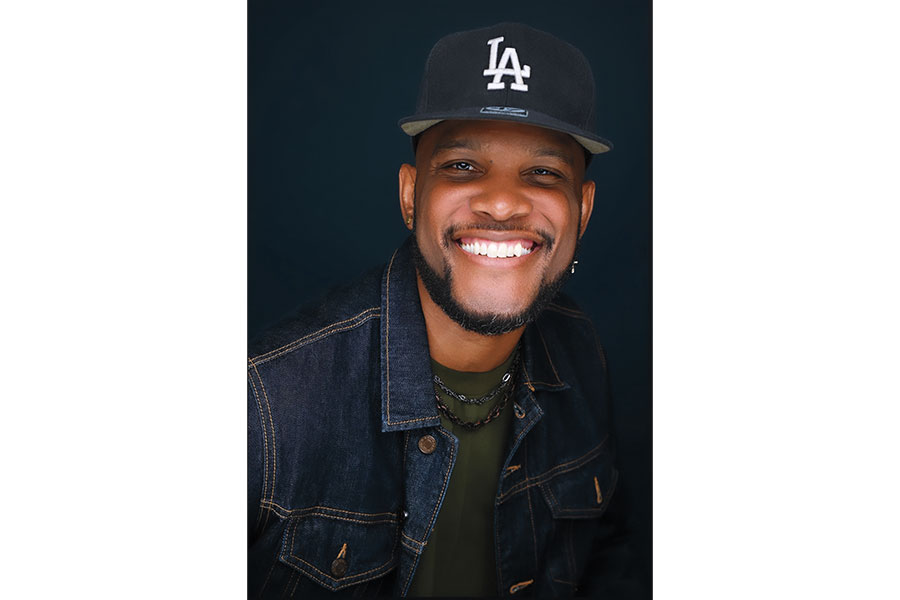
When he was accepted for the internship, “It made me realize, ‘Whoa, the things that I’ve been taught to be ashamed about are actually the things that make my story compelling,’” he says. “So, from then on, I was like, ‘I’m going to share my story. I’m going to walk into every room and bring all of myself in the room, because that’s what makes me interesting. That’s what makes my stories and my lived experience compelling.’ From then on, it was no longer a point of shame.”
Shortly after his May 2021 graduation from LMU, O’Quinn joined NCIS: Los Angeles as a writers’ assistant; the following year he cowrote and coproduced an episode of that series titled “Shame.” His subsequent endeavors include being on the support staff of The Equalizer, participating in Paramount’s Writers Mentoring Program, being a staff writer on S.W.A.T. and working as assistant to R. Scott Gemmill, creator-showrunner of HBO Max’s Emmy-winning drama The Pitt. He is currently story editor of the CBS fall spinoff series NCIS: New York, which Gemmill executive-produces.
He relies on his former “fish out of water” feeling to write stories that he hopes will help others forgo shame for strength. When it comes to writing characters, he cites a time after divinity school when being unhoused gave him a new, empathetic perspective beyond the stereotypes of the homeless community.
“It influenced my creativity,” O’Quinn says. “Because when I’m forming characters, I want them to be full and three-dimensional. It’s beautiful to have this diverse library of experiences that I can drop within the characters that I write, making them beautiful, complex, amazing — and problematic sometimes, because that’s life. Through crafting characters that are both beautiful and ugly, it allows us to create the fullness of humankind with the hopes of having us see each other in new ways.”
Q: How did you learn about the Foundation’s Summer Internship Program?
A: I was looking for an internship, and Elena Muslar in the career and professional development office at LMU gave me a list of paid internships, and that was on the list of opportunities. I was like, “This is mine.” Seeing how many Emmy winners went through the program, I was thinking, “I want to be added on that list. I need to do this.”
Q: You worked at Gale Anne Hurd’s Valhalla Entertainment Productions, whose shows at the time included Fear the Walking Dead. What did you do there?
A: Working in scripted development, it was a lot of script reading, both television and feature film. I would do script coverage. I’d talk directly with the Valhalla president, Phil Kobylanski, about why something stood out, why something really resonated. I also did what they called “Intellectual Property Grids,” where I would read comic books or books or newspaper articles. I’d research anything that was out there that could be a story that aligned with their brand of horror or sci-fi and then do a small write-up on the intellectual property. We would have weekly meetings where we would pitch some of the things that we’d found, and from there, they would either ask further questions or say, “Oh, that’s great, but it’s just not aligned with where we are.”
Q: Besides the transformative experience of applying, how has the internship helped in your career?
A: I still keep in contact with Phil Kobylanski at Valhalla. I shared with him a couple of projects that I’m writing and developing that are in the horror space, and he said, “When they’re done, please shoot me the scripts. I would love if this is something that works with our brand.” Also, I was fortunate enough to be able to work on the Emmys, starting as a PA. I didn’t get that through the Academy, but it was definitely a bridge to the production company that was doing the Emmys [at the time, Done+Dusted]. Working in that space, the relationships with people that I’ve established have been astronomical: writers, producers, talent, executive producers. It all started the year I was an intern.
O’Quinn with the team from The Pitt at the Norman Lear Awards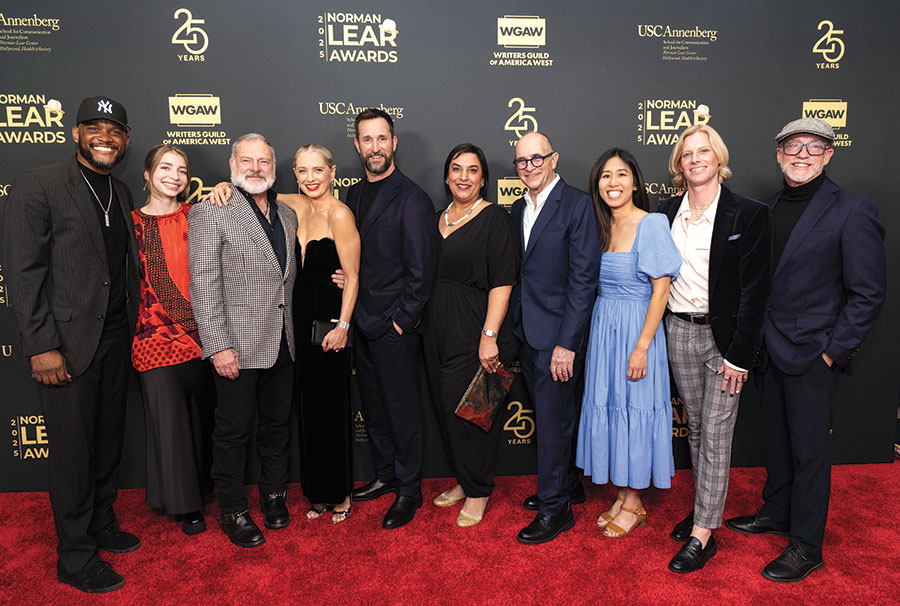
Q: And you’re still involved with the Foundation?
A: There are a couple of Foundation alumni that I took on as mentees. I always try to make sure that at every stage of my career, I am paying it forward through offering mentorship. Anytime I’m called upon to be on a panel or attend a fundraiser and share my story of how the Foundation has been a resource, I’m always available. Without the Foundation, I wouldn’t be in the position I’m in right now. It opened so many doors when I decided to come back and pursue screenwriting.
Q: And you did start your screenwriting career, with the NCIS: Los Angeles episode “Shame” that first aired in March 2023 on CBS. How did that feel?
A: Oh, that was a level of joy to me, because I went to school to be a screenwriter. So, for me, it was: This is the job. This is what I want to do. I’m officially a professional writer.
Q: You later worked with that show’s executive producer, R. Scott Gemmill, as his assistant on The Pitt, which he created. What was it like to be on such a hot show?
A: Working directly with Scott was a one-on-one master class on creating, running and building a show. I got a much closer experience of how to be a great showrunner who tells stories that matter to the world at large. I was a sponge, soaking up every detail of the story breaks, writing process, prep meetings and the editing, spot and mix sessions. And I learned about the process of working with executives to create the best possible show. Equally important was observing the conflict-mediation skills it takes to lead writers, so that everyone has an equal stake in the show. I consider Scott a blueprint for my own career trajectory.
The complete version of this article originally appeared in emmy magazine, issue #8, 2026, under the title "Jamil Akim O'Quinn."
The Television Academy Foundation’s education programs inspire tomorrow’s Emmy winners by instilling emerging talent, like Jamil, with the confidence to tell their story. Our impact is made possible by our generous community of supporters. To learn more or donate, please visit emmys.com/give.