
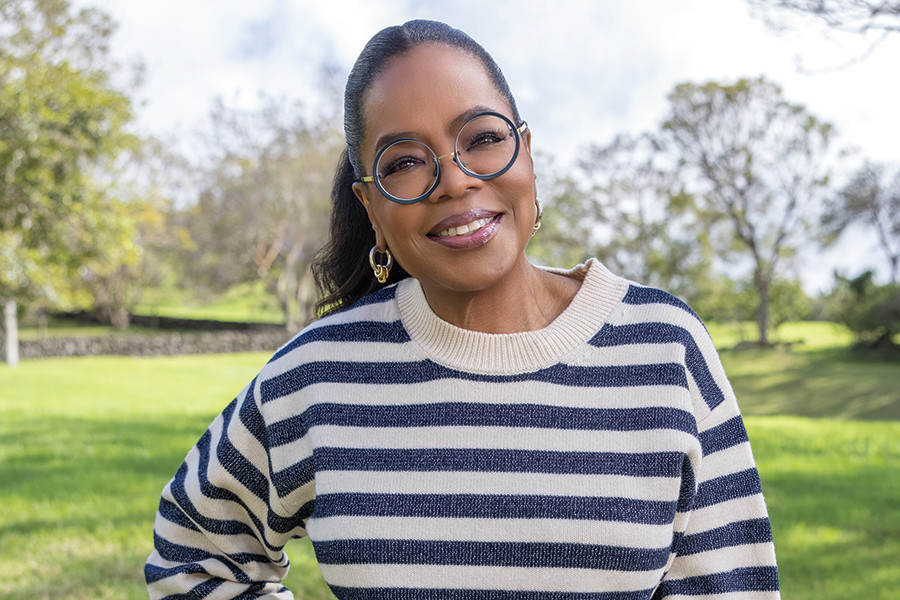
Oprah Winfrey has seen the memes.
The images of her facing the audience during that landmark 2004 episode of The Oprah Winfrey Show — clad in a head-turning, fire-engine red outfit she says her friend Gayle King suggested she not wear — head thrown back as she exclaims "You get a car! And you get a car! Everybody gets a car!"
It looks like she’s reached the emotional apex of the world’s biggest revival meeting, gifting a new car to every person in the audience — 276 Pontiac G6 sedans in total.
But Winfrey has a practical explanation for why she shouted out those words that way. People in the audience thought only one car would be given out. And when multiple people realized they had boxes with car keys inside, they weren’t sure what was going on.
“I saw the confusion on their faces,” says Winfrey, who was so intent on preserving the surprise that she called staffers the night before to make sure they taped down keys inside the boxes, so people couldn’t shake them and guess what was inside. “[Shouting] ‘Everybody gets a car’ was me trying to eliminate the confusion when everybody pulled out the keys.”
Her explanation reveals how so much of what she did on The Oprah Winfrey Show was born of her deep and unerring instincts as a producer and host. September marks the 40th anniversary of the show’s premiere, 15 years after Winfrey left the program that made her one of the most influential people in the world, the unofficial “Queen of All Media” (and official CEO of Harpo Entertainment). And the series remains bankable: In April, Amazon reached a multiyear licensing deal with Winfrey for rights to all 25 seasons of The Oprah Winfrey Show, along with The Oprah Podcast and specials for her popular “Oprah’s Favorite Things” and “Oprah’s Book Club” brands.
Oprah’s first national episode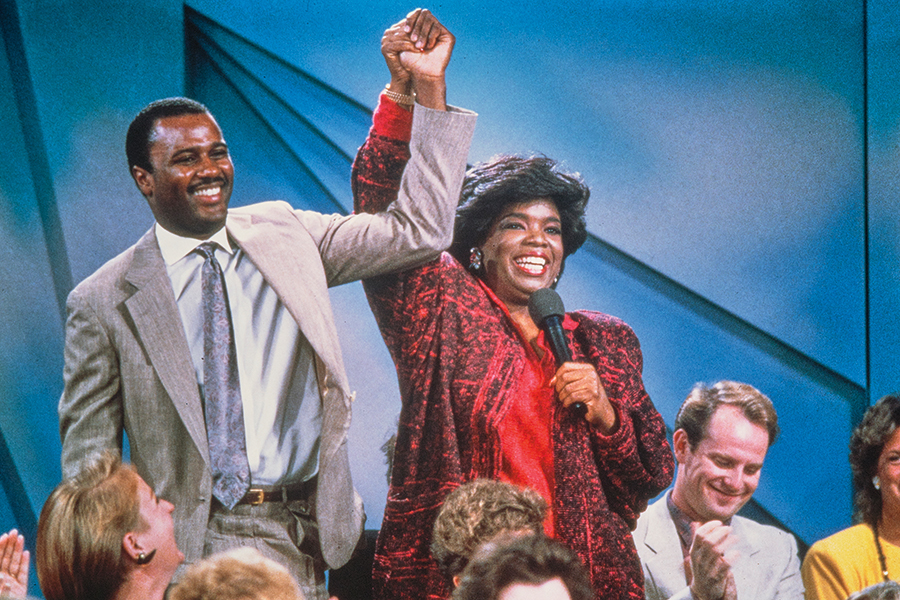
Airing from 1986 to 2011, her show drew an average of 12 to 13 million viewers a day at its height, making it the number one daytime talk show for many years. It earned 50 Daytime Emmy awards and 124 nominations in all. In 2000, Winfrey removed herself from consideration, after which the series was submitted only in directing and below-the-line categories.
In the process, Winfrey became an enduring icon, not only as a Black woman who had achieved what previously seemed impossible, but as a broadcaster who leveraged the power of syndicated TV when the medium was at its zenith. “I don’t even know how you explain it,” Winfrey says. The show was so powerful that recording artists, authors, politicians and performers saw an immediate spike in sales or attention following an appearance — the so-called Oprah Effect.
“I think it was the combination of where television was at the time,” she says, “and the fact that women were home to watch and be in the audience, and that people could come from around the country, join you in that space and create this community. All of that contributed to what it was.” Speaking with emmy contributor Eric Deggans, Winfrey recounts the origin story and highlights of a landmark show she still calls “the great love of my life.”
The Oprah Podcast just won a Gracie Award. But if The Oprah Winfrey Show were still airing on TV now, what would you be talking about?
I would be talking about what is happening in the culture but from the perspective of real people living their lives. What is missing in the conversation now is everybody’s talking around and about and not actually to [real people]. I would be talking about how, when you have people in positions of power, who have narcissistic behaviors, how that affects you. So, what happens when your husband is a narcissist, and your brother-in-law is a narcissist, and your boss is a narcissist, and you see that in your own life? Is that what you want in your leadership? I would find a way to make whatever is happening right now in our society more relatable. And I would be talking to everyday people about it on a regular basis.
Do any talk shows now feel like modern descendants of your program?
No. You know, we didn’t create this. It happened divinely, organically, in a way that none of us could have imagined or predicted. The Oprah show is the Oprah show because of myself but also because of the team that was built around it and the time when we built it. So, you can never have an experience like that again, because you will never have “appointment” anything again. And you will never have community in that way again. I was speaking mostly to that audience of women who were like myself, who were in the midst of their own self-discovery — spiritually and emotionally, in terms of relationships, raising children, having a job, their relation to the job, all of that. [The closest descendants are] creators on YouTube — they are the answer. YouTube is the new community gathering space.
I want to take you back to 1984, when a young Black woman came from Baltimore to Chicago’s WLS-TV to host a low-rated daytime program called AM Chicago. What was that like?
When I came to audition for the job, I remember Harold Washington was the mayor, and everybody was telling me how Chicago was such a racist town. Even the management team in Baltimore was saying, “You’re going to fail. You should not leave Baltimore.” I could feel inside myself that this was the time to move. I also felt that if I went to Chicago, this is going to be my place, this is going to be my new home. And if it doesn’t work out in television, I’ll figure out a way to get into advertising.
So, you were able to be your full self on AM Chicago?
I owe so much to Dennis Swanson [then general manager of WLS-TV]. I said, “I’m going to be a Black woman for as long as I live. I cannot become something that I’m not. I’m a Black woman who is also overweight. There’s nothing I can change.” He goes, “I’m looking at you, and you are who we want.”
What was the first show like?
It’s me trying to cook with one of the Chicago Bears. The skillet doesn’t work, and it’s just one big fiasco after another. Then I realize there’s no audience. So, the next day I’m like, “We’ve got to have an audience. Can we put 12 chairs in a room in the studio?” And that’s what we ended up doing. We would go out on the street and ask people to come in to get warm, and we would give them free coffee.
From giving people free coffee to giving them cars. That’s a pretty amazing progression.
The big breakthrough moment for me was having Cindy Crawford, Cheryl Tiegs and a bunch of other models on the show talking about cellulite. I said, “Honey, I could tell you something about cellulite.” And I told the story of being on an Atkins diet and not eating any carbs for a couple of weeks and only having hot dog buns in my freezer. Telling the story of the first diet is what really broke the veil for me in a way that nothing else had. I could feel the difference in the tone of the audience and the level of relatability. I think it caused me to build connection with the audience in a way that I hadn’t before.
Oprah’s Book Club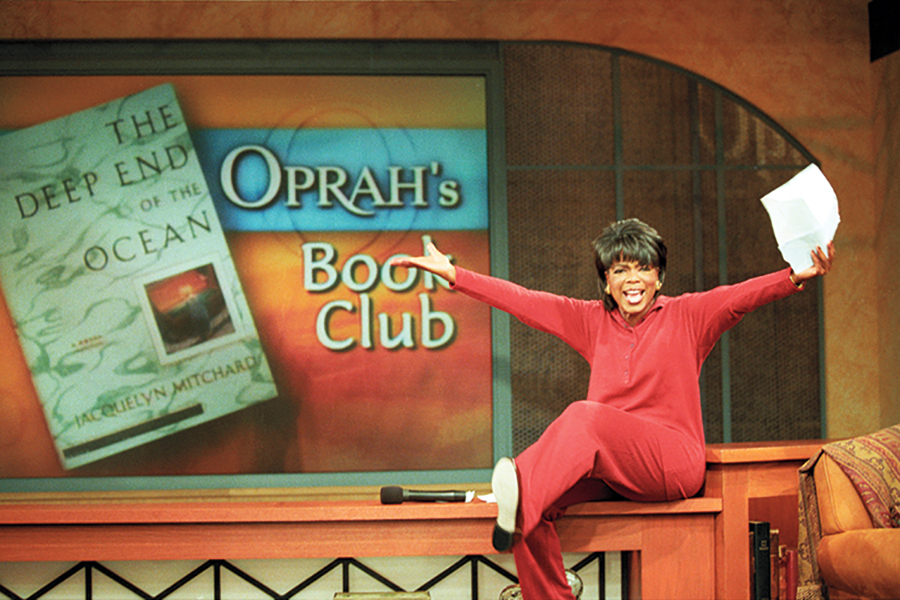
Didn’t film critic Roger Ebert suggest that you move the show from local TV to syndication — and ask for ownership?
Roger Ebert is the first person who brought up syndication. It hadn’t occurred to me. Well, syndication is one thing — ownership is another.
When I came to Chicago, I was carrying a backpack with books of [Alice Walker’s Pulitzer-winning 1982 novel] The Color Purple. I forced everybody to read it. There was going to be a movie, and I determined I was going to find a way to be in it.
Quincy Jones comes to Chicago. He sees me on AM Chicago. He tells Steven Spielberg, “I think I’ve found Sophia.” I don’t know this, but I go for the audition. I know immediately God has answered my prayer. When I went to do The Color Purple, [it took so long that] my bosses at ABC were upset with me. I said, “I will give up all of my vacation for the next two years if you just let me finish this movie.” And they did.
When it came time for syndication, my attorney said you never want to be in a position where you have to give up anything in order to have the freedom to do what you want. So, what if you owned yourself? What if, instead of just syndicating, what if you took a part of the profits? And if it doesn’t work, then you lose completely. But if it does work, you’ll be in really good shape. And that’s how that came about. All because of The Color Purple.
It wasn’t long before your local show, AM Chicago, was beating the king of daytime talk, Phil Donahue, in Chicago. And then you continued that nationally. What was it like, competing for viewers?
I was a great admirer of [Donahue]. He was the one who opened the door to conversations with regular folks, womenfolk, about what was going on in their lives. So, I feel like I owed a lot to him, but I never felt like I was in competition with him. The reason I maintained my sanity, even if the rest of my team did not, is I never felt that you could compete by worrying about what the other guy was doing. The only thing to do is to decide what it is you have to offer that the rest of the people don’t have to offer — and offer that at 120%, all the time.
You decided to stop signing autographs after tapings and talk to audience members instead. Learning about their frustrations and goals led to a segment called “Remembering Your Spirit.”
I had a conversation with Cheryl Richardson, who was a life coach, about women putting themselves on their own to-do list. And the very first time we did that show, I recall women in the audience booing her. Now, everybody’s self-help, everybody’s their own guru. But in the early ’90s, the idea of putting yourself on the list was a foreign concept — like, “How selfish, how ridiculous.”
When hosts Jerry Springer and Jenny Jones were doing more tabloidy segments and subjects on daytime, you came out with something different: “Change Your Life TV.”
I read this book called The Seat of the Soul by Gary Zukav, and that completely shifted the way I saw my life. 1989 was when I started “Remembering Your Spirit” segments, with people just taking a moment of silence. People are really relating to this, because they can see something more they’re looking for. People started saying to me, “I watched this show, and it changed my life.” So, I said, “We are going to be ‘Change Your Life TV.’” Big mistake.
Why?
Because then I got all the pushback from my critics — the hater-ation of “Oprah’s trying to start her own church.” “Oprah thinks she’s a god.” What I realized is, you never tell people you’re going to change their lives. You just do it, and you let them tell you.
That was when the show changed, and you started to book lots of experts.
I sat my producers down. I said, “From this day forward, we will not produce a show unless it is intentional.” This is the secret to why we were number one all those years. You need to present to me what the intention is, and I have to find a truth in that intention for myself. If your intention and my intention align, we’re going to be really powerful, because we’re both trying for the same thing.
How do you feel now about giving Dr. Phil and Dr. Oz a platform?
People criticize me for Dr. Phil and Dr. Oz, because of their politics or their views. Dr. Phil, he was so practical, so down to earth, so real. And he would ride in the car with me every morning on the way to trial, where I’m literally sitting on trial for six weeks. [In 1998, Winfrey was sued by Texas cattlemen who accused her of defaming the beef industry.] I felt that he was so instrumental in helping me. I thought, “Oh, you could help a lot of people. You should come on my show.”
Gayle introduced me to Dr. Oz. He explained practical things like colon cancer and bowel movements. I thought he had the language for explaining medical things in a way that was helpful to me. I thought it would be helpful to many other people. And that is how they ended up on the show.
Everybody has their own path in life, and it has not one thing to do with me, and I don’t have one thing to do with them. At the time, the reason and intention behind me giving them their breaks was I thought they had valuable information to share that had been meaningful to me.
The celebrity music episode featuring The Judds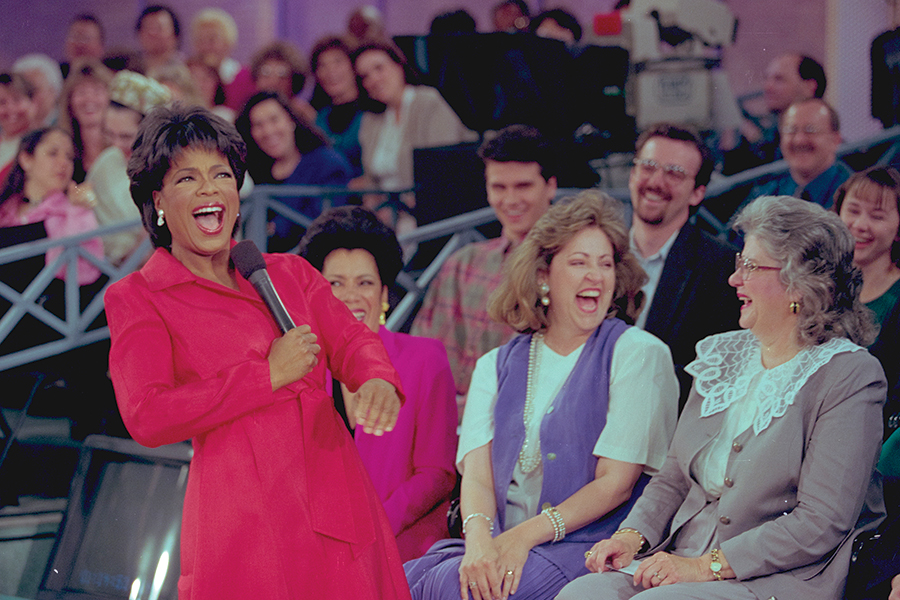
When people think about notable episodes, they think about the cars or a couch-jumping Tom Cruise or your diet episode. What stands out for you looking back now?
I did, I think, 250-some shows on domestic abuse. But there’s a Black woman named Susan, whose husband forced her 13-year-old son to film her while he was beating her up. I think we got more letters and emails about Susan than any other domestic case — women saying, “Today I decided to leave my abusive partner. Today I’m going to develop a plan.”
The show on children of divorce impacted me greatly. Because I didn’t realize until that show that even adult children — grown people — have a harder time with their parents divorcing than some of the younger kids. Because, if you’re grown — meaning teenage kid — and you’re told nothing, and you just wake up the next morning and your dad’s gone, you blame yourself. On that show, there was a little red-haired boy who said, “I begged her to stay.” It makes me cry. Shows like that live with me and abide with me. They have no celebrities or anything, just real people.
My favorite is being able to change and enlighten prejudices — so many shows on “coming out” and following your true path. We did a show about parenting and went to a Black father’s home and showed him reading to his two little girls. White people actually wrote letters saying they’d never seen such a thing or knew Black men read to their children. They only knew what they’d seen on the news.
Also among my most memorable shows were introducing [authors] Toni Morrison to mainstream America and Maya Angelou — reading with her in bed in our pajamas.
When did you know you wanted to end the show?
Makeovers were a staple for the show. And I heard myself on one of the shows saying, “What kind of mascara did you use?” And I thought to myself, “I really don’t care. I’m only asking that because I feel like I have to.” I’d sit with the producers, and they’d say, “We have to do this to get numbers.” And I thought, “Do I really want to do that?” It got to the point where we were doing reality stars, and I don’t watch those shows. So, there was a disconnect.
I talked to this kid, Mattie Stepanek, who was one of my favorite guests of all time. He was a kid that had [a rare disorder, dysautonomic mitochondrial myopathy], was in a wheelchair and was a poet. And he said to me, “I think you should think about [stopping in] the 25th year, not the 20th.” And I started thinking I could get to 25 and maintain my truth and authenticity. But beyond that, I didn’t know if I was going to be able to sit in the chair and say, “Oh my God, what kind of mascara are you wearing?”
There weren't many people in show business bigger than you at the height of the show.
Somebody pointed this out to me the other day, that The Oprah Winfrey Show was the original influencer if you look at the “Oprah Effect.” They came up with a name for it! I can only say that was a calling and responsibility to the audience that I took really seriously. It felt like sacred work to me, to be allowed into people’s homes.
What didn’t people understand about what it was like to be you back then?
I don’t think people understood how it was a ministry. Now people just talk about, “You’re a billionaire.” I’m a billionaire because I bet on myself. Because none of those men — all men, all white men — ever, ever expected this show to be as successful as it was. Because they would have never, ever agreed to that percentage. I started out with 35% [ownership] … ended up with 92%.
There you go.
Betting on yourself.
This article originally appeared in emmy magazine, issue #9, 2026, under the title "Talking the Talk."