

Genndy Tartakovsky knew his latest animated series would be a big risk.
Set in an anachronistic world, Genndy Tartakovsky’s Primal follows Spear, a prehistoric caveman, and his unlikely friendship with Fang, a tyrannosaurus. The first season, which premiered in 2019 on Adult Swim (streaming on HBO Max), had no dialogue; the next two seasons added very minimal dialogue as the characters began to develop a shared language. The series still relies on its expressive characters, sound effects, music and action to tell the story.
Tartakovsky, whose previous shows include Samurai Jack, The Powerpuff Girls and Dexter’s Laboratory, says the idea came to him because he received so much positive feedback for Samurai Jack scenes devoid of dialogue: “I kind of had a spark. Could I actually build the whole show just made up of these very visual sequences with no speaking? Honestly, I wasn’t sure if it was going to work. It was a test of confidence. When you’re working on something, you’re in the weeds. I really had to step back and question, ‘Is any of this making sense?’”
Genndy Tartakovsky at work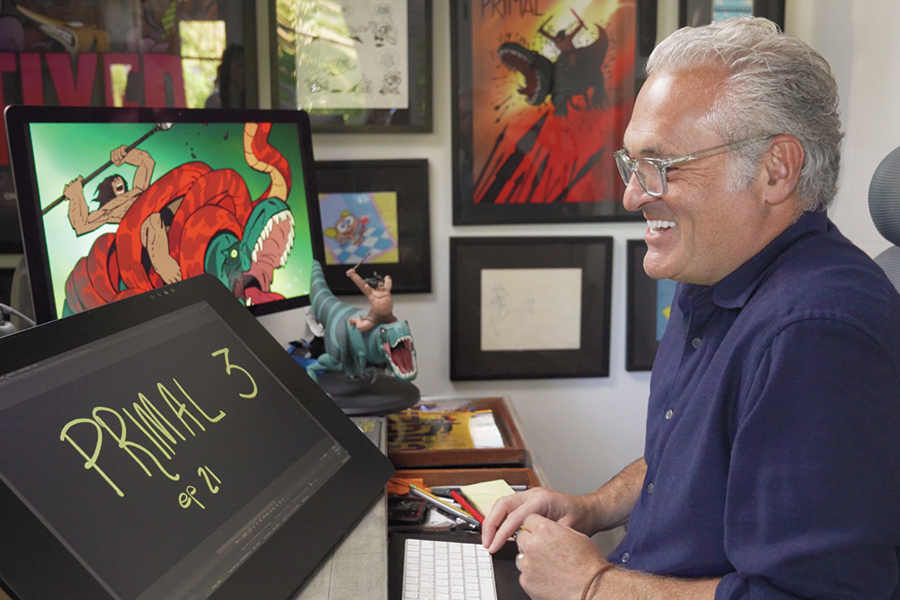
It did make sense. Not only to the show’s devoted fans but to Emmy voters. In 2020, Primal character designer Stephen DeStefano, art director Scott Wills and Tartakovsky as storyboard artist all won Emmy Awards for Outstanding Individual Achievement in Animation. In 2021, storyboard artist David Krentz won the same honor, and the show received the Outstanding Animated Program Emmy.
For the show’s third season, which dropped in January, Tartakovsky takes an even bigger risk: Spear, who died in the second season’s finale, returns as a zombie. “This idea came to me, and it was perfect, because our show is very pulpy,” he says. “Especially with Primal, I trust my instincts completely. If it feels right, then I kind of go for it.” Tartakovsky spoke with emmy contributor Amy Amatangelo about the show and what he’s learned from it.
What’s your biggest discovery about a show with no dialogue?
I realized people have to pay attention. And it actually worked to our benefit. People started putting down their phones and started to pay attention. Then, as we did more and more episodes and got a feel for it, we started to do much more complicated storytelling. We started to trust the audience — that they can go along for the ride.
Without any dialogue, music and sound effects play such a big part.
I never want to overly focus on the music and forget about the sound effects, because they’re equally important. Music creates emotion. It upholds emotion. I’ve been working with [composers] Tyler Bates and Joanne Higginbottom for quite a while. I always talk about, “What do I want to feel while I’m watching this?” I’m a fan of more avant-garde scores, so we try to experiment.
It’s the same with the sound effects. All these things are heightened because the one thing is missing. Without the verbal explanation of everything, all the other stuff gets lifted.
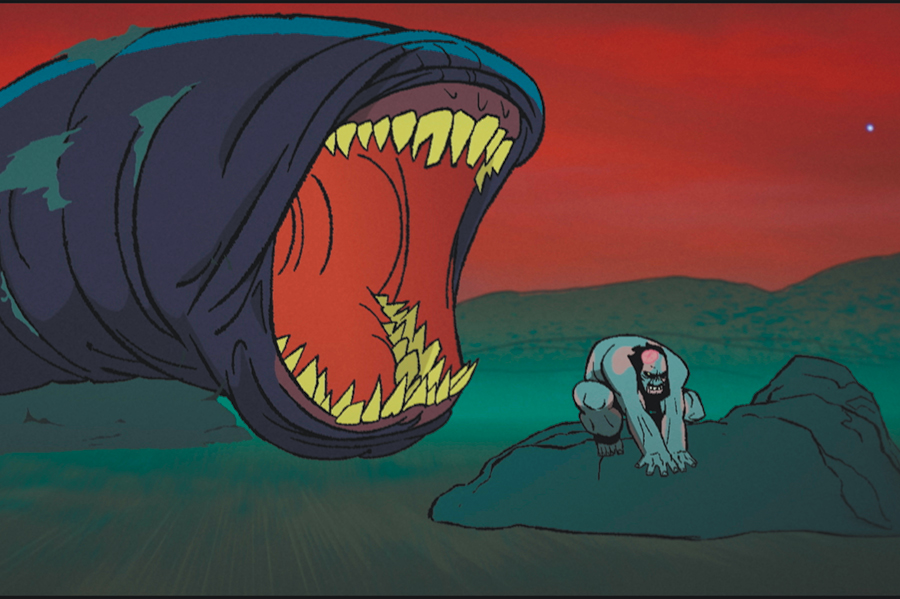
The series has received a lot of critical acclaim — and five Emmys.
When we won our Emmy the first year, it was a huge surprise, because usually on the first time out you’re not that fortunate. Especially nowadays, when IP is driving all the creative. It was nice to get support for something so different. I scream about it all the time: Before Toy Story, there was no Toy Story.
When you started, did you map out multiple seasons?
I had a loose plan, but it always changes. It’s very rare that plans stick, especially for three seasons. [It’s like when] I’m doing a drawing and accidentally make a mark, and my brain sees something in the mark that I never thought about before, then it takes me in this different direction. It’s the same with storytelling: What feels right? Could I go this way? Well, that’s kind of expected. Oh, what about this whole curveball thing? What’s that going to bring?
How did you develop Primal’s distinctive animation style?
I’m a fan of comic books, and I’m a fan of cartoon animation, so how do I blend the two? I had to find a style that’s not too goofy, that you could really connect to emotionally — and at the same time, the action could be really badass, and it feels just kind of cool. And that’s one thing we talked about a lot in the first season: “What is cool?” It’s very subjective, and you can go way wrong, because it could feel very forced.
We tried to be sincere. Sincerity is a big part of it. We just trusted our instincts. That’s one of the hardest things for me about doing TV shows. Once you get a green light, there’s a budget and a schedule and then that’s it — you’re locked in. You can’t do five episodes and then go, “Oh, wait, I discovered how to draw it better.”
Primal is streaming now on HBO Max.
This article originally appeared in emmy magazine, issue #8, 2026, under the title: "The Silent Treatment."