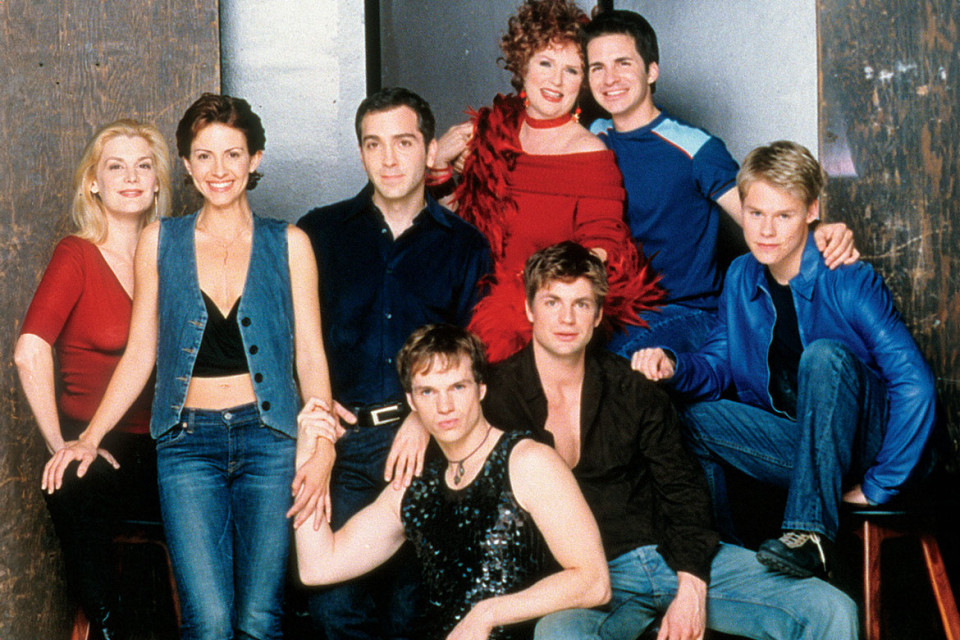
Nearly a year into the new millenium, a provocative, groundbreaking series disrupted the television landscape: Queer as Folk, about a coterie of young gay and lesbian friends in Pittsburgh, would bring gay life to TV. Over five seasons — December 3, 2000, to August 7, 2005 — the Showtime series daringly revealed truths about the LGBTQ community while depicting its sexuality in occasionally graphic but always authentic detail.
Queer as Folk never scored an Emmy nomination but nevertheless became Showtime’s number one show by the end of its first season.
This year marks the 25th anniversary of the premiere of the American version of Britain’s controversial Queer as Folk, which Russell T. Davies created in 1999. The gay writing team of Ron Cowen and Daniel Lipman created the U.S. series; they had previously created the series Sisters and won Emmys for writing the 1985 TV movie An Early Frost, a breakthrough for its depiction of the AIDS epidemic.
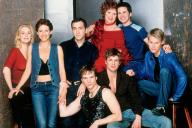
Queer as Folk’s ensemble cast — a mix of gay and straight actors — featured hunky, promiscuous Brian (Gale Harold), comic-book shopkeeper Michael (Hal Sparks), self-defeating accountant Ted (Scott Lowell), flamboyant Emmett (Peter Paige), HIV-positive professor Ben (Robert Gant), teenage Justin (Randy Harrison), bold lesbian attorney Melanie (Michelle Clunie) and bisexual artist Lindsay (Thea Gill). Sharon Gless, well-known for her costarring role on Cagney & Lacey, played Debbie, an irreverent diner waitress who was Michael’s mom and a passionate advocate for gay rights.
Portraying this dynamic group’s struggles and successes, ranging from wild and crazy nights at the local gay disco, Babylon, to family life with kids, Queer as Folk drew a surprisingly broad audience that included many straight women. An amalgam of drama, humor and camp, the series was produced for five years entirely in Toronto, which stood in for blue-collar Pittsburgh.
Emmy contributor Jane Wollman Rusoff spoke with the show’s creators and much of the main cast, who remain a mostly tight-knit group even a quarter-century later.
GENESIS OF A HIT
Russell T. Davies (creator, U.K.’s Queer as Folk): The reaction to our show was brilliant. I was on radio and TV defending it to the hilt. I found I was rather good at talking to homophobes. We had a lot of enemies, but we overruled them.
Daniel Lipman (cocreator, Queer as Folk): HBO wanted to do it as a movie; Showtime insisted on a series. We told Jerry Offsay [Showtime’s president of programming] that Ron and I would be very happy to do a series, and he gave us the nod. Showtime made a commitment to do 22 episodes and said, “Go as far as you want to go.”
Del Shores (writer): Up until Queer as Folk, gays had always been portrayed as clowns or evil people or the butt of jokes.
Michael MacLennan (writer, coexecutive producer): The show absolutely changed the hearts and minds of heterosexuals in getting a fuller understanding of what it is to be gay through the lens of love, jobs, ambition, family, sex.
Gale Harold (actor, Brian): Part of what we were doing was giving voice to a piece of American society that was still pretty marginalized. It always recharged my humanistic battery.
Robert Gant (actor, Ben): Queer as Folk was very real when it came to sexual expression. At the same time, it was an idealized, heightened [portrayal]. But it gave the deep assurance that as a gay person, you weren’t flawed.
CASTING CALL
Ron Cowen (cocreator): Every major agency refused to send actors to audition, because the show had gay characters and graphic sex. So, we went to smaller agencies.
Lipman: Then we got desperate. It was a Friday, and we were going to Showtime on Monday for casting approval, but we still hadn’t cast the lead character, Brian Kinney. Suddenly, we got a call from our casting director, Linda Lowy: “Brian is here. Come over!” It was Gale Harold. He read and was just amazing. But he told us he couldn’t come with us to Showtime on Monday. We gave him the script to read. On Saturday, he phoned: “This is Brian Kinney calling.”
Harold: When I heard the series was being adapted for an American production, I was doubtful it would ever get made. But I knew that if it did happen, I wanted a chance to work on the Yankee version of Stuart [the British series’ lead character]. The most challenging part of the job [turned out to be] remaining confident that I was doing justice to a community that on some levels I was a stranger to. Would members of the gay community believe me as Brian?
Sharon Gless (actress, Debbie): Somebody sneaked me a script. I called Showtime: “I want this part.” They said, “We’d love you to have it.” My agent said, “It’s a filthy show. You can’t do it.” I said, “Well, I just got it, so make the deal.”
Peter Paige (actor, Emmett): My manager said, “You can’t do this show. I’m worried that I’ll never be able to put you on network television again.” I said, “If this is my last job, it’s my last job.”
Gant: They told me several times, “We’d like to make sure you can go where this character needs to go, because he’ll reveal that he’s HIV-positive.” But Ben lived a very full life, because [with HIV medication], the world had changed.
Davies: I was so fed up with gay life only being defined [onstage and on-screen] for 10 years by the AIDS virus. So, it was marvelously absent from [my] Queer as Folk.
Michelle Clunie (actress, Melanie): I was reading the script and came to this line where my character says, “I don’t care what men think about their dicks.” I said, “I have to have this part.” I got to play the first full-time series regular out-of-the-closet lesbian on a TV show. It was one of the greatest parts of my career.
LET’S TALK ABOUT SEX
Lipman: In meetings with the actors, director and wardrobe person, each sex scene was very carefully choreographed in advance so that the actors felt comfortable. Like, “He’s going to turn you over, you’re going to put your hand here, you’re going to put your leg there.”
Sheila Hockin (producer): We never got into pornographic, specific shots of genitals.
Cowen: The sex was more suggestive. We used “cock socks,” which you put on so you’re not completely nude.
Gant: It covered your private parts and made sure that [the editors] could cut around it. Hal Sparks, who is straight, wasn’t experienced in the [gay sex] realm. I was. I said to him in one scene, “I’ll put your legs up,” and he went wide-eyed. [Laughs] So I said, “Okay, you can just put one leg up.”
Gless: The boys wanted to make sure that Debbie knew how to please her new love, Detective Carl Horvath [Peter MacNeill], so they taught her how to give head.
Lipman: There was a scene where Justin wanted to have sex with Brian without a condom. Brian scolded him: “Put the condom on me. I never want to hear that you have sex with anyone without a condom!”
Clunie: Before they shot the first love scene with Thea and me, I said to Dan and Ron, “This isn’t going to be lesbian sex for the straight guy. This is going to be intimacy between two women who have been together for eight years and love each other.” Dan and Ron honored that. We’d have the covers over us or underwear on quite a bit. I volunteered to be the first one to do full frontal, and I did it.
Scott Lowell (actor, Ted): I’m straight, so I had a learning curve. In one episode, my character was having a quickie in the back of a Jeep in a parking lot. I was on my back with my ankles on the shoulders of this guy, and the camera showed the Jeep rocking. I was out in the open with my ass in the air. I was able to laugh it off, but I felt very vulnerable.
Lipman: Everyone was really impressed — everyone except the gay community. Some loved it; others hated it. They objected to the sex scenes.
Cowen: [Gays] were moving toward assimilation with straight people and felt a show about gay men having a sex life would set that back.
Lowell: It had some promiscuity, people in bathhouses and hookups. They didn’t want to show the world those parts of their lives. They were angry and felt the show wasn’t putting them in the best light, even if they had to admit it was true. The audience more than doubled because straight women found the show. They loved the humor and hot guys taking off their clothes.
Harold: Brian was trying to understand his place in the world. He pursued his desires and evolving sense of identity sometimes recklessly, sometimes taking a lot of pleasure from the effect his actions had on those around him. In his private moments, he realized over time that he needed love like everybody else and might need to open up his soul to the strange land of vulnerability.
GENRE-DEFINING
Lipman: Everybody says it’s a soap opera, but we looked at it as a drama.
Hockin: Absolutely it had soap opera qualities. That wasn’t the intention, but it picked them up.
Kelly Makin (director): They gave you enormous freedom on how to tell the stories. They would be specific about what was important to them but also gave you a lot of freedom and pushed you to tell the story in an interesting way.
Cowen: Ninety percent of what happened had happened to people we knew or to us.
MacLennan: The sex scenes were always connected to stakes or a shift in the dynamic or a new emotional discovery.
Shores: Ron and Dan always wanted the sex scenes to be part of the story, not gratuitous. I would be as graphic as I could be in writing them.
Lowell: There was a lot of humor. Sharon’s character was riotous, because she didn’t give a fuck what she said and loved to be bawdy. Sharon brought a lot of Sharon to that character!
Hockin: Showtime was incredibly supportive. They did have a group that watched every episode and might give us a very small note that would say, for instance, “Can you not show quite so many hip moves?” We’d go, “Okay, there are five. Can we have four?”
MEMORABLE EPISODES
Gant: When Ted develops a crystal meth problem. Michael’s surprise birthday party. Brian’s father’s death. Michael and I adopted a homeless kid [Hunter, in season three], who ultimately comes out to us as straight. We thought he was gay, so we were disappointed.
Paige: In one episode, Ted overdoses. He’s in the hospital and is afraid he’s going to die. If he did, his very conservative mother would be sure to go over and clean out his apartment, so we rush there and strip it of all the porn and sex toys. We end up having a sword fight with about 30 dildos!
Shores: Cyndi Lauper performing in the gay bar Babylon when it was bombed [over gay rights issues, in season five]. Also in that episode: the only time Brian says “I love you” to Justin.
SHOW’S OVER
Lipman: The decision to end the series was Ron’s and my decision. The network wanted us to do another season, but we felt we’d exhausted all the stories we’d wanted to tell. Also, our lead cast — except for Thea, who lived in Toronto — had given up their lives in the States to do the series [for five years]. We felt it was time for them — and us — to move on.
This article originally appeared in emmy Magazine, issue #7, 2025, under the title "With Gay Abandon."