
Against a TV landscape rich with family-friendly fare like Full House, Growing Pains and The Golden Girls, avant-garde filmmaker David Lynch — known for dark and often erotic themes — stunned the industry and viewers alike in 1990 with a moody primetime mystery called Twin Peaks.
Even more shocking: The writer-director-producer’s two-hour pilot became the most-watched TV movie of the 1989–90 season, seen by more than 34 million people. Cocreated by Lynch and writer Mark Frost (Hill Street Blues), the show earned 18 Emmy nominations and won two (for costume design and editing), plus a Peabody Award.
This year marks the 35th anniversary of Twin Peaks’ premiere; it aired on ABC from April 8, 1990, to June 10, 1991. Set in a fictional Pacific Northwest town, the series had no shortage of sex, violence, offbeat humor and surreal whodunit mystery.
From its first scene, viewers were hooked by a maddening question — “Who killed Laura Palmer?” — after the town’s blonde homecoming queen was discovered dead on a riverbank, wrapped in plastic.
(Viewers finally got the answer in the seventh episode of season two.)
Lynch, who died at 78 on January 16, 2025, directed six episodes of Twin Peaks and wrote three. He explained the show’s inspiration in his foreword to The Secret Diary of Laura Palmer, a 1990 spinoff novel by his daughter, Jennifer Lynch: “Even though Mark Frost and I started catching ideas in a Los Angeles coffee shop, it was the great mystery of the woods that began to creep in — riding on a kind of dark night wind, bringing everything that was to become Twin Peaks. Mark and I … just leaned into the wind and welcomed it all like a deep and thrilling dream.”
As a setting, Washington state’s dense, foreboding forests infused the show with an eerie, disquieting sensibility. Combining disparate genres — horror, police procedural, soap opera and the supernatural — added to the tension.
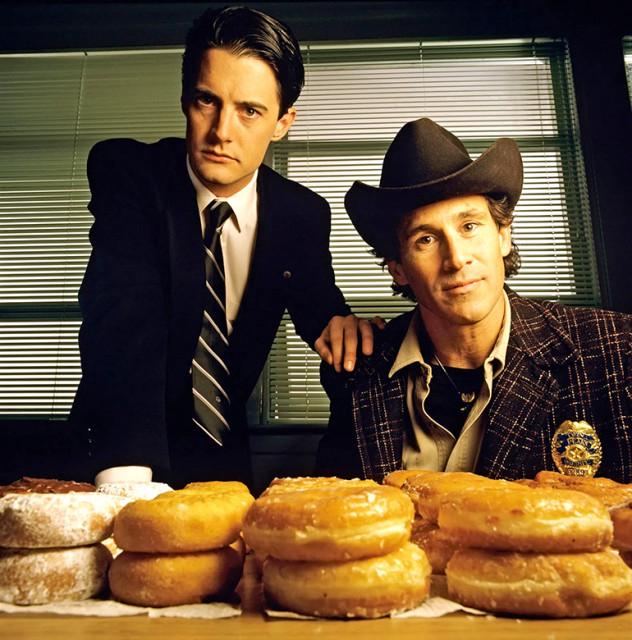
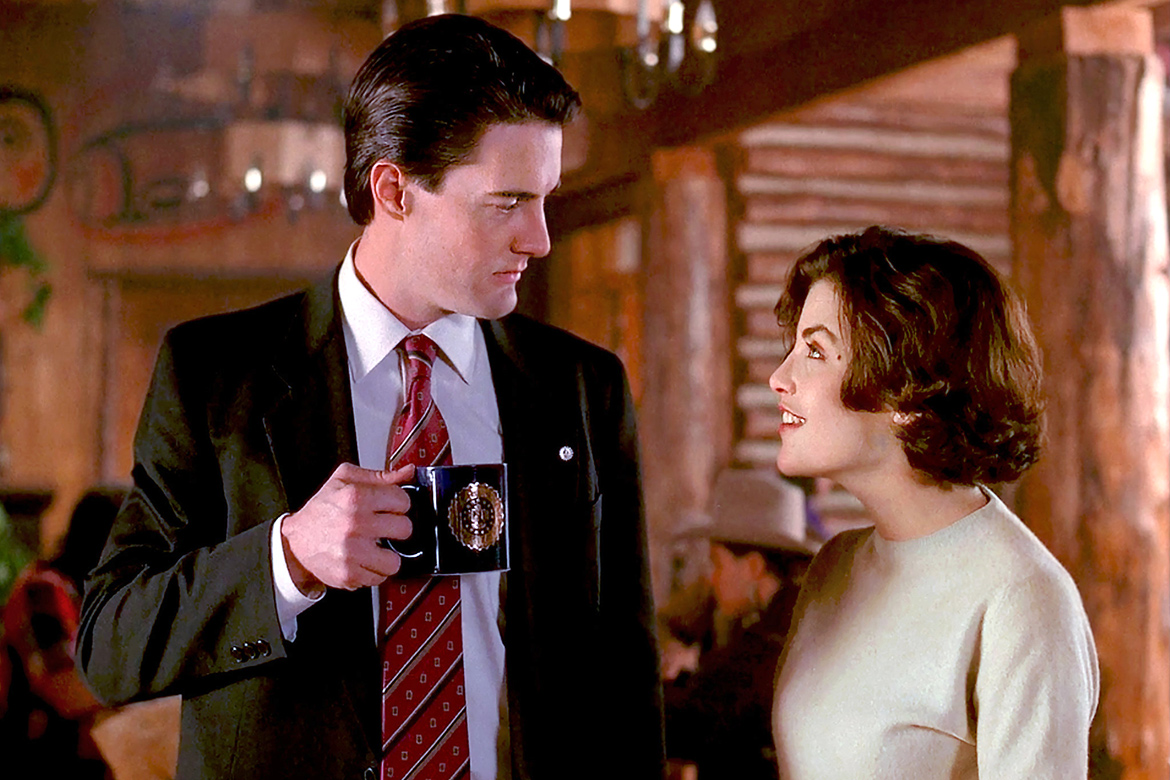
Kyle MacLachlan, who’d previously starred in two of Lynch’s movies, led the show as FBI special agent Dale Cooper, an earnest fish out of water among the many oddball residents of Twin Peaks.
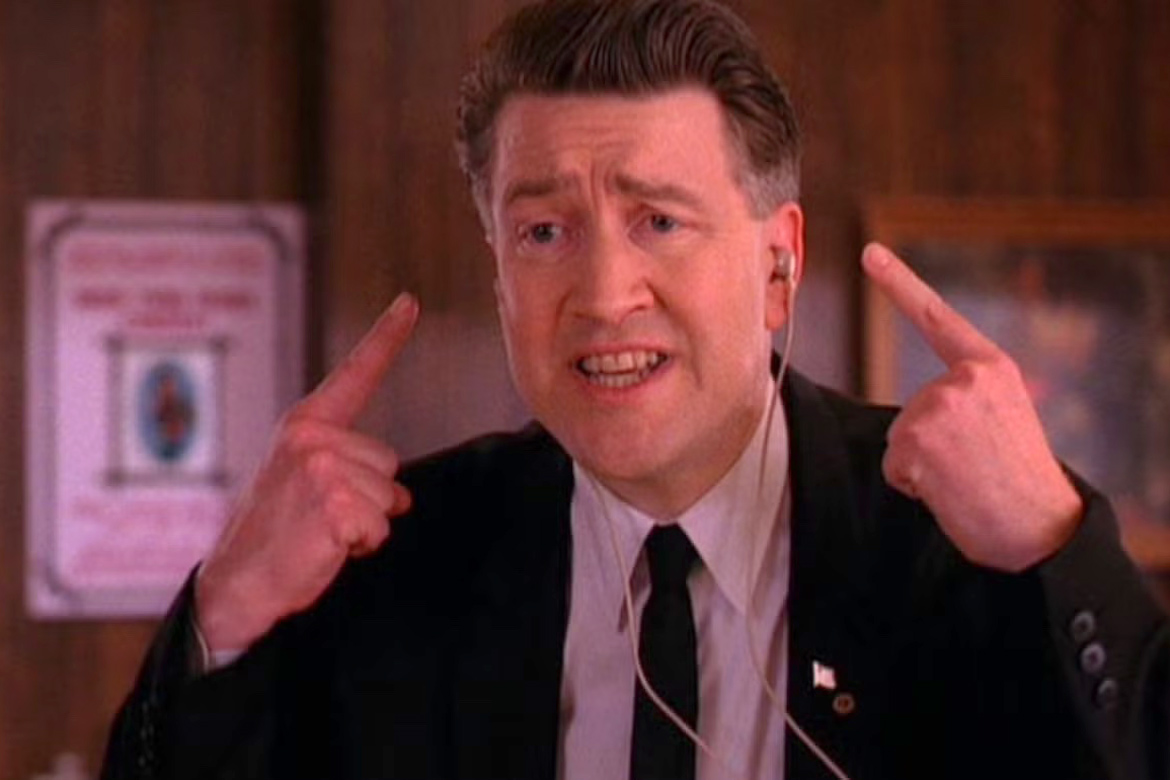
His costars included a mix of up-and-comers and established stars: Sheryl Lee as Laura Palmer (and also Laura’s brunette cousin, Maddy), Lara Flynn Boyle as Donna Hayward, James Marshall as James Hurley, Sherilyn Fenn as Audrey Horne, Michael Ontkean as Sheriff Harry S. Truman, Ray Wise as Leland Palmer, Catherine E. Coulson as Margaret “The Log Lady” Lanterman, Piper Laurie as Catherine Martell and Richard Beymer as Benjamin Horne, among others. Heather Graham and Billy Zane joined late in season two as Annie Blackburn and John Justice Wheeler, and Lynch himself appeared on the show sporadically, playing Agent Cooper’s hard-of-hearing supervisor, Gordon Cole.
Lynch had burst onto the scene in 1977 with his first feature, the sci-fi–horror movie Eraserhead, followed by 1980’s Elephant Man, which brought him a best director Oscar nomination. In 1984 he made Dune, starring MacLachlan and based on Frank Herbert’s sci-fi classic. It fared poorly, but two years later, his intensely violent and sexual Blue Velvet (also starring MacLachlan) electrified audiences, becoming his most controversial film to date. Later, the 2001 surrealistic thriller Mulholland Drive earned Lynch another Oscar directing nod.
He was making the Nicolas Cage–Laura Dern thriller Wild at Heart during Twin Peaks’ second season, and the show began to lose ratings steam. Frost had become showrunner, and the writing, Lynch said at the time, had drifted away from the initial conceit. ABC canceled the series at the end of season two.
A year later, Lynch was back with a part-prequel, part-sequel feature, 1992’s Twin Peaks: Fire Walk with Me, cowritten with Robert Engels. Then, 27 years after the show’s premiere, Lynch and Frost delivered an 18-episode third-season revival. Twin Peaks: The Return aired on Showtime and was nominated for nine Emmy awards.
Emmy contributor Jane Wollman Rusoff interviewed Frost and a number of the original series actors who brought the uncanny world of Twin Peaks to life.
ORIGIN STORY
Mark Frost (cocreator, showrunner): David and I had been working together on film projects. One of our agents asked if we’d be interested in creating a primetime TV show for ABC. We pitched a murder mystery in a small town, initiated by the discovery of the dead body of a young homecoming queen that washed up on the beach.
When I was a kid, I spent summers at a lake where, down the mountain, scandalous murders had occurred. In 1911, the body of a young woman had been found floating in a pond. I brought those two ideas to David, and he brought the idea that part of his childhood had been spent in the Pacific Northwest in a mood-setting location that had never been on network TV. We mashed the three ideas together. Laura Palmer’s murder was a very useful, juicy way to plunge right into the heart of all the relationships we proceeded to lay out.
We did a pilot, which ABC greeted with shock. However, they were in third place, had been there for a while and were willing to take risks, so they somewhat reluctantly gave us the okay. We had been calling the pilot “Northwest Passage.” But when I saw two mountains on the map that David drew on a coffee shop placemat, I said, “Let’s call it ‘Twin Peaks.’”
BUILDING A CAST
Kyle MacLachlan (actor, Dale Cooper): David cast me in Blue Velvet, and I was his choice for Cooper as well. Once Mark met me, he signed off on the idea. My character had a very strange, quirky sense of humor. He was passionate about trees, coffee and cherry pie, and he would get caught up in them. David described the way I played Cooper as a chihuahua: hair slicked back, eyes bugging out, a rapid way of speaking.
Frost: The key was Kyle playing Cooper. He was the outsider coming in, and we’d see the town through his eyes. David didn’t care what your résumé was. He didn’t even bother to hear people read. It was easier, of course, when it was an actor he knew, but otherwise he’d just meet the actors and get a sense of who they were. We looked at thousands of photos of local actors. Sheryl Lee came in and was charming. We had her return in the fourth episode playing her look-alike older cousin, Maddy Ferguson.
Mädchen Amick (actress, Shelly Johnson): My character was dealing with a very tumultuous marriage. Even though she was the victim of an abusive relationship, she was quite sassy and feisty. I enjoyed working with Eric DaRe, who played my husband [Leo Johnson]. His character was so scary, but in real life he wouldn’t hurt a fly. I had to forget him as a person whenever I needed to be afraid of him.
Dana Ashbrook (actor, Bobby Briggs): Bobby was a very bad boy. I was Laura Palmer’s main boyfriend, but Shelly and I were having a secret affair.
Michael Horse (actor, Tommy “Hawk” Hill): Hawk, being a Native, was the only one who understood that an evil entity existed. He knew there were spirits in the forest that were alive.
Charlotte Stewart (actress, Betty Briggs): Betty was one of the few normal people in the whole series. I was in David’s film Eraserhead. When he called me for Twin Peaks years later, he yelled, “Charlotte, you wanna go to work?”
Frost: The “Log Lady” walked around with a log, saying, “I want to go on a game show and test my log in every branch of knowledge.” We expanded that character into what became the heart and soul of the town. And Joan Chen [Josie Packard] was a key mysterious figure. But in the second season, she wanted to pursue other opportunities. We had to kill her off but leave open the possibility that she might come back. David said, “I know: Her spirit gets trapped in a drawer knob!” So, her face would appear in a hotel drawer pull.
David Duchovny (actor, Denise Bryson): My character came to help Cooper with a case about a drug dealer who’d sell only to transvestites. That’s why Dennis [initially] put on women’s clothes, and he found that he liked wearing them. To play Denise, I Nair-ed my legs. I was slightly disappointed with my wig. I thought I looked like my grandmother.
Amick: Frank Silva, the set dresser, was running into [the Laura Palmer bedroom set] to check something, but suddenly they called “Action!” and he couldn’t get out in time. He hid at the foot of the bed, but [he was caught on camera]. He looked creepy.
Sabrina S. Sutherland (production coordinator, later Lynch’s producing partner): David said [about Silva], “That’s Bob. He’ll be the devil spirit!”
Frost: The demon Bob was responsible for [Laura’s] murder. It helped us open the show up into a mythological dimension.
LYNCH AS DIRECTOR
Frost: After we did the pilot, David directed the first episode we got picked up for. Then he was off making [the 1990 feature] Wild at Heart, so I was running the show. Every time David came back to do an episode, it was special, because he brought that extra oomph.
MacLachlan: David would direct a mood or an attitude. He might say, “More wind,” which meant to let things breathe a little and allow the unknown to be there without having to get anxious.
Horse: David just said, “I want this,” and we gave him what he wanted. If not, he’d gently push you and say, “I think we should do this and this.”
Amick: David could do 25 to 30 takes until he got what he wanted. Other times, he wouldn’t even do a second take for safety. He’d say, “It was perfect.”
Kimmy Robertson (actress, Lucy Moran): One time David put his hands on my shoulders: “There’s a very important phone call coming for the sheriff. Two phones are ringing. The sheriff needs to get the call quickly. How would Lucy explain to him which phone to answer?” So, I started to talk. David stopped me and said, “Aces! Let’s shoot it!”
Sutherland: David would talk to the crew directly, not through the AD. He’d say, “Hey, Malone. I need you to move the clock!”
Ashbrook: David would play music sometimes that was going to be playing under the scene. In the early days, he’d have music piped into his headset so he could hear what would be playing as he watched it being done.
THE TONE ON SET
Stewart: David wore two neckties. There was always a favorite everyday one and then a different one.
Amick: We were constantly playing pranks. Heather Graham, Peggy Lipton [Norma Jennings], Lara Flynn Boyle, Dana Ashbrook and I had this game where we’d run around and take silly Polaroids.
Ashbrook: Catherine Martell and Benjamin Horne were having an affair in a hotel room. Post-coitus, he said, “I need to go wash little Elvis.” I don’t think that got past Standards & Practices.
Frost: S&P immediately called me and said, “Is that a reference to his genitals?” When it was time to shoot the show, I found a five-inch-long Elvis puppet so Richard could take it out of his bathrobe pocket and show it to Piper and then say the line. You had to be clever to get around the [S&P] junior-high hall-monitor mindset.
MacLachlan: David was always trying to figure out how we might incorporate any accident into a scene. He never said, “Oh, this is horrible!” One day, the lights were flickering. There wasn’t anything they could do, so we just integrated it.
Horse: A moose head fell off a wall once. The camera just focused on it.
Stewart: No actor was allowed on set unless they were working on camera. We didn’t know what the story was until we watched it on television.
TWIN PEAKS COMES TO A CLOSE
Frost: When the show was canceled, it felt like we had been in hospice for a long time. ABC was always desperate to solve the mystery. We said, “If you solve the mystery, you’ve ended the show.” Then they said they weren’t picking us up for a second season unless we solved the murder. We resolutely refused.
For the second season, they switched the show to Saturday night, which was considered the graveyard. Our numbers decreased. David did an incredible reconfiguring of setting up a mystery for the third year, but ABC left us hanging and dragged their feet about picking us up.
Sutherland: When we were getting closer to renewal, they filmed several different versions of the ending. The majority of us didn’t know what the real ending was. Only Sheryl Lee and Kyle knew for sure. David never wanted to reveal the identity of the killer.
Frost: When they finally gave us the news [of cancellation], David was quite bitter about it.
MacLachlan: They canceled the show with the cliffhanger of my character potentially inhabited by the demon, Bob. He had jumped from Leland Palmer to Cooper, who was transferred to a holding area [the “Red Room”].
Frost: Mulholland Drive was originally going to be a spinoff of Twin Peaks. We were going to take the Sherilyn Fenn character, have her leave town and go to L.A. and get involved in all sorts of things in Hollywood. After Twin Peaks was canceled, David tried to develop Mulholland Drive as a separate series [with Bob Engels], and he sold the pilot to ABC. But that was a horrible experience, so David yanked it away and turned it into a feature.
This article originally appeared in emmy Magazine, issue #11, 2025, under the title "A Damn Fine Show."