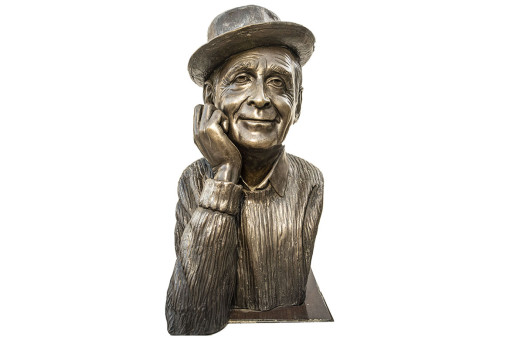


The next time you're at the Television Academy in North Hollywood, take a good look at the bronze bust of Betty White on its pedestal near the entrance to the Academy headquarters building. She's smiling, of course, as befits her storied comedy career. But take a look in the back: Embedded in her torso is a sculpted paw print, in recognition of her equally storied devotion to animal causes.
"Betty was pleased with her bust. But when I showed her the paw print, she melted. She said, 'Oh, Wim!' and fell into my arms," recalls Wim Griffith, the sculptor who created the bust. "I was really glad that I could touch her in that way."
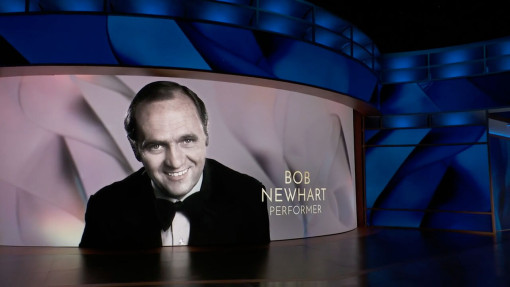
Griffith, who is based in Lakewood, California, is responsible for twelve of the sculptures on display in the Academy's Hall of Fame Garden, which pays tribute to the men and women whose achievements in television have seen their induction into the Television Academy Hall of Fame. His other subjects include Bea Arthur, Dinah Shore, James Garner, Bob Newhart, Merv Griffin and Dick Wolf, plus plaques of Grant Tinker and Bud Yorkin.
The paw print touch is but one of the ways the Hall of Fame bronze sculptures, crafted by more than a dozen artists, capture the personalities of the honorees. The bust of Chuck Lorre gazes upward with a creative twinkle in his eye. Life-size sculptures of I Love Lucy's Lucille Ball and Desi Arnaz appear to converse; perhaps Lucy Ricardo is pleading for another shot at showbiz.
Another life-size statue, this one of Johnny Carson, stands near the Saban Media Center as if in the middle of his Tonight Show monologue. Miniature full-body statues of Jackie Gleason and Carol Burnett portray, respectively, his pose and catchphrase, "And away we go!" and her signature charwoman character. Perry Como's bust seems to break into sculpted song; Phil Donahue listens intently, perhaps to a talk-show caller.
"It's not enough just to get the eyes, nose and mouth right," Griffith affirms. "Merv Griffin is smiling that smile — there's that energy, that enthusiasm when he talked to people. It made more sense than a closed mouth. I don't want it to look like a death mask."
The Hall of Fame Garden was initially designed by the late production designer Jan Scott, a former Academy vice president and governor and 11-time Emmy Award winner who suggested the idea of honoree busts; the Hall of Fame itself had been founded by former Academy president John H. Mitchell in 1984.
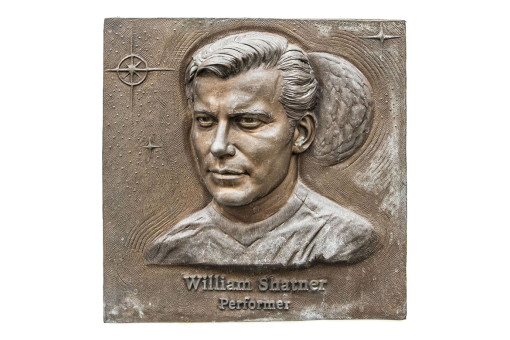
Scott had been asked in the early 1980s by then-Academy vice president Leo Chaloukian — the Academy's president from 1989 to 1993 — to join the building committee he chaired, as the Academy was at the beginning of a years-long process to establish its current headquarters. The late art director-sculptor Richard Stiles subsequently joined the duo to focus on the sculptures and instillation; his own eight sculptures include Burnett, Como, Gleason, Angela Lansbury, Rod Serling and Oprah Winfrey. A plaque on the plaza commemorates Chaloukian, Scott and Stiles.
"We were the Big Three!" Leo Chaloukian, now 90, says with a laugh. "But it all started with John H. Mitchell. While he was president, he got the idea of having a central location for Academy headquarters. He was contacted by the Community Redevelopment Agency about possibly being the tenant at the North Hollywood property."
New sculptures were added through the years as more honorees were inducted. In 2011, a water wall was installed bearing plaques with the sculpted likenesses of 42 inductees. With the environmental focus on drought-resistant landscaping, the plaques now adorn a wall of the Academy headquarters building.
Stiles served for years as the chair of the Hall of Fame sculpture committee, which selects artists and oversees the process from commission to manufacture; most sculptures are made at the American Fine Arts bronze foundry in Burbank. The two most recent committee co-chairs were production designer Joe Stewart and the late costume supervisor Phil Wayne.
"Some sculptors are better with women, some are better with men," explains Stewart, a three-time Emmy-winner and former Academy governor, of the sculptor selections. "Some are better at hairdos, like Michael Landon's [by Greg Polutanovich]. Some are more animated, like Chuck Lorre's [by Wesley Wofford]. You marry the artist with the feature. And some people gravitate more toward celebrities."
For performer likenesses, there's also the matter of which stage of their careers to portray. Griffith chose The Golden Girls for Betty White; for Dinah Shore, he was inspired by her styling in her eponymous variety shows in the 1950s and 1960s.
The sculptors primarily work from photos and videos, but two of Balboa Island, California sculptor Miriam Baker's subjects sat for her: CBS Corporation chairman and CEO Leslie Moonves at CBS Studio Center and newsman Dan Rather in New York.
"I'll take my calipers [a measuring tool] and measure their head, their nose, down from the top of the head, other measurements," relates Baker, who also did a bust of Aaron Spelling and plaques of Chet Huntley and Don Pardo. "We talk. I'll swivel them." She works in water-based clay; for Moonves, she sculpted up to a point and then went back for a second sitting. For Rather, she began work at home before meeting him, then took his measurements and made instant corrections. He sat for her three times.
"It's easier with the real person," Baker notes. "You're looking at a three-dimensional being."
And while those aren't the real people in the Hall of Fame Garden, their bronze likenesses are real enough: Individuals and groups, including busloads of tourists, seniors and school children, regularly stop by to discover the sculptures and pose for photos with them, absorbing some lessons about art and television along the way.
"It's a fantastic way of representing the people inducted, and the artists," Stewart says. "It's become an eternal memory for the Television Academy. And for the celebrities, it's better than a framed headshot!"