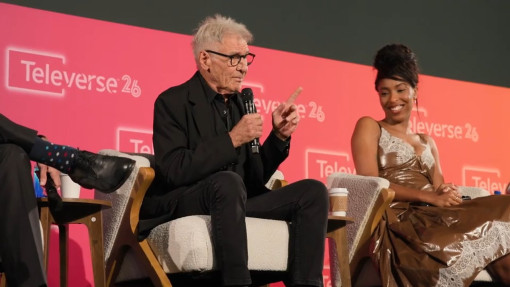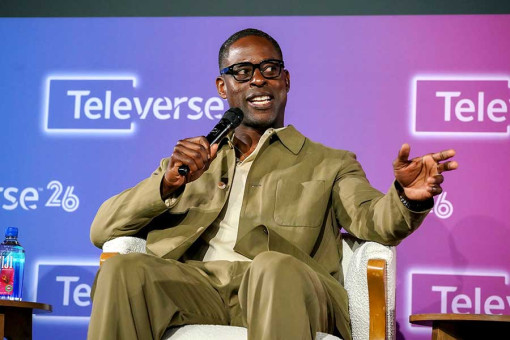


The first day of Televerse, the Television Academy’s first-ever TV festival, culminated with a special, members-only panel titled “Candid Conversations with Cris.”
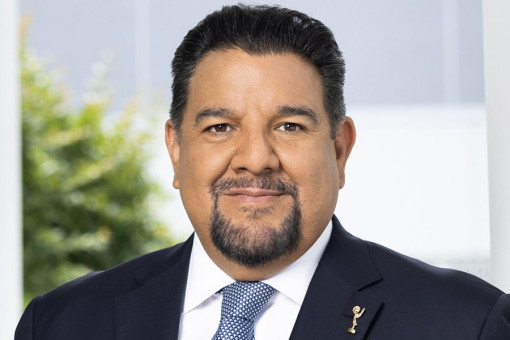
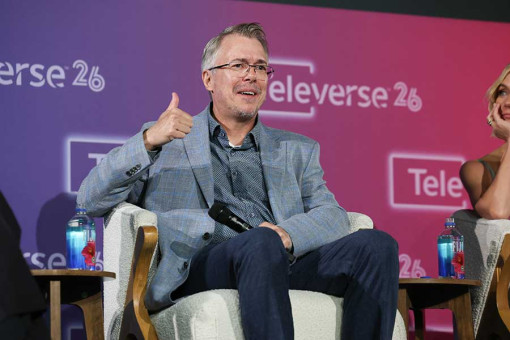
During the aptly titled event, in a packed ballroom at the JW Marriott Los Angeles L.A. LIVE, Academy chair Cris Abrego engaged in wide-ranging discussions with three prominent executives about the state of the industry today — and where it may go in the future. His guests: FX chairman John Landgraf; vice president of nonfiction series at Netflix Brandon Riegg; and Fox Entertainment CEO Rob Wade.
First up was Landgraf — who, Abrego noted, is often called “the Mayor of Television.”
In response, Landgraf quipped, “I feel like I’m a mayor, but Silicon Valley has sent in the National Guard!”
The reference was fitting, because the discussion focused largely on the effects of Silicon Valley on the entertainment industry, especially the influence of artificial intelligence and YouTube.
Some excerpts:
On AI
• “AI is an amazing tool. I don't worry that it can reach the supreme heights of creativity that the most gifted artists can reach. But what I do worry about is: What if AI can do the job that an entry level, college-educated or masters-degree-educated person can do? What about the entry-level job? What about the apprenticeship? What about the training of people?”
• “If I don't exercise, I get weaker. If I don't walk, my legs get weaker. And I think something that automates thought is likely to make us a little weaker. I personally think that the iPhone has already made us weaker in the sense that, if you take the time to learn something, understand it, load information into your working memory, it's yours. You have it. It's not yours just because you can access it with a few keystrokes from a phone. The notion that we have access to all this knowledge, I think, is wrong. We have access to it, but you really have access to the knowledge that’s inside your head. So, I already have some concerns about what access to information with the phone has done, and it's clear that AI is going to turbocharge that tendency to say, ‘Why do I need to learn something myself when I have a PhD-level information source right there that can answer any question I have to ask?’ I don't know where that leads, but it's worrying to me.”
On YouTube
• “You have to admire the growth of YouTube and the engagement it's creating. It's dominating growth in television, but its business model is to not invest in anything. It pays a revenue share to creators who do all the heavy lifting, the hard work and upload something for free. Some of those creators are being extremely well paid. But what I loved about the way Hollywood worked is that you had a very, very precious piece of real estate as, say, a broadcast network had with a primetime schedule. We had very limited amount of prime real estate. ... You really worked hard, creatively, to try to make something great, because you had your moment to shine. And not only did creative recognition depend on the audience's response to that moment in time, but your compensation depended on it. If it was really good, and it became ER, and you made that many episodes, you got paid. ... That's just not the way things work now.”
• “I don't begrudge somebody getting paid [on YouTube]. But I don't know how that medium is going to support the kind of jobs that the Writers Guild and the Directors Guild and [IATSE] and the Teamsters and SAG-AFTRA support. It's a really different business model. ... It's get a phone, start making something, try to get attention and build from there. Some of these are really substantial businesses now. But what they are not is Game of Thrones.”
On seeking diverse voices and perspectives for FX projects
• “People are always going to take what they think is a shortcut. And I think that looking at somebody's gender or their age or their ethnicity or some other external aspect and thinking that you can judge their talent is just lazy — it's a shortcut. As far as I can tell, intellect and talent are equally distributed in the population. So, what is the industry doing when it's doing that? It's being lazy. What were we doing before? We weren't doing it intentionally, but with our directors, we were [emphasizing] experience. We were saying, ‘We want someone who's directed an episode on HBO or Showtime or AMC or one of the Emmy-nominated shows on Amazon or Netflix.’ But if you only do that, then, by definition, you say, ‘Well, nobody who hasn't found their way into this system has talent.’ Respectfully, I guarantee you, there's somebody as talented as Steven Spielberg living within 100 miles of the Mississippi River who probably will never find their way to a director’s chair or a camera. There's talent, you just have to go out and find it.”
• “I would say, genuinely, to the extent that that FX has had its most successful seasons in the last decade by a wide margin, a lot of that is because we threw open the aperture for who we were willing to consider, and we broadened the talent pool from which we were drawing. There were some really incredible people who got Emmy nominations and awards who came through the door that way.”
Next, Abrego delved into the state of unscripted television with Riegg and Wade — both of whom dismissed trade reports recited by Abrego claiming that unscripted is on a downward trajectory.
“I think we're in a fantastic place,” said Wade, whose network slate includes The Masked Singer, The Floor and several Gordon Ramsay titles. “I couldn't disagree more with those headlines.”
Riegg, who oversees such shows as Love Is Blind, Squid Game: The Challenge and America’s Sweethearts: Dallas Cowboys Cheerleaders, added, “Every genre goes through peaks and valleys. But if you look at unscripted right now, I’d argue we’re on a real upswing with good momentum.”
Some excerpts:
On the state of nonfiction programming
• Riegg: “The nonfiction genre has matured a lot since the boom time of early 2000s. A lot of what I think you see the industry going through — and I include the buyers in that —adjusting to what people want to see and the increase in sophistication in terms of what the viewers expect. I think there's always a bit of a transition period, and you have to feel your way out. This isn't anything revelatory, but you never know when you're going to have to go through that period of reinvention. I think the one thing we've seen consistently in the business is that every time we say, ‘Comedy's dead’ or ‘Unscripted [is dead],’ something comes along and reignites everyone’s imagination and passion. Then it starts a whole new cycle. So, you have the ebb and flow of that. Probably part of the challenge that Rob has, and certainly we have at Netflix, is there are just so many options out there. There are so many things begging for your attention, and there's a plethora of choice. So, to break through, the bar, the degree of difficulty, is probably higher.”
• Wade: “I think unscripted hit maturity a few years ago, which meant that creatives had to get really creative. It was easy pickings, I'd say, at the beginning. We had a brand-new genre around the early 2000s, and all these possibilities. You could get by on a one-line pitch: celebrities dancing, celebrities singing, normal people singing. Now you have to add to that. And I think it's exciting, because I see that reinvention happening in some of the pitches. And I think, as buyers, we’re always guilty, or something I can say for myself, we’re always a bit guilty of playing it a bit safe. I think it's up to us, and we need to start taking some more risks.”
On evaluating potential projects
• Riegg: “I tell my team all the time: The two core tenets of the job are picking and making. Hopefully, you pick the right ideas, and then, ideally, you have to make the best version of them. As simple as that sounds, it’s very complicated at the same time. Netflix occupies an interesting space as a service. We’re trying to have something for everyone; and in some ways, for the content execs, that's incredibly exhilarating and liberating. On the other hand, it's also very daunting, because there's not a single prism that you look at these pitches through. ... But, generally speaking, we’re all hunting to find great ideas and then bring them to life in a way that will resonate with our viewers.”
• Wade: “When you're looking for a new idea, it's got to be original. It's got to be a super clear concept. It's ideally got to be scalable — as in not just a few episodes but it’s got to scale to multiple episodes. But most of all — at Fox, anyway, which is part of our DNA — it’s got to have unexpected and surprising broad content. That's what we look for. Our biggest issue, and the reason I'm jealous of Brandon, is the amount of inventory that he has. At Fox, we have very limited inventory — two hours on primetime. So, I have to be very, very specific about what we choose.”
On working with YouTube creators
• Riegg: “YouTube is an incredible platform, and when we’ve worked with creators who gained popularity on YouTube, it's really us saying, ‘Let's be open-minded.’ Because traditionally, there was a specific pool of talent that you worked with or that you that you heard pitches from. Now, I think it would be naive of us to think that's the only group you could pull from in terms of having an idea. So, a lot of this stuff, whether it's MrBeast or it’s Sidemen, it's more about the team going, ‘Hey, who out there seems to have a feel for what people are responding to? Who out there has some really innovative and creative takes and vision?’ It’s a credit to a lot of these creators that they're doing it themselves on YouTube and gaining that notoriety on their own. And lot of them have been equally intrigued and saying, ‘Can I find an idea that will work on Netflix or another platform or network?’ We really embrace that. I think it has just expanded the pool of talent and creators that we work with. Again, the goal is to find things that work, and I think anything that helps you get closer to that goal is laudable. So, it's been something that we will continue to do, and I’m excited about it."
• Wade: “It's a massive focus for us. But we come from a slightly different angle. We're not really getting creators to try and come to broadcast. I think that's going to be very, very challenging. YouTube is a phenomenal platform, and some of the creativity coming out of there is amazing, and there's a huge amount to learn from the way that creators have this unimaginably great understanding of their audience, of their content, how it's responded to, how to create maximum engagement. When I look at what Fox can give, we have distribution, we have finance, we have massive ad-sales scale, we have great relationships with brands. We have a lot of assets which can help amplify, finance and grow the ambitions of creators. People always talk about MrBeast or Sidemen — who are great creators. But those are top-10 creators. There are hundreds and thousands of fantastic creators with the potential to grow their businesses. I think it's a very exciting time to understand how legacy media and creators can work together.”
The above interview excerpts have been edited for length and clarity.
Find more news and information about Televerse here.
For the latest news about Televerse sign up for Televerse updates.