
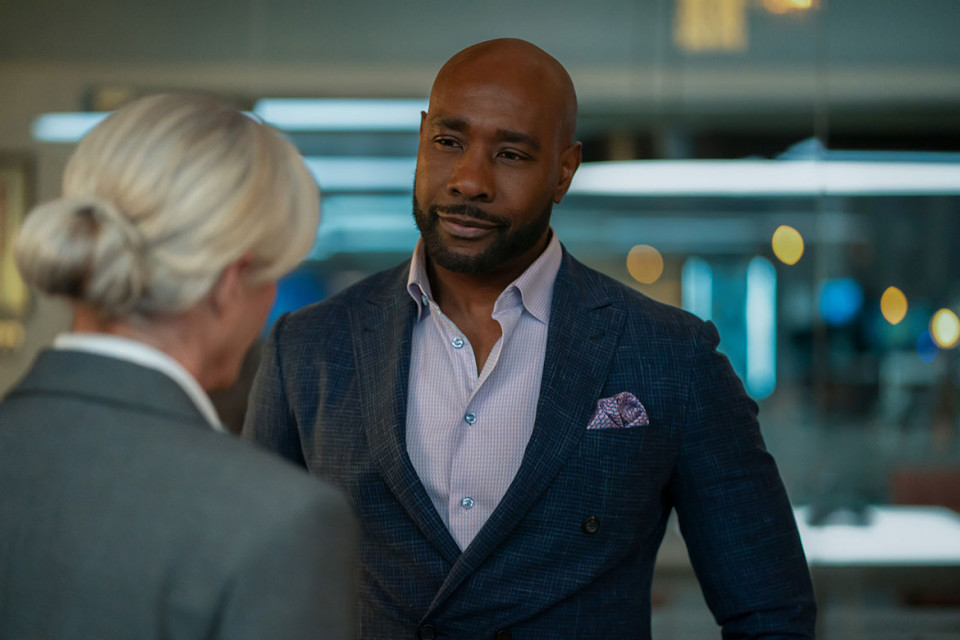
Morris Chestnut was working as a bank teller while studying finance in college when he went to see a friend act in a play. Chestnut thought being on stage looked like fun, so he enrolled in an acting class and was hooked.
A year later, writer-director John Singleton cast Chestnut cast as Ricky in his acclaimed debut feature, Boyz n the Hood. The neophyte performer dropped out of school to do the film, returned for a semester, then got cast in the NBC comedy Out All Night and never looked back.
Today, Chestnut stars as Dr. John Watson in the CBS medical drama, Watson. The show, now in its second season, is a contemporary take on the character from Arthur Conan Doyle’s Sherlock Holmes stories. It’s also the second CBS series adaptation of the Holmes saga, after the 2012-19 drama Elementary.
Chestnut, winner of two NAACP Image Awards (for his work on Showtime’s Nurse Jackie and Peacock’s The Best Man: The Final Chapters) has had prominent roles in numerous TV projects, including FX’s American Horror Show, Fox’s Rosewood and The Resident and Hulu’s Reasonable Doubt.
On the feature side, Chestnut’s performance in Boyz n the Hood led to parts in more than two dozen movies, including Kick-Ass 2, Identity Thief, The Best Man and The Game Plan.
Here, Chestnut talks with The Television Academy about the arc of his career, his role on Watson and how acting opportunities have changed for African American actors since he broke into the business.
The Television Academy: You started acting in 1991 with the Oscar-nominated movie Boyz n the Hood. What was it like pursuing roles as an African American at that time?
Morris Chestnut: It was challenging. I was still very green in the industry, in terms of understanding how things work, understanding and learning how to act. So, when I got the break in Boyz in the Hood, I wasn’t a strong actor, but I had this huge opportunity. Back then, if you were in a hit movie, you didn’t go into a TV show. But that was the first thing my agent put me in. With Boyz n the Hood being a hit, he put me in a sitcom [Out All Night]. I was able to work, but it wasn’t until I did [the 1999 film] The Best Man that people started seeing me as a leading man.
How did the part of Watson come to you?
I had a general meeting with Aaron Kaplan [executive producer and CEO of Kapital Entertainment], and when he ran down the list of projects that he was developing, he mentioned Watson. I didn’t think twice about it at the time. I thought, “This sounds cool,” but you never know. I’ve had hundreds of general meetings, but very few of them end up turning into parts. About a year after that meeting, my manager called me and said, “That project Aaron talked about is getting made. They’re interested in you and would like you to read the script.” So, I read the script, loved it and met with Craig Sweeny, the showrunner. We had a great vibe, we saw eye-to-eye on a lot of things, and we went for it.
What appealed to you about the role?
I love playing smart characters. This character was smart, but he was flawed. When the show opens in the first season, he’s dealing with abandoning his wife, a traumatic brain injury caused by going over a waterfall, the loss of his best friend and he’s trying to put his life back together while mentoring some of the smartest young minds in the medical field. So, I was drawn to all those elements. Craig told me where the character was going to go, the storylines and how he wanted to do the show, which was a major draw, as well.
On the show, Holmes has now returned from the dead. How does that affect Watson?
One of the things I love best about Holmes is working with Robert Carlyle [who plays Holmes]. He’s an incredible actor — so giving, so thoughtful, so caring on set. When the Holmes character is there, Watson doesn’t feel the responsibility he feels when he’s with his students. He’s a little bit more relaxed. He can actually learn from Holmes, instead of always doing the teaching. So, one of my favorite elements of Holmes existing is just the opportunity to be more free, more relaxed and have a little bit more fun.
There have been different versions of the Sherlock Holmes characters on TV, like CBS’s Elementary, BBC’s Sherlock and The CW’s Sherlock & Daughter. How do you think your show stacks up to those other iterations?
I love what we do in our show. Our show is different in that we’re a procedural, solving all these very rare medical cases. Not only are we dealing with the element of [the Holmes] mythology, but we’re also dealing with these unique medical cases. So, we’re right up there with all the other shows.
Do you have a favorite episode so far?
I particularly love the first episode of this season (“A Son in the Oven”), which is so heartfelt and emotional, where [Watson’s ex-wife, Dr. Mary Morstan, played by Rochelle Aytes] deals with possibly losing her mother. The family aspect of that episode was so touching to me. My mother’s elderly now, and we’ve been dealing with some issues with her. My father suffered from dementia, so when the mother in the episode really didn’t know her own daughter and was going through those memory issues… it was a really strong episode, and I felt it emotionally.
Dr. Watson and his ex-wife Dr. Mary Morstan (Rochelle Aytes) with her mother in the season 2 premiere. 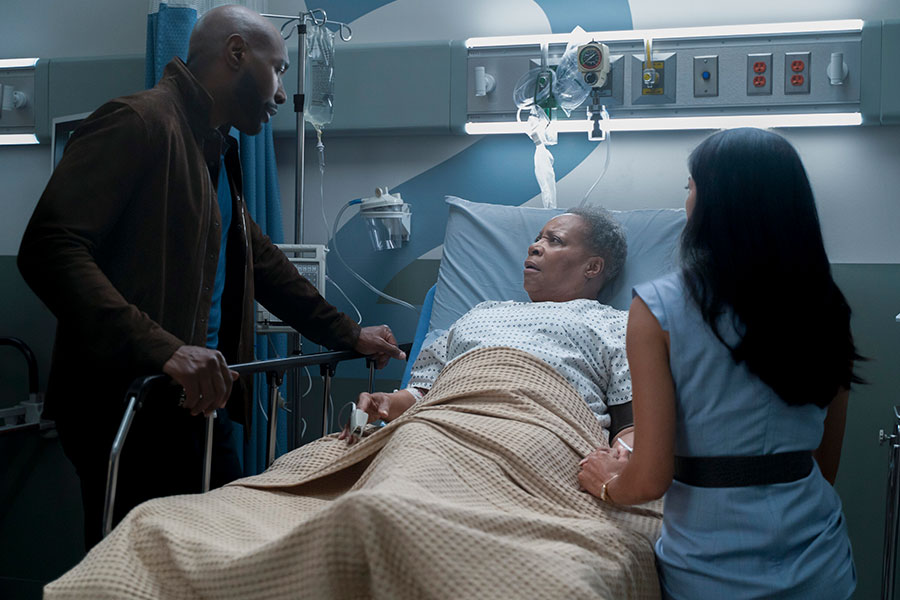
How has your character changed between Season 1 and Season 2?
The first season he was dealing with a traumatic brain injury, and with [Holmes nemesis] James Moriarty [Randall Park]. He was fighting evil, in his mind, and was working to build a huge genetic locker. Now, this season, he’s more focused on developing different relationships; with Laila (Tika Sumpter), and a working relationship with Mary. He’s still dealing with Sherlock, but in a different way than last year.
You’ve received many honors, including NAACP Image Awards and a star on the Hollywood Walk of Fame. What do those acknowledgments mean to you?
At this point in my career, I’m appreciative of them. People recognize what I’m doing and that allows me to continue doing what I do. I have so many high aspirations and so many things I still want to do, I’m not stopping to smell the roses at this point. I appreciate the honors, but I don’t really focus on them because there’s so much more I want to achieve.
Looking at the industry from the time you did Boyz n the Hood to today, how do you think things are, in terms of roles for African American actors?
The opportunities for African American actors, and even for minorities in general, have definitely increased dramatically. At the time I was doing Boyz n the Hood, the leading men were probably Eddie Murphy and Denzel Washington. There weren’t a lot of African American leading men in the movies. I like to think that today’s opportunities came because we had the opportunity to do films like Boyz n the Hood and New Jack City. Those movies did well, and they opened up the opportunity to do others. The industry has changed for the good, in terms of opportunities in front of the camera, but I think we can still increase the opportunities behind the camera.
This interview has been edited for length and clarity.
Watson is now airing on CBS and streaming on Paramount+.