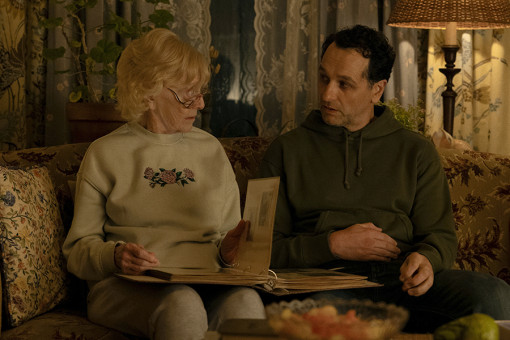


Each season of Slow Horses brings with it a new set of stakes.
Each season also brings with it something that audiences may not be aware of: a new director.
A different director takes over for the previous one and helms every new episode of Apple TV’s Emmy-winning series, which centers on Jackson Lamb (Gary Oldman) and his dysfunctional team of MI5 agents practicing their unique brand of tradecraft while calling Slough House their headquarters.
For the show’s fifth season, director Saul Metzstein was tasked to employ his unique skillset and help guide the compelling storyline while also relying on his previous experience directing season three.
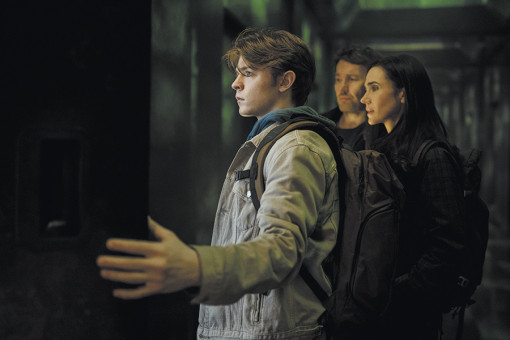
That experience came in handy, given the fifth season’s subject matter. The shocking premiere episode begins with a terrifying mass shooting in a London shopping square, as this violent act puts our spies on a complicated and twisty quest to determine who planned the shooting and why. (The shooting occurs with our heroes still processing the death last season of MI5 agent Marcus Longridge, played by Kadiff Kirwan, who was killed in a shoot out at Slough House).
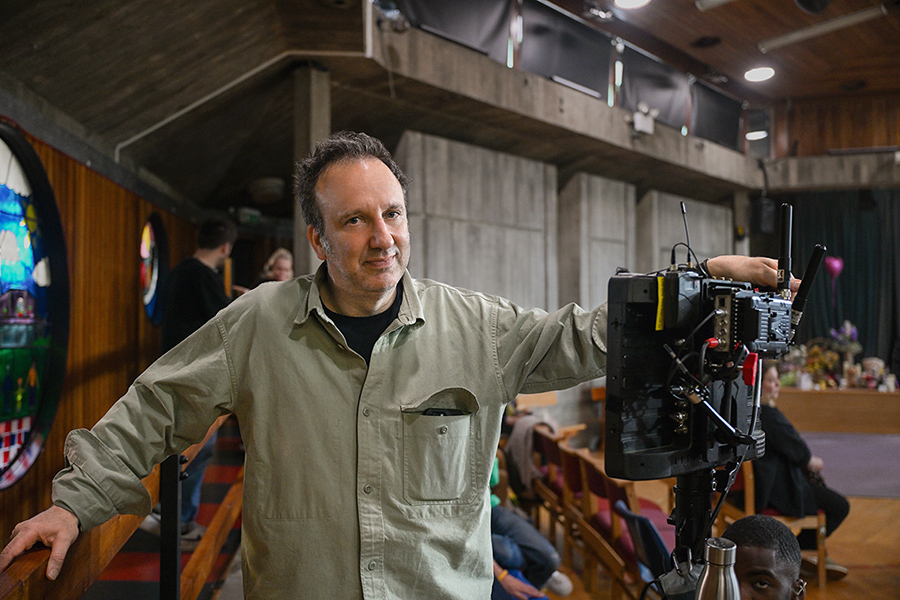 Slow Horses director Saul Metzstein on the set / Apple TV and Monica Helberg
With the fifth season currently streaming, the Emmy-nominated Metzstein — who is also a BAFTA-winning feature film director (Late Night Shopping, Guy X) — shares with the Television Academy the fun challenges that come with picking up where another director left off. He also reveal what were his favorite moments to film this season.
Television Academy: Since each season of the show taps in a new director, did you have a traditional “tone” meeting when you came onboard?
Saul Metzstein: No, I didn’t. One of the things [the producers] kept saying was they wanted to make it like a film — in the sense that they wanted the director to [be an] auteur each season. The producers thought each season should feel like its own, unique version.
I think what’s special about the show is that it mixes humor with actual thrills. When you start doing a TV program, you really want to learn everything you can from the people who’ve done it before. So, I had a few Zoom meetings with James Hawes — who directed season one — and I interrogated him to death. The funny thing is, I thought I made it in the same way that he made it. But, when I look back at the seasons, it was quite different. I think you always end up making your own version of it, anyway.
What are the biggest challenges of picking up where a different director leaves off?
I don’t want to make it sound terribly easy, but we have [writer and executive producer] Will Smith, who [ran] the show for five seasons. He knows all the character arcs and where things start and stop. What’s clever about a program like this is that it has a lot of plotting — but, actually, there’s a character piece hidden underneath all that. I think the filmmaking [style] changes quite a lot, but the actors anchor [the tone of the show] because they hold onto their character arcs.
Can you unpack what those changes are?
[Seasons] one, two and three are shot very differently. Having said that, seasons one, three, four and five are all shot by the same director of photography. I do things like tracking shots — things you pick up from [working on] movies, not from usual television coverage. I try to keep the camera moving as much as possible. I almost never storyboard a shot list. I don’t really like that standard; you shoot a master shot, then you shoot a close-up and then you shoot a tighter close-up. I think that can make for pretty uninteresting stuff. I try to make dialogue scenes as inventive as one would make action sequences.
What’s it like working with showrunner Will Smith, who’s departing the series after five seasons?
In a way, [it’s] quite sad. You have this thing where you’re getting really good at something you’ve been practicing. So in many ways, you always feel like you’re just getting going. We tested the water in season three, then we pushed the boat out in five and there was a lot of stuff that we [already] knew. We had a shorthand with certain things. There were plenty of versions of the program that we could still make — that Will and I are not going to make — so there’s a little bit of sadness.
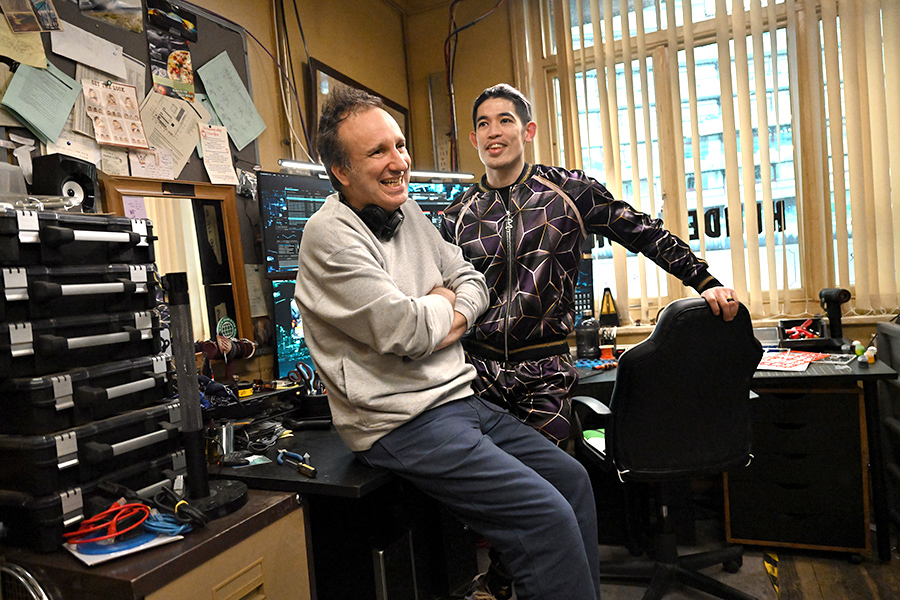 Metzstein and Slow Horses actor Christopher Chung / Apple TV and Monica Helberg
Talk about filming the opening scene of the season premiere. The mass shooting in the square is done so methodically.
You could call it tonal whiplash, but I think it has a much deeper meaning. If you look at the modern world, it consists of terrible things happening when, at the same time, self-obsessed idiots ignore it all. It was a marvelous way of explaining the modern world. Half the time you’re conscious of awfulness all over the world, and the other half of the time, you’re on your phone, or listening to music with headphones on and not paying attention to anyone else. To me, it summed up the duality of the modern age.
There are plenty of thrillers out there, but very few that manage to tell you something interesting about the world in a slightly ironic way. Talking to an American audience, Slow Horses has that cynical British eye. The agents do always win, but I’m not sure they always get the cathartic moment you’d get in an American TV show. The British are very cynical.
The farewell party scene in the premiere episode uses dialogue and movement to help illustrate each character’s personality. But with an often silent character like Coe (Tom Brooke), it’s kind of startling to see him emerge from the background at this party. How do you ensure that a character like Coe gets his due?
Every time I watch that scene, I’m amazed that he appears in the background. Tom has very clear ideas about how that character functions, which then gives you a basis for how to work with that character.
In the script, he appeared there in the beginning and then at the end. What you have to be conscious of in this sort of drama is that every scene has to end with a punch — whether it’s a joke, a bit of information or a bit of choreography. If a character doesn’t say anything, and you know they have to be there at the end, you’re never going to cut to a shot of them during the [middle of the] scene. With that scene, there are a lot of characters […] and then the characters are pushed into finding their own space. I’m sort of manipulating them, in a way, so that they don’t have to worry about where the angles are going to be.
Do you have a favorite scene in episode one?
I really love River (Jack Lowden) and Shirley’s (Aimee-Ffion Edwards) argument in the toilet cubicle in the disco. Her performance is the fireworks, and Jack always lifts himself up to the quality of whoever is opposite him. While still being entertaining, it’s quite a moving scene. It’s basically two shots; two actors acting in a very confined space.
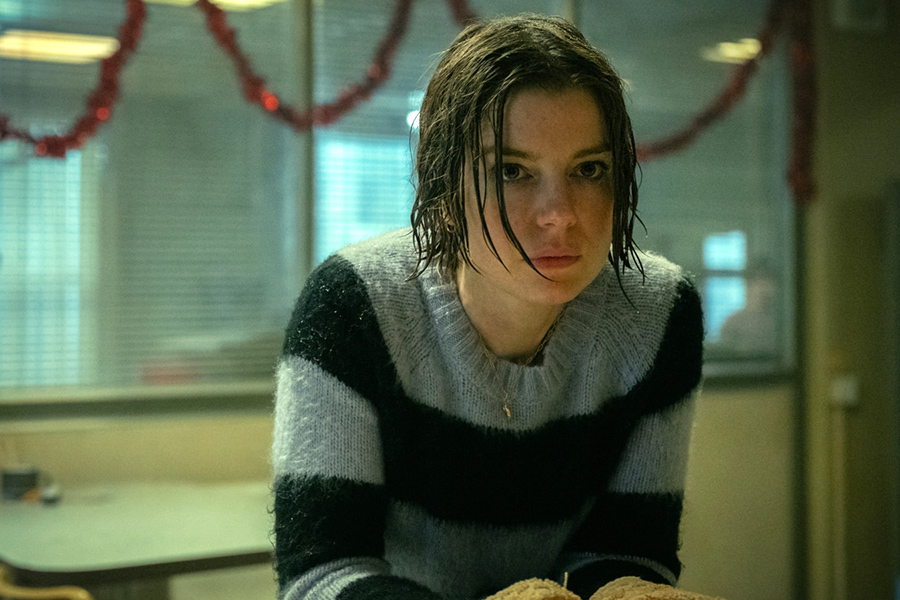 It was Aimee-Ffion Edwards (above) who suggested a key beat for her character in the season premiere / Apple TV and Monica Helberg
Aimee’s idea was that Shirley would reveal all that she felt. But then, at the end, she would have to undercut it because it wouldn’t be a Slow Horses moment [otherwise]. It’s a moment that feels emotionally honest. Then, she does this protective, cynical, sarcastic way of getting out the other end because they never really want to show each other how they actually feel. Particularly, if you’re British, you don’t do that.
What elements from this season did you find most rewarding to direct or be involved in?
It’s the most Slow Horses [that] Slow Horses has ever been. I really enjoy the balance of a proper, complicated thriller with proper character [drama] that’s funny.
I was only ever meant to direct season three, then they asked me back. I actually ruined the planning because each season [was supposed to] have a new director. Of course, three and five are by the same director, which slightly ruins the overall plan. Adam Randall, who did season four, has come back to do season six. So, between the two of us, we’ve messed up this wonderful plan of one-off seasons.
How does your work this season compare with what you accomplished on the third season?
Season three was more technically complicated. With season five, you have all these actors who are just so good at their parts — and [you have] a writer who so understands what to do. Also, the plot is intricate — but easy to follow. To me, that’s where you’re meant to get to with that program. It’s really fun to direct.
When the original producer, Jean Robinson, set it up, it was at the end of Covid. A lot of the crew would have normally been on big films. She got an amazing crew [together] with the offer of a continuing series that was done on a scale that they were happy with. Almost everyone [stayed and worked on] every season. Any time I would set up a scene — between the actors and the camera operators and the crew — they could only make it better.
This interview has been edited for length and clarity.
Slow Horses is now streaming on Apple TV.