

In honor of Catherine O'Hara's passing on Jan. 30, 2026, the Television Academy is reposting a behind-the-scenes look at the making of the late actor's Emmy-winning Apple TV series, The Studio.
Evan Goldberg vividly recalls an incident that inspired The Studio, the Apple TV+ Hollywood satire he cocreated with longtime partner Seth Rogen.
“When we were young writers in need of a job, we were in a notes session with an executive,” Goldberg says. “In the middle of the meeting, the exec put his head in his hands in defeat and said, ‘I got into this because I love movies — but now I have this fear that my job is to ruin them.’”
Rogen’s character, Matt Remick, echoes this sentiment in the show’s first episode.
Promoted to head up the fictional Continental Studios, Matt dreams of making the kind of quality films he grew up watching. Instead, his CEO (guest star Bryan Cranston) tells him to replicate the billion-dollar success of Barbie, with a franchise movie based on … Kool-Aid.
The Studio is a painfully funny show. By turns hilarious and cringey, it’s both a valentine to the movies and a skewering of the people who make them. Former Veep executive producers Alex Gregory and Peter Huyck, along with Frida Perez, are cocreators with Rogen and Goldberg, who codirected all 10 episodes.
Catherine O’Hara (Schitt’s Creek), Ike Barinholtz (The Afterparty), Kathryn Hahn (Agatha All Along) and Chase Sui Wonders (City on Fire) costar with Rogen. Adding to the fun are a cavalcade of Hollywood cameos by stars playing spoofy versions of themselves, among them Sarah Polley, Zoë Kravitz, Anthony Mackie and Ron Howard.
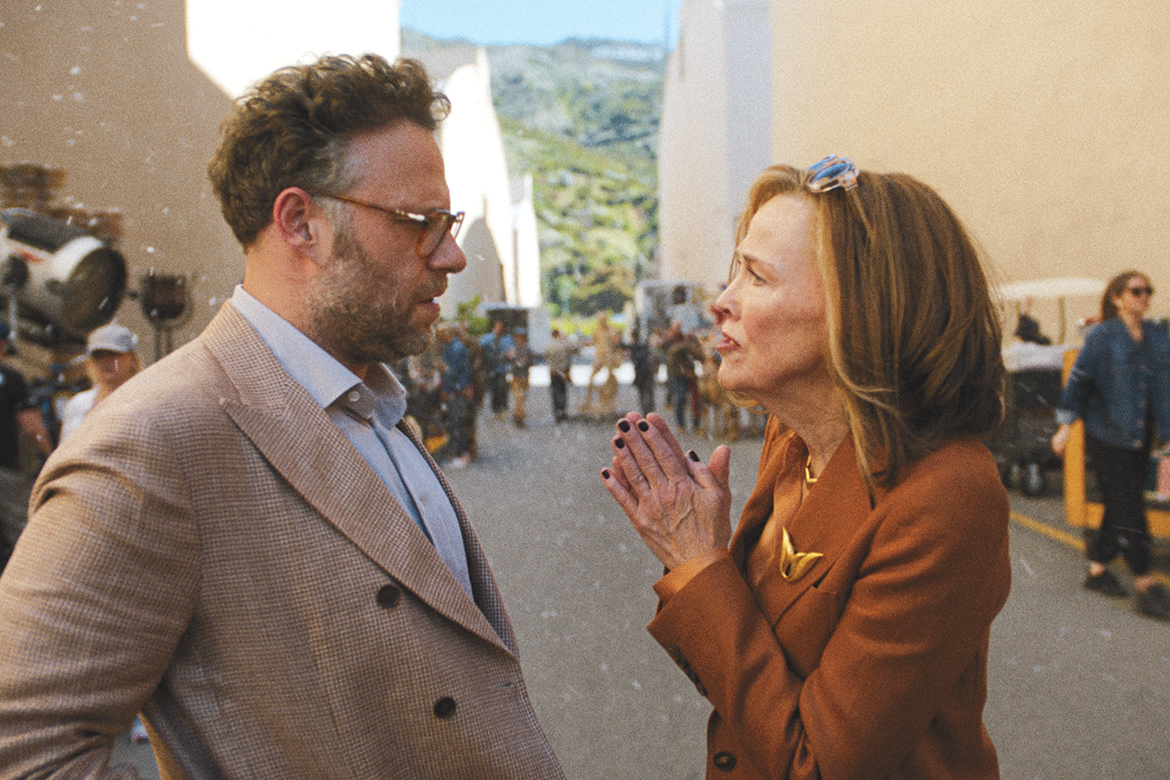
Rogen spoke with emmy via Zoom from the production offices of Point Grey, the company he and Goldberg founded in 2011. He can trace the show’s genesis to 2022, when he was filming The Fabelmans with Steven Spielberg, “and I was rewatching The Larry Sanders Show for the first time in a long time,” he says. “Evan and I were obsessed with that show growing up.”
Rogen and Goldberg, who have nine Emmy nominations between them, were looking for something they could shoot close to home in L.A. “We always try to write what we know from personal experiences,” Rogen says. “Superbad was very much based on our teenage years, and Pineapple Express was based on our 20s. And This Is the End our 30s, in a lot of ways.”
Goldberg says, “We started talking about what characters would be fun for Seth to play that would be different than what we’ve done before, and the idea of him playing a studio head kind of stuck.”
Matt aspires to be cool, but despite his vintage sports cars and bespoke suits, he’s a bumbling, insecure mess who often sabotages himself — as when he asks a teleprompter operator to add his name to an actress’s Golden Globes acceptance speech to ensure that she thanks him. Nevertheless, redemption is always within reach.
“The intoxicating thing about Hollywood — and a funny conundrum for a character like Matt — is that any delusion of grandeur can be realized,” Rogen says. “It just takes one movie to change the entire course of Hollywood, and he feels as though he could be the one to do it, at any moment.”
“What Seth and Matt share deeply is an unfettered, all-consuming love for film,” Goldberg says. “They live and breathe it. Both want to make commercially successful projects but care more about artistically satisfying ones.”
Rogen remembers a time when the two weren’t mutually exclusive. “There was a world where When Harry Met Sally was one of the biggest movies of the year,” he laments. “It’s not only a great movie, but a blockbuster.”
Matt shares his artistic sensibilities with his newly promoted development exec, Quinn Hackett (Wonders), who’s as power-hungry as any of her male coworkers.
“She’s a mini-Matt,” Wonders says. “She both worships and has a deep respect for him — but she’s ruthlessly ambitious and would do anything to get to the top. She has a Machiavellian energy to her.”
Her chief rival is Sal Saperstein (Barinholtz), the jaded senior vice president who was aced out of the top job by his best bro, Matt. Unlike Matt, Sal has no illusions about making art.
“Sal loves movies, but not like Matt loves film,” Barinholtz acknowledges. “He loves the parties and being around hot people.” And while Sal is initially so distraught at not getting promoted that he calms himself with a quick hit of cocaine, Barinholtz says, “He’d rather keep his job and have fun than have Matt’s life.”
Inevitably, Sal and Quinn lock horns, most memorably in the fifth episode, appropriately titled “The War.” After she embarrasses him in a development meeting, Sal rebukes Quinn for not knowing her place — and a tit-for-tat battle ensues. Eventually, the savvy veteran and the aspiring upstart reach an uneasy détente.
“Quinn sets out acting as if she has zero respect for him,” Wonders says, “but she does have something to learn from him, and there’s a middle ground where art and commerce can coexist.”
There’s no such middle ground for marketing exec Maya Mason, a brassy firecracker played with over-the-top glee by Hahn. "Making money is her sole goal," Hahn asserts. "Maya has no artistic ambitions; she's straight-up business. Her creativity comes from her clothes."
Like The Player, Robert Altman's 1992 Hollywood satire, The Studio gets great mileage from its celebrity cameos — many of them friends who’ve appeared in previous Rogen films.
In a Chinatown-like noirish episode, a reel of film goes missing, and the film’s director, Olivia Wilde, becomes a prime suspect.
Another episode finds Ron Howard — in a decidedly non-Opie moment — berating Matt over a note on his film. “It was spectacular to watch him act, because he’s so good, and you forget that’s how he started,” Hahn says.
“Everyone wanted to have a cameo as long as they had one good, clear joke,” Goldberg recounts. “Nobody wanted to be window dressing. It was, ‘What’s my joke?’”
Charlize Theron, who worked with Rogen on the 2019 rom-com Long Shot, makes the most of a single line, dispatching Matt from a party with perfectly timed profanity.
“If you were an executive, your wildest dream would be to be invited to Charlize Theron’s party,” Rogen says. “And your worst indignity would be to be personally kicked out of Charlize Theron’s party by Charlize herself.”
Casting director Melissa Kostenbauder (Tokyo Vice) says the most challenging part of the celeb cameos was “getting the stars wrangled, working on schedules and doing their deals.” And while a handful of actors declined to play themselves (she won’t say who), most were game.
“Seth and Evan were very clever in their approach to making people feel comfortable,” Kostenbauder says. “They would meet with them first and then tailor the script to them and send it to them. If that person wasn’t interested, we would just come up with a new list and start talking about who else could fit into the world they’d created.”
Goldberg adds, “About 20% said, ‘I’m not so sure I want to play myself this way,’ and every single time, they made themselves look like a bigger asshole by the end. On purpose.”
One such person was writer-director Sarah Polley (Women Talking). In the second episode, she directs Greta Lee (The Morning Show) through an intricate single-take, magic-hour Steadicam shot. With daylight fading, there’s little margin for error. When Matt arrives on set to show support, he becomes a one-man wrecking crew, driving Polley to distraction. “Support me from anywhere on Earth other than here!” she shouts at him.
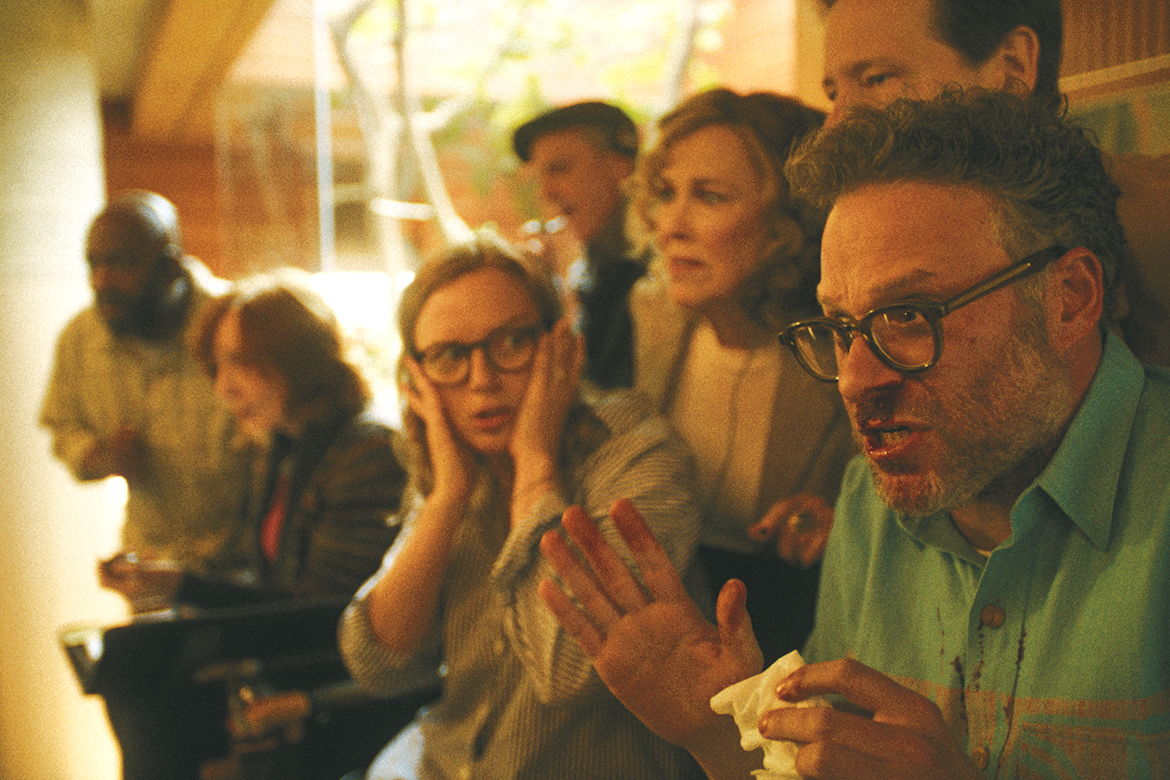 Photo courtesy of Apple
Via email, Polley says, “It was a great opportunity to let out a lot of the frustrations that had built up over the years on sets. I was interested in playing someone who’s comfortable expressing anger.”
For the director and former actress — whose last TV role was in the 2008 miniseries John Adams — the episode provided a gratifying discovery. “I’ve always secretly wanted to do comedy, so this was an awesome opportunity to get to do that,” Polley writes. “It was so unexpected and wonderful and made me realize I love acting again, which was a huge surprise to me.”
No guest star goes to town more with his role than Bryan Cranston. Cinephiles will note that his character has the same name, Griffin Mill, as Tim Robbins’s titular studio exec in The Player. But Cranston’s idea was to parody Robert Evans, the famed Paramount studio chief.
The octogenarian Mill favors blazers on top of turtlenecks and sports a bushy mustache and long sideburns. “People lock into a look they had when they were at their most virile and powerful,” Cranston observes. “And for Mill, that’s the ’70s.” Cranston’s favorite accessory is Mill’s gaudy shark’s tooth necklace. “It’s a symbol of virility,” the actor says. “What’s great about Seth and Evan is they created an atmosphere where you have permission to go crazy,” he adds. “You feel like you can’t go wrong.”
For a comedy, The Studio is stressful to watch — and that’s by design. The show is mostly composed of long, single tracking shots without cuts, giving viewers an immersive experience of the execs' constant state of panic.
"We didn't want to do master, closeup, find it in the edit bay," Goldberg explains. "Panic is a huge part of Hollywood, and we concluded that a single camera whipping around, never being sure exactly where it's going to go, was the best way to capture that panic. We wanted to do it more like a play. We thought it was very exciting to have one camera, one monitor — we either get it, or we don't."
In technical terms, the extended one-shot take is known as a "oner." As Matt describes it, "The oner is the ultimate cinematic achievement ... the perfect marriage of artistry and technicality."
Achieving that seamless marriage posed its own set of challenges, according to cinematographer Adam Newport-Berra (The Bear). "We wanted to create a character out of the camera, to give it a sense of omniscience. So, there are a lot of times where the camera will move in and out of spaces or make a choice to move away from a character."
An even bigger challenge was how to move the camera. "The camera weighs 40 pounds, and you're moving it in and out of cars, through windows, up from the top of a building down to the ground," Newport-Berra says. "And when you lift a 40-pound camera off a 40-foot crane, the counterbalance changes. There are so many things I didn't even think of until we were doing it."
For the actors, who had to know where the camera was at all times, oners were both exhilarating and terrifying. "If you messed up during a take, everyone laughed very generously, but there was a deep, deep sense of shame, because we only had so many takes to get it right,” Wonders says.
“All of us relied on the actors to do what they promised to do, and vice-versa,” Newport-Berra says. “It created this kind of codependence that was really electric, and it made everyone work a lot harder for each other.”
“It did cut down the margin of error for editing,” Rogen notes. “And when you’re doing these whip pans in dialogue scenes, there’s no coverage, so to speak. We couldn’t piece it together in the editing room.”
And how did the Apple TV+ execs feel about such a daring way of shooting a comedy?
“We created a filming style which doesn’t allow one to give too many notes, which is something they obviously had to come to terms with,” Goldberg acknowledges. “They’d say, ‘Can you cut to this?’ ‘Well, there are no cuts.’ ‘What about this, can you tighten this?’ ‘No, we can’t tighten anything up.’ Though I was surprised at how many notes we could accommodate, because we did have whip pans that were stitched together,” he says, adding that Apple was a great team player.
There was one special guest the filmmakers were particularly eager to impress. In the first episode, Martin Scorsese appears in Matt’s office to pitch a “pet project” — a film about the Jonestown Massacre.
Rogen had never met the directing legend before, and he and Goldberg were understandably on edge. “We were nervous he might find it disturbing that we only had one camera on set,” Goldberg says. “So, we had a second camera crew waiting, just in case.”
Rogen adds, “We didn’t just hire a second camera. We hired the camera crew who did Killers of the Flower Moon — people he had just worked with for a year and a half.” Luckily, Scorsese approved of the one camera. “He was like, ‘It’s like French New Wave, I get it. That’s cool,’” Rogen says, breaking into Scorsese’s trademark staccato.
Rogen and Goldberg's partnership spans 30-plus years, since they first met in a Vancouver bar mitzvah class at age 12. “I thought he was funny,” Rogen recalls. “He was the only other kid I’d ever met who wrote in their free time.”
“We’ve been married to each other longer than we’ve been married to our wives,” Goldberg says. “We’re codependent in a good way — and undeniably better when we do things together than when we do things apart.”
Have they acquired more sympathy for execs, having made the series? “Even before we made this, we had more sympathy for studio execs than anyone in the world,” Goldberg says. “Because they could’ve been us — if I wasn’t good at writing comedies, I might’ve ended up being a studio exec.
“For the most part, they’re film lovers, they’re TV lovers, and they want to make great art — and that’s why we made this show.”
This article originally appeared in emmy magazine, issue #6, 2025, under the title "Picture Show."