
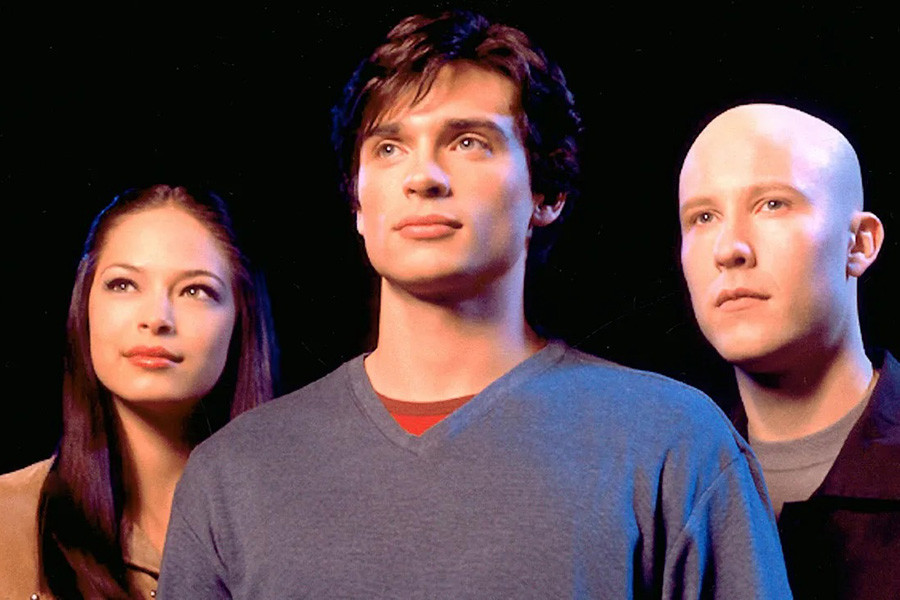
Michael Rosenbaum & Tom Welling Q&A/Smallville
Clark Kent doesn’t fly in Smallville, but time certainly does.
Which is why, 25 years after the premiere of The WB’s hit teen drama, it’s a little surreal to see Clark and Lex Luthor — aka actors Tom Welling and Michael Rosenbaum — sitting next to each other on a Zoom chat, swapping memories of what they achieved together an entire generation ago.
“Tom and I have honestly become closer after the show,” Rosenbaum says. “We always worked really well together. But it wasn’t until years later that we started spending more time together and visiting each other. We’re kind of like brothers.”
How fitting, considering that Smallville is an essential member of the extensive Superman family.
A Man of Steel origin story of sorts from writers, showrunners and cocreators Al Gough and Miles Millar, the DC series focused on Clark’s humble days as a teenager in Kansas. As in many glossy WB shows of the era, the handsome hunk angst-ed over a romance — in this case, childhood friend and neighbor, Lana Lang (Kristin Kreuk). But Smallville uniquely combined that signature formula with a classic DC superhero mythology. Here, future arch-nemesis Lex began as Clark’s close friend and confidante. And Clark’s extraordinary powers served as a metaphor for alienation and responsibility.
“It wasn't just a spectacle,” says Rosenbaum. “It was the show at its best, because it was about heart.” Echoes Welling, “It asked, ‘Who do you want to be? Who are you supposed to be?’”
That message took off with fans faster than a speeding bullet. The pilot episode — which aired October 16, 2001 — pulled in 8.35 million viewers, a record at the time for the highest-rated series debut in The WB’s history.
Welling, who worked in construction before pursuing a career as a fashion model, turned into an “It Boy” splashed on dozens of magazine covers; Rosenbaum, best known for the short-lived WB show Zoe, Duncan, Jack and Jane, became instantly recognizable — thanks to his shaved head. “We were thrown into the machine,” Welling says. “At least Michael knew how to handle it.”
By the time Smallville ended in 2011 — by which time it had moved to The CW and Clark had finally took flight — it had blazed a trail for a slew of DC superhero series that included Arrow, The Flash, Supergirl and, most recently, Superman & Lois. “We [demonstrated] how to push the envelope when it comes to the superhero shows,” says Rosenbaum. “And they are all great in their own ways. But we started it.”
Smallville‘s greatness lives on in its own way, too. Welling and Rosenbaum currently cohost Talk Ville, a rewatch podcast that breaks down every Smallville episode in chronological order. (They’re currently on Season 9). Hanging out in Rosenbaum’s L.A. office — which includes a poster of The Breakfast Club signed by the whole cast — the pair get super-reflective with the Television Academy.
Television Academy: Let’s start with your friendship origin story. How did the two of you first meet? At an audition?
Michael Rosenbaum: No, it was at a table read. I was probably more nervous than anybody and thinking, “These people are all really good-looking. They're going to fire me.” But Tom was this big, smiley young kid — and we hit it off. He wasn’t afraid to ask for help. He’d ask me, "Hey, can we read this? Do you have any ideas?” I would be there for him. It was like, “Let's make each other better. Let’s make each other great.” That’s what we did from the get-go.
Tom Welling: I actually don't remember it.
Rosenbaum: You don't?!
Welling: No.
Rosenbaum: People get fired in table reads. I've seen it happen.
Welling: Listen, when you're in such a high state of survival mode, your brain doesn't store everything, because it doesn’t have time. I think that's probably what happened. I don't remember that table read. There's a lot of the show that I don't remember. It's just strange.
Specific memories aside, did you think the show would be such a hit?
Welling: There was a moment when we were promoting the show in New York City; I walked outside in Times Square, and there was a poster of me as Clark with the “S” on my chest — with no shirt — in the cornfield. It was 60 stories high! And I was like, “Oh, okay.” It was the first time I thought, “The network is really putting a lot behind this.”
Rosenbaum: I was recording audio for the pilot, and our director David Nutter said, "You want to see the opening [scene]?” Afterwards, I called my mother and father — which I never did. I said, “I think this is going to be a hit show, and I might become famous from this.” I mean, I was just blown away.
What exactly blew your mind?
Rosenbaum: The cinematography. The scope. The hair. The makeup. The stunts. It was lightning in a bottle. It was a perfect recipe for a successful show.
Welling: It was on the WB — which, at the time, didn’t have a lot of high-performance, stylized stunts.
Rosenbaum: Yeah, they got the best of the best for every department — and it showed.
It also had a killer opening theme song.
Rosenbaum: “Save Me” [by Remy Zero]!
Welling: I walked into a store once, and it literally came on. I looked around, and I was like, “Who put this on?” It’s burned into my brain.
Smallville famously adhered to a “no tights, no flights” mandate. But Tom, didn’t you secretly want to put on that suit and fly around?
Welling: No. I always thought it was a show about Clark Kent before he became Superman. And I think that gave us the longevity that we had. I mean, if I had tried to put on the suit in Season 3, I don't think the show would have lasted.
Rosenbaum: It wouldn't have. It would have become campy. The story was Clark’s journey to Superman and Lex becoming the ultimate villain. So, the show was all about, “How do we get there?” Well, if you just bring out the suit, you’ve [got there] very fast. If he already knows how to fly by the end of season one or two, what are we doing here?
Welling: That’s what they did for Tyler Hoechlin’s show [Superman & Lois]. That's what Smallville would have been.
Why was Clark and Lex’s friendship so effective? It was an innovative twist on the lore.
Rosenbaum: You have to give all the credit to Al and Miles. The idea of [Clark and Lex] being friends, I was like, “How is this going to work?” Then you watch it, and it all pays off. There were ebbs and flows, and you kept wondering when he would finally turn to the dark side. But, like, when have you ever cared about Lex Luthor? I know that Clark was the centerpiece of the story, but it was Lex’s story, too.
Welling: The audience gets to meet both of these characters at a place in their lives when they're still trying to figure themselves out. That’s the code the creators cracked.
Rosenbaum: The show was genius in how it portrayed two different family dynamics. You had the Kents (John Schneider and Annette O’Toole), who were loving and supportive. And over here, you had Lionel Luthor (John Glover), this megalomaniacal billionaire tycoon who was ruthless. [Lex] was always in his [father’s] shadow. All Lex wanted was unconditional love. It's a really tragic story.
How did you adjust to superstardom and all that press?
Welling: It’s not that I didn't like it. The challenge was our shooting schedule. They would want us to do these things on the weekend, and I felt burnt out.
Rosenbaum: Tom would film so many hours a week, and then he had to go do a photo shoot.
Welling: We did the cover of Rolling Stone magazine [in 2002]. I remember shooting all night and going to the photo shoot and not being very happy. People have brought me that cover to sign it, and the look on my face — I recognize it. I remember the photographer being like, "All right, can we get a smile?” And I was like, "You ain't getting one smile.” I was so tired. I was about to pass out.
Rosenbaum: I mean, we all worked hard. But Tom had to carry the show. He was in almost every scene. The hours, especially in those first few seasons, were ridiculous.
Welling: And if you don't see me in a scene, it's because I'm on the other stage shooting. We had eight days of principal photography for an episode, and then two days for a second unit on that episode.
Rosenbaum: Everything was overlapping. It was insane.
On a happier note, you did get to shoot two episodes with Christopher Reeve in the second season. What was that experience like?
Welling: He was really funny. He wanted to joke around a lot. We had gone to New York to film. It was me and the producers; we were going to spend the first half of the day filming all of his scene coverage. And then, the idea was, he would leave, and I would do my scenes with [a stand-in]. But he stayed much longer than he was supposed to. [His team] literally threatened that they were going to call the police, because he wouldn't leave. He said, “They're always trying to tell me what to do!” I did feel like he gave us his blessing, as well, by appearing on the show.
Rosenbaum: Tom really got to hang out with him. At Madison Square Garden, for a Rangers celebrity charity game, I presented him with a Smallville blanket. There, I got to talk with him a little bit. I mean, honestly, what a super man he was. You really had to meet him to feel his energy and his warmth.
Tom, are you in touch with the other Supermans?
Welling: Yeah. I know [Superman Returns’] Brandon [Routh], Tyler and Dean [Cain]. We've been together at conventions. Dean was on Smallville, actually. He was a villain. That's the first time I met him.
Rosenbaum: David Corenswet [from James Gunn’s 2025 Superman] has said that Tom was his Superman. Nicholas Hoult [who played Lex Luthor in the 2025 Superman] came on my podcast [Inside of You] and was like, “You were my Lex Luthor.” Hearing that was unbelievable.
Welling: I think Smallville will probably influence actors who play these characters in the future, because it's such a huge reference point.
The two of you have cohosted the Talk Ville podcast since 2022. What’s your top takeaway from rewatching all these episodes?
Welling: I see the bigger arcs of the story that I was not able to process while I was filming it. You really didn’t know what was happening until you got your next script, which was like two days before the start of shooting. Keeping track of those big arcs was impossible. Now that we're rewatching, I'm like, “Oh, that’s why that's happening.”
Rosenbaum: For me, it’s actually sitting back and taking in all these episodes — all these years, all these seasons, all this work that we did with our peers and our crew — and realizing, “Wow, I get why people really love this show!” I also have an appreciation for all the actors and what I did. I don't love watching myself, but I was like, “Hey, you did good, kid.”
I'm really just proud of what we all accomplished and feel very blessed. If Smallville was the only thing I ever did — great. How many people can say that they were on a hit show that has stood the test of time for 25 years?
This interview has been edited for length and clarity.