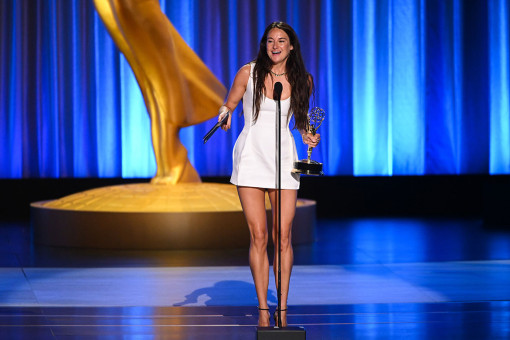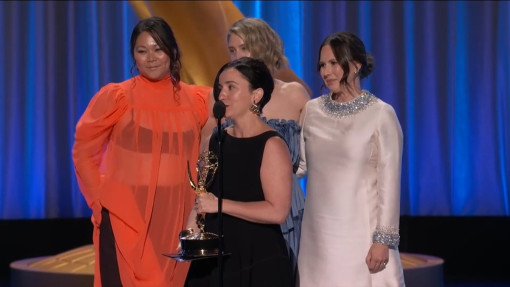


Sometimes, lunch is just lunch. And sometimes, when an engaged man starts turning an infatuated eye toward another woman at the table while his concerned fiancée looks on, the midday meal becomes a foreshadowing of romantic complications. When depicted in a scene from BEEF, the Netflix dark satire on class and coupling, it can even result in a 2026 Emmy nomination for Outstanding Picture Editing for a Limited or Anthology Series or Movie.
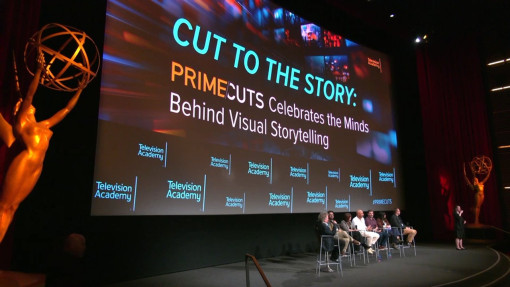
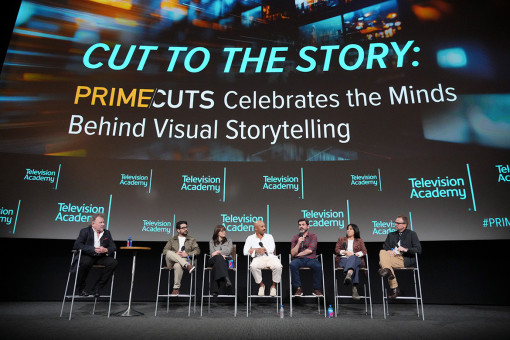
Such was the case for Lauren Connelly, ACE, whose clip of the tension-filled scene between the affianced Austin (Charles Melton) and Ashley (Cailee Spaeny) and Austin’s possible new amour Eunice (Seoyeon Jang) was one of those shown at the Television Academy’s October 1 event “Cut to the Story: Prime/Cuts Celebrates the Minds Behind Visual Storytelling.”
Held at the Academy’s Saban Media Center, the evening also celebrated the 20th annual edition of Prime/Cuts; the event usually gathers a panel of Emmy-winning and Emmy-nominated picture editors to discuss the art and craft of their profession and is presented by the Picture Editors peer group. To mark this special occasion, Prime/Cuts was presented Academy-wide and expanded to focus on the importance of collaboration for post-production excellence, with other artisans onboard to discuss how various creative elements combine to influence the storytelling and shape the final edit.
Click here to check out the "Cut to the Story: Prime/Cuts Photo Gallery."
Joining Connelly on the panel were BEEF supervising sound editor Christopher Gomez, MPSE, an Emmy winner this year for sound editing for a limited or anthology series, movie or special; another Netflix project Emmy winner, Charles Divak, ACE, supervising editor for Sean Combs: The Reckoning, who won for nonfiction program picture editing; Sean Combs composer Pierre Charles; and two drama series Emmy nominees from HBO Max’s The Pitt, editor Mark Strand, ACE, for picture editing, and co-producer-writer Valerie Chu for writing. Michael Ruscio, ACE, an Emmy nominee this year for editing the Netflix limited series Death by Lightning, moderated.
“The tone of BEEF lives in the detail,” Connelly said. “My philosophy as an editor generally is to go with my gut, my instincts, what makes me feel something, what makes me laugh, what makes me cry. What was interesting about working on BEEF is how much of the material in this amazing cast made me do that in every single take.
“It was an embarrassment of riches,” she continued, “so you really had to analyze every moment with such great detail and make such deliberate and precise choices with every single frame of footage that we had, and every single subframe of audio that we had. [The cast] did give us such a wide range of performance and tone: funny reads, serious reads, pauses in different places.”
One notable detail in the lunch scene: When viewed from Austin’s perspective, there were no cuts between the prospective women rivals; the two were related only via his looking from one of them to the other.
When it came to the audio, Connelly and Gomez analyzed every word down to the syllable while in the cutting room. They would shift words and sometimes create “callbacks,” inserting a word from a previous line into a later one.
“We love sound,” Gomez said. “We want to put sounds everywhere, but a lot of it is staying out of the way and figuring out how to not overcrowd it, because these actors are doing so much with the subtleties in their performances.
“A big thing was the polish and pristine nature of these locations and this upper class; they’re away from the rest of the world. How do we convey wealth? A lot of it was just the quietness of it.”
Picture editor Lauren Connelly, ACE (BEEF)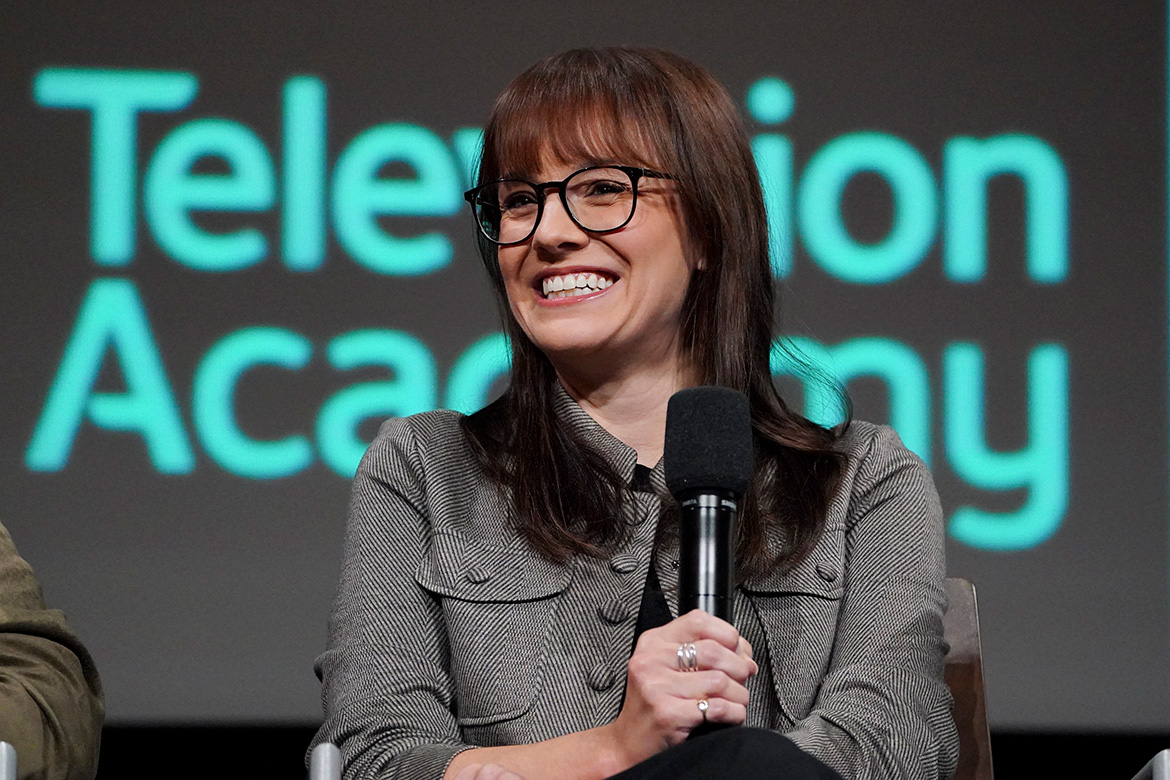
Divak also takes his cues from the footage. “I think as an editor, you have to have a lot of patience, where you can kind of let the footage speak to you, rather than force it,” he says. “If you're trying to make a scene what you want it to be, it’s like wrestling this toddler. And trying to get him to go to bed, and he won’t. You have a really bad product doing that. So, you have to have the patience to let it talk to you, to hear its feelings, to feel the footage, and the answer comes from that.”
In the case of Sean Combs: The Reckoning — which traces Combs’s rise as a hip-hop mogul, his alleged but unproven connections to the fatal shootings of rappers Tupac Shakur and The Notorious B.I.G. (Biggie Smalls); and arrest, trial and conviction on criminal sexual charges — Divak had the benefit of footage that had been acquired from an unnamed source. Combs himself had hired a videographer to document the days before his arrest.
In viewing the footage, “I was blown away, because it’s one of the rare times that you can actually see behind this mask of Sean Combs,” he said. “He’s extraordinarily polished — a master manipulator, master marketer, and everything you see is what he wants you to see. But the camera was rolling the whole time, and so you see these little times where the guard breaks, the mask comes off and you see the real person underneath it. Once I saw that, it was obvious that it had to be scattered throughout the [opening] episode and then come back to throughout the series.”
The emotion evoked in each scene must feel organic to the viewer, he said, a quality which Charles’s music captured perfectly: “With Pierre, every cue built and built and was in the right place, exactly where it needed to be.”
Perhaps remarkably so, considering that Charles began assembling ideas and creating musical cues without having yet seen a single frame. In meeting with executive producer-director Alexandria Stapleton, other producers and editors, he took note of Stapleton’s concept of a circus amidst the serious subject matters such as sexual assaults and intellectual property theft.
“There’s this other side of Sean Combs, where we’re examining this character who embodies a ringleader of a circus, and he’s got this intoxicating vibe about him, where people are drawn to him,” Charles said. “My job was to find an instrument palette that aided and abetted that storyline.”
He asked a percussion player for some of his collection of “weird” instruments — “Can we start laying down weird percussive beats that I can build as the backbone to the score?” — hired a flute player who specializes in world and ethnic flutes to record “weird” samples which became synthesized and recruited his violinist wife and other string players to provide sounds of acoustic instruments.
“Because there’s so much heaviness in this series, I didn’t want to lean into a classic melodramatic doc score,” Charles said. “I wanted to create a very cinematic experience, taking my scripted experience into this world of a real-life character. And so it was we found the sound, and Alex loved it.”
Like his colleagues, Strand makes specific editing choices for every shot of his episodes of The Pitt, providing some control to a show that, set during a 15-hour shift in the emergency department of a Pittsburgh hospital, portrays a chaotic environment. If he’s working on an episode Chu wrote, they will check in with each other, from adjoining offices.
“She is so available for conversation and hungry to hear how it was going, how I was feeling about the scenes coming together, and if I had any questions,” Strand said. Their jobs are similar, he added, in that Chu writes in the voice of the showrunner and he edits in the voices of the showrunner and writer. “If it were mine, maybe I would do it slightly differently.”
In a clip from The Pitt, medical staff members gathered to share reminiscences of a frequent patient, Louie Cloverfield, who had died that day; Ernest Harden, Jr. won an Emmy this year as guest actor in a drama series for the role. The scene, as it turns out, was considerably shorter than the one that was shot.
“There was a lot more to the story of Louie,” Strand said. “There was more to the memories of Louie, and so that was fantastic for the actors, to have lived in it and portrayed it in the moment, and then we could pare it back, and those feelings and emotions were still in the scene. [One key] story about Louie was probably twice as long, but we had just enough, because we also are always dancing with melodrama, and we don’t want to quite go that far.”
Writer Valerie Chu (The Pitt) and picture editor Mark Strand, ACE (The Pitt)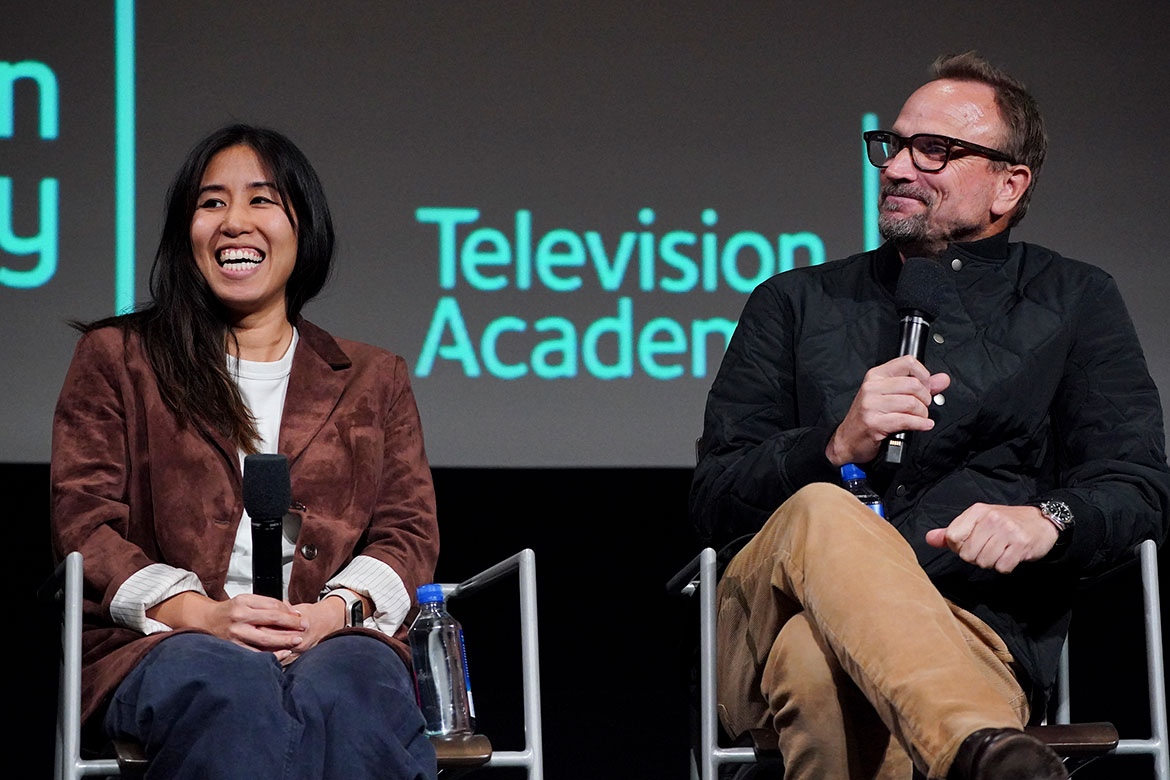
Strand said that he’ll sometimes reinstate lines at a writer’s request. For her part, Chu said, “One of the many things I’m amazed by with our editors is, the pacing of the show is so important, and that’s something that you cannot convey in the script. After just coming off set over the last couple of days, I was constantly sitting at [Video] Village, being like, ‘Oh, does there need to be a pause there? Should that moment breathe a little bit longer?’ And you guys have such fantastic instincts. You’re always battling the notion that we don’t have time in the ER for these long debriefs, balancing which moments are going to be able to breathe a little bit more, because we’ve earned that from the fast pace.”
Their collaboration, as the others presented this night, clearly works. Said Chu, “I am trying to get my agents to negotiate in my contract that Mark must be the editor on all my future episodes.”
Robert Michael Malachowski Jr., ACE, and Maura Corey, ACE, are the Picture Editors peer group governors.