

Anyone can get stage fright — even Laurence Olivier, arguably the greatest actor of the 20th century. He fell victim in 1964, while appearing as Othello at London’s Old Vic Theatre. He later described these hellish episodes in his memoir, Confessions of an Actor. With palms sweating and heart racing, every performance became a panic attack. Things got so bad that ahead of delivering his soliloquies, he asked his Iago (Frank Finlay) to remain always in sight, fearful that “I might not be able to stay there in front of the audience by myself.”
Celebrated actress Sybil Thorndike — a woman who also knew her way around The Old Vic’s boards — didn’t believe in suffering for one’s art. She allegedly offered Sir Larry this advice: “Take drugs, darling. We do.”
Thorndike was most likely referring to benzodiazepines — powerful sedatives, like Valium and Librium, that were heavily marketed in the 1960s to treat anxiety disorders and the stress of daily life. During that turbulent decade, “benzos” became go-to drugs for taking the edge off. The Rolling Stones even wrote a hit song about them with 1966’s “Mother’s Little Helper.”
By the 1980s, though, a different drug category had emerged to combat stage fright: beta blockers. Originally intended decades prior to treat high blood pressure, heart conditions and the like, they eventually became a popular anti-anxiety med. For actors, this was a huge breakthrough. Unlike benzos, beta blockers control the physical symptoms of performance anxiety — racing heart, quivering voice, trembling hands — without inducing drowsiness or brain fog. After all, how can actors be “in the moment” if they’re completely out of it?
Whereas benzos carry the dual risks of addiction and lackluster performances, beta blockers are non-addictive and, when prescribed by a doctor, are well-suited for situational use (big auditions, first day on set, awards ceremonies). Still, while many thespians found beta blockers effective for treating stage fright, for the most part the pills remained a secret. In a profession where Method acting was supposed to be painful, nobody wanted to be accused of cheating.
Now, after decades of furtive use, beta blockers are out of the closet.
Bobby Lee has been open about popping a beta blocker to alleviate anxiety.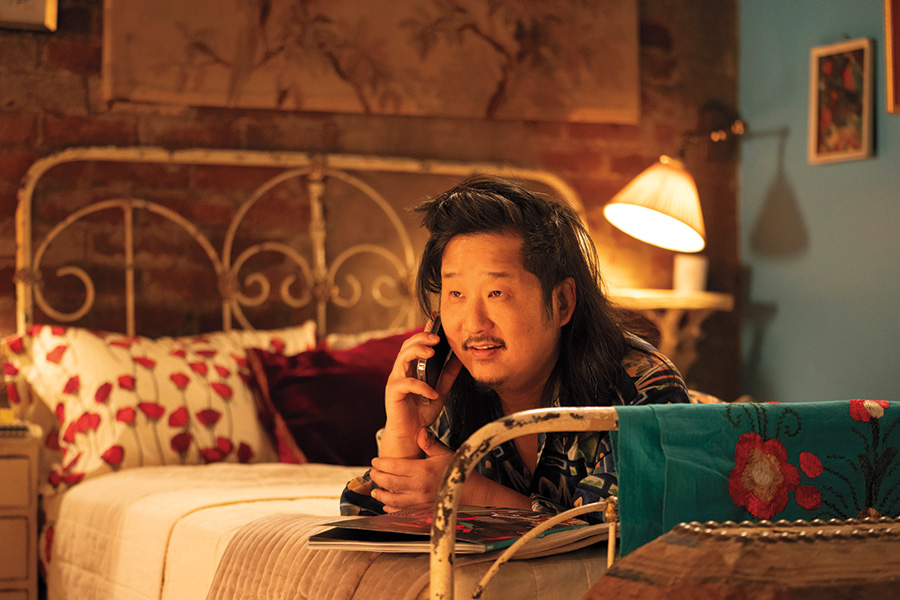
Bobby Lee (It’s Florida, Man; MADtv) is one actor who has admitted to taking them to grind through a shoot. He began taking beta blockers after experiencing “a couple nightmare auditions.” His anxiety was so high on set, he compared the symptoms to PTSD. That was 12 years ago. Since then, he hasn’t worked on camera without a 25mg “safety net.” He claims beta blockers have changed his life. “When I’m not on beta blockers, I’m far more anxious, and I ruminate about my lines,” he says. “When I did And Just Like That…, for instance, acting opposite Sarah Jessica Parker made me extra stressed and extra anxious. I would have freaked out without BBs.”
Lee knows that confessing to using beta blockers to nail a role may violate some unwritten SAG-AFTRA rule, but he finds such standards hypocritical: “I don’t want to name names, but I know for a fact that other actors use them when on set. I don’t know why they’re embarrassed to admit it. I don’t care — whatever works.”
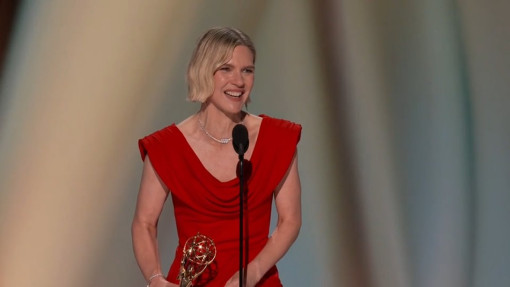
Plenty of performers have recently stepped forward to name-check their favorite performance enhancer — not as an acting aid, but for awards shows. When Robert Downey Jr. won his Oppenheimer Golden Globe in 2024, he prefaced his acceptance speech with “Yeah, yeah, I took a beta blocker, so this will be a breeze.” It was perceived more as an admission than a punchline. Natasha Rothwell (The White Lotus) told Vanity Fair that her 2022 Emmys prep consisted of “Deep breaths and beta blockers.”
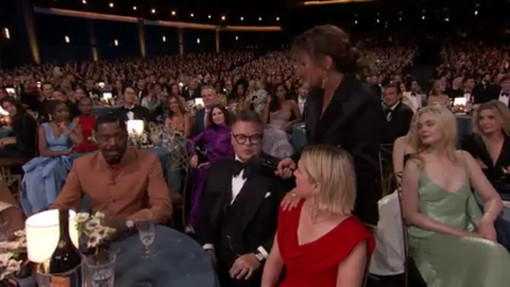
Dan Levy admits to taking a beta blocker 90 minutes before cohosting the 2024 Emmys with his father, and, at last year’s Oscars, Rachel Sennott (I Love LA) blurted on the red carpet, “Take that beta blocker, girl! Swallow it down and lock in!”
With stage fright so prevalent, and mind-body wellness so integral to celebrity culture, it’s not surprising that beta blockers are being discussed openly today. The one that’s most often prescribed for actors is propranolol, known by the brand name Inderal. Many actors prefer it because it’s highly effective at reducing performance anxiety symptoms, kicks in fast (immediate release within an hour) and, if necessary, will last through a double-overtime shoot (the extended-release capsules offer 24-hour coverage). No more xerostomia (cottonmouth), tachycardia (increased heart rate), psychogenic tremors (the shakes) or hyperhidrosis (flop sweat).
Eugene and Dan Levy host the 2024 Emmys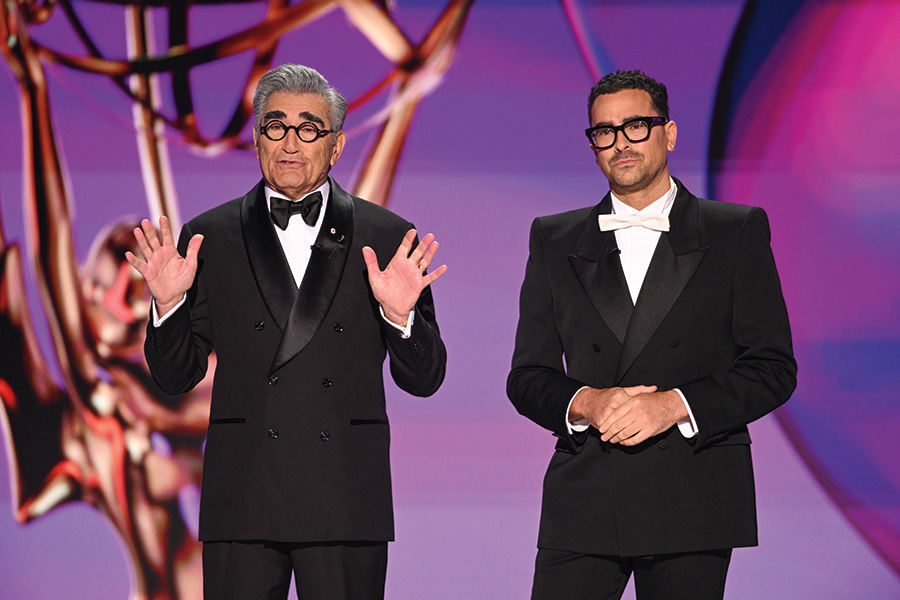
Performance anxiety, whether on stage or screen, is an occupational hazard familiar to most actors. A 2012 study by media psychologist Gordon Goodman and professor James C. Kaufman, summarized in their paper Gremlins in My Head: Predicting Stage Fright in Elite Actors, found that of the 136 “elite” film and TV actors surveyed, about 80% had experienced stage fright at least once.
Drugs like Ritalin, Xanax and Vicodin require a doctor’s prescription, and the same goes for beta blockers, as Khloé Kardashian discovered around the time of a 2022 episode of Hulu’s The Kardashians. While Khloé is backstage getting glammed-up for an important talk-show appearance, her anxiety level is rising. “Momager” Kris Jenner asks, “Do you want one of my beta blockers?” Kardashian replies, “Oh, I love those,” to which Jenner responds, “I know. They’re really great.”
Backlash to the scene was swift. On platforms ranging from Women’s Health magazine to Australia’s Sky News, medical experts warned of the dangers of taking beta blockers without a doctor’s supervision. Asthmatics might experience respiratory distress. It could be dangerous for diabetics. Those with hypotension (low blood pressure) could lose consciousness. Side effects might include fatigue, dizziness, insomnia, sexual dysfunction, jaundice, swollen ankles and heart failure. As the commercials advise, “Talk to your doctor.”
Dr. Jon Deam, a psychiatrist and the founder of Aveo Wellness — a Southern California concierge-care clinic that specializes in treating the anxiety disorders of high-profile individuals — says there’s been a 30% uptick in prescriptions for beta blockers at his practice compared to two years ago. “If you’re someone that’s pretty capable, but in those moments where you have to perform, you have to emote, then beta blockers are very impactful and powerful,” he says. “They won’t cure stage fright, but this drug certainly helps people to be more functional.” Sure, but can an actor turn in a great performance while on them? Deam doesn’t hesitate: “Yes,” he says bluntly.
Bobby Lee can attest to that. “I just finished shooting my first comedy special for Hulu,” he says. (Finally is set to premiere in November.) “I never take beta blockers when I do stand-up, but I did the second night, because there were cameras, and I wanted to see if it would help. We shot four shows over four nights, and that second performance is the one that became the template we ended up using. Everyone agreed that I did better improv and was more loose and relaxed on the second night.”
Despite ringing celebrity endorsements, performance-enhanced acting does have its detractors. “We do not advocate for any drug use during a performance,” says John Jack Rodgers, executive director of the Stella Adler Academy of Acting & Theatre. “Performing on stage or on camera requires deep amounts of research, sensitivity and focus. Any substance which might detract from an actor’s ability to commit fully to what they have planned is not a good idea.” Far from being a liability, Rodgers insists that anxiety can actually be a beneficial emotion. “If an actor’s nerves are properly channeled,” he explains, “the heightened energy can elevate the performance.”
I Love LA’s Rachel Sennott and Jordan Firstman (pictured with True Whitaker) have discussed their appreciation for beta blockers on red carpets.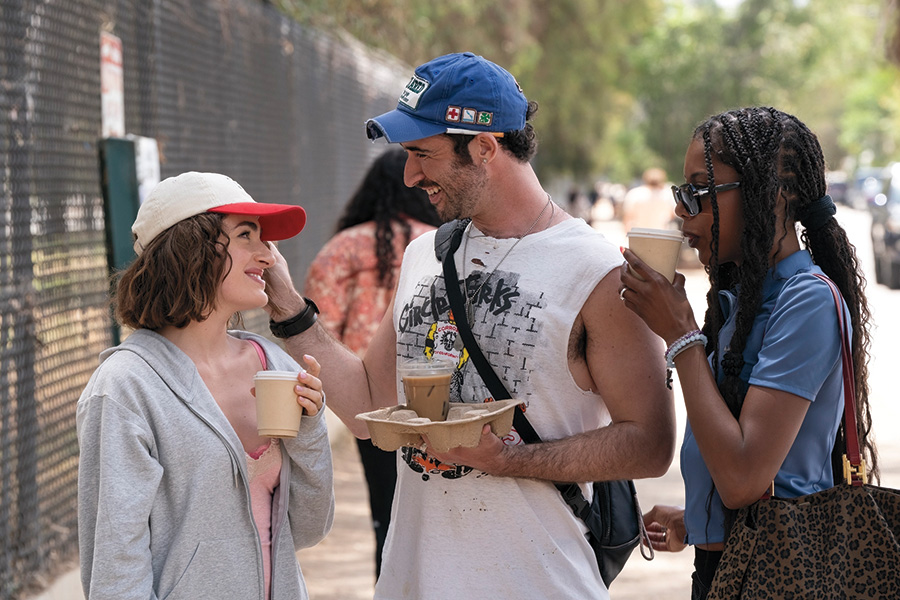
What does it feel like to be on this drug, anyway? In a Vanity Fair promo video for the HBO series I Love LA, actor Jordan Firstman divulged that he dropped a beta blocker before arriving at the show’s 2025 premiere. “It’s amazing!” he said, gushing about how effortlessly he navigated the media gauntlet flanking the red carpet. “Your mind is like, ‘Oh, I could be nervous right now, but I don’t feel like it, so I won’t be nervous.’”
That anecdote is supported by a 1982 study involving 22 classical musicians, who, like actors, are vulnerable to panic attacks. In the paper Effect of Beta Blockade and Beta Stimulation on Stage Fright, researchers concluded, “Beta blockade eliminates the physical impediments to performance caused by stage fright, and even eliminates the dry mouth so frequently encountered.”
And perhaps more important: “The quality of musical performance as judged by experienced music critics significantly improved. This effect is achieved without tranquilization.” The control group — musicians who played their instruments without beta blockers — “showed a significant impairment of technical motor performance.” So, for frazzled actors who are torn between Method and madness … to block or not to block? That is the question.
This article is a report on a trend within the television industry and is not intended as medical advice. Readers should consult a healthcare professional before taking any medication.
This article orginally appeared in emmy magazine, issue #9, 2026, under the title "Actors' Little Helper."