

It turns out the biggest trend in television isn’t ad-supported subscriptions, greenlighting foreign productions or streaming live sports. It’s the “oner,” a long (sometimes very long) scene or sequence shot in one uninterrupted take with a single camera. There are no cuts — not in the camera, not in post — the theory being that this type of real-time coverage is more immersive and engaging, because it mimics the way people naturally perceive the world.
This cinéma vérité style was pioneered by legendary film directors, with perhaps the most famous oner of all being the "bomb car sequence" in Orson Welles’s 1958 noir masterpiece Touch of Evil. (It clocked in at 3:20.) Paying homage to their idols, young TV directors studied this lensing flex and improved upon it. Over the years, one-shots became increasingly ambitious, aided in no small part by Garrett Brown’s 1975 invention of the Steadicam, an ingenious camera rig that combines the freedom of handheld shots with the stability of a dolly.
With the arrival of smaller digital cameras, combined with the vast storage capacity of solid-state drives and the so-called “gimbal revolution,” oner-upmanship reached new heights — or lengths, for those timing them at home. Using three-axis motors and onboard electronic sensors to counteract unwanted movement, these super-light, portable devices transformed the field of camera stabilization, allowing the kind of mobility and framing precision that was impossible with a standard Steadicam setup.
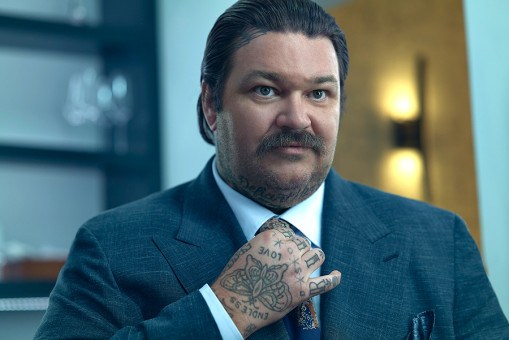
The oner has evolved from being an insider buzzword to a pop-culture phenomenon that’s now celebrated on Instagram with fire emojis. Seizing the moment, Seth Rogen parodies this cinematic infatuation in his Apple TV+ Hollywood satire The Studio. Episode two, titled “The Oner,” hilariously illustrates just how arduous, complicated and frustrating it is to shoot one of these things.
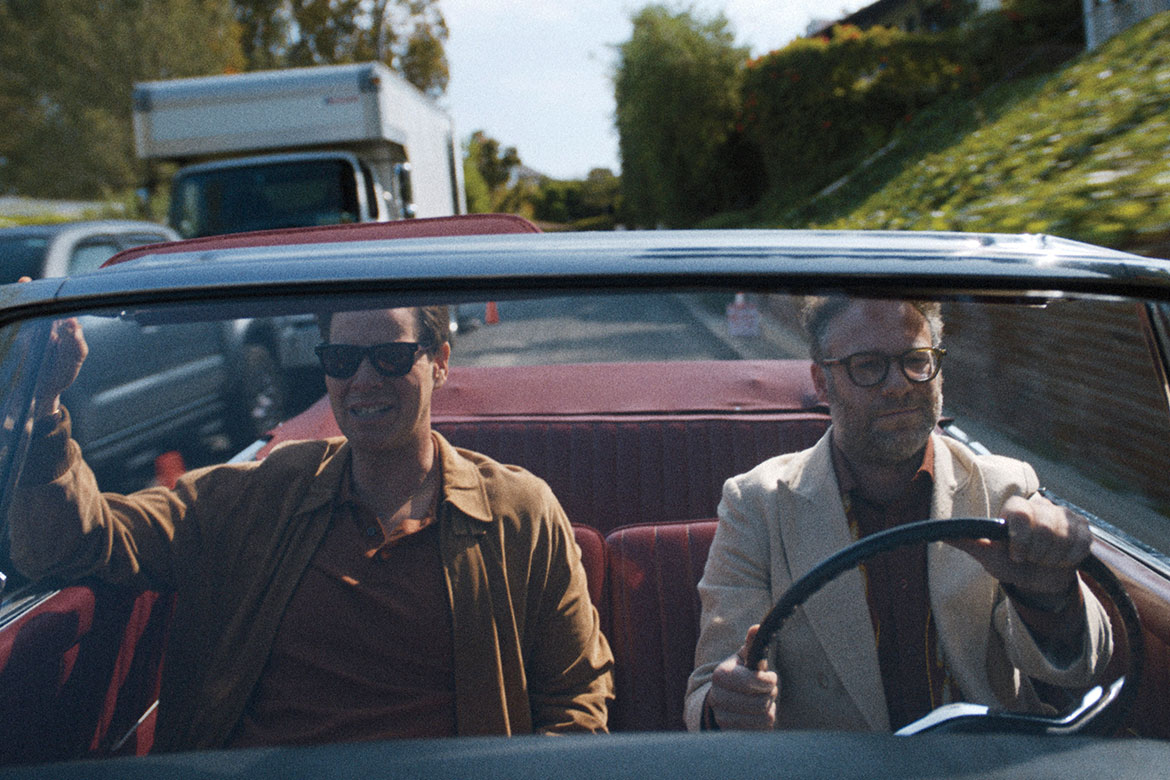 The Studio / Courtesy of Apple TV+
Rogen’s character, studio head Matt Remick, shows up on set to watch a “magic-hour oner” in progress. He soon begins offering dubious suggestions, like adding a marijuana joint to the scene. (That’s Rogen writing what he knows.) As the shoot progresses, his creative input and mere presence result in a number of aborted takes. There are audio and video flubs, as well as missed blocking and dialogue cues. Losing the light, the day ends, and the scene is scrapped. And in true meta fashion, naturally, the episode is shot to look like a oner itself.
But oners that have come before pale in comparison to what the creators of Netflix’s breakout series Adolescence have pulled off. The limited series, about a 13-year-old boy accused of murdering a female classmate, has not only spurred a debate about incel culture and male vulnerability on two sides of the Atlantic (both in the House of Commons and on U.S. talk shows); it has also shattered the record for television oner screentime. Each of the four episodes, which vary in length from 51 to 65 minutes, was shot in a single take. If you listen carefully, that sound you hear is Orson Welles clapping.
Plenty of films and episodes have been hyped as oners when in fact they were not, instead using separate takes spliced together at strategic points. Sometimes they’re cut together during a “body-crossing” (hidden by an actor blocking the lens) or over smoke or a black background. CGI can make many edits appear seamless.
Adolescence uses none of these so-called “stitch points.” From the moment director Philip Barantini said “Action!” the camera didn’t stop rolling until the entire script was shot or a take was abandoned due to human error (like bumping the gimbal into a wall, which happened) or a technical glitch (like the Bluetooth signal controlling focus-pull dropping out, which also happened). It helped, of course, that Barantini and his talented cinematographer, Matthew Lewis, had already honed their long-take skills while shooting the 2021 restaurant drama Boiling Point, a 90-minute one-take tour de force that racked up 11 British Independent Film Award nominations and won four, including Best Cinematography.
Asked what the difficulty factor was compared to shooting Boiling Point, Lewis doesn’t hesitate: “Four times the planning, four times as difficult. One-hour takes are very physically demanding.”
That’s an understatement. Imagine shooting four oner episodes 10 times, once in the morning and once in the afternoon, over five days. Each episode also required two weeks of rehearsals for cast and crew. The actors started by running lines in five-minute blocks and gradually adding pages until, by the end of a week, they were able to tackle the entire script. During these run-throughs, they also practiced blocking and hitting their marks, as in a stage play. The roadmap of circuitous lines and Xs left scant margin for error. During those rehearsals, Lewis and his crew shadowed the actors and devised their own blocking schemes, which were just as challenging. Sometimes, for instance, it was necessary for a technician to be in frame during a shot; when that happened, they were costumed to blend into the action like an extra. Staging cues were also devised for details like focus, lighting, sound and camera movement.
The intense rehearsal and shooting schedule was necessary to develop the muscle memory needed to nail four marathon takes. Despite all those repetitions, it didn’t come easy. Except for the first episode, where everything clicked on day one and take two was the keeper, the rest of the schedule was dicey. The other three episodes went down to the wire, each requiring the full shoot week and extra takes along the way. With so many variables, the threat of a dead take always loomed; there were countless camera handoffs, zig-zag tracking shots up and down stairwells, even a transfer made on the fly from a camera operator to a drone.
None of that one-shot magic would have been possible without another technological breakthrough: the DJI Ronin 4D, a small, inexpensive digital camera that, fully kitted out, tips the scales at just 10 pounds.
“We tested all the high-end cameras. We got nervous, because to get a steady shot, the camera had to be attached to an Easyrig or Steady Arm,” Barantini says. “That meant the camera could only be attached to one operator, which wouldn’t work, because we had to pass the camera back and forward multiple times.”
So, they kept testing gear and hoping for a break. It came in the form of an unlikely piece of hardware that was new to the market and widely dismissed by finicky DPs as a product suitable for TikTok influencers or music-video directors on a budget, but not for a Netflix series. The 4K test footage proved otherwise. Barantini’s enthusiasm is palpable: “It was like they designed this camera for exactly what we wanted to do: go from being fixed and steady to handheld and moving.”
The Ronin 4D’s unique, built-in gimbal design made that versatility possible. Just press a button and, as Barantini says, “The gimbal locks, and you can be quite rough with it.” He sounds more like a sales rep than a director: “This camera is unique, the first of its kind. Matt [Lewis] liked it so much he bought one himself.” (The DJI Ronin series of cameras earned an Engineering Emmy Award last year.)
With that problem resolved, relationships on the set became symbiotic and telepathic. Lewis is still in awe: “Everyone was brilliant. I don’t know how they did it in the time we had available.” Searching for an answer, he comes up with a word that’s apt for a cinematographer: focus. “The pressure involved with the oner results in tremendous focus,” he says. “There’s no room for distraction, no thinking about shopping lists or anything like that. You’re so focused and in the flow, it’s almost a meditative state.”
Lewis pauses to let this sink in. The oner isn’t about smooth handoffs or delicate, 360-degree gimbal rotations. It’s about being mindful. “It’s the sort of focus some directors want, so they ban phones and sitting down on set,” he says. “But a oner creates that atmosphere naturally, because everyone knows any mistake can ruin the take.”
Was it worth all that effort? Well, there’s already talk of an Adolescence sequel, which is hardly surprising given the show broke the Netflix eyeball algorithm: 66.3 million views in its first 11 days, more than 114 million in less than a month post-debut. With the right material — like a raw, ripped-from-the-headlines TV series that delves into teen sexuality and online bullying, where cutting away from the action to relieve tension might let audiences off the hook — maybe the long, unflinching one-shot is more engaging.
Cornell Professor Emeritus James E. Cutting, a cognitive scientist and author of Movies on Our Minds: The Evolution of Cinematic Engagement, says there’s a reason Adolescence was a hit: “Long takes can be extremely effective, and they certainly add a sense of immediacy. If one considers the camera a proxy for the viewer, and if the camera moves — panning, tilting and tracking smoothly — you’re really in the scene, and that can be exciting.”
A question remains. Adolescence credits a “Series Editorial Department.” On a show with no edits, where were the cuts? Lewis sets the record straight. “There are actually four cuts in the series: one at the end of each episode,” he says matter-of-factly. “None of us realized just how important each millisecond at the end of those scenes would be. We had to get the one cut we did right.”
A millisecond here, a millisecond there. Does it really matter? “Yes, because there’s so much emphasis on it. Those decisions took weeks,” he says. A smile finally creases his face and laughter erupts, triggered perhaps by the absurdity of it all. “Think about it: If we cut out too soon, everyone would be like, ‘Oh, that’s terrible!’”
This article originally appeared in emmy Magazine, issue #8, 2025, under the title "How the "Oner" Became a Television Art Form."