

Slit throats. Severed hands. Scalp wounds.
Gory bits that tell a story are an integral part of the Prime Video series Scarpetta, a forensic crime thriller based on Patricia Cornwell’s bestselling Kay Scarpetta book series. Adapted for television by Liz Sarnoff, the show stars Nicole Kidman as Dr. Kay Scarpetta, a skilled medical examiner who must unmask a serial killer so the career-making case she solved 28 years earlier doesn’t become her downfall. The eight-episode show, now streaming, is told in dual timelines, with Rosy McEwen playing Scarpetta in the ’90s.
Executive producer and director David Gordon Green hired special-effects makeup artist and designer Christopher Allen Nelson and prosthetic makeup designer Vincent Van Dyke to create the fake bodies and body parts that are so prominent on the show. Emmy- and Oscar-winning Nelson (American Horror Story) worked on set, while Emmy-winning Van Dyke (Star Trek: Picard) supervised the build of bodies and parts at his Los Angeles–based studio, Vincent Van Dyke Effects.
"This special-effects makeup team could build a head-to-toe, lifelike replicant of an actor, and they could also put the internal organs in," Green says. "So, when Scarpetta takes a blade to the body, we have the interior that’s just as realistic as the exterior."
Nicole Kidman as forensic pathologist and medical examiner Dr. Kay Scarpetta; with Bobby Cannavale, who plays forensic specialist Pete Marino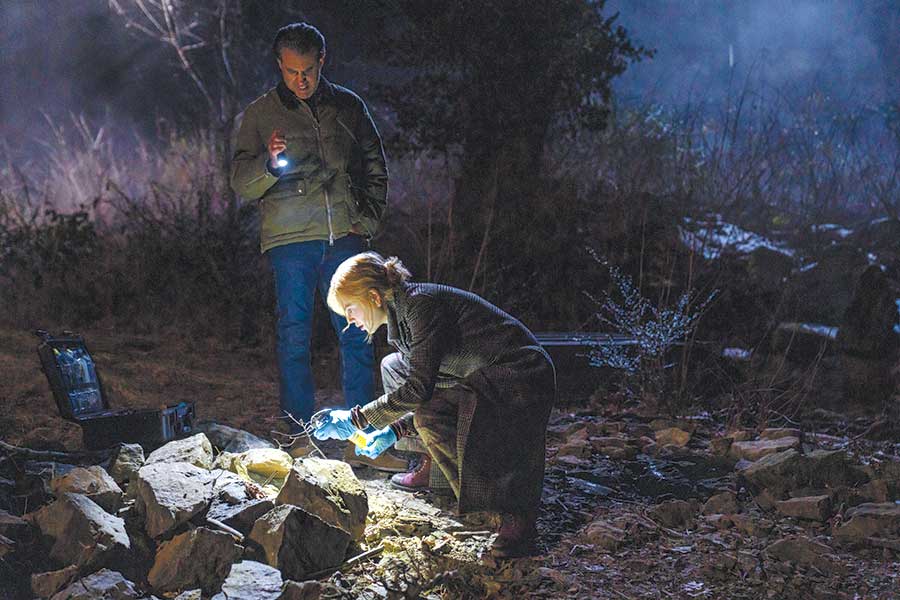
To ensure authentic crime scenes and autopsies, Green hired Dr. Amy Hawes, a forensic pathologist with 25 years of experience. Hawes, who has served as chief medical examiner in local and state jurisdictions in Tennessee, read scripts for accuracy and was on set in Nashville to share her expertise.
Hawes worked with both Kidman and McEwen, teaching them how to make proper incisions on a cadaver and sharing the emotions a forensic pathologist might feel while working. When it came to verifying the look of various special effects, she was amazed at how real the team’s creations seemed.
"Part of the learning experience for me was the difference between bodies in real life and how they’re seen through the camera," Hawes says. "Blood, for example, might look different on a deep blue cutting board in the autopsy room than on a fake body. The underlying color and the lighting make a difference."
Blood splatter is created in different ways, Nelson explains, ranging from flicking thinned-down fake blood onto an actor with a paintbrush to using a pressurized pot filled with fake blood sprayed through a hose.
Nelson breaks down each episode’s script, discussing with the director and Hawes what special effects are needed, before he designs the body parts with Van Dyke. Sometimes an actor is made up with prosthetics; other times, a fake body is needed. "In the first episode, for example, we were considering [using the actress for] a scene of the victim’s body by the railroad tracks," Nelson says. "But then we realized we’d be shooting outside, at night, in November, in Nashville. It would be very cold, dirty and miserable to do that to an actress. So, we decided to make a dummy."
Nelson says that body was one of the hardest to build, as Van Dyke’s team had to cast the actual actress in sections using medical-grade silicone while she was lying on her side. Her arms and head were all cast separately, and when all the parts were made, they had to be grafted together.
Jamie Lee Curtis as Scarpetta’s sister, Dorothy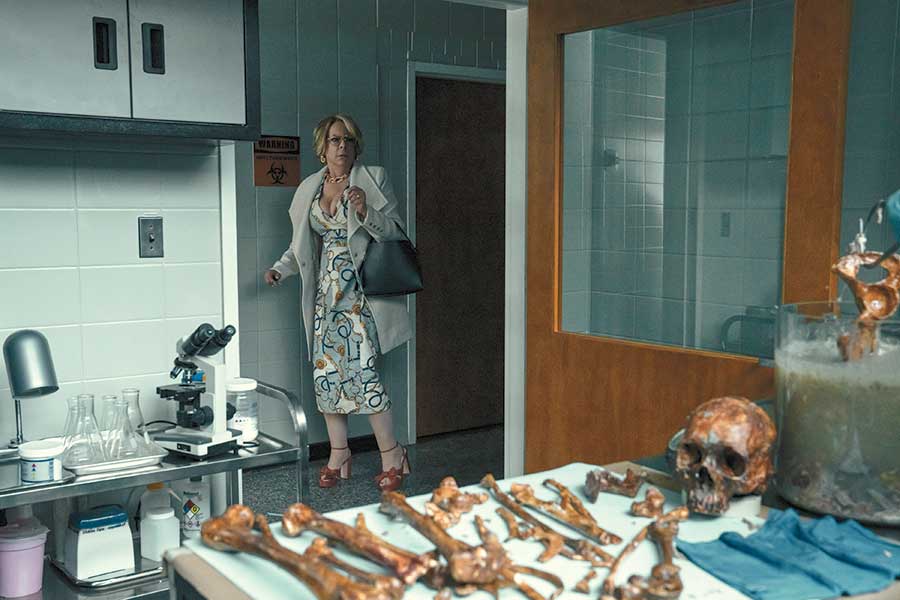
"Her hands have been severed," Nelson says. "Her throat has been cut. It’s gruesome, but it was also a beautiful piece of work and art. The way it’s lit and shot — with blue, tinted lights and moonlight — gave it a ghostly appearance."
Creating a body for an autopsy scene, Van Dyke explains, involves using layers of silicone that mimic skin, muscle and fatty tissue. A painting process adds washes of translucent colors to build up the complexion. The hair, brows and lashes are punched in. Little signs of pooling blood are added.
“We take into consideration how long that person’s been deceased," Van Dyke says. “How much lividity [skin discoloration] is there? If you’ve seen this person earlier in the episode alive, we want to make sure you can recognize the dead body."
A specialized team of 15 artists works at Van Dyke’s studio to recreate various body parts, ranging from heads to hands, based on research done online and with anatomy books.
On set, Nelson handles any unexpected issues. For example, one victim had gunshot wounds to the chest, but the fake body’s Y incision wasn’t built to open. When Hawes said it would have to be opened to extract the bullets, Nelson performed some quick surgery himself. Taking a razor blade, he sliced the silicone and peeled it back to imitate skin peeling back. He then inserted material to mimic muscle tissue, dressed it with fake blood and tucked the bullet slugs in so Kidman could remove them correctly.
"It’s not just doing gruesome stuff," Nelson says. "It’s designing a postcard for the camera — something that, when you see it, it affects you. A lot of work goes into this stuff, and sometimes you only see a second of it. I always approach it from: What story are we trying to tell? We’re trying to tell a story through visuals."
This article originally appeared in emmy Magazine, issue #5 2026, under the title "Body Building."
Scarpetta is now streaming on Prime Video.