
The surveillance state is all around us — in the cameras that watch us and even in the devices we own — a creepy reality that makes Peacock’s The Copenhagen Test an unfortunately timely spy thriller. For the lead character in this eight-episode series, premiering December 27, it’s also a waking nightmare.
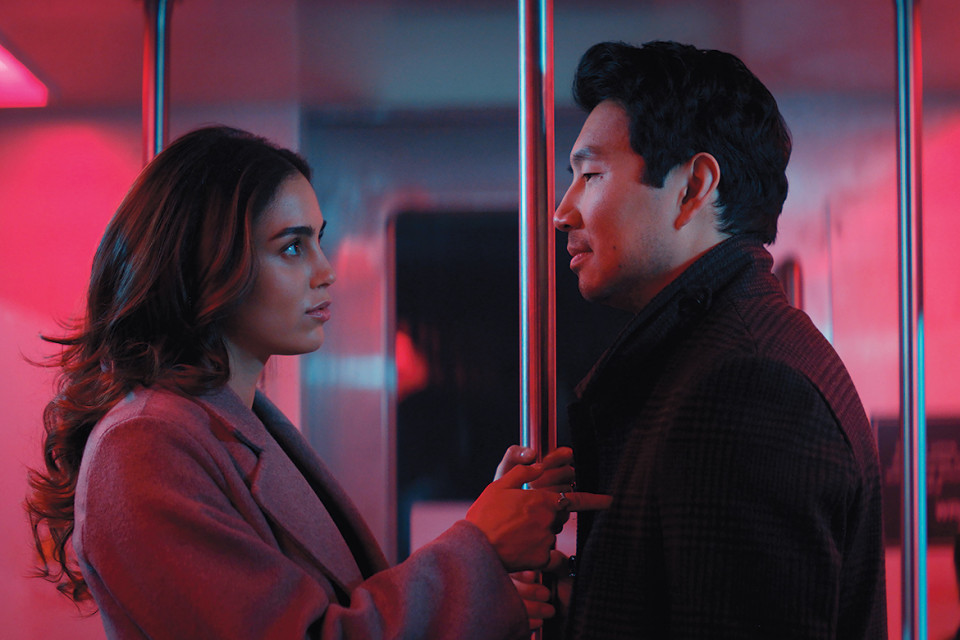
Simu Liu stars as Alexander Hale, a former Green Beret now working in a shadowy government agency known as The Orphanage — an internal affairs unit for organizations like the CIA and FBI. When an unknown enemy hacks his brain, gaining access to everything he sees and hears, The Orphanage turns the situation into a trap. They stage his life to bait the hackers, thrusting Alexander into a deadly psychological game.
Liu joined costar Melissa Barrera — who plays Michelle, the agent posing as Alexander’s girlfriend — to talk with emmy contributor Hunter Ingram about espionage, identity, choreography and what it was like to team up and face off.
This isn’t the easiest concept to pitch. Simu, what first intrigued you about creator Thomas Brandon’s story?
Simu Liu: The script came to me when I was in Sydney shooting [2021’s] Shang-Chi and the Legend of the Ten Rings. From a Hollywood perspective, I was nobody. But my agent said the script was from James Wan’s production company, Atomic Monster, and that I’d be a great fit. It was the first script I’d ever been sent — my first real attachment post-Shang-Chi — and it was such an education in how things get made. I’ve been attached to so many different things that have not worked out. Then in 2023, I got a call saying, "It’s going." I feel like it was kismet, because I don’t think I would have been ready for the lessons it had to teach me as a performer and as a first-time executive producer before then.
It’s so hard to find a unique take on anything these days. The premise isn’t easy to describe, and we all had anxiety about how to pitch it. But there’s something fascinating about someone unknowingly being a mole. There’s a little Truman Show element to what’s happening. Once you wrap your head around the idea, it’s incredibly thought-provoking — a bit cerebral but also a fun, kinetic action thriller.
Who is Alexander Hale, and why center the story on how he literally sees the world?
SL: We’ve watched a lot of spy movies that glorify what these people do. Alexander is very skilled, but there’s also a blue-collar quality to him that I wanted to lead with. It lends itself mostly to his military background. People who come to intelligence from the military will tell you that there’s an operating system that drives your decision-making. That’s who Alexander is.
Melissa, Michelle is a mystery. She is tasked with playing Alexander’s girlfriend for the people watching him. But she is a calculated, capable agent whose real story is unknown. How did you get to know an unknowable woman?
Melissa Barrera: It was a day-by-day process. When we started shooting, I’d only read two scripts, and I didn’t know who this woman was. I tried to build my own past for her, but with every new script I got, it all went out the window. It was challenging, because I never fully got to know her, even after a full season. But it was also exciting, because I could do and be anything. I could also suck as an actress, because maybe Michelle sucks as an actress. Those are the kinds of things I would say to myself after a bad day!
What was your first meeting like? Since this fake relationship is central to the story, your chemistry was crucial.
MB: We met in Toronto at the production offices. He walked in looking so fancy, and there I was looking like a hobo — old T-shirt, pants and sneakers. I asked if he always dressed that way, and he just laughed. From there, we chatted, gushed over each other and immediately made plans to hang out before shooting, to build chemistry. It was just effortless from the beginning.
SL: I’d been a fan of Melissa’s for a long time, both on screen and off. I had an idea of what she would be like and what she might bring to the table or be up for, and she exceeded all my expectations. From day one, she was just so down. It’s such an oversimplification, but it’s so important. If you want to go through every line in the script, or be in fight rehearsals for three hours, let’s do it. We were always encouraging that enthusiasm and pulling it from each other. She was just 100% down to get her hands dirty and do the work.
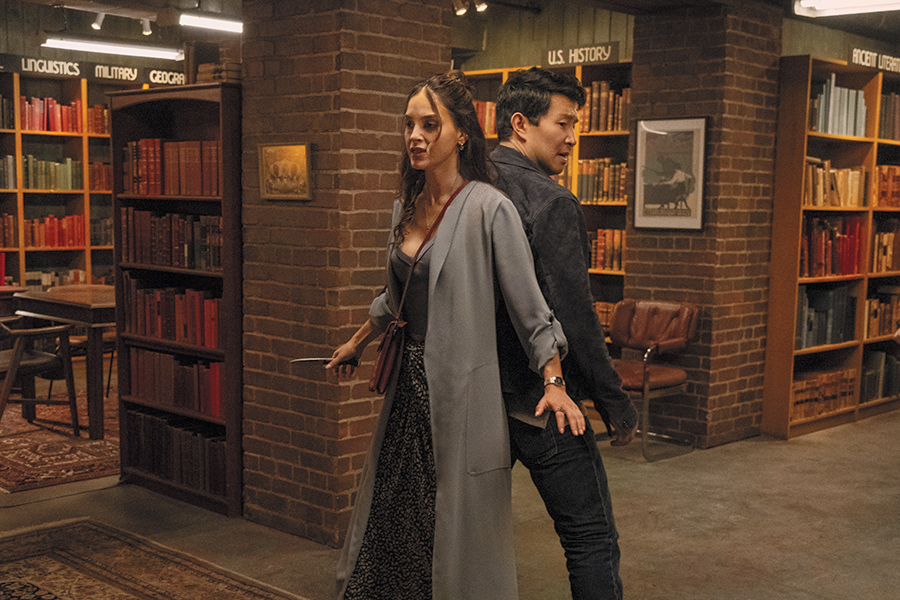
These are incredibly physical roles. Alexander was a Green Beret, and Michelle is an elite agent. What was the training process like?
SL: She has such a high bar for herself, in the best way. I wouldn’t want anyone to tell me to move on if I wasn’t fully happy with a scene, and I know she’s the same. But my favorite thing is the time between takes three and four, where you’ve done it a few times, and you’re close to unlocking something. She was right there with me. It has to feel gritty; you have to feel every punch. You can’t feel like two people who went to stunt training and have all these beats they have to hit. Every time you’re swinging, you’re swinging for the first time, and you’re swinging to kill. We spoke that same stunt language.
MB: The physical aspect is always my favorite, because it helps me get into the body of the character. I trained with Simu for a bit, but he was so busy — he’s basically in the entire show. I am not, so I had extra time with the stunt team, which I needed, because I wanted to look badass. He’s already so badass, and I wanted it to look realistic that I could take him out. I trained really hard to be able to sell that.
Simu, was it freeing to craft a fighting style different from what audiences might expect after Shang-Chi?
SL: Alexander is much more tactical in the way that he fights — it’s very grounded. Our stunt coordinators James [Mark] and Chris [Mark] and I would be choreographing, and the moment somebody did something that was too Shang-Chi, we would cut it. There were moves we banned, because we knew no military guy would ever do them. We wanted to create a unique visual language for Alexander — we wanted him to be very deadly, very good at what he does, but no bullshit.
Simu, how did you physically play someone who has been hacked? It’s not something you can just show the audience.
SL: Weirdly, it is not dissimilar to performing with a camera pointed at you. You show up on set with a bunch of lenses pointed at you and then do everything you can to ignore the fact that there are lenses pointed at you. So, we wanted Alexander to be a good performer and a good liar, whether he realized it or not. For me, it was about his eyes. Because he is hacked, his eyes are a part of the performance. It’s about where he’s looking. It’s like every scene is a sleight of hand.
Michelle is operating on a similar level of deception. Did you find it difficult to play her many motivations, Melissa?
MB: We wanted their relationship to feel complicated and layered, especially since Alexander doesn’t know who he can trust. Michelle has to be there for him, but she’s also playing him, protecting him and he’s her mark. There are so many layers to her.

This series is led by three non-white actors, including Sinclair Daniel [The Other Black Girl] as Parker, Alexander’s handler. Alexander’s life as a first-generation Chinese-American who served in the military is rarely shown on screen. What does that representation mean to you?
SL: I don’t see it as a race thing, but rather the lived experience of someone whose family is not perceived as native to the country. Even if you weren’t born into one of those specific households, everyone can relate to some level of feeling like an outsider, like you’re being held back from your true potential or your full breadth of opportunities. It’s one of the main reasons why I really responded to the script — it colors everything that Alexander does. I’m a fan of many diasporic Asian movies, and I’ve played characters with parent issues and intergenerational trauma, specifically with fathers. But it felt refreshing and special for Alexander to have two parents who love him and are proud of him, because those families exist, too.
MB: When I realized there was this triangle of leads and none of us were white, I was like, "This is so fucking cool." These kinds of shows don’t give people like us the spotlight. Usually, the spies and the heroes are all white, and we are the people around them. But this show really does look like what the United States looks like. The whole cast is so diverse, and that is what the world looks like. But I hope that doesn’t become the headline. I hope people just watch it and connect with it and then realize how cool and important it is.
In my experience, when you try to sell something by spotlighting how diverse it is, it kind of makes the show feel niche in a marketing sense. I lived it with In the Heights and Vida, and it makes the general market feel like it isn’t a show for them. But this is a show for all Americans and everyone in the world, because it is so relevant.
The Copenhagen Test is executive-produced by creator, coshowrunner and writer Thomas Brandon along with coshowrunner and writer Jennifer Yale, as well as Simu Liu, James Wan, Jet Wilkinson, Michael Clear, Rob Hackett and Mark Winemaker. The series is a production of UCP, a division of Universal Studio Group.
This article originally appeared in emmy Magazine, issue #13, 2025, under the title "Eye Spy."