
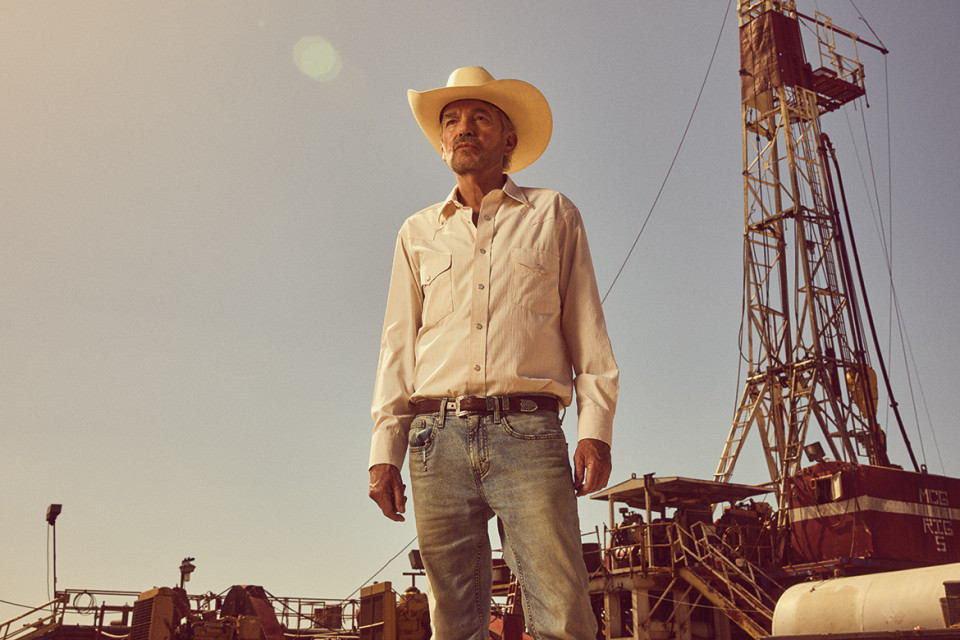
Oil and dirt. Diamonds and Western wear. Season two of Landman — a tale of roughnecks, billionaires and drug traffickers fighting for fortune in West Texas — has them all. The Paramount+ series follows oil-company fixer Tommy Norris (Billy Bob Thornton) as he navigates everything from narcotics cartels to oil-field explosions.
This season raises the stakes as Norris faces new challenges after the death of M-Tex owner Monty Miller (Jon Hamm) at the end of season one. Newly widowed Cami Miller (Demi Moore) steps in to run the business, with Norris beside her as M-Tex’s president.
On the home front, Norris contends with his brassy ex-wife, Angela (Ali Larter); headstrong daughter, Ainsley (Michelle Randolph); rebellious son, Cooper (Jacob Lofland); and Cooper’s love interest, grounded young widow Ariana Medina (Paulina Chávez).
Sam Elliott joins the cast as Norris’s father, T.L., while Andy Garcia, whose menacing cartel boss Gallino appeared in last season’s finale, returns alongside his wife, Bella (Stefania Spampinato).
Cocreator–executive producer Taylor Sheridan tapped trusted collaborators to capture the dust and drama of West Texas. Costume designer Janie Bryant (1883, 1923), set designer Carla Curry (Yellowstone, 1883, 1923) and director of photography Robert McLachlan (Yellowstone, 1923) all know how to deliver Sheridan’s vision.
The three spoke with emmy contributor Dinah Eng about the challenges they faced bringing Landman to life, working in and around the Fort Worth area.
Janie Bryant
Costume Designer
Bryant defines each character’s style through the designers she selected for them.
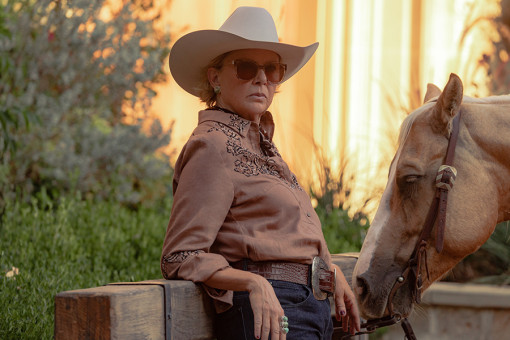
“Cami Miller [Moore] is very much Carolina Herrera, Dior, Fendi and Tom Ford,” she says. “Her character is all about luxury, old money — very Southern in a melodic, feminine way. That’s in contrast to Angela [Larter], who’s Roberto Cavalli, Dolce & Gabbana, Versace. She’s new money — flashy.”
At their first costume fitting, Larter captured her character instantly. “She was like, ‘I have to have V cuts,’” Bryant recalls. “‘I have to show my boobs.’ So, we figured out all these ways to accent her bosom, which was really fun. I told her that when I designed Mad Men, everyone called me the boob doctor. So, I guess I’m in the right place.”
Bryant, who also dressed Randolph in 1923, says the directive for the actress’s present-day, college-age character was, simply, “as little clothing as possible.”
For Ariana (Chávez), the look was Boot Barn simplicity: Wranglers, Levis and spaghetti-strap camisoles under plaid shirts.
“A white or light shirt is very important in Texas, for protection,” Bryant notes. “You need your arms covered because of the sun. For Tommy Norris [Thornton], clothing isn’t a priority, so I kept him in whites, beiges and grays.”
Boot Barn also outfitted Cooper (Lofland), who wears Cody James shirts, Wrangler jeans, Western belts, boots and Texas Tech hats. “I love the contrast between Cooper and Tommy,” Bryant says. “I used darker tones for Cooper and lighter tones for Tommy. They’re in a lot of scenes together, so it was important to break up those colors and see the difference in their characters.”
One of the challenges in designing costumes for a show centered on oil-rig roughnecks was matching the stains on the clothing to the oil, dirt and dust.
“My aging and distressing team was incredible,” Bryant says. “We created mixtures and formulas to break costumes down naturally, without ever using real oil or dirt. There was a lot of sandpapering, multiple TSP [trisodium phosphate] baths and layering techniques so that every piece looked lived-in and worn by men who spend their lives on rigs.”
Carla Curry
Set Decorator
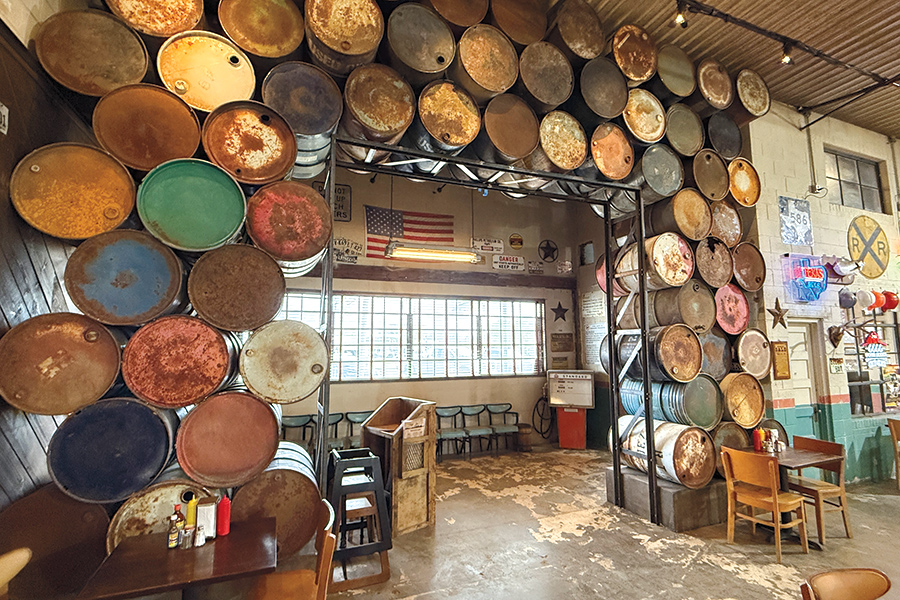
Working on Landman felt like coming home for Curry, who grew up in the Permian Basin — the stretch of West Texas and southeastern New Mexico where the show is set.
"This is something I'm very familiar with," Curry says. "In the oil field, I've had friends and family who were drillers, landmen, roughnecks. I wanted to be part of this show and am honored to step into that world."
Scenes range from oil-rig explosions to family gatherings to meetings in a billionaire's office, so Curry and her team often decorated multiple sets a day. Two in particular created tough shooting turnarounds: the M-Tex House, where many characters live, and Ariana's home, both chosen in season one for their locations and looks. Exteriors were shot on location, while interiors were built on stages.
Ariana's house is filled with consign-ment finds that feel like generational hand-me-downs — unique pieces not easily replicated. "When we'd shoot, we'd go back and forth," Curry says. "We'd have to pack everything up and move it either back to the location or back to the stage set."
Similarly, shoots at the M-Tex House required constant moves. "We called it the Saginaw Swap, because the location is in Saginaw, Texas," Curry says. "The biggest compliment I got was from Billy Bob Thornton. We were standing on location, and he said, 'I can't tell where I am — onstage or on location. It's seamless.' That was a huge compliment for our crew. They know exactly where every spoon goes in the drawer, where every picture goes."
Curry's favorite sets include The Patch — a Western-themed eatery-bar where characters can meet at all hours — and the man camp, where oil-field workers live in temporary lodgings. "That's a common sight in the Permian Basin," she says. "Man camps are portable buildings set up like small apartments. They're sparse but give a sense of community and a place to clean up and sleep."
Curry, who lives on a ranch in the Texas Hill Country with her husband, describes herself as a stickler for authenticity. "That just comes from living that life," she says. To ensure the hats hanging in the M-Tex House looked right, "I stole them from my husband. It's hard to fake a good, sweated-out hat."
Robert McLachlan
Director of Photography
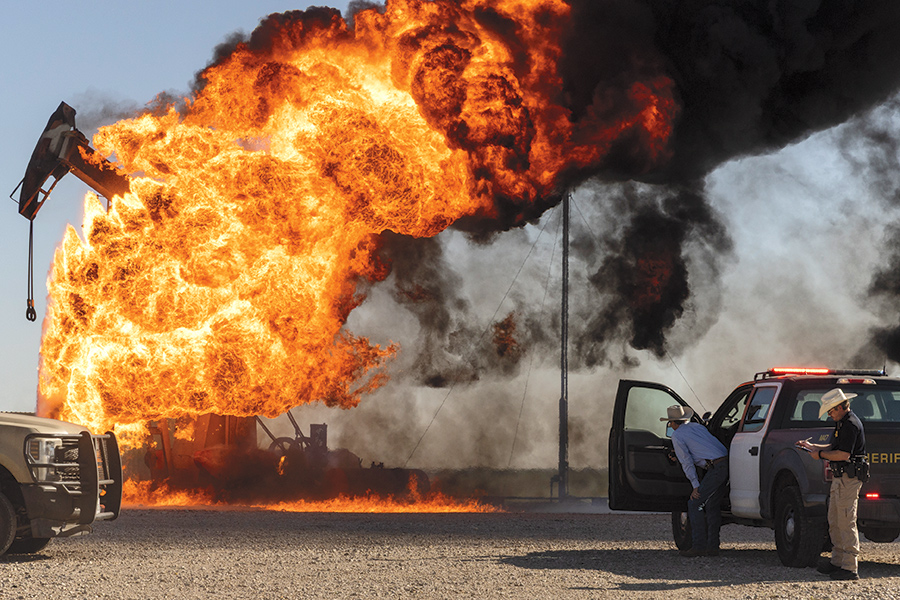
Multiple cameras and careful timing combine to give Landman its authentic West Texas look — a strategy McLachlan uses to capture the heat and aridness of an unforgiving landscape.
While he calls the dusty, gritty oil patch a miserable place, McLachlan also finds beauty in its desert-like conditions — a beauty he worked to capture on a ranch outside Fort Worth, which doubled for the Midland and Odessa oil fields.
"We were quite successful in getting the feel by using color correction and [shooting at specific] times of day," McLachlan says, noting he approached the visuals with a stylistic sensibility he calls "documentary-adjacent." He adds, "For me, that means finding the best possible places to put the cameras to tell the story, so the audience discovers things at the same pace the characters do. We're all on the same ride."
For the best light, he shoots wide shots either very early or very late, leaving tighter coverage for midday, when the light is more easily controlled. Because much of the show is shot outdoors, the hours available for filming are limited, requiring the crew to work exceptionally fast. McLachlan says that on occasion he's used five cameras for coverage, but more often they rely on three, cross-shooting both sides.
"That takes a huge amount of pressure off the actors, because it means they don't have to do the same thing over and over for every camera angle," McLachlan says. "It keeps their performances fresh."
Scenes set in Fort Worth's urban environment — home to oil billionaires and power brokers — were filmed with a cooler palette, contrasting with the warm tones of West Texas, where oil gets pumped.
One of the most challenging scenes to shoot, McLachlan recalls, was in episode two, when Cooper strikes oil. "Technically, it was a big undertaking to reproduce what it looks like when somebody strikes oil, and it erupts before anybody's ready for it," he says. "Everything was covered in what we used for oil: a milkshake-thickening material that was colored. It all had to happen at the right time of day, so that it looked gorgeous, spectacular and realistic."
This article originally appeared in emmy Magazine, issue #13, 2025, under the title "Grit & Grandeur."