
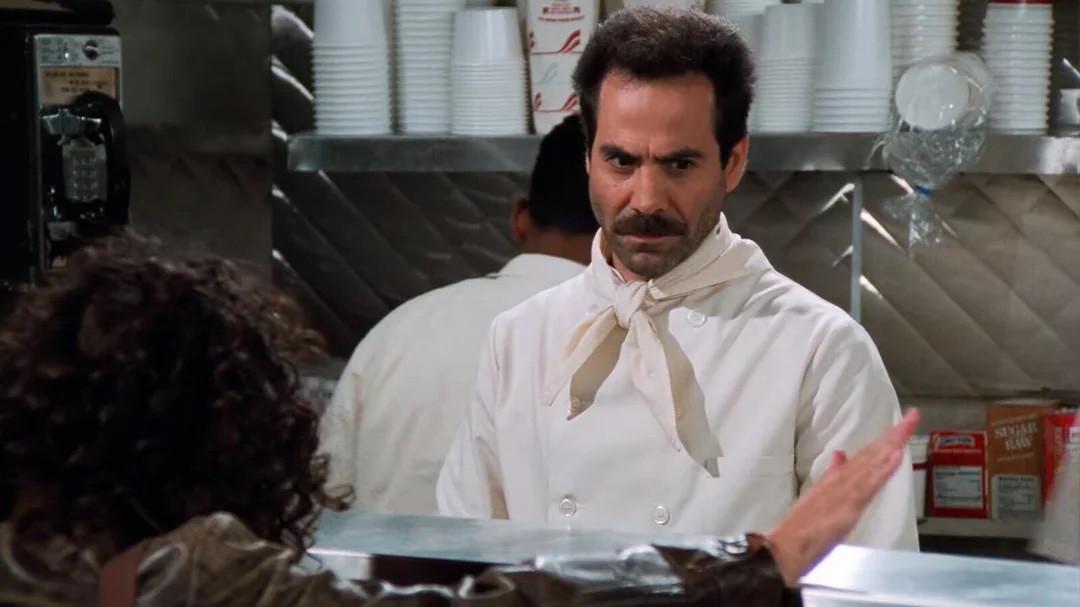
Throughout its nine-season run, Seinfeld delivered more than its fair share of classic episodes. (Think “The Contest” or “The Puffy Shirt.”) But out of the 172 episodes that the hit NBC sitcom produced, there is one that has arguably penetrated pop-culture more than any other: “The Soup Nazi.”
Even writer Spike Feresten is surprised that he’s still talking about “The Soup Nazi,” which aired 30 years ago this week, on November 2, 1995. “Soup Nazi” was Feresten’s first episode for the series — created by stand-up comedian Jerry Seinfeld and executive producer/showrunner Larry David — and it didn’t feel particularly noteworthy or special at the time. Especially since Feresten was convinced that, while writing it, he would be fired.
“When we finished [the episode], I thought I had just made the worst episode of Seinfeld,” Feresten recalls. Of course, the writer couldn’t have been more wrong — “Soup Nazi” is one of the most beloved episodes from the infamous show about nothing. And it owes its origins to an experience its scribe had while working and living in New York City (more on that later).

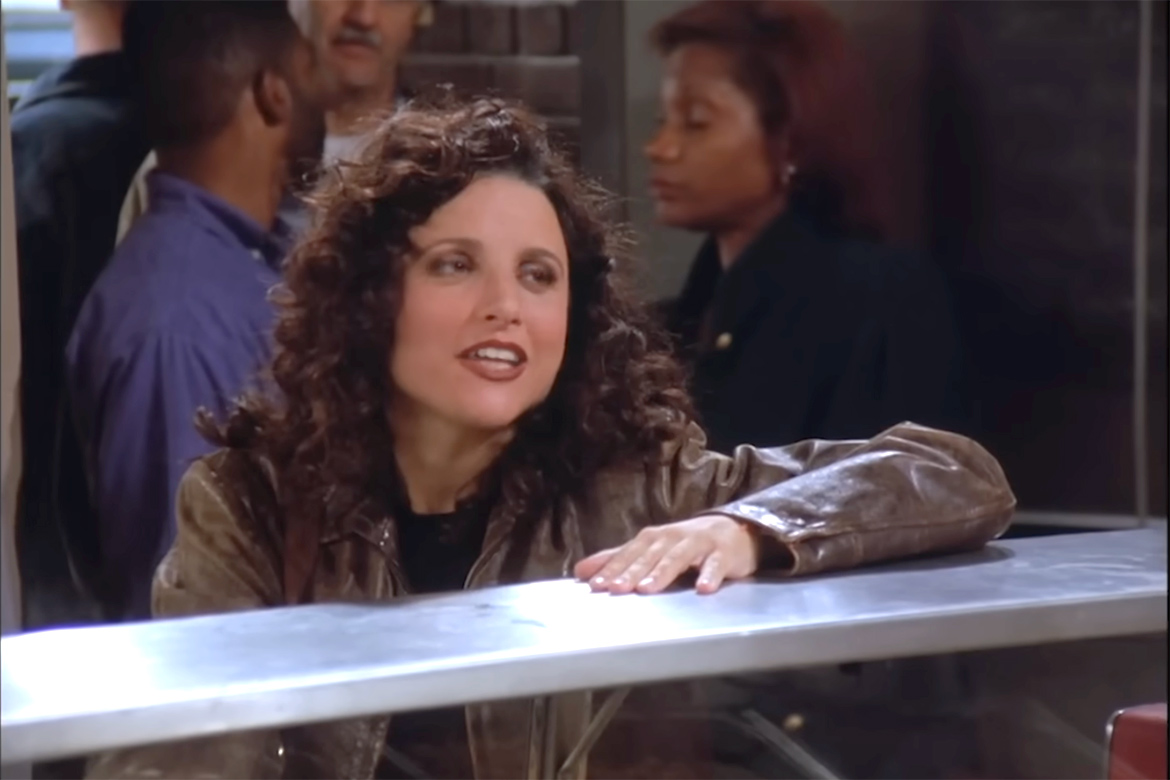
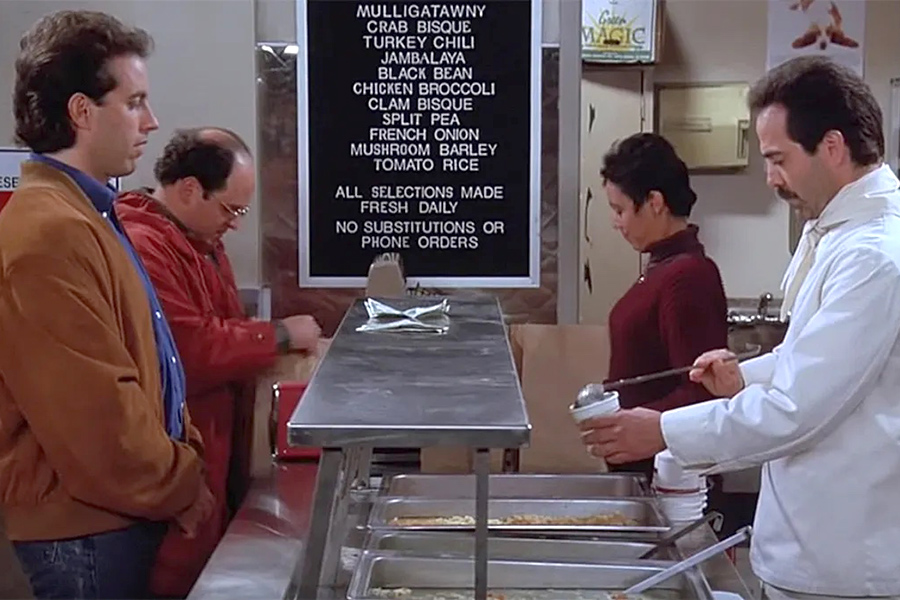
In the sixth episode of the seventh season, the gang is abuzz about a soup place where the owner, nicknamed the Soup Nazi (Larry Thomas), makes the most amazing soup. “You will be stunned,” Jerry (Jerry Seinfeld) promises before they venture into the restaurant. But, Jerry warns, there are specific rules to ordering; if there’s any error or misbehaving, the Soup Nazi shouts, “No soup for you!” and denies service. George (Jason Alexander) found that out the hard way. So did Elaine (Julia Louis-Dreyfus), who was famously banned from the establishment after telling its proprietor he looked like Al Pacino.
Other stories in the episode include Jerry and his girlfriend, Sheila (Alexandra Wentworth), annoying everyone by repeatedly calling each other “schmoopie” while Elaine buys an antique armoire off the street that ends up stolen — even though Kramer (Michael Richards) was guarding it. (It also ends up being home to Soup Nazi’s secret recipes, which Elaine uses to get some very comical revenge at the end of the episode.)
“Soup Nazi” helped earn Louis-Dreyfus her first Emmy win (she submitted both this episode and “The Wait Out” for consideration that year), while Thomas was nominated in the Outstanding Guest Actor in a Comedy Series category. Feresten’s script, the one he thought would lose him his job, was nominated for Outstanding Writing for a Comedy Series.
In honor of the episode turning 30, Feresten tells the Television Academy how his own life influenced elements of the episode and how we weaved the various storylines together.
Television Academy: Did you ever think you'd still be talking about this episode 30 years later?
Spike Feresten: Well, I haven't stopped talking about it. And, honestly, it was my first year on the show, and when we finished, I thought I had just made the worst episode of Seinfeld. [The feeling I had] was the complete opposite of, “We'll be talking about this in 30 years.”
I remember looking at Larry David when he was editing the episode next to me and just going to myself, “This guy's gonna fire me when this thing airs. This is not a good episode of television.” And I think I misread Larry, I think he was just tired. I remember him saying to the editor, “I can't look at this anymore. It's done.” And I misinterpreted that as, “Boy, he hates this. It was nice while it lasted, and I enjoyed my time here.”
Elaine's first encounter at the counter was based on something Feresten witnessed / NBC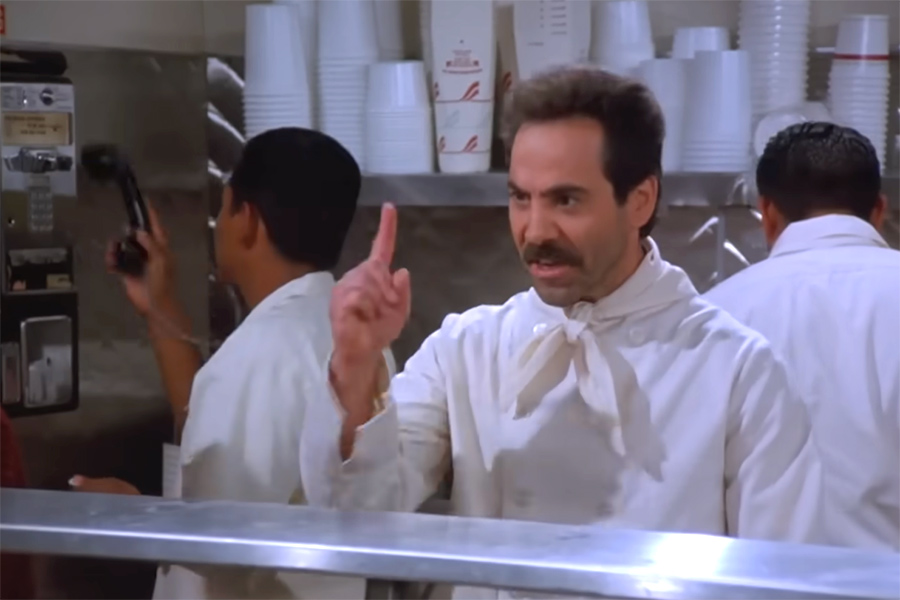
How were your nerves before even watching and writing this episode, since it was your first credit on the show?
My nerves are never good, but I was especially nervous. I was in the very first month or so of my contract [on the series] as a writer. I had just come off [working with] David Letterman where, every nine weeks, you could get fired — it was just in your contract, so you were always pushing and pushing. And then that ninth week would come along and, whether you did well or not, you still thought at any minute they could lower the hammer. I was always working as hard as I could just not to get fired, really. And it really motivated me to push and do well in a space that I had not worked in before, which is half-hour sitcom writing.
And this was Seinfeld’s seventh season. At the time, it was the number one sitcom and number two show on television. Second only to ER.
It was a pretty big deal. When I came out [to L.A.], I was coming off David Letterman, where we had a 14-story building right there on Broadway. I thought, “Well, Seinfeld, hell, that'll be 30 stories high. That'll be a big-ass skyscraper full of people.” And I couldn't have been more surprised when it was this little bungalow at CBS Radford with just the writers. I went, “This is it?”
I was very excited to be at CBS Radford because they had shot Gilligan's Island there, and the lagoon was still there. One of the first things I did was go to the other side of the lot, see the leftover body of water and go, “Oh my God, I've made it.” But the nucleus of creative power of Seinfeld was surprisingly humble and simple. It turned out to be really nice, I just didn't know that at the time. I was just at the beginning of this thing.
There’s a lot going on for the character in “Soup Nazi.” What were the origins for those storylines?
It was my very first pitch session, and I was pitching 10 shreds of stories. And when you pitch stories on Seinfeld, it was really just telling stories from your life. Like, “Here's what happened to me and I think it could work as a Kramer story,” or “I think it could work as [an] Elaine [story].” I had been told that if I'm telling these stories and Jerry — and, more importantly, Larry — starts laughing out loud, then you're doing okay. That’s going to turn into an episode.
I pitched these stories and I didn't hear [them laugh]. Towards story [idea] nine or ten, I was getting the flop sweats. I was nervous, and there was this little lull. And Larry said, “Well, what else is happening in New York?” So I just launched into this story and I said, “There’s this weird guy we call the Soup Nazi, where we all get lunch.” And [Larry] started laughing and he went, “The Soup Nazi? Why do they call him that?” So I told him: “If you don't order your soup properly, he gives your money back and doesn't give you the soup. Either you fall into line with the group or you don't. And if you don't, everybody turns away. Nobody acknowledges what happened to you or the rudeness you had just received.” He said, “There you go. That's your episode.”
What were some of your real experiences that made it into the episode?
My experience with the Soup Nazi is all over this thing; it’s more of a documentary than it is a comedy. At the beginning of the episode, when George is going in [to order soup], that's me going with my friend and me reassuring him, “I know how to order soup. You don't need to keep lecturing me about how to hand the money.” And I was rejected that first time because I was arrogant — I wasn't listening. When Elaine says to [the Soup Nazi], “You kind of look like Al Pacino,” and bangs her hands on the metal counter, that happened to a woman in front of me. The only difference is the real Soup Nazi swore at her and told her to get the “eff” out.
But the bottom line was the soup was really worth the trouble. On a cold winter day, his Mulligatawny just made you feel great. He really was a genius. I think Kramer says, “He's a misunderstood genius,” which I think is a Larry line. Michael really nails [the delivery] with that line.
I was also so hung up on the exact way everything looked, but Larry really woke that episode up. He put the Soup Nazi’s assistant in [the script], who had that great move with giving the money back. That did not exist; that was not a real part of the Soup Nazi’s thing. But I remember when [Larry] put that in the script, and I was like, “There you go.”
Did you have a hand in casting Larry Thomas as the Soup Nazi just because you had interacted with the real guy?
What was wonderful about working with Jerry and Larry that season is — if it was your episode, you were involved with all of it. You were in on all the casting, you were in on the editing. You and the other writers would be on the floor with [Larry and Jerry] the weekend before, when they would lock themselves in their office and rewrite the script themselves. But you were expected to sit outside that office and they would occasionally come out and ask things like: “What kind of person steals an armoire?” And [the writers] would go, “Well, maybe two gay designers or a gay couple would want it.” And the door would slam for two more hours.
So that’s how you came up with the gay men who steal Elaine’s armoire. They were so fun.
Yul Vasquez played Bob and John Paragon was Cedric. Unfortunately, John passed away in 2021, but I remember we were trying to find a line at the end of one of the Soup Nazi scenes and a customer was speaking Spanish. We needed an out to the scene. John — out of the blue — just goes: “Adios, muchacho!” He tossed that line into the script and made it right into the show. I don’t rewatch the episodes, so I had forgotten about that. But I was just thrilled that John was there because I was a huge Pee-wee Herman fan, and I loved Pee-wee's Playhouse [where Paragon played Jambi the Genie and voiced Pterri the Pterodactyl]. It was pretty exciting; it was probably why he was cast.
Even the armoire story is based on a real thing that happened to me. I had gone to the 26th street Flea Market and bought an armoire; I had it delivered at 4 o'clock on a Sunday afternoon. The manager of my apartment building came out and said, “There’s no moving furniture on Sundays.” In real life, I said, “Here's a little money. Can you just let me at least bring it into the basement?” So he did, and that was fine. But that's where Seinfeld stories lived.
How challenging was it to weave the stories together, like Kramer getting a new armoire for Elaine after it’s stolen but he actually gets it from the Soup Nazi?
We were always looking for connections. It wasn't just this episode, especially seasons seven, eight and nine. The connections were in all stories. It was a strange kind of board game where it was like, “Okay, if she has the armoire, what could she technically find in the armoire? And if she has [the soup recipes], then she could do this.”
I remember Act Twos [in scripts] being a lot easier than Act Ones. If you were able to get to a good act break in the first act, you felt a little bit of relief and more relaxed. But I always thought that the fun part of writing Seinfeld was looking for those connections.
Where did the Jerry and Sheila story come from, with them constantly calling each other “schmoopie?”
That was me. That was a girl I had been dating when I was in L.A., when I first got hired on the show.
I can't remember the words she used but they were these public displays of affection that were really annoying. I remember asking a friend of mine, “Does that annoy you when she does that?” He goes, “Oh, it's really bad.” I remember pitching it to Larry and he says, “There's a guy who sits across from me who's got a girl who's doing the same thing, and it's bugging me. Let's do that story.”
I think the “schmoopie” came from Jerry. I think that was a rewrite because I think, originally, I had been writing “sweetie” and little terms of affection that were more cliché. The one thing Seinfeld hates is cliché. Schmoopie really, really sounds like Jerry.
 Jerry and George at the counter / NBC
And Ana Gasteyer has a small role in the episode as a woman kicked out by the Soup Nazi. This was the year before she joined Saturday Night Live, so how did she come to Seinfeld?
Talent always finds a way, right?
In those casting sessions in general, there was always one person that would walk in and just nail it — and that was Ana. I didn't know who she was at the time; I know who she is now. But I went, "Wow, there you go. You're in."
Since you initially didn't think it was a good episode, when did you realize that people actually really liked it?
A few weeks later, it airs and the internet has just been born. And there's one Seinfeld message board and it says, “Soup Nazi. Worst episode ever. 9:45, Mike.” We aired at 9 p.m. and this was [posted at] 9:45. There's no other post, and it just confirmed everything I believed. So I went to this bar called Lola's with some of the writers, and I drowned my sorrows. I go, "I can't believe this is probably the last time we'll all hang out together."
The next morning, I came in [to work] — I was so afraid of the hammer falling on me. We're having this staff breakfast, Jerry's assistant came in and she went, "Have you seen what's going on?"
We all went into the other room and, all over the New York news, was the real Soup Nazi. Everybody in media, apparently, was having lunch there and immediately recognized that Larry Thomas looked exactly like the real guy and acted just like the [real] guy. It just lit up the New York media, and that was the beginning of the craziness. The ratings were great. I remember when the rerun aired, it aired with the rating at the same level — which was rare.
The episode had 33.1 million viewers, which was the live number, since there were no plus-threes or plus-sevens back then. That's a huge number!
It was a big deal — and we did it twice [with the rerun]. And it means it's exactly a blessing and a curse. As I get older, it's nice to have something that people have seen and they can't believe that they're meeting the person that wrote that episode.
At the same time, it's like coming out of the gate with something that big. It's like, “Gosh, what do you got for me next?” That's the curse. But I'm cool with it.
This interview has been edited for length and clarity.
Every season of Seinfeld is streaming on Netflix.