
Lisa Simpson, true crime solver?
Well, sort of. Yeardley Smith, who has voiced Bart’s brainy little sister on The Simpsons for more than 35 years, has another long-running gig: Since 2017, she has cohosted and coproduced the podcast Small Town Dicks, which examines how crimes in small towns throughout the country were investigated and solved.
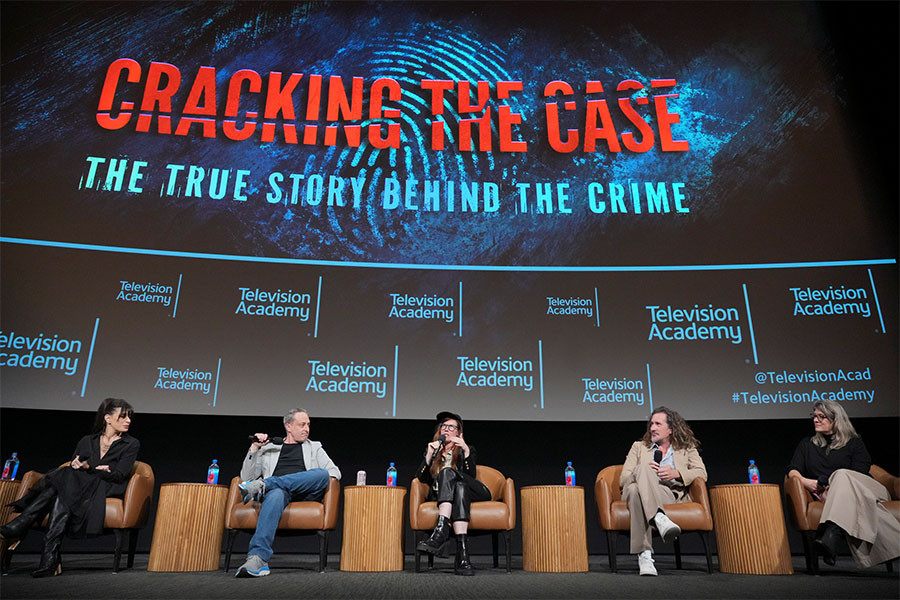
With more than 200 episodes under her belt, Smith was a savvy choice to moderate the Television Academy’s November 18 event “Cracking the Case: The True Story Behind the Crime,” a discussion among television creators of the true crime genre. Joining her on stage at the Saban Media Center in the NoHo Arts District were documentary director-producer- cinematographer Skye Borgman, whose credits include My Father, the BTK Killer and Unknown Number: A High School Catfish; Ian Brennan, cocreator-executive producer-writer-director of Monster: The Ed Gein Story; Erin Lee Carr, cocreator-director of Murdaugh: Death in the Family; Ari Mark, owner-director-executive producer at AMPLE Entertainment and codirector of Amy Bradley is Missing; and K.J. Steinberg, creator-writer-showrunner, The Twisted Tale of Amanda Knox.
What attracts creators to true crime stories? Smith’s own theory, she said, is that “we want the good guys to win.” For Borgman, “It’s really the curiosity and the confusion and trying to figure out how something like this could happen: how people act, the way that they act, why they do the things they do. I’m not always completely able to find out the reason why something happened, but just that digging and that finding is really interesting to me.”
Carter believes, “We watch true crime because we’re really scared of it happening to us, and we are preparing for when that eventuality happens — understanding that evilness and how to sort of safeguard against it. But now I just feel more scared than ever at night!”
And for Mark, whose Netflix docuseries about Bradley’s still-unsolved 1998 disappearance from a cruise ship sparked new leads, his initial reason — a fascination with human behavior — became instead the realization that “we can leverage the [television] platforms. Having worked with a lot of families over the years [in unsolved cases], I genuinely believe we can actually find people and bring justice to people. When you can instantaneously get that kind of information to billions of people, clearly it makes a difference.”
Creators of scripted programs may still take somewhat of a documentary approach to their works. Carter, for instance, assembled a 400-page binder of factual material for the Hulu Murdagh series, about the mysterious deaths that befall a wealthy and powerful South Carolina family. On the other hand, noted Brennan, a veteran of several scripted true crime programs, “We say from the beginning that we are doing a painting, not a photograph. That frees you up; you’re not as tied to this fact, this fact, this fact, this fact. You can sometimes tell a truer story.” The character of concerned neighbor Glenda Cleveland in Netflix’s Dahmer — Monster: The Jeffrey Dahmer Story — whose portrayal garnered Niecy Nash-Betts an Emmy Award — was a real person, but as written for the series, was “a pastiche that if you were telling the real, factual story, would have been broken up in five or six different people, and it would have been sort of lost, as it was lost [in real life, when police ignored people’s suspicions] at the time. [This approach] can get us some big capital-T truer nuggets than I think we would have if we were doing a much more documentary-style approach.”
In both scripted and non-scripted programs, creators need to decide which facts are depicted on screen and which are excluded. Brennan wouldn’t show acts of sadism. Sometimes nuggets of truth might slow the story progression. Standing before a whiteboard in putting together a show, Carter said she thinks about, “What do I need to say? And if I put out this thing, and I don’t say this, will it still be the truth?”
Not all stories get to be told, with the chief obstacle usually being access to those involved. “The north star has to be the family,” Mark said, recalling a proposed project where the victim’s mother was too exhausted to participate — and the FBI also told him not to touch the case. Other times, key figures may be unavailable, but creators devise alternative ways to tell the story.
For Hulu’s Amanda Knox, about the U.S. student in Italy tried and falsely convicted for the 2007 murder of her college roommate, Steinberg had Knox’s blessing, but had to contend with the Italian legal system, whose “threshold for defamation is quite low,” she lamented. “I was in Italy writing and editing four scripts at once, and being on Zooms of 30 people, Italian lawyers combing through every single word on every page.”
How did she resolve the situation? “You cry a lot, you pound on the desk and you say, ‘This is Amanda Knox’s voice. Are we going to perpetrate this against her again? This is supposed to be her moment to have the mic.’ And they bend as much as they can, and I bend as much as I can, and I fight for things that are really, really important. It was tough.”
Even without such battles, telling true crime stories can take a toll on creators’ mental health; some panelists are in therapy. Beyond the actual subject matter, Borgman noted the difficulties dealing with unhappy family members’ feedback once they’ve viewed the finished production.
“I don't know that there is a way to come home and just leave it behind,” she said. “There are many sleepless nights. But it’s also an incredible honor to tell these stories, to be able to give this platform to families — we’re their last hope sometimes. They’ve run into dead ends with law enforcement. They’ve run into dead ends with anybody else. And we have the opportunity to shed some light on these stories. So, it’s not just darkness. There is some brightness when a case is solved, or when people feel heard for the first time in their entire lives, because you sat down with them for eight hours and listened to them tell their story. So, there is some hope that you can take away from it.”
Megan Chao and Nicole Demerse are cochairs of the Academy’s Activities Committee.
Watch a replay of the event here.
See images from the event here.