

Here’s a fact you won’t find on a holiday card: Reindeer like cable.
Not to view — to eat.
CBS television crews made the discovery during the network’s transmission of the 1994 Winter Olympic Games from Lillehammer, Norway.
“During the opening ceremonies, it was kind of a challenge,” recalled Barry B. Zegel, who was the network’s Director of Olympic Operations for those games. “But we got through it — and we didn’t electrocute any of [the reindeer].”
Zegel shared this reminiscence when accepting the Charles F. Jenkins Lifetime Achievement Award at the 2026 Engineering, Science & Technology Emmys, an honor bestowed on an individual whose contributions have significantly affected television technology and engineering. The ceremony, held October 14 at the Television Academy’s Saban Media Center in the NoHo Arts District, was the last event of Emmys season 2026, and this year had historic significance as well.
Click here to see the 2026 Engineering, Science & Technology Emmys Photo Gallery
For the first time since 2015 — and only the second time ever — these Emmys were a joint presentation by the Television Academy and the New York-based National Academy of Television Arts & Sciences, a significant development in that the two academies are exploring reunification after separating into two organizations in 1977.
Appearing together to welcome honorees and attendees were Wendy Aylsworth and Paul Debevec, governors of the Television Academy’s Science & Technology peer group, and Joe Inzerillo, chair of the NATAS Technology & Engineering Subcommittee. “We’re here to recognize the achievements of the companies and the individuals who continue to push the boundaries of what is possible, and advance the technology of storytelling far beyond our wildest imaginations,” Aylsworth said.
Hosted for the 10th time by Kirsten Vangsness, who since 2005 has played FBI technical analyst Penelope Garcia on Criminal Minds, now on Paramount+, the ceremony presented two sets of awards. The Television Academy bestowed a lifetime achievement and a corporate achievement award, along with Emmy statuettes to individuals and organizations comprising recognition to seven companies, all previously announced. NATAS presented Emmy statuettes for six previously announced awards and one revealed this night, plus honors for three late Television Engineering Pioneers.
Jenkins Award winner Zegel won two NATAS Sports Emmys for the 1994 and 1998 Winter Olympics, retired as senior vice president, Studio Operations at CBS Television City and was instrumental in founding the Academy’s Science & Technology peer group.
“I truly believe that technologists are as much a part of the creative process as other disciplines who bring our stories to life,” he said in acceptance. “Charles F. Jenkins was the first visionary who came up with a system that could get moving pictures through the air. The achievements that he reached were amazing. Tonight, I find myself thinking about how far we've come from those early experiments, to a world where digital high-definition television is available anywhere, anytime, on virtually any device.”
After reflecting on his career and acknowledging family and colleagues, Zegel closed his acceptance with, “What excites me most is what's coming next — the extraordinary stories our industry will tell with the help of emerging technologies. The tools will continue to change. The talent, imagination and collaboration that bring stories to life will remain at the heart of it all. So, to the Television Academy, thank you for this incredible honor.
Winners of the 2026 Engineering, Science & Technology Emmy Awards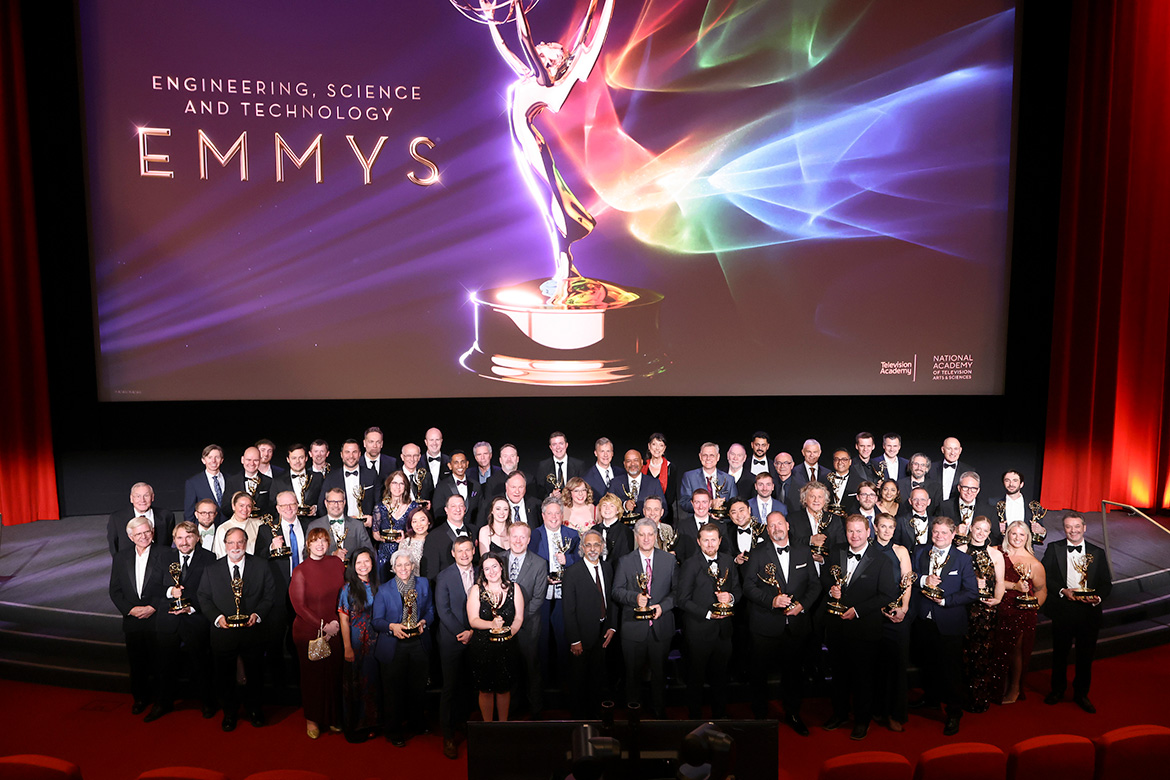
Chapman/Leonard Studio Equipment, Inc. received the Philo T. Farnsworth Corporate Award, given to an agency, company or institution whose contributions have significantly affected television technology and engineering. For more than eight decades, the company has pioneered custom camera support equipment for television and film production and sports broadcasting.
“Thank you to the Television Academy for this incredible recognition,” company president Charles Leonard said. “This award carries deep meaning for us, because it reflects the spirit that has guided our teams for four generations. From the beginning, our purpose has been to develop tools centered around the user and to provide the teams and education needed to help filmmakers capture powerful moments through movement. Our industry thrives because of people who push boundaries and the teams behind the cameras who make it all possible. Tonight is about them.
“To our global network of distributors, our team and our users, thank you. Your feedback, dedication and trust fuel everything that we do. We're proud to continue advancing innovation alongside the community that inspires us all. Thank you.”
Star Wars: Skeleton Crew, Disney+ and Industrial Light & Magic won the competitive NATAS award for Excellence in Production Technology — Application, for innovative product usage. The companies earned the accolade in recognition of the series’ use of ILM’s “Oscar” UX application, which affords control of virtual production to the user/filmmaker for easier creative decisions and scene adjustments in real time.
ILM staff R&D engineer Mike Jutan accepted, noting, “Designing an exceptional user experience comes from a deeply held sense of empathy. To be an engineer, but to imagine yourself walking a mile in the shoes of a virtual production artist, under extreme pressure to bring the filmmaker's creative vision to life in real time — the collaborative bond between ILM’s engineers and artists has long been our secret to success. Thank you so much. This is really a dream come true.”