
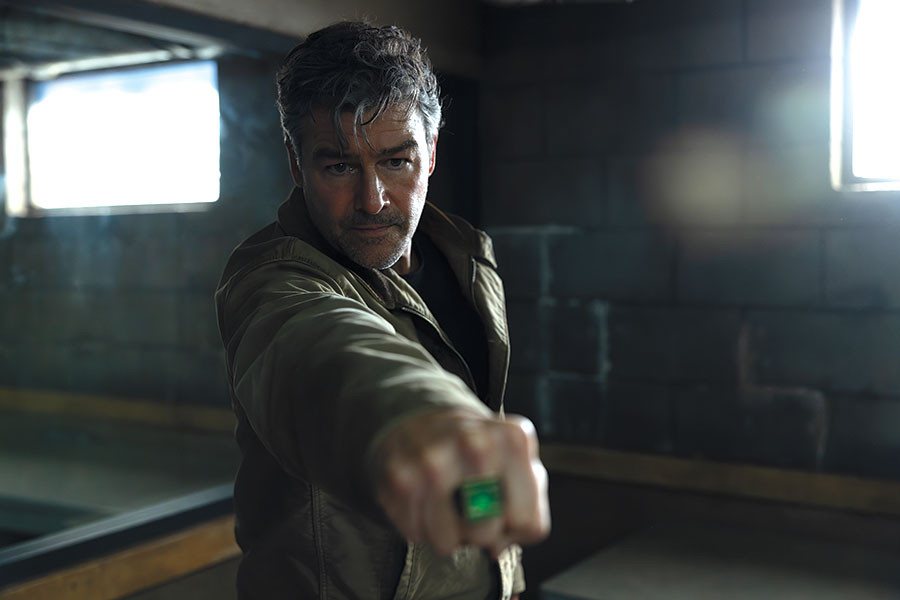
Kyle Chandler did not grow up dreaming about playing Green Lantern.
In fact, he wasn’t preoccupied by comic books at all during his suburban Chicago youth. By his own admission, he was more of a Donald Duck obsessive than someone with fingers stained by superhero mythology. The Green Lantern, who first appeared in a 1940 issue of DC forerunner All-American Comics, was entirely foreign to him. Ditto for Hal Jordan, a rebooted version of the same hero who burst forth from the pulpy pages in 1959 (six years before Chandler was born) as a run-of-the-mill human who possesses god-like abilities when wearing the mighty power ring.
So, when a script for a new HBO Max series called Lanterns was sent to him by his representatives in September 2024, Chandler’s first reaction wasn’t excitement. It was hesitation. He opened the pilot (written by series cocreators Chris Mundy, Damon Lindelof and Tom King) and read some of it. Then he set it aside.
The troika of writers saw Chandler as the prototype for who should play Hal, an intergalactic cop who must train a next-gen recruit while solving a twisty murder in seemingly placid small-town Nebraska.
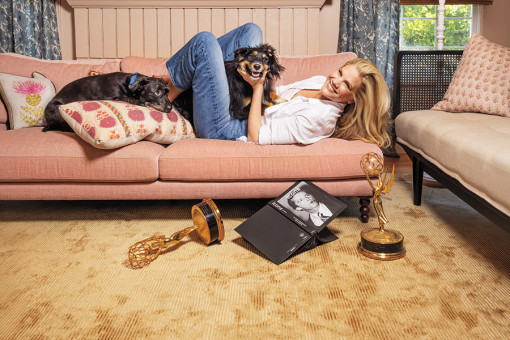
“It was like, ‘Who do we envision? Kyle!’” Lindelof says of Chandler, the Friday Night Lights star who won the Emmy for lead actor in a drama series in 2011. “He’s got the gruff energy, the cynicism, also the nobility, the humor. He’s the entire package.”
But ….
“He hasn’t done superhero stuff or this kind of genre stuff before,” Lindelof continues, referencing the noir vibe of Lanterns. “We’re never going to get that guy.”
Yet Chandler did re-engage with the script, this time sharing it with wife Kathryn and daughter Sydney, star of the FX series Alien: Earth, who was home visiting her mom and dad in Los Angeles.
“I said, ‘Would you guys read this with me? Let’s take characters and just read through the whole thing,’” Chandler recalls of the spontaneous living-room table read. “When we finished, they both literally, at the same time, jumped up off the couch and pointed at me and said, ‘You have to do this.’”
Aaron Pierre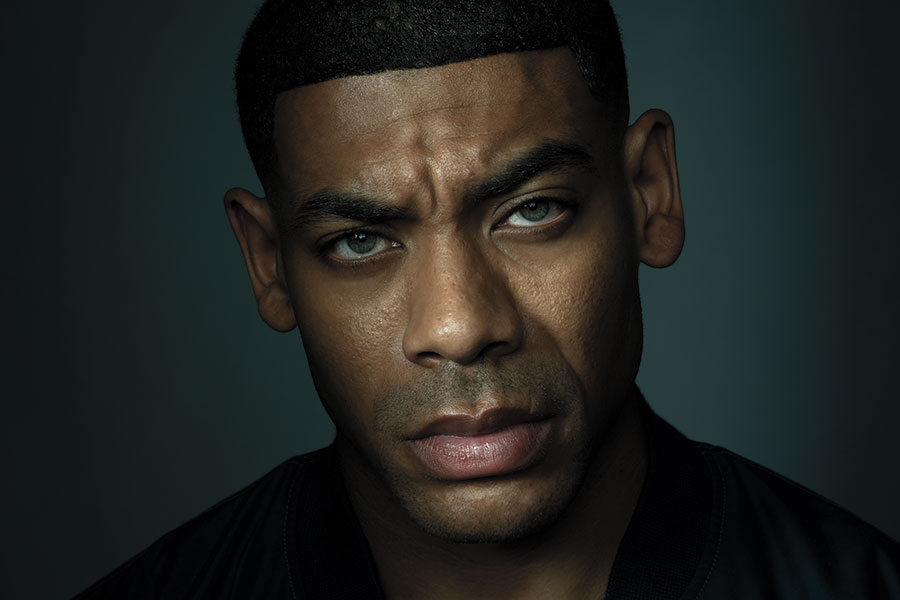
It didn’t hurt that Chandler enjoys a longstanding relationship with HBO Max original programming head Sarah Aubrey; she’d run Peter Berg’s Film 44 production company during Friday Night Lights’s heyday and was now spearheading the Lanterns effort on the network side. Chandler turned to his wife and daughter and promised on the spot to take the role. “I was excited from that moment on,” he says. “I’ve got like four lightning-in-a-bottle projects that I’ve done in my life that really stand out: Friday Night Lights, Bloodline and Early Edition.” Lanterns marks the fourth.
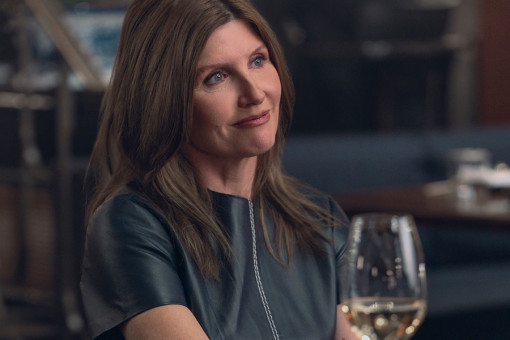
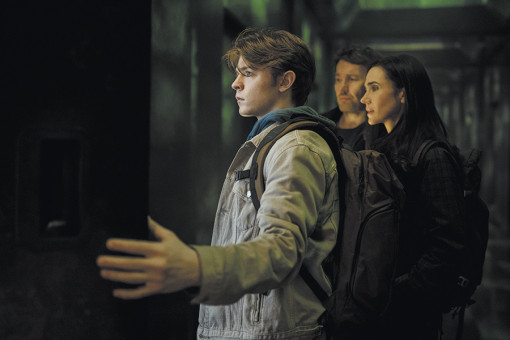
That conviction matters, considering that HBO is placing a large wager on Lanterns, the third series — following Peacemaker and The Penguin — in the new DC universe overseen by writer-director-producer James Gunn and producer-executive Peter Safran. The series, which costars Aaron Pierre as up-and-coming Green Lantern recruit John Stewart and Kelly Macdonald as pragmatic, F-bomb–dropping Sheriff Kerry, will receive a plum Sunday-night lineup slot come August 16. For decades, that perch has represented the high-water mark for drama. Indeed, the show’s comic-book origins take a backseat to its hardboiled energy; the series better resembles a recent HBO hit that Mundy worked on: True Detective. And it evokes a very different Chandler from Chicago: influential crime novelist Raymond Chandler.
“The good news is you can think outside the box,” says Mundy, a Rolling Stone journalist-turned-crime drama maestro (Cold Case, Criminal Minds, Ozark), who became the key creative voice steering the series. “And you’re not constrained by the real world.”
Of the three cocreators, King was first to board Lanterns. In late 2022, Gunn and Safran tapped the Eisner Award winner to be part of a group of seven so-called architects who would hammer out the contours of the new DC Universe. King also boasted an unusual backstory: He’s a former CIA counterterrorism operations officer whose ancestry runs through Rushville, Nebraska — the very real town where Lanterns is set. His grandmother, who helped raise him in Los Angeles alongside his single mother, grew up in that rural town of 877 people in the state’s panhandle, just 25 miles from the South Dakota border.
“My grandmother used to tell me about before and after World War II and what it was like being a little girl there. More cows than trucks. She rode a horse to school. Kind of an idealistic place,” King says, before presenting the town’s flip side. “She would tell me there were secrets, things that we didn’t talk about, like the guy on the hill who was so shellshocked from the war. She was like, ‘That town is as complicated and as dark and as mythical as the city you live in.’”
When a new Lanterns series was floated in the architects’ room — a gritty, transcendent cop drama that would replace a previous iteration that had been in development at HBO since before Covid — King quickly claimed it. “As soon as I heard it, I could see the whole show in my head,” he says. “I was like, ‘Oh my God, there’s so much potential there.’ If you got the right actors, the right environment, you could create something — this sounds stupid to use as an adjective — truly HBO peak TV.”
Lindelof, the three-time Emmy winner and Lost cocreator whose deal was at Warner Bros. at the time, signed on after Gunn and Safran offered him his pick of a dozen or so film and TV projects based on marquee DC heroes. “They did the rundown with me and were like, ‘Any of this interesting to you?’ The thing that I gravitated to was Lanterns, because all they said was, ‘We love the characters. It’s a buddy thing. It’s noir. And the guy who pitched this is Tom King.’”
Lindelof was a fan of King’s work, particularly the comics The Vision for Marvel and Mister Miracle for DC. But Lindelof had only met King, who inhabits an alternate D.C. — Washington, that is — just once, during the pandemic. (Lindelof’s 2019 DC-based limited series Watchmen featured the character Rorschach, which inspired King’s 12-issue comic series about the deranged vigilante the following year.) Aubrey was on the verge of bringing in Mundy, the final component of what would become the Lanterns three-headed Cerberus.
“You have this guy with huge comic-book cred and this guy who does crime thrillers, who’s just finished True Detective: Night Country with Jodie Foster,” Lindelof says. “I see the chocolate. I see the peanut butter. I don’t know where I am in the Reese’s equation, but maybe I overlap both these worlds.”
Still, Mundy needed convincing. He remembers asking Aubrey repeatedly, “Are you sure that I’m the person you want to be talking to?” But he began talking to King by phone, and then, in March 2023, he met Lindelof for breakfast at Great White in Larchmont Village. They didn’t discuss specifics about the show — they were simply exploring whether it would be cool to partner up. Lindelof quickly won over Mundy, and the three writers began their creative jam sessions.
They built the scaffolding for the pilot over a two-week period later that month while working in the backyard of Mundy’s home near the Paramount lot, his dogs keeping the trio company.
Two months later, the WGA called a strike, and writing across the industry ground to a halt. Mundy, Lindelof and King weren’t able to resume work on Lanterns for another 148 days. “The second the strike was over, we were on Zooms endlessly, and then Tom came out. It was this weirdly fast start and then this long middle gestation period that was probably good for the process,” Mundy explains.
They wrote the pilot at Lindelof’s offices on the Warners lot. Lindelof likened that process to “breaking a wild mustang that doesn’t want to be ridden.” Somehow, the gentling ended.
Aubrey told Mundy that they broke the HBO record for the quickest turnaround for a pilot of a big, world-building series.
“Damon and I are both wonderfully neurotic writers who care very deeply, and Chris is much more Midwest Zen,” King says. “So, it was Damon and me just throwing idea after idea and trying to top each other, and then Chris was like the ref or the umpire, always grounding us.”
In April 2024, the trio assembled a writers’ room and took over a house in Warner Village — which doubles as a standard American neighborhood for film and TV productions — and tricked out the garage, putting up whiteboards where prop shovels and brooms would normally hang. About two months into the writers’ room, HBO liked what it saw and gave the greenlight for the remaining seven episodes. The plan was for Lanterns to be a continuing series and not a limited one. Mundy would be the showrunner.
Kelly Macdonald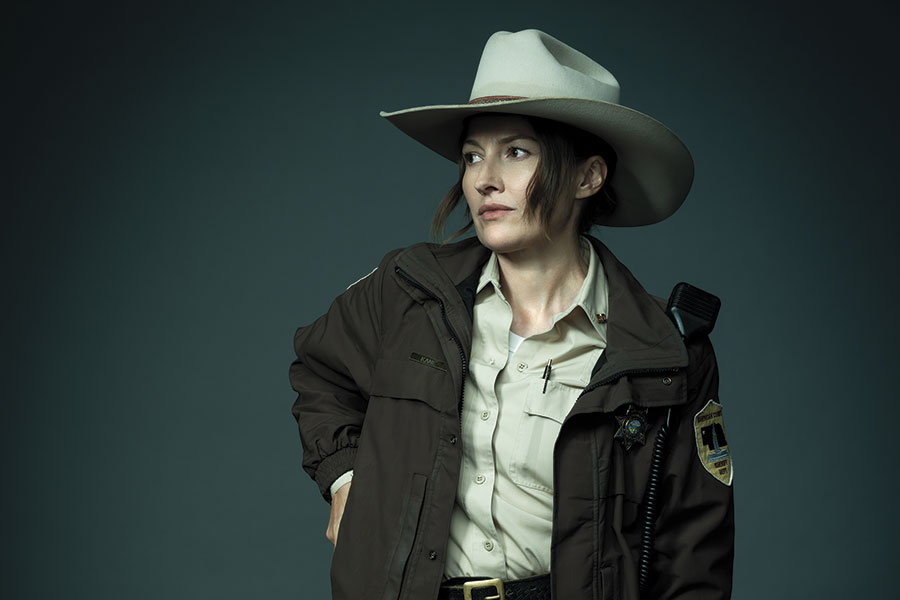
Casting became the make-or-break element.
Hal was trickier because of age considerations. The actor had to straddle a small window where he’s still vital but beginning to consider stepping aside and yielding to John, the upstart Green Lantern. “You didn’t want to put somebody that looked like they should cash in their 401(k). Kyle was a lightbulb moment,” says Mundy, who was a writer on the second season of Bloodline but never met the actor. “He’s exactly right.”
Finding their John presented different challenges. In this incarnation, he is a former Marine as well as an introverted artist. The role required an actor who could harness both the yin and yang — not an easy feat. Londoner Pierre is known for his stage work in Othello at Shakespeare’s Globe, a performance that moved director Barry Jenkins so deeply that he offered him a recurring role on Prime Video’s The Underground Railroad. Pierre’s recent television work includes The Morning Show and leading roles in Rebel Ridge and Genius: MLK/X, in which he portrayed Malcolm X. He has also landed a coveted part in Gunn’s 2027 Superman sequel, Man of Tomorrow.
“There were a lot of great choices. It went from a list of probably 25 down to seven or eight, then down to three,” Mundy says. “The thing that ended up winning the day for Aaron is a combination we always talk about: For all of Aaron’s physicality — he’s six-foot-four, very fit, boxes, was a sprinter in high school — there’s a real quietness to him, too. He wasn’t having to find either of those two modes. They were both naturally in him.”
He’s the kind of sensitive superhero who uses his power ring to light a lover’s postcoital cigarette. For Pierre, the role let him reconnect with a character that resonated on a personal level during his adolescence. (John Stewart, who debuted on the page in 1972, was one of the first Black superheroes in the DC Comics universe.)
“I wanted to see characters that I felt represented me, and I also wanted to see characters that felt competitive within the superhero space,” Pierre says. “John Stewart and Static Shock — characters that resembled me — were equally as capable, if not more capable, than a lot of superheroes. So, John Stewart was definitely an exciting character for me to win. He made me feel seen and represented and confident as a young man.”
For the Lanterns brain trust, Macdonald as Rushville’s territorial Sheriff Kerry was the easiest puzzle piece to place. The Scottish actress won an Emmy in 2006 for her supporting role in the BBC One film The Girl in the Café, and she was nominated in 2011 for her long-running role on another HBO crime drama, Boardwalk Empire. “She was the only person we talked to,” Mundy says.
James Hawes, who directed the first two episodes of Lanterns, sent Macdonald the pilot script and gave the project his strong recommendation. “I didn’t know anything about the Green Lantern or the comic, but I knew James,” she says, having collaborated with Hawes on Black Mirror. “And the fun jumped off the page, that sort of antagonism between my character and Kyle’s character. I enjoyed the antagonism between him and John’s character, too. Just a lot of fun dialogue, and it’s like a superhero caper as well.”
Alexa Fogel, the casting wizard behind everything from The Wire to True Detective, assembled the rest of the cast, including Garret Dillahunt (High Potential) as a conspiracy theory–prone cowboy. Macdonald and Dillahunt previously acted together in the Oscar-winning No Country for Old Men.
The grueling six-month shoot in Los Angeles began in January 2025. Lanterns occupied three stages on the Warner Bros. lot. The unincorporated town of Piru, located about 40 miles from downtown Los Angeles, doubled as Rushville. Some filming took place near an old military base in Pomona in the Inland Valley.
“A chunk of our special-effects budget has gone to getting rid of mountains and creating Nebraska horizon,” Mundy says wistfully. “But it doubled incredibly well.”
Macdonald frequently got lost trying to find the remote locations, including a spooky ranch. “I tapped it into my phone, and my phone said, ‘You have reached your destination.’ And there was nothing there,” she recalls. “It was so early in the morning, and I was clearly not in the right place.”
One particularly long day offered a spectrum of climatic extremes. The cast and crew took heat breaks and wore protective eyewear because of the harsh environment. But it culminated with a taste of Lanterns’ potential.
“People were in down coats in the morning, and then you’d bake during the day,” Mundy recalls. “Toward the end of the night, there was a little scene where Kyle and Aaron have a conversation across the top of a car, and I remember looking at James, and we were like, ‘Oh, this is going to work.’ There was a vibe between them. They had chemistry.”
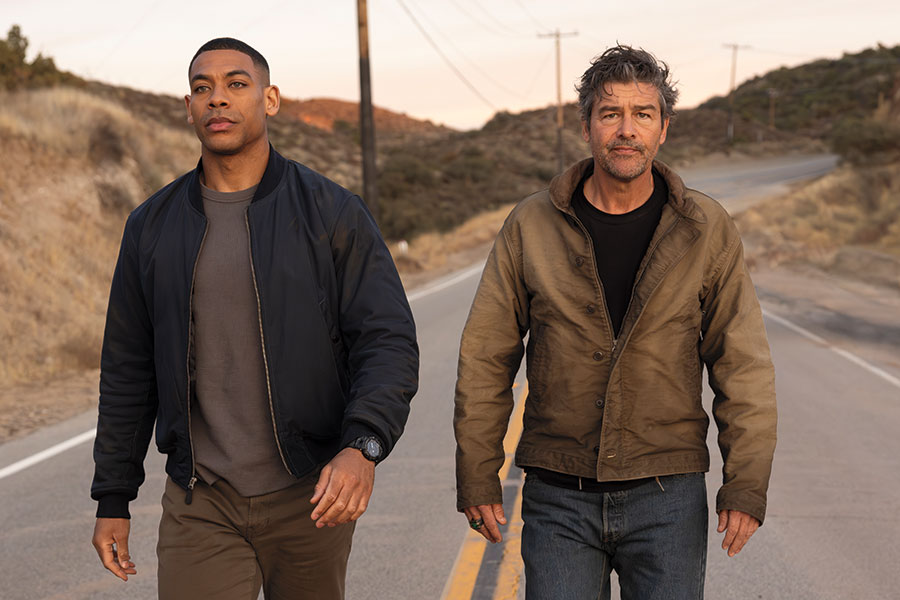
More than a year later, Pierre also remembers that scene vividly: “As a creative, you get this electric feeling when you’re in a flow state with somebody, and that’s what that felt like. However many times we needed to do it, we would do it, and we would find different nuances each time.”
For Chandler, that sequence was akin to two pugilists who had finally found their footing in the ring. “You’re trying to figure out if your game plan is going to work with this guy, what he’s going to pull out, what that dance is going to be,” he says. “And it didn’t take too long into the shooting. We’re just starting to really make fun of each other, find each other’s weak spots within the characters, and how to jab at each other and piss each other off. And once you find that, you know you can [create a moment].”
Just don’t ask anyone about a second season. King learned that the hard way. In the comic-book world, writers frequently plan 12 months ahead. So, he asked Lindelof early in the process if they should be thinking about planting seeds now for future arcs.
“When I’m in the room, I’m like, ‘What’s next?’” King says. “Damon has a rule. You don’t say ‘Macbeth’ in a theater. You don’t say ‘second season’ in a writers’ room. Damon would shut me off and be like, ‘No, son, we don’t talk about that. We’re going to get to it when we get to it, and it’s going to be brilliant. We want to put together the best season of television we possibly can.’”
Just a group of disparate pros trying to make one excellent season — and hoping the Lanterns light keeps on shining down the road.
Lanterns is executive-produced by cocreators Chris Mundy, Damon Lindelof and Tom King, along with James Gunn, Peter Safran, Ron Schmidt and James Hawes. The series is a production of HBO in association with Warner Bros. Television and DC Studios.
This article originally appeared in emmy Magazine, issue #10, 2026, under the title "In the Limelight."