
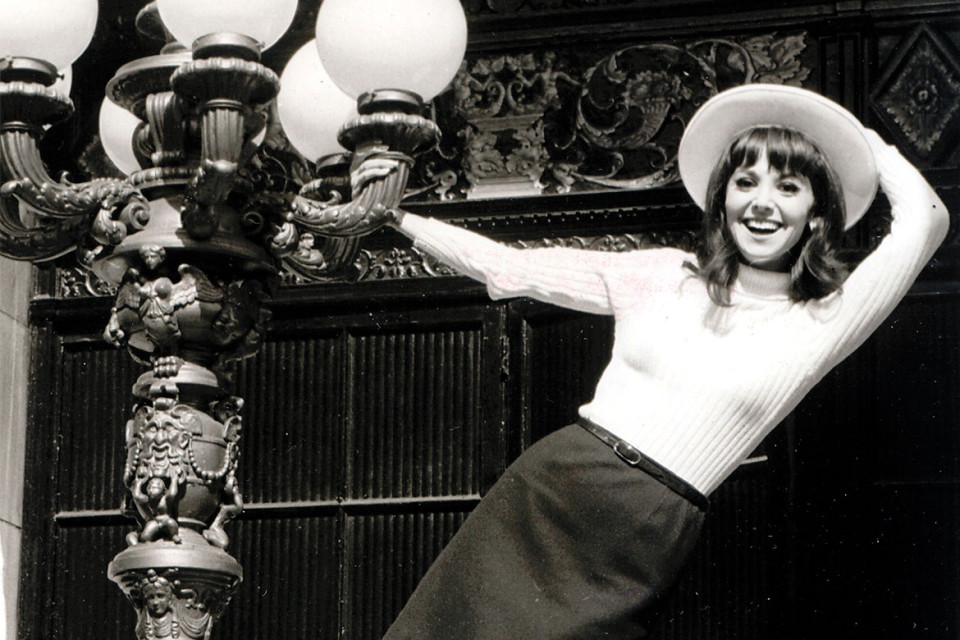
To boldly go where no woman has gone before — that was Marlo Thomas’s goal as the lead of That Girl, which premiered in 1966 just as the fight for women’s equal rights was beginning to gain momentum.
There had been a few sitcoms about single working women — Meet Millie, Private Secretary and Honestly, Celeste! — but That Girl was the first about a woman in her early 20s who lived alone in a New York City apartment while pursuing a career.
This year marks the 60th anniversary of That Girl's debut. Developed by Bill Persky and Sam Denoff, the show ran on ABC from 1966 to ’71 and was nominated for seven Emmys. (Four were for Thomas.) She was second-generation TV royalty; her father was comic Danny Thomas, star of TV’s Make Room for Daddy (later The Danny Thomas Show), which ran from 1953 to ’64.
In 1966, television was brimming with sitcoms focused on families or fantasy characters, in addition to quiz shows, game shows and variety hours. Thomas had begun her career in guest roles on Bonanza and My Favorite Martian, but That Girl offered a fresh premise and was a hit, paving the way for later sitcoms centered around single career women, like The Mary Tyler Moore Show, Murphy Brown and Sex and the City.
She played aspiring actress Ann Marie, with Ted Bessell as her boyfriend, Donald, and Lew Parker and Rosemary DeCamp as her protective parents. While trying to score substantial acting jobs, Ann found herself in wacky situations, like paid gigs as a dancing chicken and speaking mop.
After That Girl, Thomas starred in dramatic telefilms, most notably as a schizophrenic in 1986’s Nobody’s Child, for which she won a lead-actress Emmy. In 1972, she launched a multimedia franchise, “Free to Be … You and Me,” to uplift kids, and its TV component won the Emmy for Outstanding Children’s Special in 1974.
Thomas later appeared on Friends, Roseanne and Law & Order: Special Victims Unit, among other series.
She was wed for 44 years to Phil Donahue, the creator, producer and host of The Phil Donahue Show. He died in 2024.
Emmy contributor Jane Wollman Rusoff chatted with Thomas about That Girl and her other projects — past and future. At 88, this recipient of a 2014 Presidential Medal of Freedom is currently collaborating on a new sitcom.
What did you like about That Girl’s Ann Marie?
In those days, girls were very much defined by the Church, the school, parents, the pink telephone. I loved Ann Marie, because she had a dream. She wanted to try her wings as an independent single girl. She found she was strong and resourceful.
How challenging was it for you, a single woman, to executive-produce That Girl?
It was unusual for [a female star of a series] not to have her husband as the buffer between her and everybody else. When [director] Danny Arnold came around in the second year, he said, “You need a female story editor,” because it was all about what I and seven men thought a girl would say. I was the only woman. So, it was great to [add] Ruth Brooks Flippen, because then we were a little coalition.
Was the show’s father-daughter relationship based on you and your real-life dad?
No, but it had some colors of it. We started out with Ann Marie fighting for independence. But as the series went on, it became more of a partnership, which was like my dad and me.
What are your memories of Lew Parker, who played your father?
He never had children of his own. On one episode, he had a line — something like, “From the moment I saw you, I knew you were what I always wanted.” But he cried every time he tried to say it, because in a way it was the truth about him and me.
What are your recollections of Ted Bessell, who played Ann’s boyfriend?
Teddy was such a love. There would be no That Girl without Ted Bessell. He was absolutely half the show.
Was it a harmonious set?
We had the same crew for five years. On Thursday nights, all the guys would play poker on the soundstage ’til the wee hours of the morning. I would arrange for plenty of booze and sandwiches.
You’ve said that Standards and Practices was “always looking for sex … in all the wrong places.”
In the ’60s and early ’70s, free love was happening; “no bras” was happening. But on television, married couples were still sleeping in separate beds. So, a single girl on her own was a tremendous challenge for Standards and Practices. They had a lot of fear that they would miss something and be held accountable. They saw innuendos everywhere.
Before That Girl, you starred in an ABC sitcom pilot, Two’s Company, which the network didn’t pick up. What happened next?
Edgar Scherick, head of ABC programming, wanted a meeting with me. He said, “Clairol and ABC believe you can be a television star.” I was elated. So, Mr. Scherick sent me scripts to read. At our next meeting, I told him, “In all these shows, the girl is the wife of somebody or the daughter of somebody or the secretary of somebody. Have you given any thought to doing a show where the girl is the somebody?” He looked at me like I was speaking Swahili. “Would anyone watch a show like that?” he asked.
A couple of weeks later, [he and I] came up with the concept of a single girl who wanted to be an actress who moved away from home and whose parents were terrified that she’d lose her virginity. Edgar had the courage to say, “I’m not sure about this, but I’m going to bet on you, kid.”
After That Girl, you made The Lost Honor of Kathryn Beck in 1984; Consenting Adult in 1985, in which you played a mom whose son comes out as gay; and then you won an Emmy for 1986’s Nobody’s Child. Why did you choose dramas over sitcoms?
When I finished That Girl, ABC wanted me to do another series right away. But I wanted to learn more [about acting], so I started studying with Lee Strasberg in New York.
But you never abandoned comedy. How was Ann Marie different from Sandra Green, Rachel’s (Jennifer Aniston) mother on Friends, whom you played in three episodes?
She was the opposite of Ann Marie. She’d married the wrong guy and was getting divorced. She wanted to be like her daughter — free and independent. She asked, “What’s new in sex these days?”
What was your goal in creating Free to Be … You and Me?
To change the world. It was about being anything you want to be, and that you shouldn’t be held back by race or gender or anything.
After the album and the Free to Be book you wrote, you produced a star-studded Free to Be … You and Me TV special, for which you won another Emmy and a Peabody. Alan Alda and you did a song, “William’s Doll,” and football player Rosey Grier sang “It’s All Right to Cry.” You liked going against the grain, didn’t you?
Yes. And I didn’t get married ’til I was 40. I met Phil on his show. I was sure within 10 minutes of the interview that this was the guy.
He had an extremely loyal female following.
He was like the Pied Piper for women. They just adored him, because he didn’t speak down to them. It was a hell of a show: He filmed an abortion. He had on Ralph Nader debating the head of General Motors. He believed that women at home weren’t idiots.
Your real first name is Margaret. What’s the story behind “Marlo”?
My parents nicknamed me Margo. But when I was 3 years old, I couldn’t pronounce the “G,” so I called myself Marlo. Later, I wanted to change it, because it felt like a baby name, like I was saying “wawa.” I tried, but it didn’t stick. So, I just left it Marlo.
This article originally appeared in emmy magazine, issue #8, 2026, under the title, "That Woman."