

With Stranger Things officially wrapped, the Duffer Brothers and the show’s original young stars — Millie Bobby Brown, Finn Wolfhard, Gaten Matarazzo, Caleb McLaughlin and Noah Schnapp — look back on a decade-long journey that grew from a breakout hit into a defining chapter of their lives.
Nearly 10 years ago, in the summer of 2016, Netflix’s Stranger Things premiered and quickly became a monster hit. Set in 1980s Indiana, the series follows a group of friends who encounter secret government experiments, supernatural elements and an enormous mystery threatening their reality. For eight years it remained the streamer’s most-watched English-language series (until 2024, when Wednesday surpassed it).
Even as the waits between seasons lengthened — nearly three years elapsed between seasons three and four, and almost three and a half between seasons four and five — fans remained engaged. In 2025, when the fifth and final season premiered the day before Thanksgiving, the four-episode drop set a record for premiere-week viewership (59.6 million global views). Three more episodes rolled out on Christmas Day, and the finale, which Netflix also released in select theaters, debuted on New Year’s Eve.
The cast and creators of Stranger Things gather for the start of season-five production. From left: Noah Schnapp, Millie Bobby Brown, David Harbour, Winona Ryder, Cara Buono, Joe Keery, Amybeth McNulty, Charlie Heaton, Brett Gelman, Maya Hawke, Natalia Dyer, Jamie Campbell Bower, Priah Ferguson, Linda Hamilton, Gaten Matarazzo, Caleb McLaughlin, Ross Duffer, Matt Duffer, Finn Wolfhard and Sadie Sink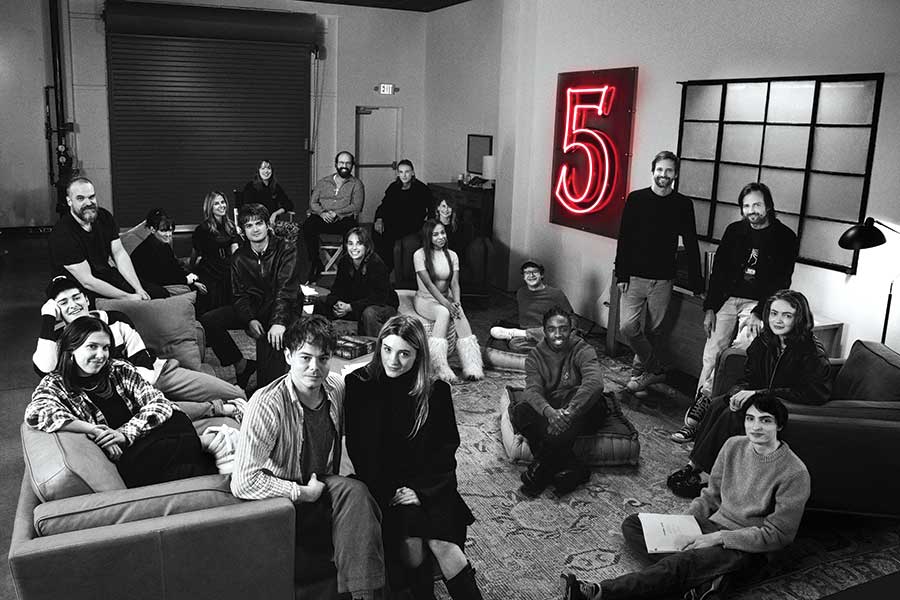
David Harbour and Winona Ryder may have had top billing, but the kids’ storylines were the real focus. Millie Bobby Brown, Finn Wolfhard, Gaten Matarazzo, Caleb McLaughlin and Noah Schnapp were between the ages of 11 and 13 when the series began. The end of the fifth season was not only the end of a television show, but also of a central part of their lives.
That was also true for creators and showrunners Matt and Ross Duffer. The twin brothers had few credits to their names (Wayward Pines, Hidden) before Netflix took a chance on them and their vision, which was, as Matt Duffer puts it, "What if Steven Spielberg found a long-lost Stephen King book that had never been adapted and just made a giant movie out of it?"
Emmy contributor Neil Turitz spoke with the Duffer Brothers and the show’s original five young stars about the making of the final season and the show’s impact on audiences and themselves.
Season four ended on a heavy note; though temporarily victorious over the villainous Vecna, the team had suffered major casualties. Eddie Munson (Joseph Quinn), friend and mentor to Matarazzo’s Dustin, was dead, and in the final moments, it appeared that the fictional town of Hawkins itself had entered the supernatural "Upside Down."
Matt Duffer (creator, executive producer, writer, director): With season four, we talked a lot about the ending of [Star Wars: Episode V - ] The Empire Strikes Back. You’ve resolved this story to an extent, but you’ve also hit a low point. I just remember the feeling that gave me as a kid, of, "I cannot wait to see what’s next." That was really what we were going for.
Gaten Matarazzo (actor, Dustin Henderson): Reading the end of season four was more of a shock than anything. It’s the first time where there isn’t really a shred of optimism, as there had been in seasons past. It felt like everything was crashing, and it’s really scary and effective. It was an interesting place to pick up from in [season] five.
Caleb McLaughlin (actor, Lucas Sinclair): At the end of season four, I knew that in season five we were gonna get right to it, and I knew everyone was going to get the opportunity to showcase their talent in an amazing way.
Makeup designer Barrie Gower created elaborate prosthetics to turn Bower into Vecna, the monster seeking to destroy humanity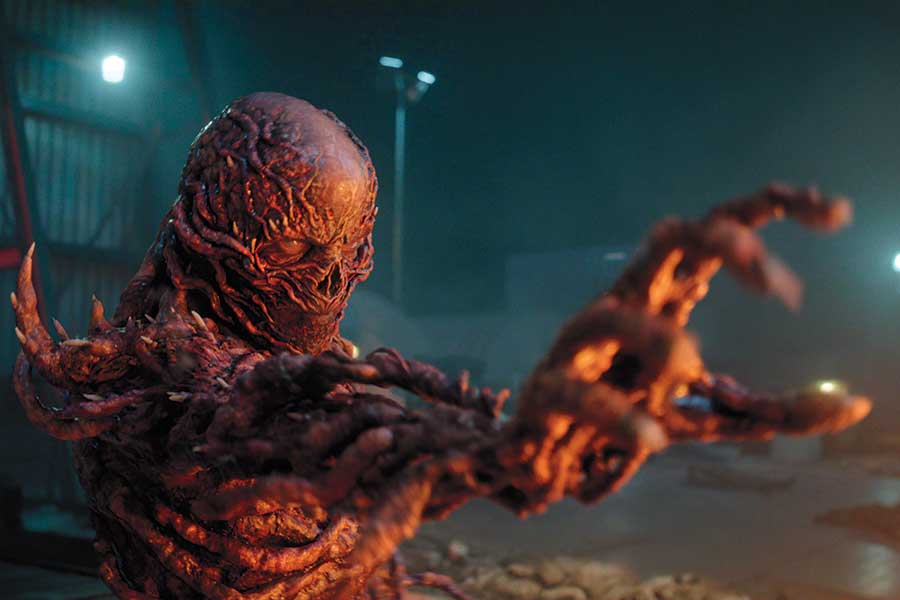
The Duffers and their team of writers knew they had their work cut out for them, understanding the expectations fans had and their own responsibility to stick the landing.
Ross Duffer (creator, executive producer, writer, director): The ending evolved a lot over the course of 10 years, but we had the last 10 minutes of the show for a long time. That was comforting, because we had a North Star we were confident about and were excited to write to. We worked backwards from there.
Matt Duffer: We could have 10 hours of a show that people absolutely loved, and then, if you fall on your face in the last 10 minutes, none of that matters. It always comes down to the ending.
The events of the previous season had allowed the writers to explore the characters in fresh ways; e.g., Dustin still reeling from his friend Eddie’s death and Will stepping into a newfound sense of self.
Matarazzo: A big aspect of grief that people tend to forget is the pessimism and the anger that comes along with it, the disdain toward things that used to make you happy. That’s something I wanted to tackle going in, especially because Dustin is purposefully bringing to life an aesthetic that represents Eddie — his clothes, his hair, his music — as a way to cope. I was excited to take a different approach to a character I’ve known for a long time.
Noah Schnapp (actor, Will Byers): I remember calling the Duffers and telling them where I’d like to see some things [wrap up], and then being told, "Oh, get ready. It’s exciting for you. You’re going to like it."
Millie Bobby Brown (actress, Eleven/Jane Hopper): They are so receptive. They’re so respectful of that. I’d heard David [Harbour] say he writes an email to them after every season, explaining what he’d like for the next season.
Schnapp: I’d never done it before, but I figured, this is the last time, so … .
Ross Duffer: I don’t know where they got the idea that David writes us a letter after every season. [Laughs] I don’t remember ever getting one. I do remember Noah sending us a long text, and he was basically describing what we were already going to do.
Schnapp: When I read the scripts, I was like, "Whoa, this is new." It was a challenge that I’d never experienced with the show. So, it was exciting to step into a stronger version of Will and show new colors of this character that we hadn’t seen before.
Brown’s Eleven engages The Mind Flayer in a final showdown.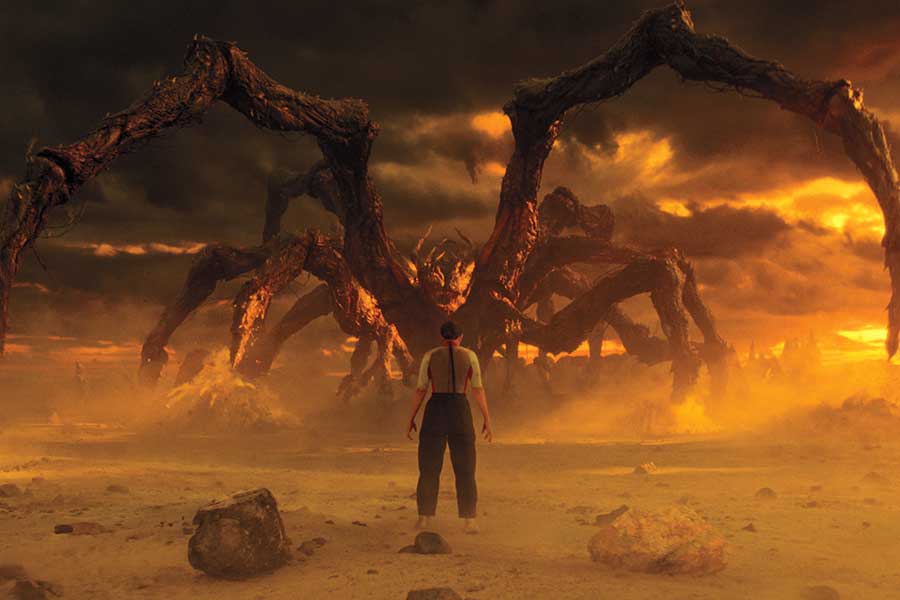
Production on the final season began in January 2024 and lasted most of the calendar year, but because of the 2023 writers’ strike, only about half of the scripts had been written. As a result, filming began without the actors knowing their characters’ fate.
Brown: There’s a reward in not knowing — not having the scripts and having to really test yourself as an actor and just shoot blindly, which makes you brave and instinctual.
Matarazzo: There’s a part of that where the anxiety of not knowing what’s coming next translates into what we do on screen.
McLaughlin: Going into season five, I didn’t think about my character or myself, because there’s a story that needs to be told. I want to make sure my character complements the story as much as possible, because this really is an ensemble show, and the show wouldn’t be what it is without the ensemble.
The Duffers were used to writing while shooting. Only season four’s scripts were completely written before shooting started, due to the pandemic. So, while it was stressful, there was a system in place.
Matt Duffer: What really helped us is we have these incredible directors coming in, and we’re not the type of showrunners who hover. I mean, what am I going to do, hover over Shawn Levy’s [Deadpool & Wolverine] shoulder? Hover over Frank Darabont’s [The Green Mile] shoulder? So, when they’re directing, we’re back in Los Angeles, working with our writers.
Ross Duffer: One of the more stressful moments in our life was trying to write the final script while in the midst of production. We’d never written with so much noise.
Matt Duffer: But the fun thing about laying the tracks as the train is going is that you learn as you’re shooting. You’re seeing what works, what doesn’t, and you can pivot. If you look back at all the seasons, the last two episodes are usually some of our favorites.
Ross Duffer: We do our best work under intense [pressure]; we need the gun to our heads. This was also the most challenging season logistically. Just in terms of pulling it off from a production standpoint, we have more sets and more complicated set pieces than we’ve ever had.
Matt Duffer: It was our largest-ever second-unit crew and the most number of days they’ve ever shot. Organizing all of these units was insane, but I’m proud that when we got back to editorial, there was only one shot that we thought we had gotten but didn’t.
Ross Duffer: It’s a little depressing, though, because it’s a closeup of a G.I. Joe lunchbox. That is officially the last shot of Stranger Things.
Matt Duffer: We got every conceivable angle on that lunchbox, though.
Ross Duffer: We shot the shit out of that thing.
Things got emotional for everyone during the writing and reading of episode eight.
Ross Duffer: The two most emotional days were the last day, when we were saying goodbye to the cast and those characters, and when we wrote "The end," not "of season," but "of series." That was a very emotional moment, because we will never have the opportunity to write these characters again. That hit really hard.
Matt Duffer: But then the stress became, "Okay, how do we pull this off?" We felt good about what was on the page, but then it was going to be a real pain in the ass to film it.
Matarazzo: We read episode eight in September and wrapped in December, so we were getting pretty close to the tail end before they finished it.
Finn Wolfhard (actor, Mike Wheeler): We were all together for [the final table read]. It was not even a conversation, more like looks, stares, feels, touches. It was just a vibe. Honestly, it’s stupid to say, but reading it and experiencing it all for the first time together was very special.
To read the rest of the story, pick up a copy of emmy Magazine here.
This article originally appeared in its entirety in emmy Magazine, issue #2, 2026, under the title "On the Upside."