
Despite the shimmering ball gowns, passionate love scenes and string covers of Taylor Swift songs, Netflix’s Bridgerton has never been about perfect fairytale romances. Each season comes with its own unique flavor of angst and complications, with complex characters making complicated decisions that spark weeks of internet discourse.
That discourse is something Bridgerton star Luke Thompson is more than ready for.
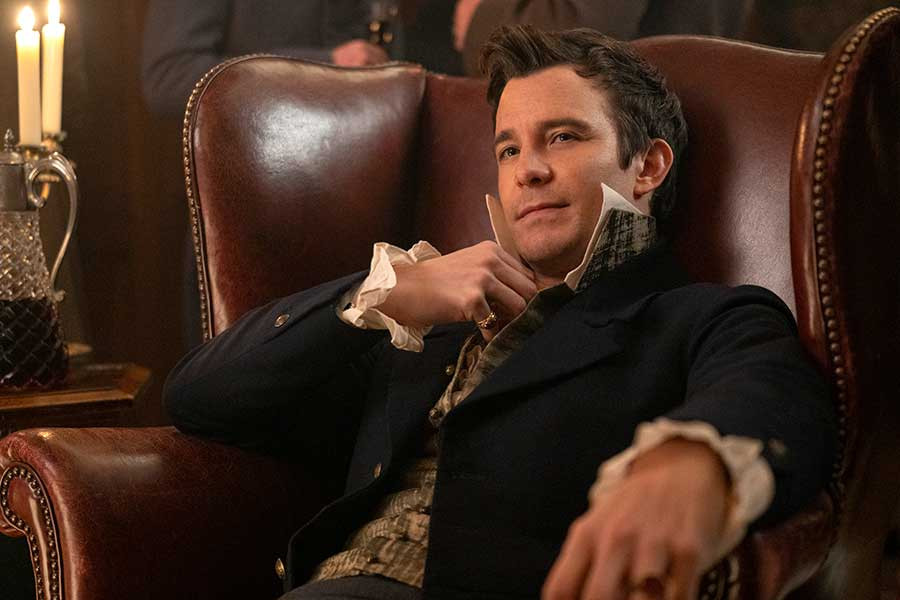
With the second half of the fourth season now streaming, the latest chapter of the Regency-era hit centers on Benedict Bridgerton (Thompson), the second son in line to the throne who has never showcased much of a desire to get serious and settle down. Everything changes for Benedict when he crosses paths at the masquerade ball with Sophie Baek (Yerin Ha), an unassuming maid who slips in undetected and steals his heart — only to run off without revealing her true identity.
Benedict and Sophie's love story may be in the vein of Cinderella, but this season’s leading man isn’t quite Prince Charming. Somehow equal parts sensitive and careless, his character is polarizing viewers — and if you ask Thompson, that’s a fantastic thing.
"You want disagreement, you want debate and you want people to think very different things about your character," Thompson tells the Television Academy. "I always feel like if there's multiple reactions, you've done your job well."
The actor recently spoke with the Television Academy about his character’s many layers and how production filmed this season's steamy staircase scene. He also shares why he is glad the show didn’t “soften” one of the most controversial moments from the books it is based on.
Television Academy: There’s a scene in the first part of the new season where Benedict talks about feeling like an imposter or a joke. From your perspective, has he been closing himself off from serious relationships because he’s genuinely not interested in them, or does it stem from something deeper?
Luke Thompson: I think he is interested, [but] he’s scared of the idea of giving someone everything. That's why he's so good at just giving everyone a little piece of himself and not really going further than that.
What do you think it is about Sophie that not only catches Benedict’s eye at the masquerade ball, but also gets him to let his walls down?
They're opposites. But, within [each] opposite, there's a little element of the other. Sophie is much more of a realist, but she has this tiny part of herself that's like, “I'm gonna go to the ball and live this dream.”
Benedict is someone who is full of fantasy and make-believe. Though, there is this tiny part of him that’s like, "I do want more." They are opposites in some ways, but there's a shared language.
Sophie (Yerin Ha) and Benedict (Thompson) in a scene from Bridgerton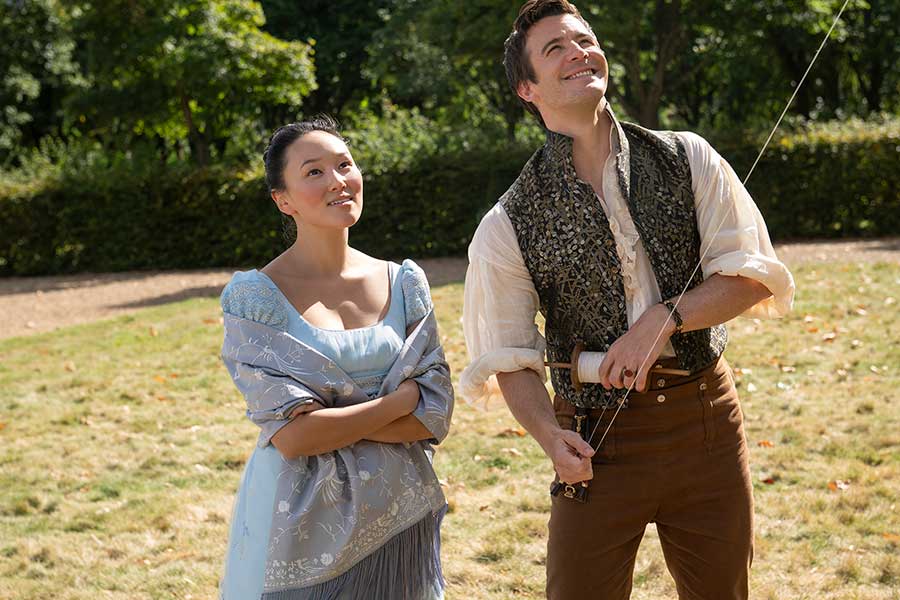
What can you tell me about filming that steamy staircase scene in this season's fourth episode?
With a scene like that, you're doing an awful lot of rehearsal — particularly with the intimacy coordinator. It was one of the tallest sets [the show has] used — and heat rises, so the combination of that and the candlelight meant that the top of the staircase was like an oven. We were in that staircase for a whole day.
What was your reaction to the controversial "be my mistress" line?
I was glad they kept it in [the show] and didn’t soften it. It’s a slightly controversial moment in the book, and I think that’s a good thing. Shows should have provocations and should make people talk — some people can be really angry, and some people can defend him. By keeping it in, they’ve redefined what even I thought of Benedict.
He's got this gooey and soft outer layer that's charming, easygoing, kind and sensitive. Also, he does have this more controlling or anxious side of him. He hides that under a lot of ease and charm. It’s a completely [out of] left-field line, but it makes sense.
On the show, Benedict has been with both women and men — and Sophie is clearly his endgame. Some viewers have expressed concern that his queerness will be erased, but I also think it’s important to acknowledge that ending up with a woman doesn’t make him suddenly not queer. What are your thoughts?
I think it's quite a refreshing story, actually. There's enormous value to stories that are about repression and men struggling with their sexuality. [But Benedict has] always been a character that has felt very relaxed about the idea of sex, and it doesn't feel like it's something that really determines his identity [or] that he feels he has to "solve" in order to know who he is. I think that's refreshing, because it's surprising to have a character, particularly a male character, for whom that isn't a big deal. I think he could have ended up with a man perfectly well, but love is where it falls. And, for him, it was Sophie.

You’re known for being a private person who doesn’t have social media. Are there any online discussions about your character that you weren’t even aware of until someone brought them to your attention?
I get a sense of things, because social media is everywhere. I think it's nice that people see very different things reflected in the character, because it’s just as interesting as [my] conception of [Benedict]. I don't think I'm the guardian of [his] character. I think a character can live in people's imaginations in all sorts of ways.
There’s a lot to love about Benedict, but is there anything about his character that frustrates you personally?
His childish, innocent side is quite charming in some contexts. I do think, however, that he has a slight arrested development. I feel like he’s got some growing up to do.
This interview has been edited for length and clarity.
Bridgerton is streaming on Netflix.