
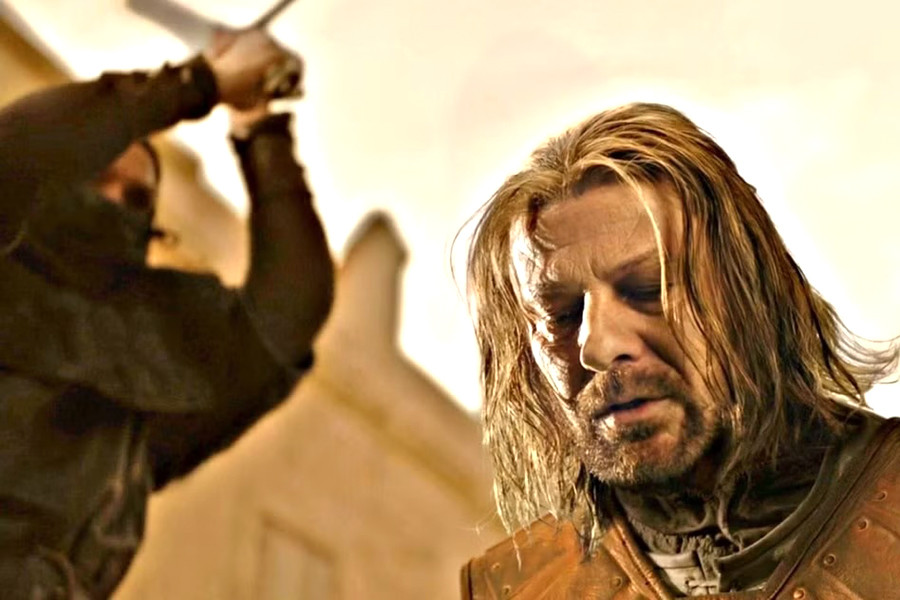
Well before he oversaw the shocking execution of Ned Stark (Sean Bean) in the Game of Thrones season one episode “Baelor,” director Alan Taylor had developed a reputation as HBO’s go-to guy when it was time for a major character to get whacked.
He directed the Rome episode in which Julius Caesar was assassinated, the Deadwood episode in which Wild Bill Hickok was shot and The Sopranos episode in which Tony smothered Christopher.
He didn’t get the “Baelor” job for that specific reason — though he admits that in previous interviews, “I probably contributed to that mythology.” He was nonetheless uniquely qualified to make sure the beheading of Thrones’ main character to that point felt as powerful and weighty as the moment deserved — especially since his execution by the order of cruel King Joffrey (Jack Gleeson) would be witnessed by Ned’s two daughters, Sansa (Sophie Turner) and Arya (Maisie Williams). Written by Game of Thrones showrunners David Benioff and D.B. Weiss, "Baelor" marked a significant turning point for both the series and its fans, especially if those watching the show had not read the source material. Ned's fate indicated that no character is safe — even those you may be invested in.
Ahead of the memorable episode’s 15th anniversary on June 12, Taylor looked back at how the iconic TV moment came together.
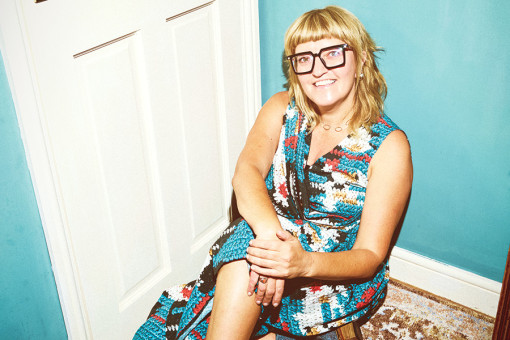
Alan Taylor (right) on location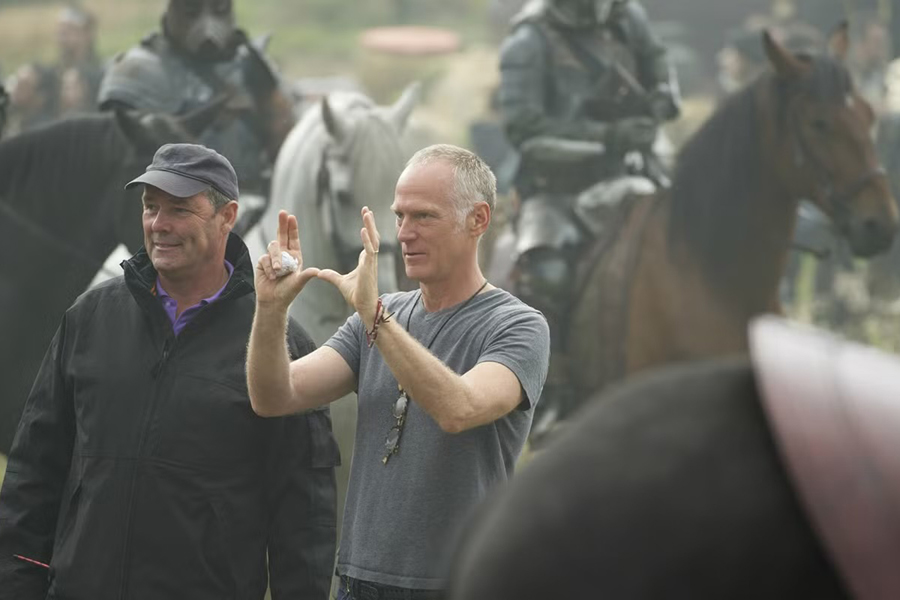
Television Academy: How did you wind up directing the last two episodes of the first season?
Alan Taylor: When the show began, there was a notorious pilot [directed by Tom McCarthy] you had to go into a locked room and sign an NDA [to see]. I watched it, and I could see what was beautiful in it and what [needed work]. They were looking to reshoot the thing, and there was a period when I was maybe going to do that. Then something fateful happened — my mom got ill, and I had to go up to Canada to help her for a while. So, Tim Van Patten came along with [director of photography] Alik Sakharov, and they did a perfect job of reshooting the pilot.
Then, [HBO] came back to me and offered me the last two episodes of the first season. When I started reading the scripts, I realized I had stumbled into something wonderful, both because of the Baelor scene in the ninth episode and giving birth to the dragons at the end of the finale.
Because the show had so many far-flung international locations, you were shooting both your episodes at once.
We were totally block-shooting. More recently, House of the Dragon does something where they block-shoot the whole season. With Thrones, we were only block-shooting two episodes at a time. The Dothraki scenes were in Malta, and so was King's Landing at the time — before we made the wonderful connection to Croatia. And the budget was low compared to later seasons.
What were the challenges of shooting this pivotal sequence on location?
We really only had one option for where to stage the Baelor scene, and it was one of those things where you walk in and the architecture is really great, but you realize the sun is exactly in the wrong place all day long. So, that was a bit of a nightmare. Alik Sakharov and I had to come up with a plan for how to be facing in the best possible direction, given where the sun was. I think we had two days to shoot that scene.
It's kind of charming, by later standards, how minor the set construction was. We really just built a stage and hung some banners behind it, and that was it. [Laughs] That was supposed to be the Great Sept — this amazing piece of architecture that came out of George R.R. Martin's brain — which had these seven arches overhead. So, we shot it with that in mind. Then, we couldn't afford the VFX to put that in later. It was the most we could muster. We didn't have enough extras, and we couldn't afford to [digitally] tile them. We were really going by the seat of our pants. This was a lesson for me: By that point, people were so invested in Ned and his two daughters that that's mostly what you experience in that scene. So, our production value didn't seem to be much of a bump for people.
Sansa (Sophie Turner), Cersei (Lena Headey) and the sadistic King Joffrey (Jack Gleeson) look on at Ned Stark's execution. 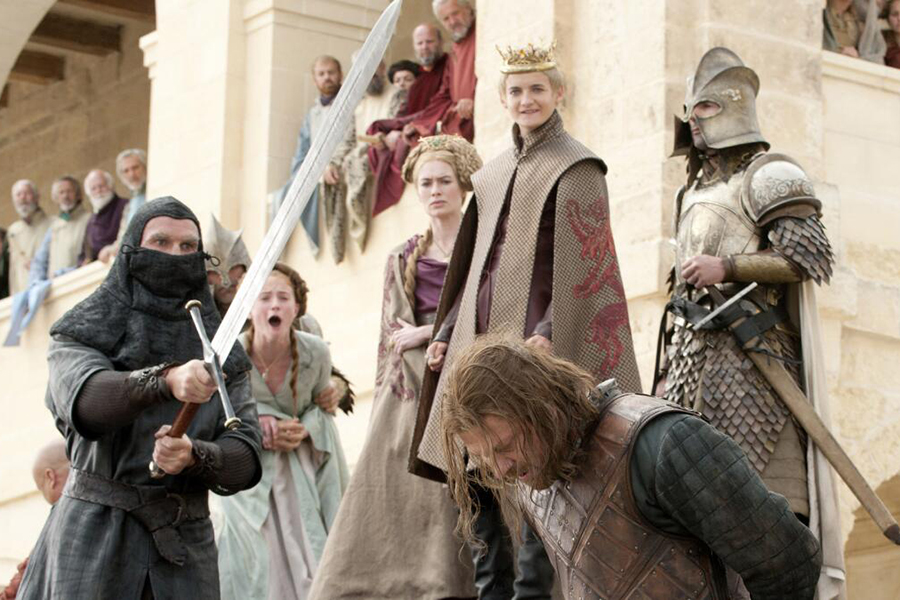
How did you want to stage it to emphasize Ned, Sansa and Arya?
You want to make it as big and epic as you can, given the limitations. You also want to try to keep it focused on its true, emotional story. A few things have always been important to me in anything I do, like using point of view as the way into any scene. While Alik and I were figuring out how to chase the sun, he said to me, "Well, this is really just a story about a father and two daughters." And that was a very clear way to [articulate] how we were going to cover the scene. That led to certain things tying to their points of view, right down to featuring their audio's point of view. One subtle thing I'm sort of proud of is that we hear Ned's breathing taking over at one point. Then, once he loses his head, we switch to Arya's breathing. We're sort of very much inside the heads of these people we care about.
And the other thing that was important to me was to empower some of the coverage on them. Arya and Sansa are the only two characters that get these sort of dramatic crane push-ins on their close-ups, to sort of say, "Okay, there's a lot of stuff going on here, but pay attention to these two."
I have two daughters, and the last shot we added in the edit was my favorite shot, which was Ned looking up and seeing that Arya's not there anymore. That broke my heart, because at least he's got some kind of solace that maybe she won't have to watch this; maybe she'll be okay.
In the episode, Ned thinks his life will be spared if he swears fealty to Joffrey. What sort of direction did you give Sean Bean about how to play Ned's realization that Joffrey is going to break the deal and execute him anyway?
Sean is a brilliant actor, but he's also got a lot of experience dying on screen, so I think he knew how to approach it. We talked about [Ned's] two daughters, and that he was doing this for Sansa — almost at Sansa's request. And then I think the most devastating thing for him was to see his other daughter, who had gone missing in the crowd. Just making sure he was aware that, despite all the chaos around him, those were the two things we were going to be experiencing with him. Also, Ned is a man of such great grace and honor that once he realizes the jig is up, he doesn't fight it anymore.
Interestingly enough, I had a near-death experience where I almost died and then didn't. But, in the almost dying, I got so close that I realized it was over and there was nothing I could do about it. There's a kind of shift that happens to you. It's not quite acceptance — it's certainly not something you want to do — but it's kind of letting the fight go. So that was an important thing.
Sean came up with something very beautiful for that moment, which was — he started saying a sort of prayer to himself. That was not scripted, and the words were chosen by Sean, and it's a way of ending gracefully.
This interview was edited for length and clarity.
Game of Thrones is streaming on HBO Max.