

It's not easy to make a fake product that fools everyone. Think about AstroTurf, Impossible Burgers and the “duck lips” of Instagram. There’s one thing, though, that has managed to bridge the uncanny valley: synthetic fur. Even the experts were fooled when Fox Sports personality Erin Andrews appeared on camera January 11 wearing a fake-fur jacket. Reporting live from the sidelines before the NFC wild-card game between the San Francisco 49ers and the Philadelphia Eagles, Andrews and her fashion statement went viral.
Accused of supporting the slaughter of helpless animals and ridiculed online as the Cruella de Vil of pro football, the Emmy-winning broadcaster quickly drew the ire of PETA. After analyzing footage from the Fox pregame show, the animal-rights organization contacted Andrews’s reps to issue a stern rebuke — only to discover they had miscalculated.
“Ms. Andrews got creamed on social media for wearing what looked like an enormous fox-fur jacket,” PETA president Ingrid Newkirk says. “So, we called her reps, and they said, ‘No … it’s fake!’” Newkirk is still stunned. “We got it wrong. That’s how convincing faux fur can be. It certainly looked real.”
In the end, justice prevailed: The fashion media went gaga, Andrews was absolved of crimes against nature and her faux-fur showstopper — Auter’s “The Fox Jacket” in Sand Noir, $950 — sold out online within 24 hours.
Fox Sports reporter Erin Andrews in the Auter jacket that went viral. 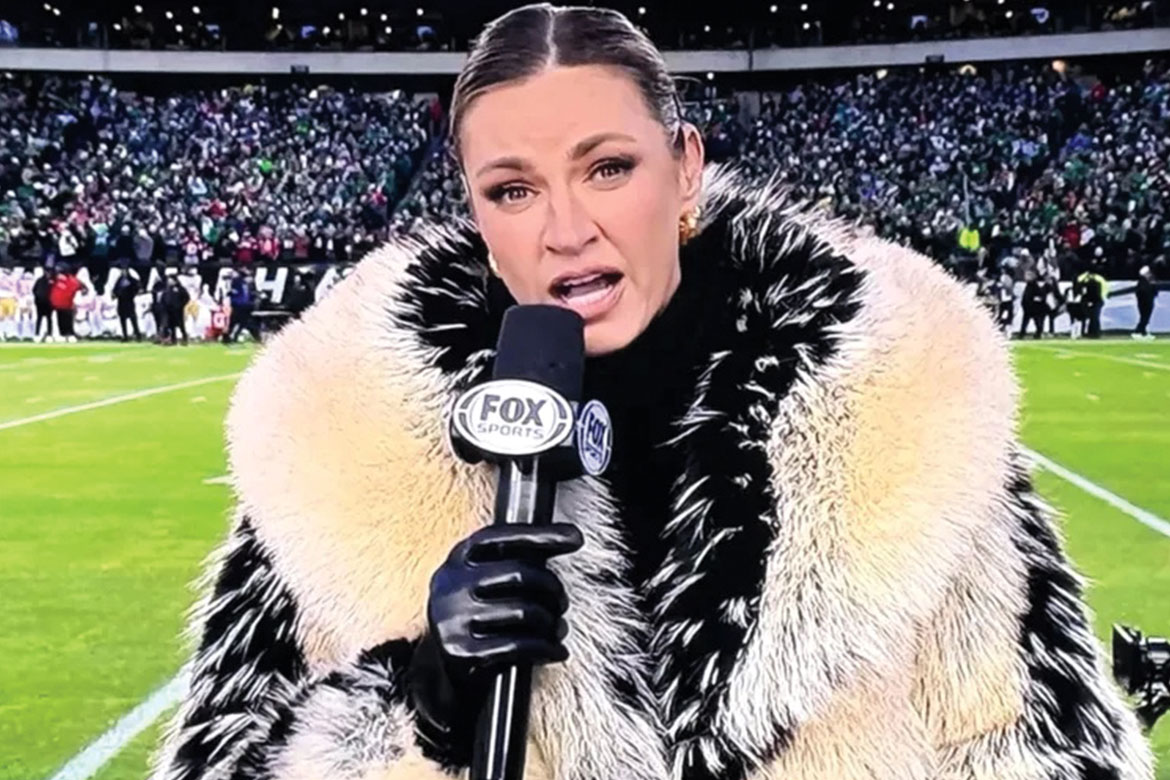
Here’s how fake fur is reverse-engineered: Start with synthetic fiber blends (modacrylic, acrylic, polyester) that have the same luster, weight and “snap-back” of real fur; ensure the fibers have variable densities and lengths, called “pile heights.” (Soft, fine “undercoat” fibers mixed with longer, coarser “guard hairs” create the volume and uneven surface of real fur.) Add multilayered dyeing (up to eight dye layers are required to duplicate organic patterns and color gradients), and don’t scrimp on the finishing. (Fibers are brushed, sheared and heat-set to make them lay in a natural direction, just as fur flows on an animal’s body.)
Donna Salyers, the founder of Fabulous Furs, a faux-fur company whose client list ranges from the Broadway play Frozen to Fox’s hip-hop drama series Empire (2015–20), insists the only foolproof way to distinguish between real fur and its PETA-friendly counterpart is to inspect the backing material: Animal hair grows out of a hide, while synthetic fur is knitted into a polyester mesh base. Salyers confirms that high-quality synthetic fur can easily escape detection. “I once went to MAGIC, a big trade show in Las Vegas, and they put me next to all the real fur brands. It was three days before anyone realized I was selling faux fur.” She explains how her garments flew under the radar: “I passed the ‘blow test,’ which is what furriers do to test the quality and proper finish of a pelt — they blow on the hairs to make sure the fibers all move individually.”
Real fur has been almost completely phased out of TV shows and movies.
Producers fear the social-media backlash, and many actors are vehemently anti-fur, like Sopranos star Edie Falco, who refuses to wear fur on camera. One exception is the use of vintage fur in period pieces: All of the furs Angelina Jolie wore in the 2024 Netflix movie Maria, for instance, were authentic. Costume designer Massimo Cantini Parrini selected archival furs to duplicate Maria Callas’s ’70s diva look. PETA consulted and grudgingly approved.
The anti-fur movement has spread beyond wardrobe departments. The Television Academy banned real fur from all of its red-carpet ceremonies this year, including the Emmys telecast and Creative Arts Emmy Awards. Media and fashion are onboard, too. Hearst (Cosmopolitan, Elle, Esquire) and Condé Nast (Vogue, GQ, Vanity Fair), have barred all pelts from their editorial and advertising content. And, starting this September, there will be no real fur on runways during New York Fashion Week.
The best synthetic fur is produced in Italy, France, China, Japan and South Korea, and retail distributors charge up to $75 per linear yard for these luxurious textiles. Still, that’s a bargain compared to real fur. A genuine Fendi fur coat (Russian sable with silver-tipped hairs) was recently posted on eBay for $95,000. That same coat could be replicated in a wardrobe department with four yards of synthetic fur.
Some designers have gone all-in on ersatz animal skins.
If showrunner Mike White wants the female lead in an upcoming White Lotus season to be swaddled in Max Mara’s faux-shearling Teddy Bear Coat (Gstaad? Aspen?), that camel wool–silk confection will set the budget back $4,670. For those who prefer their fake fur 100% vegan, Stand Studio, a cult Scandinavian brand favored by fashionistas like Bella Hadid and Kendall Jenner, offers a 100% polyester jacket at $1,200. And the Apparis Sai Coat (faux mink) is indie-budget friendly at $545. Bargain-hunters who covet Deborah Vance’s power wardrobe on HBO Max’s Hacks can find a $99 knockoff of Etro’s $2,200 faux-fur leopard velvet blazer — the one Jean Smart wore in season four, episode two, “Cover Girls.”
Many actors’ costumes today are bespoke designs. This is particularly true in period pieces, where historical accuracy counts. For Netflix’s The Crown, costume designer Amy Roberts used faux fur to recreate the royal garments, including ermine robes for the queen’s coronation. Claire Foy’s white fur stole in season one and the tricorn hat Olivia Colman wore in season four are also completely faux.
The Witcher is another showcase for fake fur. The medieval fantasy series, which will conclude its long run on Netflix this year, makes liberal use of the stuff, especially as a stand-in for animal-skin bedding. An upcoming Witcher episode features a Liam Hemsworth sex scene, but rest assured, the intimacy-coordinated action will be propped out with Fenrir’s Timber Wolf and Mountain Grey faux-fur throws.
Fake fur is also a staple of soap operas. Nothing fleshes out a soap character faster than a fur coat, shorthand for a variety of archetypes: old money, femme fatale, scheming villainess. Shawn Reeves, costume designer on General Hospital, is currently working on the show’s 61st season. He’s been in the business long enough to remember when New York furriers would lend their wares to producers in exchange for a free plug in the closing credits. Those days are long gone. Today he only uses faux fur. When the price of Prada’s faux-shearling coat is mentioned, Reeves laughs: “Prada also sells ripped blue jeans for $1,000. A beautiful faux coat doesn’t have to cost more than $600.”
Several characters on General Hospital will be decked out in fake fur this season. Reeves breaks down the lineup: “Tracy [Jane Elliot] is old money — the Hamptons and Newport crowd. She wears a conservative-cut mink. There’s also Ava [Maura West], who is nouveau riche. I dress her in bolder colors and stronger silhouettes. She’s very dramatic — sable and fox. Then there’s Trina [Tabyana Ali]. She’s an art student who works at Ava’s gallery. She’s young — early 20s — and gets cropped shearling jackets. All faux.”
Reeves doesn’t miss courting furriers and toting their eight-pound mink coats around television studios. “Faux-fur coats are so light, and the quality is amazing. I have to literally separate the pile to make sure it’s fake.” He knows all about the fur police. “Because the coats look so great, we still get complaints, like, ‘Why is she wearing real fur?’ A few times, I had to show the label to someone to prove it really is fake fur.”
Costume designers may soon have to prove their coats are not only fake but also sustainable. One knock on faux fur is that it’s manufactured using petroleum-based plastic polymers. These materials don’t fully biodegrade — they break down into micro and nanoplastics that end up in landfills, oceans and food chains. But for the environmentally conscious, there’s good news: Paris- and New York–based startup BioFluff is attempting to disrupt the fake-fur industry with Savian, a biodegradable alternative made from plant-based fibers — primarily hemp, flax and nettle.
The company launched Savian at the 2024 COP28 global climate summit in collaboration with fashion designer Stella McCartney, who designed a faux-lambskin coat made of the eco-friendly textile. Since then, Savian — now available in a variety of colorways and patterns, ranging from cheetah to beaver — has been a topic of interest in fashion circles. The chatter seems to be: It may be fake, but is it fabulous? If Savian furs and dinner jackets start showing up on red carpets, it may just have a shot.
This article originally appeared in emmy magazine, issue #7, 2026, under the title, "Faux Real."