

Full spoilers for Carrie’s first season finale are below.
When Carrie White goes to prom, all hell breaks loose.
That’s what fans of Stephen King’s classic horror novel, Carrie, expected to see when Mike Flanagan’s TV-series adaptation of the book dropped its entire first season on Prime Video. But the writer-director-showrunner’s take on the material subverted those expectations with some notable changes to the 1974 source material.
As a massive fan of both the book and of King in general, the Midnight Mass creator expanded the tragic and bloody tale into eight episodes that unfold across an entire semester, as the sheltered, bullied Carrie (Summer H. Howell) struggles to come to terms with the challenges of being a high-school misfit in a small town and the revelation that she has dangerous telekinetic powers. Raised by her oppressive mother, Margaret (frequent Flanagan collaborator Samantha Sloan), after the death of her dad, Ralph (Tahmoh Penikett), Carrie goes from being homeschooled to having her first in-class experience, complete with her first active-shooter drill. It’s at school where Carrie’s powers manifest and intensify, as the teenager discovers that she is not the only one with these strange abilities.
With King’s blessing, Flanagan — who previously adapted the author’s Gerald’s Game and Doctor Sleep into feature films — envisioned a three-season arc for Carrie that not only added an X-Men-esque element to the troubled teen’s mythos, but also completely reimagined Carrie and her mother’s respective fates.
“It was a great thing to go to Stephen King and say, ‘Hey, you've got this great idea here that I would just love to grab on to and ride as far as we can,” Flanagan tells the Television Academy about taking his massive swing with the material. “He was very excited about it, and it just opened the world and the possibilities of these stories in a way that felt faithful to the ideas of the book.”
Samantha Sloan and Howell in a scene from Carrie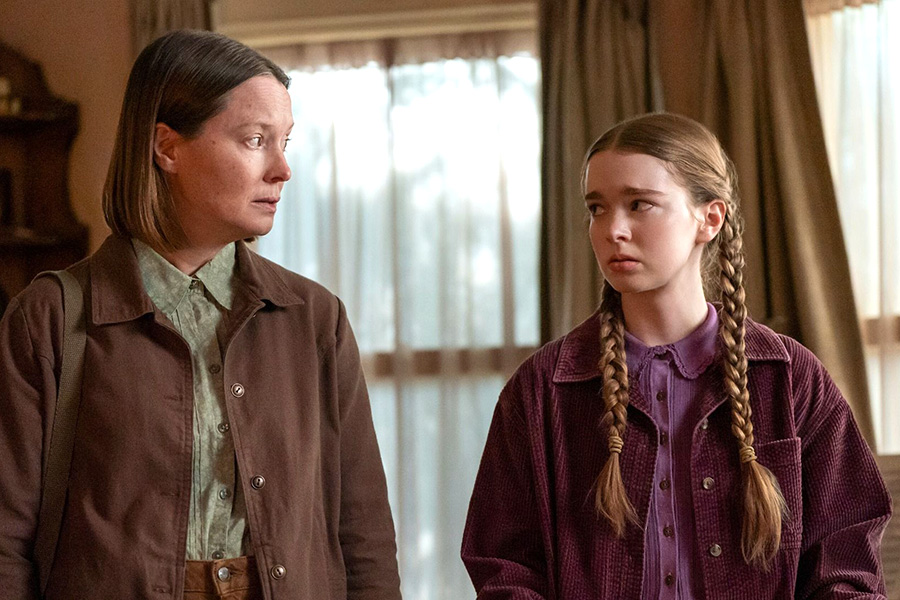
Flanagan’s adaptation maintains the story’s iconic tentpoles (like Carrie being doused with pig’s blood at prom) but weaves through them an entirely new element that pushes the titular character into uncharted territory. The most significant difference from the book — and from other Carrie adaptations — is that, in the series, Carrie survives the fiery events of prom night, which results in the deaths of some students and faculty. She still has a final showdown with Margaret, but the matriarch is dealt her death blow in large part by a mysterious figure new to the Carrie mythos — played by Flanagan’s wife and longtime collaborator, Kate Siegel. (Siegel’s character initially enters the story seemingly as a documentarian, taking testimonials from those who survived Carrie’s rampage).
Beyond that, Flanagan takes an idea from the book that suggests other girls outside of Carrie’s hometown possess her “gifts” and braids it into his narrative, with Segal’s character (which the show doesn’t name in dialogue) taking on almost Professor X-like role leading these young women in an effort to add Carrie to their shadowy ranks. Spearheading this effort is Emaline (Thalia Dudek), who mentally projects herself into Carrie’s mind and interacts with her during key episodes.
Later, with Carrie’s permission, Emaline psychically “takes the wheel” from her new friend at prom and steers Carrie’s body through the carnage. Emaline wields the teenager like a telekinetic blow torch and, in the aftermath, embarks with Carrie on a road trip to wherever a potential second season takes them. But, Flanagan insists Carrie isn’t as passive a passenger as she may seem.
“When Emaline takes the wheel [at prom], I believe Carrie's still very much there,” Flanagan explains. “Emaline might be driving, but Carrie's in the car. She's there watching it all.”
Below, Flanagan reveals at length how he came up with these new and surprising additions, the show’s thematic ties to The Shining and how he pulled off a late-season episode featuring several fun cameos from Ronald D. Moore’s Battlestar Galactica.
Television Academy: Was Carrie surviving prom something you mapped out early on in your adaptation?
Mike Flanagan: Yes, it was very early on — especially knowing that we were going to be spending more time with her and really doing a deep dive into the character. It is a tragic story, but it would be so bleak to go through all of that just to watch this version of Carrie die. It was always important to me that she survived — which was, in and of itself, a huge change — but we felt like the character would earn it, given the way we were telling it.
The idea of there being other young girls with telekinesis is prevalent in Stephen King’s novel, and he's expanded upon it since in his other work, but those who haven’t read the books will be surprised.
It was hugely exciting. That was one of the foundational changes, which is kind of funny. We call it a “big change,” but, honestly, it was honoring something in the book.
It was one of the first things that really got me eager to dive into this one. And it was something that was really exciting to Stephen King, too, because — you're right, it's all over the book. He points at it so much. But Carrie, in other versions, never lives long enough to [realize] that she isn't alone. King does expand on these ideas; as he grew as an author, he started to kind of let that bigger world into his stories and interconnect them. And I think Carrie likely would have found herself more a part of that tapestry if the book had come along later in his career.
(From left) Emaline (Thalia Dudek) and Chris (Alison Thornton)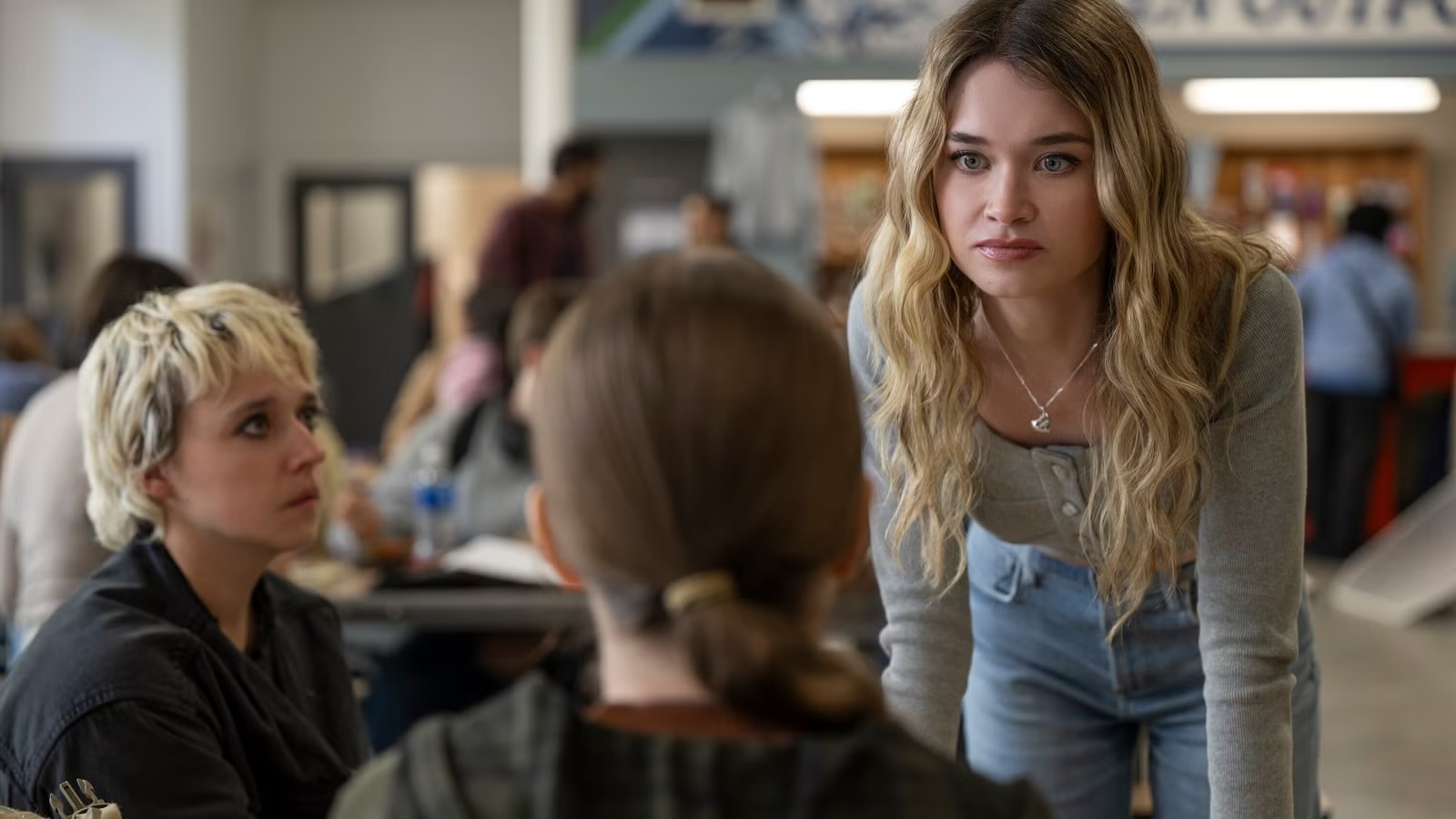
How were those conversations with King about bringing what he hinted at into your story?
It was a great thing to go to Stephen King and say, “Hey, you've got this great idea here that I would just love to grab on to and ride as far as we can.” He was very excited about it, and it just opened the world and the possibilities of these stories in a way that felt faithful to the ideas of the book.
Did I miss the name of Kate's character?
We never say it in dialogue. I think she's named in the credits. Her name is Adelaide.
She’s reminiscent of Julia Sigsby [from King’s The Institute], but, unlike Sigsby, Adelaide has powers herself. So we have Adelaide and her group, but then there’s Katee Sackhoff’s character, Amanda, who — along with others — want to stop people like Carrie and those in Adelaide’s charge. There’s a lot of world building going on.
Oh, I love a chance to do some world building!
And it's something that, I think, was really exciting to Steve. We got to invent [some of] these characters out of whole cloth, but each was a reaction to what was already there in the book. We know there's this impulse with Margaret White in the book, that her daughter needs to be killed. So, in a world where there are others like Carrie, we figured there would be other parents who have had the same impulse and maybe succeeded. And that’s kind of where Amanda came from.
We also said, “Well, if there's this group of other women who become aware of Carrie, what's the first thing they're going to do? They're going to send a spy. They're going to send someone to observe her.” So, that’s where Emaline came from. Once we declared that we have the whole spectrum of [psychic] power that King laid out for us — with astral projection, clairvoyance and other things — boy, what an opportunity it was to introduce a character that can appear to be a friend to Carrie, but who's there to spy on her. And Emaline tells you exactly who she is right away. She says, "I'm a spy, you're my mission and I'm just surprised you caught me.”
Then, with Adelaide, I thought it would be a great character for Kate, and to kind of sneak her into the story as an unseen narrator. Then, we reveal her to be a critically important character only in the last few moments of the show, which kind of makes us rethink this interview structure we've seen [that Adelaide uses]. All of those characters were really fun to present to Steve and to say, “These are invented out of whole cloth. This is where I think they can impact the story. What do you think?” He was very excited to have those conversations. He had a lot of ideas about all three of them.
You also got the word “shine” in there, with Kate. Knowing the importance of that, especially its use in The Shining, was that just cool for you to have as a fan? Because fans have long posited that Carrie has a kind of “shining,” like Danny Torrance does in the book and in Kubrick’s film.
I was so excited to get that word in there. I believe that, if Steve had written those books in a slightly different order, he would have used that word. That's what he's talking about with her. But one of the great joys of being a King fan is finding the threads and the connections, and it feels like I would be missing out on an amazing opportunity if I didn't use or create those threads for other fans to pick up.
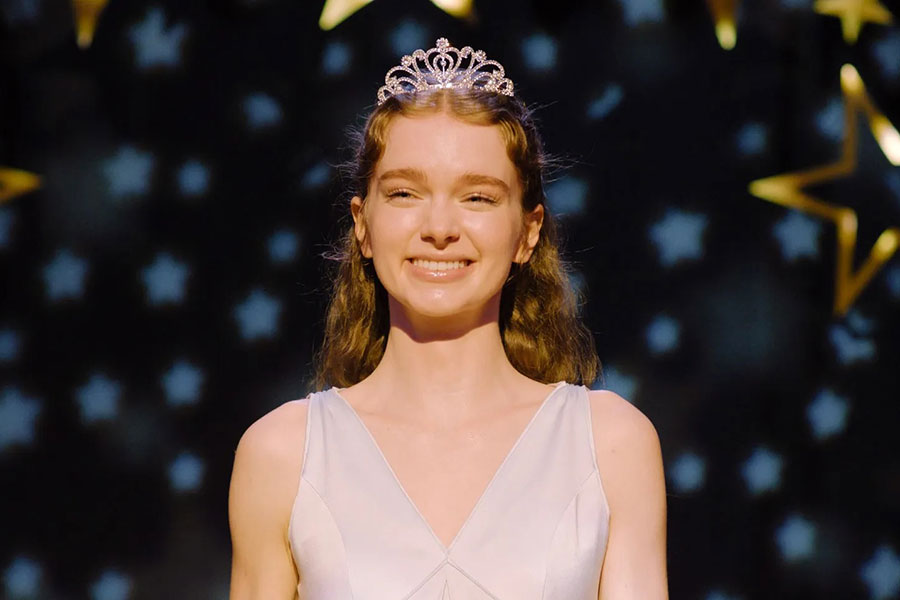
Emaline “takes the wheel” during the prom massacre. Is the intention that she killed everyone at prom, and Carrie only killed her tormentors Chris (Alison Thornton) and Billy (Arthur Conti)? Or was Carrie more present than it seemed?
These are some of the fun questions we got to play with. The question of culpability was something I was very interested in. The way our story shapes up, it was clearly going to be a tragedy and not a horror story. We talked a lot about how there really weren't monsters in this version. The tragedy at the prom is authored by a lot of people. And since we knew that Carrie, in this version, deserved to survive the story, a lot of conversations were had about what she could live with and what she couldn't.
Emaline taking the wheel is actually another idea from the expanded Stephen King universe. We did the same thing in Doctor Sleep. With Carrie, it was important that she still have her agency and rage; that she had earned those. So, at the beginning of the prom, it's all Carrie — up until the point where Tommy (Joel Oulette) is killed, which is an accident. That's what kind of paralyzes her. When Emaline takes the wheel [at prom], I believe Carrie's still very much there. Emaline might be driving, but Carrie's in the car. She's there watching it all.
When it came to Chris and Billy’s deaths, it was very important to me that it was clear that Emaline was standing off to the side. That was all Carrie White; she had earned that moment with Chris. And her reaction to what she was capable of doing is critical.
As for who else died at prom, and why and how, there were other people there, too. That was something else we wanted to point at, so there are still some revelations about how certain events happened and went down at prom.
After prom, with her school on fire, there is this very audacious moment where Carrie dances down Main Street. How did you approach that sequence and finding the right song for it?
That scene's one of my favorites. It was always scripted that — in the aftermath of this huge, awful moment with Chris — that [Carrie] would dance through Main Street. We've all seen the version where she stands rigid, with her eyes wide, and walks threateningly through Main Street. But I was trying to think about kids today and the world they've inherited. I think about what my teenage son will talk about in regards to the environment, politics, the economy and everything else, and that these kids face a much bleaker future than we ever did. So, many times, I think the spirit of that generation is, they fucking dance through it! There's nothing else to do! That image of her, dancing through Main Street in the fire — not trying to spread more destruction, but trying to reject the destruction that was behind her, and just give in to this “Whatever, the world is ending, and I'm going to dance through it” feeling — it just felt beautiful in its horrible way. It also felt accurate, I think, to the way young people feel today.
Carrie, wearing her Haute & Freddy band shirt 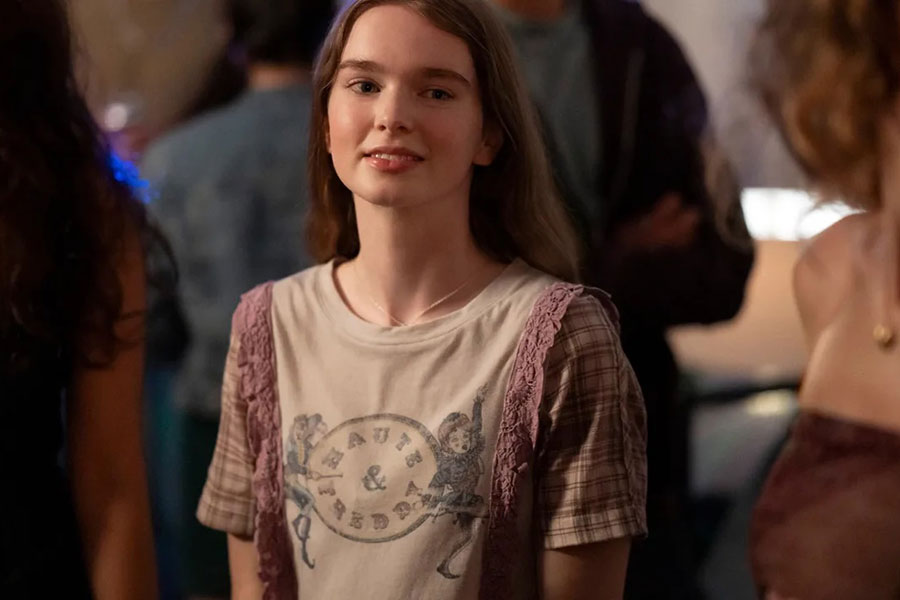
The song is what broke it wide open. We found that early in the writers’ room. We heard a demo of the Haute & Freddy song, “Shy Girl,” long before it was released. And that song roared out, feeling like the vibe of our show. It became the backbone of our score. We use almost Haute & Freddy’s whole album, and Carrie's wearing their shirt in episodes two and three.
We spend significant time with the faculty throughout the season, but neither Miss Desjardin (Amber Midthunder) or Principal Grayle (Matthew Lillard) survive the prom, though they live in the book. Did you go back and forth about their fates?
A little bit. Also, in the writers’ room, we looked at the weight of the tragedy of those characters. Part of what we talked about was the efforts of the education system, the efforts of the adults working within it to try and protect these kids and manage the situation. We thought about the more tragic outcomes that would realistically occur. At one point, we were like, “How do we even keep Grayle alive on that stage!?” He's standing right at ground zero of these explosive forces at prom. And then there’s Ms. D.'s death, which is something that hit us in the heart — because it is an accident. It also speaks to the collateral tragedy of this event. We talked a lot about every outcome, but it really came down to the adults kind of bowing out of the story because it really was about our younger characters on their own.
In the book, telekinesis does run in Carrie’s family. Here, we learn that Margaret has it, too, although hers is not nearly as powerful as her daughter’s. I don't know if self-loathing is the right term, but is it that she sees in Carrie something that scares her because she also saw it in herself?
That was something, thematically, that we heard a lot when we talked to teenagers in the writers’ room. We thought that was incredibly relatable, which is how much tension and friction exists between parents and kids. That it is there because the parents see something of themselves in the kids that scares them, or that they deny is there, or feel it is something they have suppressed. It also added this layer of tragedy that Carrie and Margaret had so much more in common than they ever realized, and only discover it in the very end.
For Margaret, we decided that she never had [powers] to the degree that Carrie did. But, she also clearly repressed it.
Lastly, I have to ask about all of those Battlestar Galactica cast appearances: You have Penikett, Michael Trucco and Katee Sackhoff in key roles, and three more BSG alumni — Tricia Helfer, Aaron Douglas and Rekha Sharma — showing up at a school assembly to deliver one line each. I’m guessing you’re a fellow fan?
I'm a huge Battlestar fan. It's the reason I was so excited to cast Katee Sackhoff in my first real movie [Oculus]. Over the years, I've been lucky enough to meet and work with other [Battlestar] cast members. I'd worked with Trucco for the first time on Hush, and we've worked together a ton since then. I worked with Mary McDonnell on House of Usher. And I've been lucky enough through them to meet and interact with the other cast members.
In episode seven, we had this scene with these single-line parts. Those parts, they’re hard to cast because it’s really tough to find actors to come in and make an impact with one line. We were looking for different ways we could do that. So, Trucco was like, “You know, I think Aaron Douglas is in town.” And I thought, “Well, we already have Trucco, we've got Katee Sackhoff, we have Tahmoh as Ralph White — we’ve got three Battlestars. If Aaron Douglas came, wouldn't that be neat!?” By then, it began to snowball, because we were aware it was shaping up to be this mini-reunion. With Rekha, it was like, “The production isn't going to be able to fly these people in.” And I'm like, “I will fly them in if they're from Battlestar Galactica! I will book the tickets myself!” Then Rehka was like, “Yeah, I'll join.” Before I knew it, Tricia Helfer was on the line. So when Tricia was coming, it's like, “This is officially a reunion now!”
I wasted so much time that day on selfies, I drove the crew crazy. We applauded each actor as they came down to set, they did their one line, and then I said, “Everybody down for a picture!” At one point, Aaron Douglas ad-libbed a line where he was like “This prom, cancel the fraking thing!” And I'm like, “Yes, this is amazing. He said ‘fraking!’” We couldn't put it in the show, though, because that felt like one degree too far.
There are only a few principal cast members left from Battlestar that we've got to get in. I guess I just have to make more stuff, and we'll find a way to do it.
This article was edited and condensed for length and clarity.
Carrie is streaming now on Prime Video.