

For most major sports, time is the fire in which the game burns. So, it was a big deal when sports broadcast pioneer David Hill introduced the so-called “score bug” — the first persistent on-screen score and game-clock graphic — more than 30 years ago, first in 1992 on U.K. Premier League games and then for U.S. coverage of the 1994 FIFA World Cup on ABC Sports and ESPN.
In the decades since, that data-rich feature has been bottom-of-the-screen table stakes for sports telecasts worldwide. But here in the United States, until just last year NASCAR fans were driving blind while following their favorite racers. When Prime Video took over TV rights to the preeminent stock car circuit in 2025, it made friends out of fans right away with a clever new on-screen feature: the “Burn Bar.” Introduced for last year’s Coca-Cola 600 at the Charlotte Motor Speedway (the first televised NASCAR event under the plat-form’s six-year, $7.7 billion deal), it’s an AI-powered on-screen graphic that shows a driver’s fuel consumption and efficiency throughout the race.
The Burn Bar’s data provides essential context. For instance, William Byron and his Chevrolet ZL1 led for 283 of the 600-mile race’s 400 laps. Without the Burn Bar telling viewers that Byron was running on empty, how could they have known that Ross Chastain and his Camaro were in an excellent position to pass Byron on lap 395 and secure the victory?
“We spent 18 months having conversations with teams and fans and drivers and crew chiefs, asking them, ‘What’s the most misunderstood thing about televised racing?’” says Alex Strand, Prime Video’s senior coordinating producer.
The "Burn Bar," introduced by Prime Video to televised NASCAR races, indicates a driver's fuel consumption and efficiency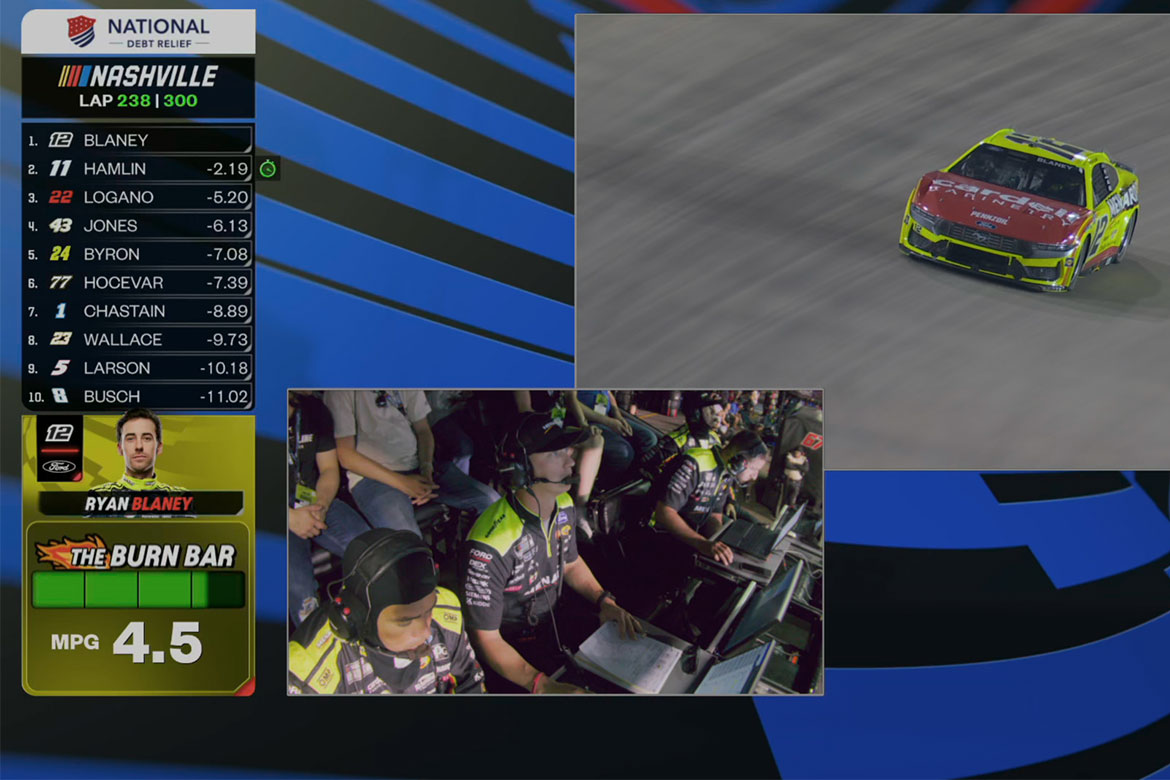
Strand and his teammates — a collective tapping into other company divisions, including Amazon Web Services (AWS) — have devised other innovations, too, including “Defensive Alerts,” a data graphic that warns viewers when blitzes are coming during Thursday Night Football games. Prime Video says the feature predicts this more accurately than the highly paid offensive coordinators on the other side of the ball.
Sports programming on major streaming platforms was up 52% in 2025, according to Nielsen. But Big Tech companies aren’t the only ones wowing us with new on-screen stats. NBCUniversal’s Peacock has a few new “bugs” of its own, some derived from the innovation that par-ent company Comcast applied to its X1 cable platform around events like the Winter and Summer Olympics.
During the so-called “Legendary February” broadcast schedule, plenty of these tricks were on display across NBCU platforms for coverage of Super Bowl LX and the Milano Cortina Winter Games.
NBCU’s best-known recent innovation may be “Peacock Performance View,” an interactive, augmented-reality mode for NBA coverage on mobile devices and connected TVs. Choose Performance View instead of “main broadcast” and you’ll see a continuous stream of information, including the full-season shooting percentage for the ball handler, whoever they are and wherever they are on the floor.
Jim Denney, chief product officer of global streaming and NBCUniversal Media Group, says features like Performance View have to work across myriad mobile, computer and TV operating systems and must be assiduously tested and refined before they’re deployed.
That takes strong collaboration between production and product teams, not to mention outside vendors, including Sportradar, the tech company that helped create Peacock’s AI-based viewing mode. With NBCU reclaiming NBA TV rights under a new 11-year, $27 billion deal, Denney says a quarter of Peacock’s NBA viewers have at least sampled Per-formance View so far.
Fan engagement is a buzzword for a reason. A global sur-vey of top sports media executives conducted by Dolby last year found that on-screen gizmos that enhance viewer expe-rience are among the best ways to maximize investments in live-TV rights.
And more on-screen innovation is on the way. When it’s suggested to Strand that the Burn Bar could be augmented with something like “Remaining Rubber” to show tire-wear status, he replies with a “wink-wink,” indicating the rubber may be hitting the road — and the screen — soon.
This article originally appeared in emmy magazine, issue #7, 2026, under the title, "For Sports on TV, the 'Bug' Is the Feature."