

When it comes to the fifth episode of FX’s Alien: Earth, an hour-long standalone horror film is exactly what Noah Hawley intended. He does, after all, love a bottle episode, having placed one in nearly every season of his shows (Fargo, Legion).
Hawley also intended this episode to fit seamlessly into the Alien franchise by recalling the 1978 and 1986 films’ look and feel. Set aboard the USCSS Maginot, the episode is a flashback connecting to the season’s beginning, in which we saw the ship crash to Earth, its crew having been slaughtered and its dangerous cargo unleashed on the planet. It’s a short film that explores the franchise’s biggest overarching themes, particularly, “Who is the monster of this tale: the aliens, the crew or the capitalist corporate culture seemingly behind every character’s motivation?”
The episode also gives the sci-fi/horror franchise a new sole survivor, not unlike Ripley (Sigourney Weaver) in the films, but with a caveat: Chief Security Officer Morrow (Babou Ceesay) is a cyborg employed by the Weyland-Yutani Corporation, tasked with protecting at all costs the ship’s cargo — five distinct alien specimens with a serious thirst for freedom … and human flesh.
The cast and crew of Alien: Earth — all of whom say they were honored to bring this iconic franchise to television — spoke with emmy editor Stephan Horbelt about the work that went into episode five, “In Space, No One ....”
Rob Inch, second unit director and supervising stunt coordinator, preps for a scene with the Xenomorph (Cameron Brown).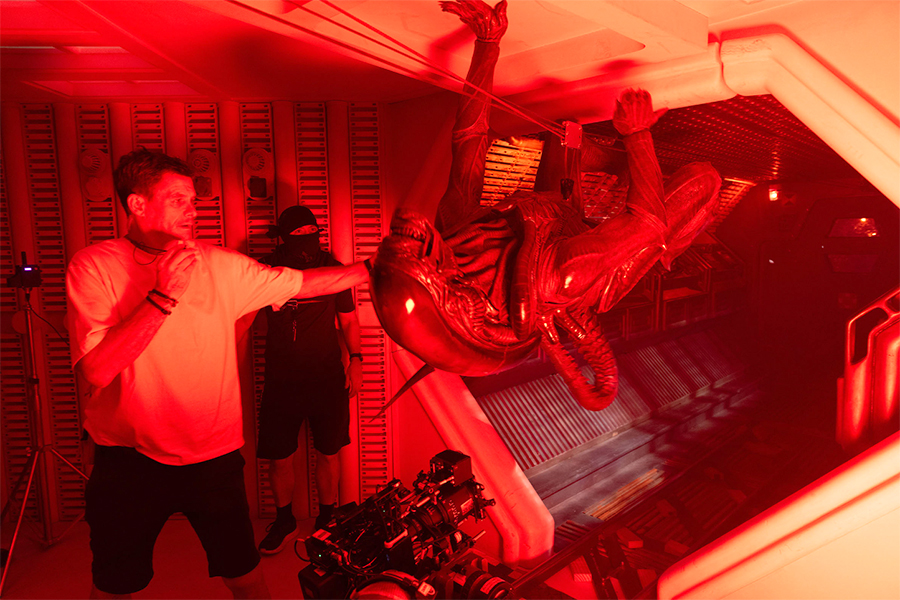
LIGHTNING IN A BOTTLE
Noah Hawley (creator, showrunner, EP, writer, director): In a film, you only have time to tell the most critical parts of the story. A series gives you the opportunity to use pieces that really expand on the themes or the characters. On Fargo, we did the puppet-show episode in season five, we did this black-and-white East/West episode with the tornado in season four. In season three, Carrie Coon went to Los Angeles for an hour. I like that idea of taking people to an unexpected place to expand their sense of what the story means.
Jeff Russo (composer): In all the series I’ve done with Noah — in Legion, in Fargo — there’s always been a standalone episode. He likes to tell stories like that. So, I expected there to be one without knowing what it was.
Hawley: In 2023, the strikes shut us down. It was about eight months before we could really go back, but I was able to look at the 20 minutes of footage we’d filmed, and I started to have this idea that there’s a real opportunity here to do classic Alien in the middle of our innovation on what Alien could be.
Russo: We talked about this fifth episode being a true tip of the hat to the early parts of the franchise, and how I could contribute to that. I did think of the episode as a standalone feature. It’s not feature-length, but it really is a standalone story, told in the middle of the show.
Babou Ceesay (actor, Morrow): When we were shooting the episode, it felt very much like a self-contained film. It felt like an Alien movie.
A NEW 'FINAL GIRL'
Hawley: Viewers met [the Maginot] crew for 10 minutes in the beginning of the series, so they’re not unfamiliar, but they’re not well-defined. Babou’s character you’ve seen now for four solid hours, so you are really invested in him. It does feel like, “Well, this is his episode, and we’re expanding on his story so you understand him better.” And one thing I’ve always loved about the Alien franchise is that it doesn’t have rose-colored glasses about humanity, and it has some morally dubious characters in it.
Ceesay: Morrow’s literal existence [as a cyborg] is a gray area. Like, what are the mechanics underneath? There are all these questions — how much is machine, how much of his brain is left? — with many different interpretations.
Hawley: We obviously know going in that only Morrow survives. But I find that with the most skilled storytellers, you forget that at a certain point, and you’re in the survival story with them. If the story is good enough, you’re so in the moment that the deaths come as a surprise, even though you know they’re coming.
Cam operator Ross Coscia in the ship’s cryopod room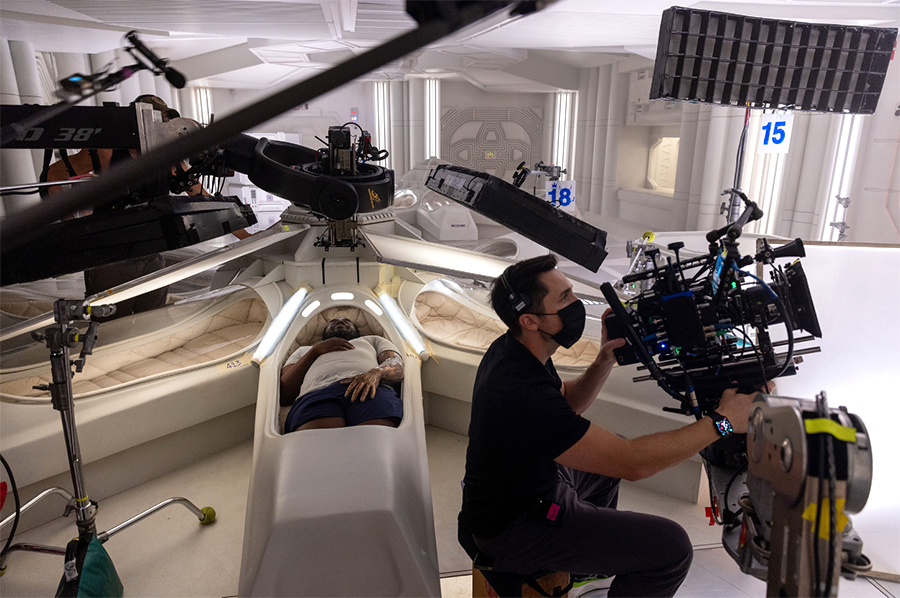
Ceesay: When the episode came out, people were contacting me to tell me, “You’re the new final girl.” [Laughs] One person wrote to me saying, “I hated your character for four episodes. Like, loathed. Now, I’m team Morrow.”
FINDING THE RIGHT DIRECTION
Hawley: The moment I decided to do this episode, I decided that I had to be the one who shot it. I mean, just look at the Alien canon: You’ve got Ridley Scott, David Fincher, James Cameron, Jean-Pierre Jeunet — a murderer’s row of the great directors of our age. Whether it was hubris or just a desire to play in those waters, I wanted to get in there and do my spin on it.
There’s a lot more handheld in episode five than I’ve ever used before. It’s not one of my favorite things, but it was a useful tool here [to make things feel] more out of control. That becomes visceral, and the audience might not be noticing, but they feel it.
The sequence with the tick escaping and the Eye Midge rocking the tube and escaping — all of that’s especially challenging, because the elements are make-believe. There are no ticks in that tube; there is no Eye Midge. I mean, we have a photo reference, but you really have to plan out all the shots. It’s a much more insert-shot sequence than I’m used to doing. And I shot a lot of it. My editor [Regis Kimble] is there on location with me, so we’re cutting it together and seeing what pieces we missed, but that scene was technically challenging.
There’s one shot near the end that I don’t know if people really noticed, when Zaveri [Richa Moorjani] is running from the Xenomorph; she presses herself against the wall, and you see it emerge from down the hallway. We were doing a slow push on Zaveri, and I thought, “What if we try a double-zoom, where we basically put a line in the middle of our frame, and we zoom into Zaveri’s face, then do a longer zoom down the hall to the Xenomorph, and we put them together?” You get this feeling that you can’t really explain, because both shots are zooming, but it’s impossible for one side to zoom 12 inches and the other side to zoom so much further. But it creates a feeling in the audience. I’m always starting with those feelings, then going, “Well, how would I achieve that?”
Actor Richa Moorjani (Zaveri) on the set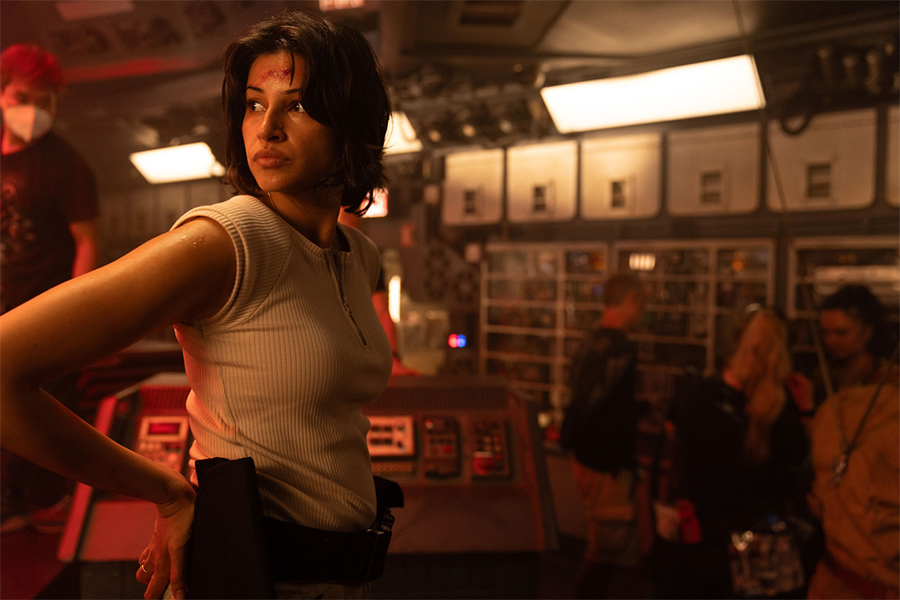
Andy Nicholson (production designer): There were specific rooms in the Maginot which recalled rooms from the [Alien ship] Nostromo — the bridge, the MU/TH/UR computer room, the cryopod room. One of my first questions was whether Noah wanted the Maginot to be a sister ship to the Nostromo. What was he looking to do with this in terms of Easter eggs? Because the Nostromo is a benchmark in science-fiction production design. Nothing had been done like it before, so it meant a lot to me.
Hawley: We certainly had conversations with FX where they were worried it was too big, too expensive, but I was very clear how I could pull it off in a way that wasn’t going to break the bank. We had a lot of post-crash spaceship, and we needed to convert it to pre-crash spaceship. It was such a great challenge.
Nicholson: During preproduction, we studied [Alien] over and over again, trying to figure out what size things were, knowing we’d be creating a sister ship. The making-of books were helpful, but it was a case of looking at the movie frame by frame on a big monitor, working out the heights of corridors from knowing how tall [Alien actor] Harry Dean Stanton was.
B-cam operator Matthew Moriarty, coproducer–first AD Cory Faulkner and Xenomorph stand-in Rachel Minchin in the ship’s MU/TH/UR room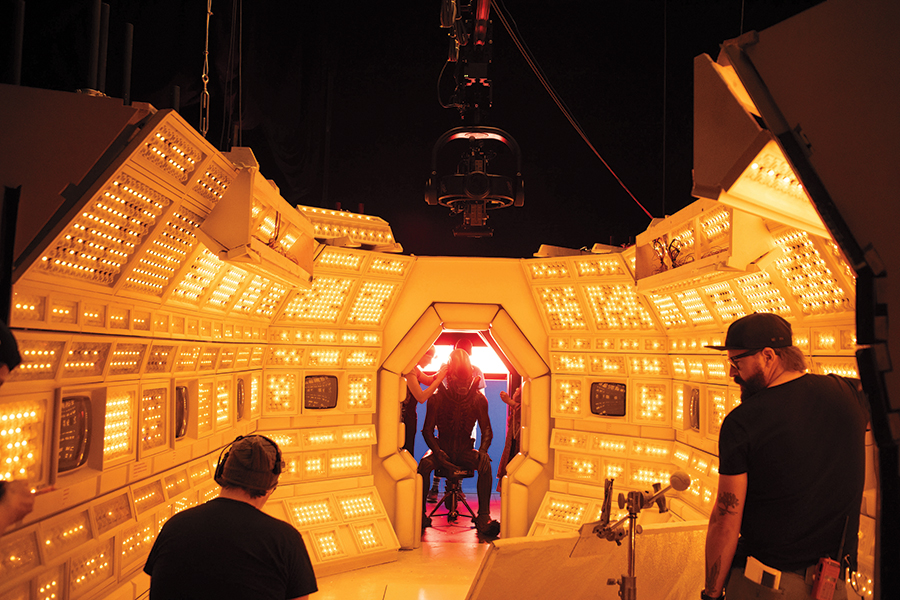
The Nostromo’s MU/TH/UR set was about eight feet by eight feet, but ours had the impact room in the bottom for Morrow to go into [where he ultimately escaped the Xenomorph], so it needed to be bigger. We took the design, stretched it and added all the lights. There’s something like 20,000 individually wired LEDs, all fabricated one bulb at a time. The back of that set is quite an amazing thing to see, and it was a testament to the practical lighting crew that it never once failed.
Ceesay: What was incredible was how much of the set was built. We could walk from the mess hall down a hallway to the lab, down another hallway — you had the opportunity to walk into a space and disappear for ages. There are flashing lights. You can touch stuff. Doors slide open.
Nicholson: The level of detail, the intricacy needed — I mean, I’ve done cockpits and spaceships before, and if you’re in a small space, the background is close to the actors. It’s going to be in focus. You’re going to see it.
Noah Hawley, Inch and actor Michael Smiley (Shmuel) prep for a scene with the Xenomorph.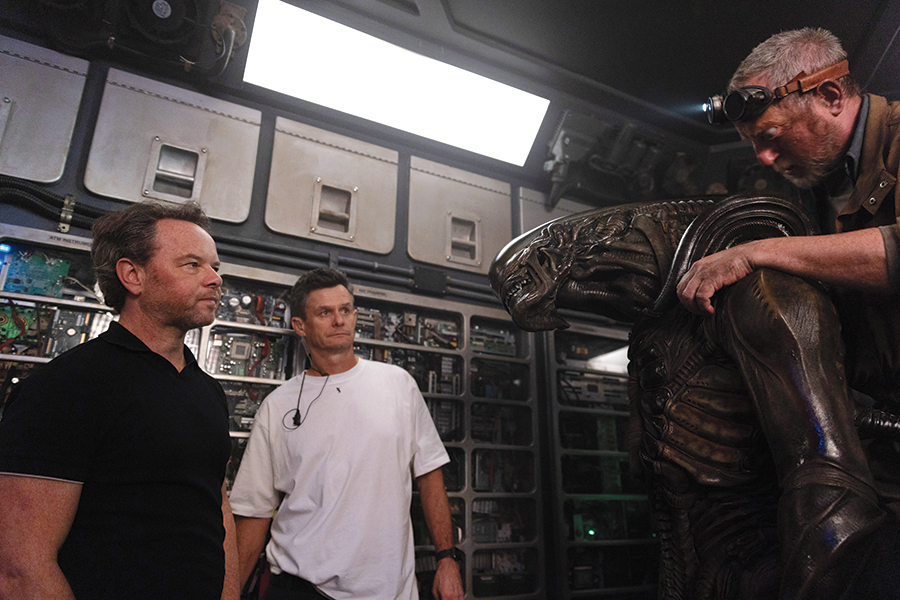
Hawley: I think for everyone working on the show, it was a thrilling return to childhood to walk onto those sets. Whatever age you were when you saw the movies for the first time was the age you became when you walked onto set. It’s really a kind of humbling moment, and everyone’s smiling, because, I mean, who among us wasn’t shaped by Alien?
Nicholson: Everybody sat in the chairs. Everybody went into the MU/TH/UR room. Everybody lay in the cryochamber. It was like Disney World for Alien fans.
The complete version of this article originally appeared in emmy Magazine, issue #7, 2026, under the title "Ship of Horrors."