

New Orleans: home of Mardi Gras, birthplace of jazz and the site of … the single largest rocket stage NASA has ever produced?
Yes, indeed. That would be the core stage of the Space Launch System that on April 1 sent the four-astronaut crew of Artemis II on a mission around the Moon. It was built at the Michoud Assembly Facility in New Orleans, then transported 900 miles by barge to the Kennedy Space Center in Florida. Providing most of the thrust for the Orion spacecraft at launch, the core stage weighs in at 219,000 pounds with its engines. "
Who would have guessed it? We were staying on Bourbon Street, and then we drove 10 or so minutes down the road and we were at the mission," Tim Lambert says. He's the writer, producer and director of the NOVA science series’ one-hour documentary special Return to the Moon, which shows the rocket leaving its assembly hangar and then again at Kennedy’s Vehicle Assembly Building, one of the largest buildings in the world.
Chronicling NASA’s Artemis space program — which aims to set up a permanent base on the Moon for long-term space exploration — Return to the Moon premiered on PBS just five days after Artemis II’s successful splashdown off the coast of San Diego on April 10. Artemis II’s test flight marked the first time humans had flown to the Moon since Apollo 17 in December 1972, as well as the first time since then that humans had seen the side of the Moon that faces away from Earth. It also took people farther from Earth (about 252,756 miles) than ever before. The crew was commander Reid Wiseman, pilot Victor Glover, mission specialist Christina Koch and mission specialist Jeremy Hansen from the Canadian Space Agency.
The Artemis II crew — Commander Reid Wiseman (center), Christina Koch, Victor Glover and Jeremy Hansen — includes the first woman, the first Black person and the first Canadian (Hansen) to fly to the Moon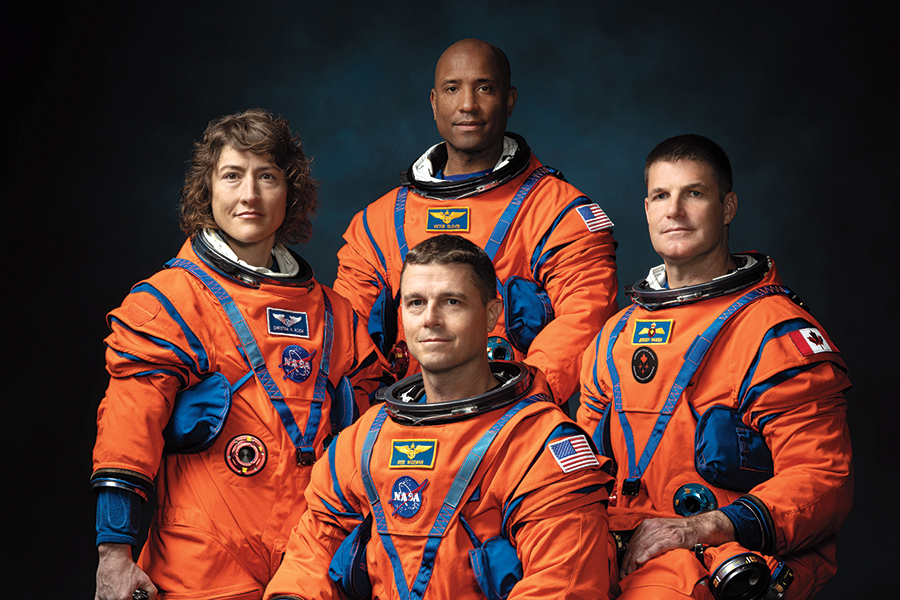
Lambert (D-Day: The Unheard Tapes, Alien Worlds) had begun work on the special three and a half years earlier. Its video footage and interviews cover the unmanned Artemis I test flight in November 2022 and testing, astronaut training and other preparations for Artemis II. The show also addresses historical elements of the Apollo and space shuttle programs and provides insights into the dangers of a mission where the smallest detail gone awry can potentially upend the work of thousands of dedicated team members — and cost astronauts their lives. And then there are the geopolitical implications: A key Apollo goal was to put a man on the Moon before the Russians did, and now Artemis faces China’s announcement that it intends to send a crew to the Moon.
In addition to New Orleans and the Kennedy Space Center, crews shot at the Johnson Space Center in Houston, NASA facilities in Alabama and Ohio and at NASA headquarters in Washington, D.C. For an international version of the show, they also shot in Germany at Airbus, which built the European Service Module that provided electrical power, water, oxygen and other essentials for the flight.
The special includes interviews with Wiseman; NASA’s first female launch director, Charlie Blackwell-Thompson; former NASA administrator Bill Nelson; mission and project managers; a space scientist and journalists.
Charlie Blackwell-Thompson, NASA’s first female launch director, monitors the Artemis I launch countdown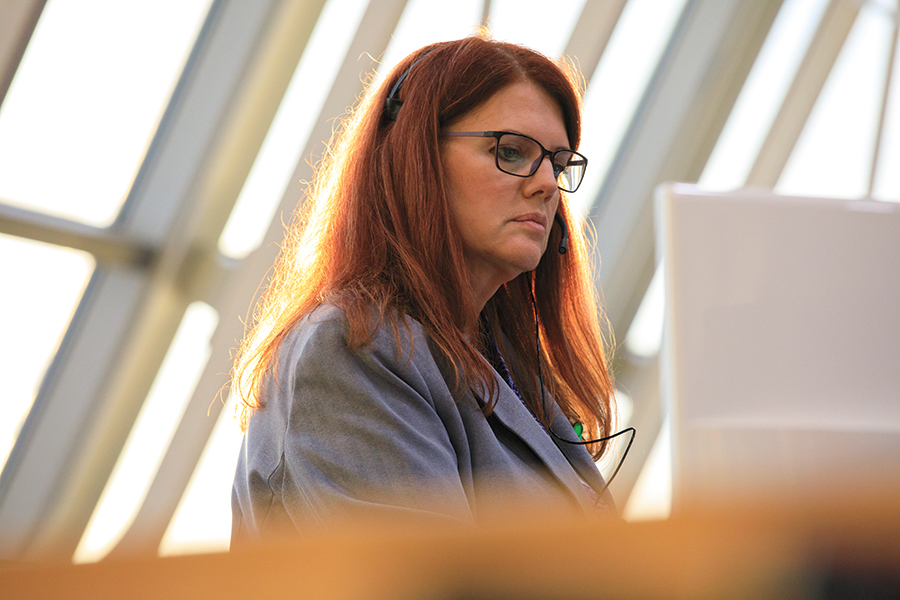
During Artemis II’s 10-day journey to the Moon and back, a NOVA crew was stationed in Houston. “We filmed in Mission Control and a fancy new area they’ve got called the Mission Evaluation Room,” where engineers monitored the Orion spacecraft and collected data, Lambert says. “We tried to film as much as possible behind-the-scenes of how a mission takes place and how it works on the ground.”
Beyond that, he says, “We recorded feeds all the time from NASA, and they supplied us 4K versions of the feeds without captions or other graphics or commentary. We were getting the clean stream. So that became like rushes for us.” To tell the Artemis II story, “We took three years making the [first] 42 minutes, and then we had to do the last 10 minutes in two weeks, which is kind of a crazy way of working,” Lambert says.
As a child in London, Lambert developed an interest in space after being roused from sleep to watch the 1969 Apollo 11 Moon landing and to see Neil Armstrong walk on the lunar surface. From his adult perspective, the project has an added meaningful layer.
The massive SLS core stage rocket arrives at Kennedy’s Vehicle Assembly Building, having been transported 900 miles on the Pegasus barge from the Michoud Assembly Facility in New Orleans.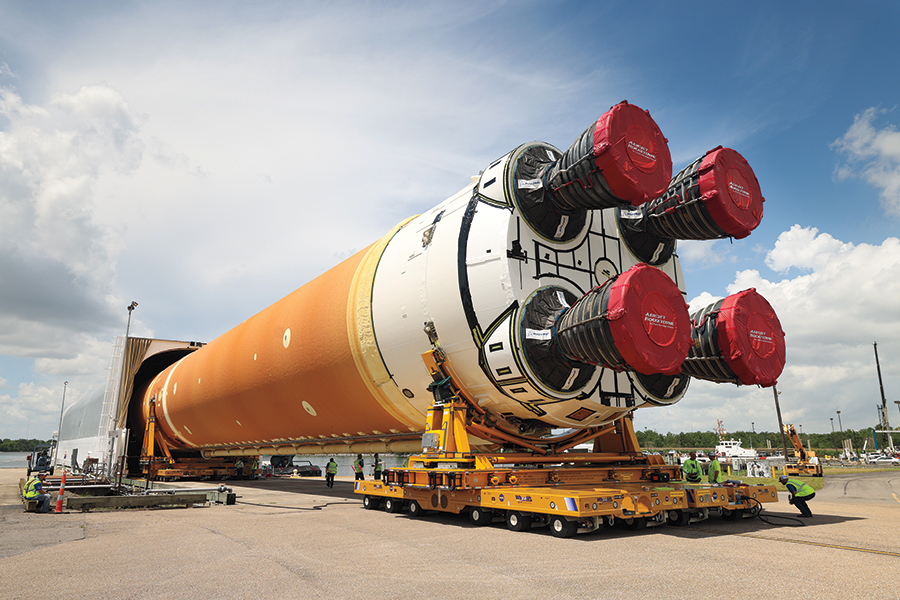
"I became a space nut and was mad for Apollo and all of that,” he explains. “And now we’re doing it all over again — only this time in a 21st-century way, and it’s much more ambitious than Apollo.
“This isn’t to go and pick up a few rocks off the Moon, a couple of days at a time. NASA’s building a Moon base: The idea is to live and stay there. The idea of making a film that gives us a window into that sort of ambition was what fascinated me.”
The complete version of this article can be found in emmy Magazine, issue #7, 2026, under the title "Going the Distance."