
Gone are the days when YouTube was a niche content hub. Today, the once-scrappy start-up (now a division of Alphabet) is the number one streaming platform, consistently boasting more than 12% of all viewing time — more than Disney+, HBO Max, Paramount+ and Peacock combined — thanks in part to a growing emphasis on the “living-room experience.”
That evolution has led some top YouTubers to invest in their own studio spaces. For the elite creators whose subscriber counts rival the populations of some small nations, the days of guerrilla street-shoots and using tiny apartments as makeshift sets are over. Now they’re converting (and even building) massive spaces into soundstages for use as all-purpose production hubs.
We’re not talking webcams and ring-light setups either; these are high-quality, full-service locations equipped with cutting-edge tech, as well as roving and standing sets that mirror traditional backlots. Some have professional offices for staff and executives. It’s not uncommon for these spaces to occupy square footage into the tens of thousands or even 100,000-plus, making them sprawling, golf cart–required campuses.
Perhaps more interesting: Many YouTube multihyphenates, who’ve had to grow quickly into roles that have them juggling creative decisions, business affairs and the minutiae of production, see their fellow digital moguls not as competition but as collaborators in a bold new future just beginning to take shape. As Alan Chikin Chow, the most-watched YouTube shorts creator, says, “We’re always helping each other out. It feels like we’re building the future as we go, and we can’t do it alone. If one of us succeeds, all of us succeed.”
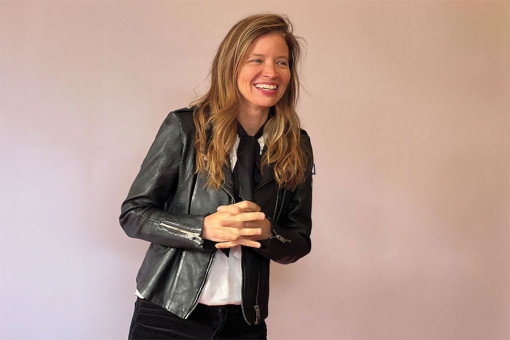
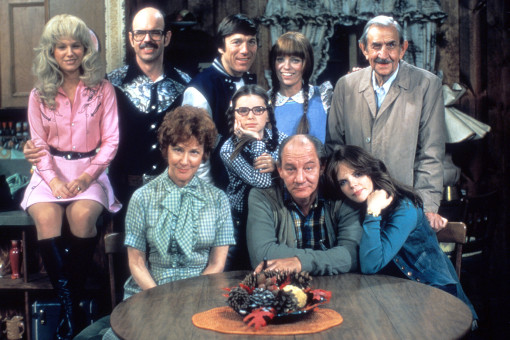
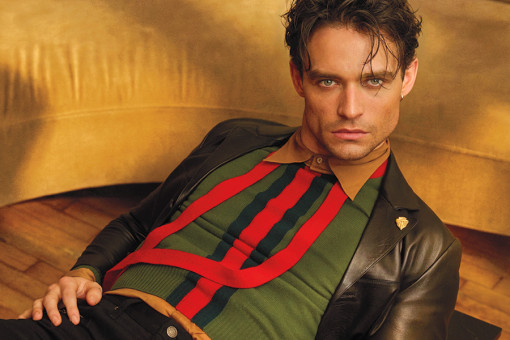
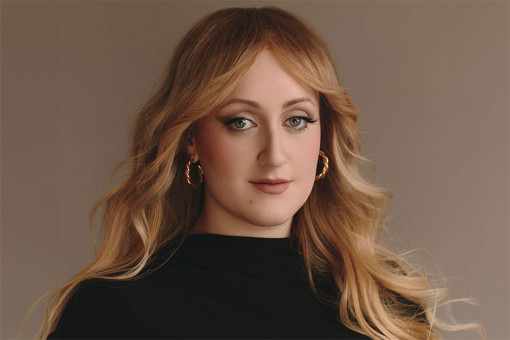
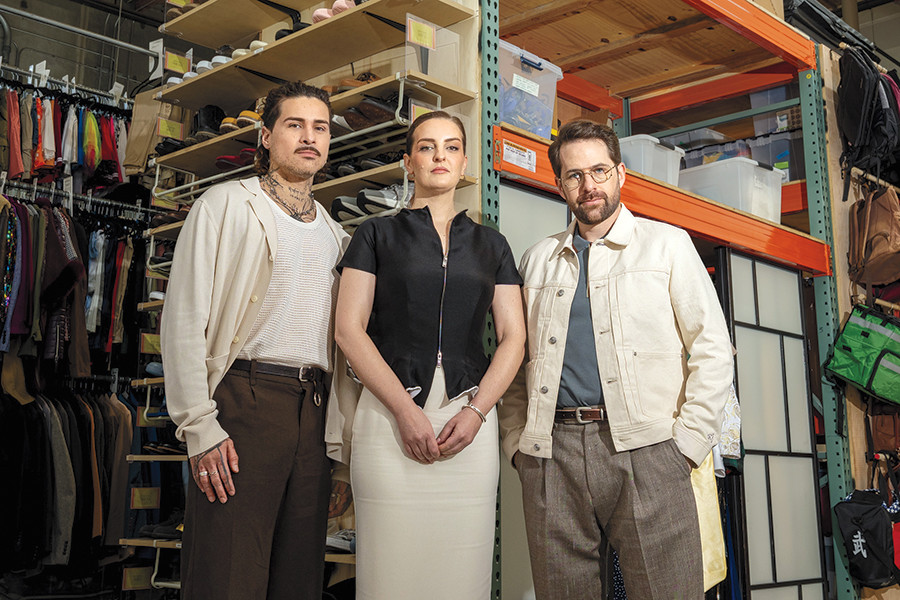
Emmy contributor Malcolm Venable met with some of the content creators who have built studios to accommodate their growing empires — Chow, Dhar Mann, and Ian Hecox and Anthony Padilla of the comedy collective Smosh — to get a glimpse at their digs and the philosophies they’re following to rewrite the rules.
SMOSH
The set of Smosh Mouth, a podcast in which hosts Shayne Topp and Amanda Lehan-Canto speak with members of the Smosh collective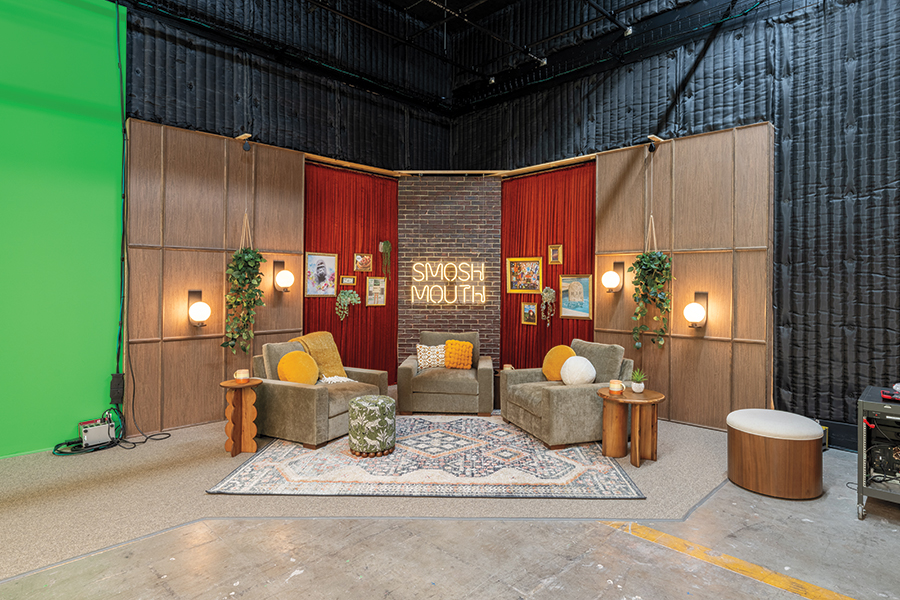
The multichannel comedy network Smosh is one of the few YouTube houses whose history aligns with the very platform itself. Founded by Anthony Padilla and Ian Hecox, Smosh became internet-famous in 2005 (the same year YouTube itself began) with a goofy sketch lip-syncing to the Pokémon theme song that became an early viral video. Twenty-one years later, Padilla and Hecox have grown up, and it shows, notably in the slick 32,000-square-foot space that is Smosh’s new home. “We’ve never seen ourselves as disruptors or the new guard,” Hecox says. “We did happen to be some of the first people to make YouTube videos, but it never felt like we were forcing our way into the industry. We’ve always gone where we felt was comfortable for us. We found that our old space could no longer support what we wanted to do, so our goal was to get to a place where we could shoot two videos simultaneously.”
That sounds simple, but Smosh’s history is not. In 2006, offbeat comedy sketches made Smosh one of the most–subscribed to channels. By 2011, continued expansion led to an acquisition, increased ad revenue and new channels for animation and gaming, but by 2017, creative differences led to a restructuring, and Padilla left. Mythical Entertainment, another YouTube powerhouse, bought Smosh in 2019, but in 2023, Hecox and Padilla reacquired most of the company and added CEO Alessandra Catanese, who’d been at Padilla’s Pressalike Productions for six years (following roles at Maker Studios, Patreon and Anonymous Content).
Now, Smosh is a 70-person operation with 53 million subscribers across five channels and a focus on comedy, gaming and revenue via slick commercials for brands. Comedy-wise, Saturday Night Live is a North Star, and the new digs help the founders and their 15-person cast realize their premium–sketch show vision. “Ian and I gave a quick walk-through with the cast,” Padilla recalls, “and there was this giddy excitement from everyone. People were like, ‘Oh my God, everything’s bigger, everything’s brighter, everything’s better.’ That was the first time I had that moment, where I was like, ‘This started in my bedroom, where Ian and I just had a webcam and were making silly videos, and this is what it’s become.’”
A wall of awards, including plaques for reaching YouTube subscriber milestones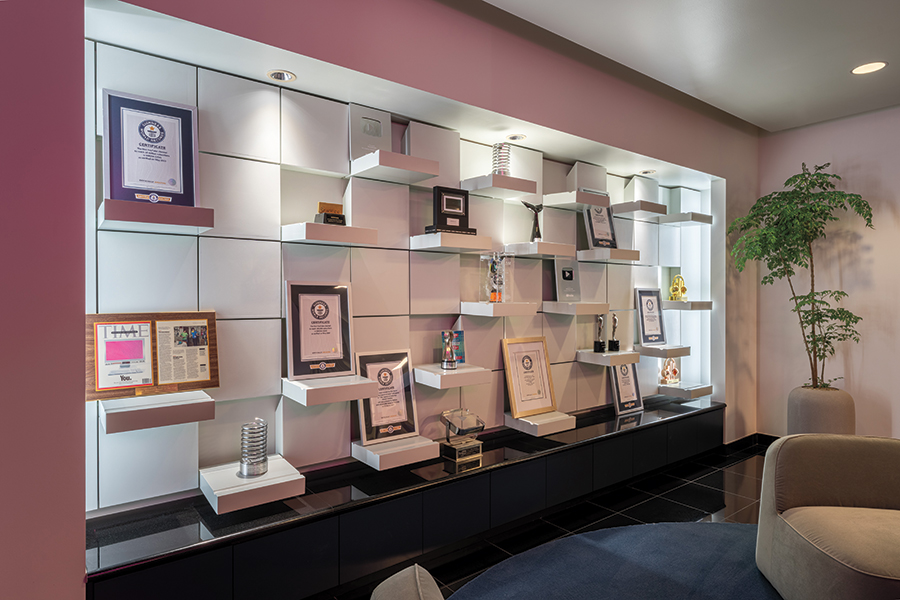
The new space includes three sound stages and space for podcasting. Roughly twice the size of the location Smosh moved into in 2022, the new headquarters contains an art department, a print shop for on-the-spot set-decoration needs, cinema-grade 4K cameras and lighting grids for a polished look that rivals traditional late-night shows, plus one of the founders’ favorite elements — a proper green room for guest players.
“Because we have three sound stages, having it all under one roof allows our cast to pop in and out of each video very quickly,” Padilla says.
Catanese makes clear that elements of the space viewers can’t see — those meant to serve employees — are just as important as what appears on screen. “We didn’t want to lose that youthful feeling but [wanted it] more elevated.” Hues of blue and chocolate feel bright and inviting yet grounded and corporate, inviting people to chill and work in hangout spaces. A dog-friendly outdoor patio with privacy hedges lets people get some sun and soak up nature.
“We want it to feel grown-up and mature, but in a way that still honors the comedy,” Catanese says. “We’re never trying to step away from our roots, but we do want to be seen and taken seriously by the traditional industry.”
DHAR MANN STUDIOS
Dhar Mann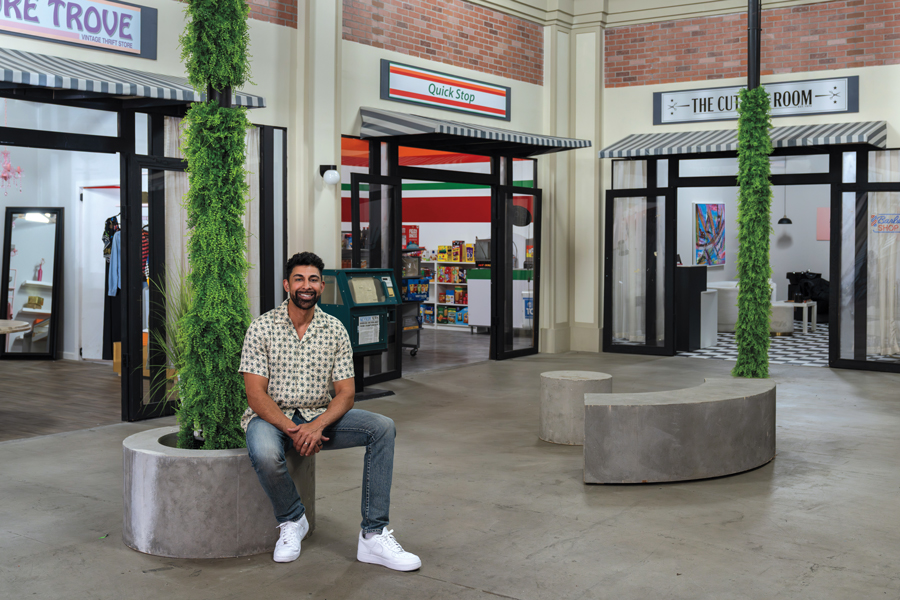
Among the sets inside Dhar Mann’s 125,000-square-foot Burbank headquarters are a courthouse that doubles as a church, half an airplane, a classroom and a mini-mall complete with a hair salon. The most meaningful, though, is probably an apartment modeled after Mann’s home during his early days on YouTube, during which he and his wife would sleep on the floor to avoid disturbing the furniture doubling as set dressing — some of which remains in use today. “When I walk through [that set],” he says, “it reminds me of where I came from. I’m so grateful for this journey.”
Mann’s journey started in 2018, when the Bay Area native and UC Davis alum pivoted from the cosmetics company he ran with his wife, Laura Avila, and turned the camera on himself. He started with advice-laden motivational speeches — a legit lane for the son of Indian immigrants who’d weathered their share of adversity. When he shifted to narrative-driven, family-friendly morality plays, the floodgates opened — and he grew to his current 27+ million subscribers. Now his videos consistently rack up 2–3 million views, and they’re filmed at Dhar Mann Studios, where a core staff of more than 200 releases five 25-minute episodes weekly.
“We’re a full end-to-end operation,” Mann explains, “so everything from ideation to writing to preproduction. We have our own casting, wardrobe and makeup. If we need a new set built, our in-house team builds it. All the way to postproduction for coloring, sound design, VFX; we do everything in house.”
Efficiency guides the process, which translates into the space’s design. “The universe we want to build is around the sets we actually have,” he says. “We know that if we want to write an airplane scene [that segues] to a school, logistically, that’s about 15 footsteps. Our writers are well-versed in the studio layout and how teams move from point A to point B. We’re probably on the 10th iteration of our studio setup, because we’ve realized every studio should have some residential space, a school and some commercial space, so within each building, you can tell an entire story without ever leaving the four walls.”
You’d never know from the outside of Dhar Mann’s deliberately nondescript digs in an unmarked office park that an entire galaxy was spinning there, but inside, whole worlds are colliding and colluding, and not just the teams making the episodes. In 2024, former MTV president Sean Atkins joined the company and became CEO six months later, bringing a business sensibility aimed at maximizing the space’s return on investment. Furthering its reach, earlier this year Dhar Mann Studios partnered with Fox Entertainment on original scripted video content set to stream on the vertical platform MyDrama.
The “Bullseye” set (above) sits beside a bank of mall elevators that can double for an office-building interior.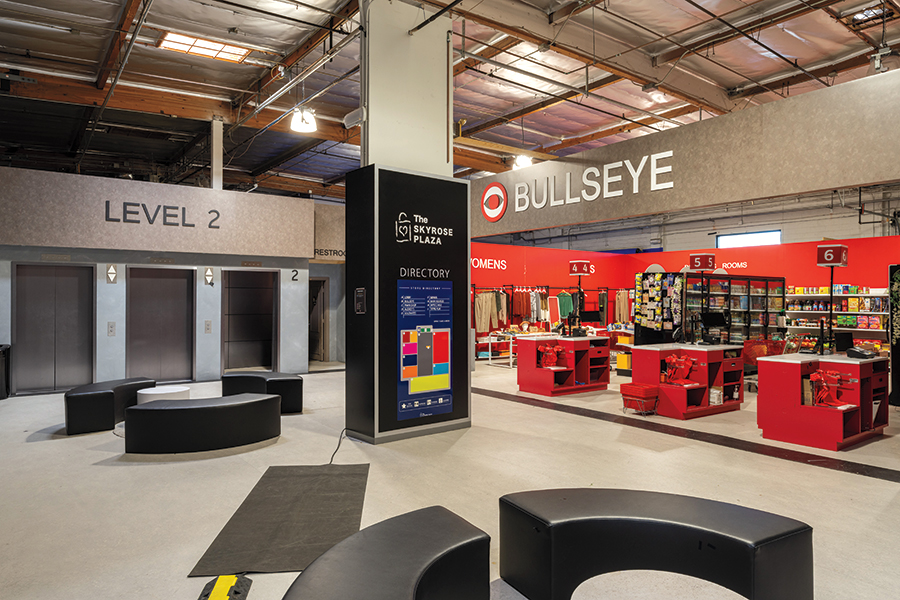
Dhar Mann Studios also has an in-house agency that represents other top YouTubers. The “Bullseye” store (which bears a strong resemblance to a certain big-box retailer) allows the studio to set stories in a recognizable space and facilitate branded content if partnership opportunities arise. Dhar Mann has already partnered with Samsung and Adobe, which had the studio bring in other creators to teach them their process and use the sets for free.
For Mann, competition represents an outdated way of thinking. “I don’t think anyone gets anywhere by trying to see everybody as the competition,” he says. “When traditional companies and creators come together to create something new and meaningful, we’re able to take the best of what’s working from the traditional model while still being disruptive and not losing the edge. That makes us unique within this new media space.”
ALAN'S UNIVERSE
Alan Chikin Chow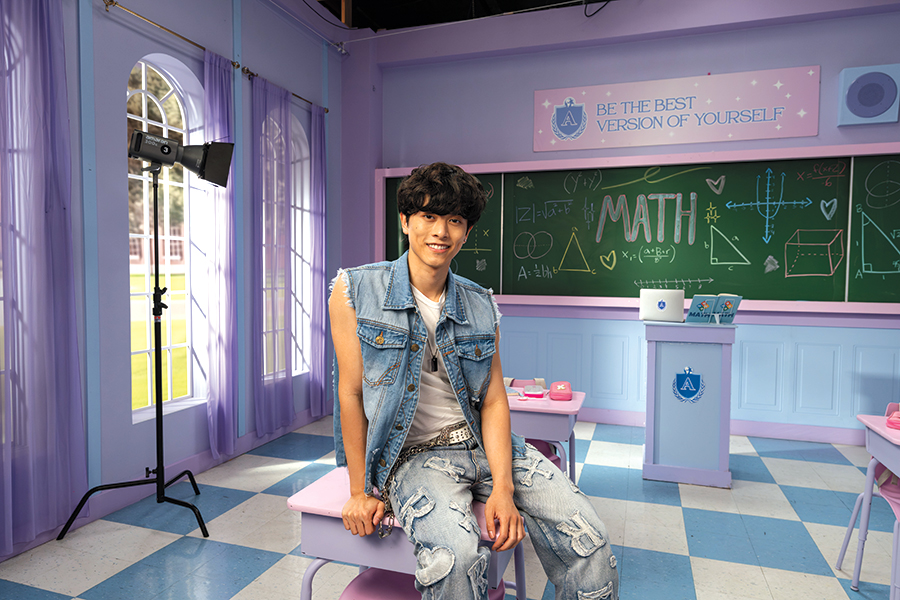
It's no accident that Alan Chikin Chow’s 10,000-square-foot content factory bursts with a bright, bubble gum–tinted color palette reminiscent of the K-pop aesthetic. Not only does his series Alan’s Universe draw inspiration from the 2017 Korean reality show Idol School, but Chow also incorporates K-pop’s fan-engagement strategy into his work — including an upcoming original scripted series for Netflix set in the world of K-pop.
"The way we like to think about Alan's Universe," Chow says of his glossy tween fantasia, “is that it’s the fantasy that kids ages 7 to 11 years old have of high school before they get to high school. And we draw a lot of inspiration from the K-pop system for how they think about fandom first. How do we support the fans? And how do we give them stories and content fans will love?”
Chow’s results speak for themselves. The Plano, Texas, native had guest roles on Disney Channel and Nickelodeon projects as a kid actor, but he started Alan’s Universe as a tiny operation in his bedroom while studying screenwriting at USC circa 2018–19. In 2023, he developed it into a series of interconnected vignettes that has now amassed 115 million subscribers across four channels and billions of views. “It was hard back in those days,” he says, “because I would pull open a kitchen drawer, and instead of eggs, it would be lights, scripts, highlighters … and I’d be like, ‘Oh my God, I cannot keep shooting where I live.’”
Hence AU Studios, which opened in 2024. Featuring 10 custom sets, the facility — like that of his peer and friendly colleague Dhar Mann — includes a room modeled after the apartment where Chow began his journey. Keeping with the narrative theme, Chow’s HQ includes locker-lined hallways and classrooms, all rendered in the same high-gloss candy-colored fever-dream palette. The layout allows his 20-person team to shoot shorts and longer-form episodes simultaneously.
A set for Bookside School includes a hallway that leads to multiple classrooms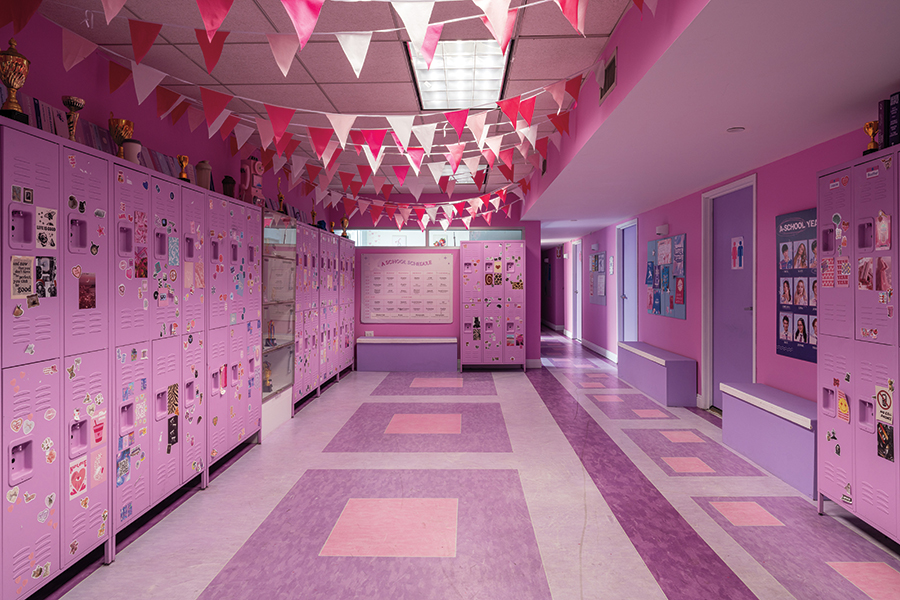
Nearly all the space is designed for multifunctionality. “I have a dedicated office space to work in, but our entire office is simultaneously office space and a shooting location. You could be doing office work, and then suddenly at 2 p.m. we’re going to burst in there and start shooting.” Chow was also deliberate in ensuring the bones of the studio met content-creation needs, though one demand resulted in a compromise. “We had a lot of challenges [at the outset],” he says, “things that you would never even imagine. My director and I had a big fight about whether or not to have ceilings; most traditional sets don’t have ceilings. But he was insistent on wanting them. For vertical video, if you don’t have ceilings, you can see where the head cuts off. So, the compromise was sets with very tall walls.”
Chow chose the location thoughtfully. His vision for Alan’s Universe includes developing it into enduring, iconic IP, so settling in Burbank was both strategic and symbolic. “There were options in Downtown, Culver City and West Hollywood. But when I filmed for Disney and Nickelodeon back in the day, we’d pass all the legacy studios. It’s sort of a mythical neighborhood. So, it feels great to be part of this new age. This space allows us to be a lot grander with our ideas, and it helps make sure there are actually eggs in my fridge.”
This article originally appeared in emmy Magazine, issue #7, 2026, under the title "A Room for a View."