
It’s every parent’s worst nightmare: Your child is missing. And not only that, but everyone believes your negligence is what made the abduction possible.
That’s the harrowing premise of Peacock’s domestic thriller All Her Fault — and it’s hardly a spoiler. The limited series — and Andrea Mara’s 2021 novel on which it is based — wastes no time plunging into the swirling panic at the heart of the story.
Marissa Irvine (Sarah Snook) arrives at the home where she believes her 5-year-old son, Milo (Duke McCloud), has been on a playdate. Instead, she is met by a bewildered stranger. No child. No playdate. No explanation. As frantic phone calls mount, one horrifying realization takes hold: No one knows where Milo is.
But All Her Fault is as interested in the kidnapping whodunit as it is in the collateral damage that follows — specifically, what happens when a mother’s worst day becomes an indictment of her competence. The eight-episode limited series examines the dynamics of modern parenthood: Who carries the mental load; who gets blamed when something goes wrong; and why, even now, mothers remain the default domestic labor.
What fascinated executive producer Megan Gallagher (Wolf) was “this idea that women work full time and then come home and work full time. The wear and tear of that, the mental load of that and how women really feel about it. So, probably the biggest challenge was not making light of those issues while also making sure to keep the entertainment factor super high.”
Marissa’s catastrophic error is simple enough: She receives a text confirming Milo’s playdate from an unfamiliar number and neglects to check it against the school’s contact list. The question All Her Fault poses is whether such a lapse justifies the tidal wave of judgment that follows. Was this truly a singular failure? Or is Marissa being judged more harshly because she is the one presumed responsible in the first place? After all, why is she the parent coordinating playdates, volunteering at school, remembering schedules and orchestrating the thousand tiny logistics of child-rearing when both she and her husband, Peter (Jake Lacy), maintain full-time careers?
But the series doesn’t luxuriate in man-bashing. In fact, the character of Detective Alcaras, a female Detective McConville in the novel, is played here by Michael Peña (Jack Ryan). The gender swap made way for a positive depiction of a male parent, one who, in addition to having a career, is deeply and lovingly involved with the care of his child — in this case, one who has special needs.
Snook and Jake Lacy as Peter Irvine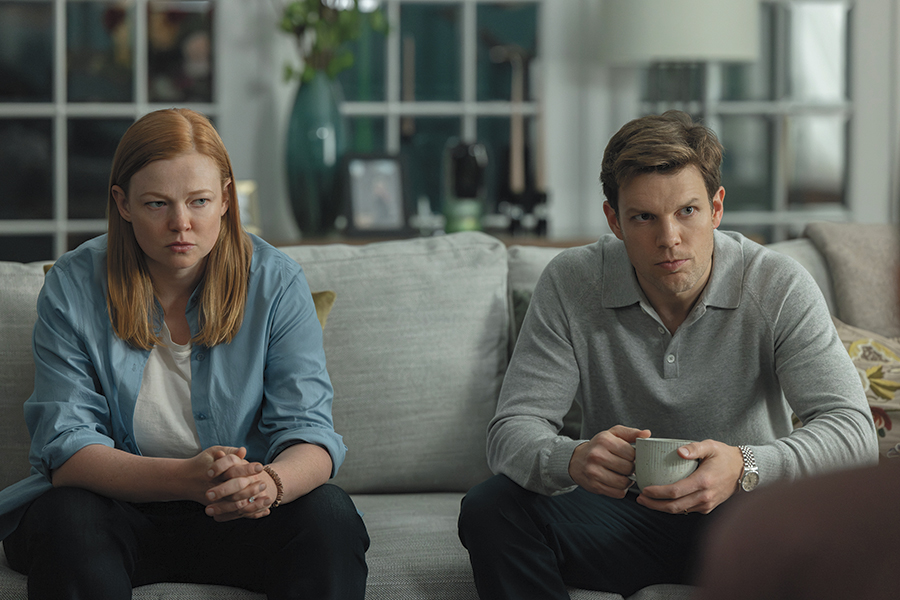
Behind the scenes, multiple women on the production have partners who stay at home, including Gallagher, who acknowledges the irony: “We’ve gone through a huge transformation, where my husband has left his job and is now a full-time stay-at-home dad. So, there are plenty of jokes in my household about how my husband does everything, and then I go off and write television series about how men don’t do enough.”
The show’s central exploration of parental imbalance, however, comes through Peter. “Peter is loving and engaged with his son, to a point that ultimately borders on control,” Lacy says. “But he offloads a lot of the mental responsibility to his wife. He’s free to be present with Milo, because Marissa handles [everything else].”
Peter’s arc includes some of the show’s most shocking turns, which Lacy could only see objectively once he had some distance from the role. “As an actor, you have to find a way to commit fully to the choices your character makes. You have to be on their side no matter what. So, I have a lot of empathy for Peter and the pain he was in and the pain he caused. But I also forgot that basically every other person who sees this show is like, ‘You’re a psycho. That’s psycho behavior.’ I’m not surprised that people felt that way. It just took me a minute to go back to seeing Peter from the outside.”
Both Lacy and Snook are parents in real life. Snook, a three-time Emmy nominee for her role as Shiv Roy in HBO’s Succession, won in 2023 for Outstanding Lead Actress in a Drama Series. In her speech, she thanked her recently born daughter and credited her with giving Snook the strength for the performance. She thinks that being a parent has informed her performance in this series, too, contrasting the experience with the 2015 Australian limited series The Beautiful Lie, in which she played a woman who leaves her husband and child. “I stand by the choices I made as an actress, but there were parents who said, ‘I don’t know how she could leave her son!’ And as the actor, I was like, ‘Because she’s in love with this guy! Of course she would!’ If I was a parent at that time, I would have probably made different choices, with a different kind of depth. For this particular role — given where the character goes — I don’t think I would have been able to do it [without being a parent].”
Lacy, an Emmy nominee for his supporting role in HBO’s The White Lotus, says, “I understood conceptually before having kids that I would do anything for them. Then you have kids, and it’s that crazy biological attachment that I hadn’t experienced before. I’m sure that inherently plays into choices that are being made, whether I'm conscious of them or not."
Given the nightmare scenario at the heart of the series, the material rattled costars Jay Ellis (Running Point), who plays Marissa’s friend, Colin, and Abby Elliott (The Bear), who plays Peter’s sister, Lia. Both actors are parents. “My kid goes on playdates every single day,” Ellis says. “And my heart was pounding out of my chest when I read [the script]. I remember rolling over to my wife, and I was like, ‘This is one you should never read.’”
“Your nerves are fried,” Elliott adds. “After the first table read, Sarah and I hugged and said, ‘We need to go home and hug our children.’” For that reason, Peña points out, levity on set became essential. “We’re constantly joking around, because we’ve got to go to such crazy depths in our souls to do a series like this,” he says.
Daniel Monks as Brian Irvine, Abby Elliott as Lia Irvine and Jay Ellis as Colin Dobbs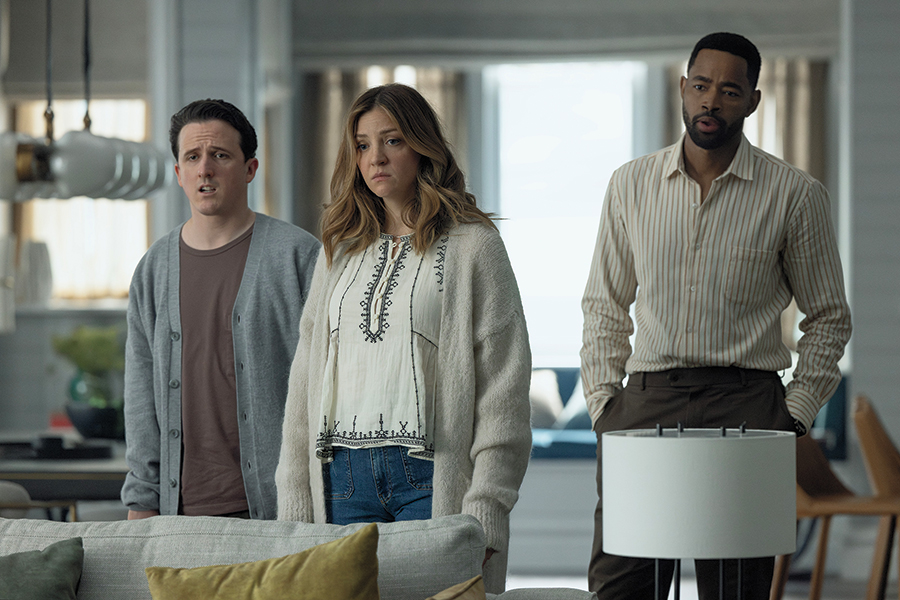
One of the core themes of the show is maternal guilt, compounded in this case by public scrutiny and a trial by media. During a press conference about Milo’s disappearance, Marissa falters under questioning from reporters, and public opinion swiftly turns against her. “It's called All Her Fault for a reason,” says executive producer Nigel Marchant (a 2011 Emmy winner and five-time nominee for Downton Abbey), noting that the title ultimately applies to multiple female characters.
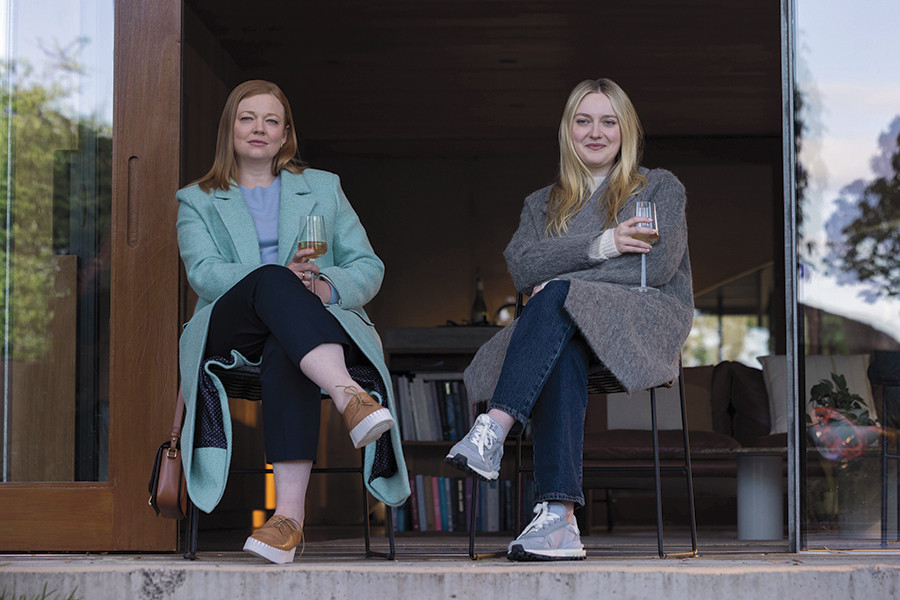
That includes Dakota Fanning’s Jenny Kaminski, a fellow school parent trapped in her own imbalanced marriage. Jenny’s husband, Richie (Thomas Cocquerel, The Gilded Age), personifies another kind of parent: one who performs the bare minimum while thinking it’s more than enough. One scene shows Jenny returning home to find Richie has made himself — and only himself — a sandwich and left the kitchen a mess. “We wanted to show that typically women just see everything a bit more and pick up the slack before their partner even notices,” says Fanning, an Emmy nominee for her supporting role in Netflix’s Ripley.
As the central mystery spirals outward, suspicion ricochets among an ever-expanding cast of characters. Even Sophia Lillis (The Chair Company), who plays Milo’s nanny, Carrie, was stunned by the script’s reveals. “[Executive producer–director Minkie Spiro] gave me the basic rundown, yet I was still surprised. I audibly gasped when I finished reading it.”
Spiro (Toxic Town), who helmed the first four episodes, says the team intentionally expanded the scope of the adaptation. “We wanted to make the world feel bigger, so when Milo is abducted, it feels like [trying to find] a needle in a haystack.” That scale was achieved in part through a Volume stage in Melbourne, Australia, where most of the series was filmed. Comprised of 6,000 screens allowing for 360-degree shooting, the towering stage is more commonly used for science-fiction epics than for domestic thrillers. The production also shot on location in Chicago, where the series is set, and captured background video of Lake Michigan for the Volume screens.
For both Lillis and Daniel Monks (A Knight of the Seven Kingdoms), who plays Peter’s brother, Brian, the experience was surreal. “It felt like being in The Truman Show,” Monks says. Sometimes the screens would glitch, “and you’re just, like, what is this world?"
Sophia Lillis as Carrie Finch and Duke McCloud as Milo Irvine 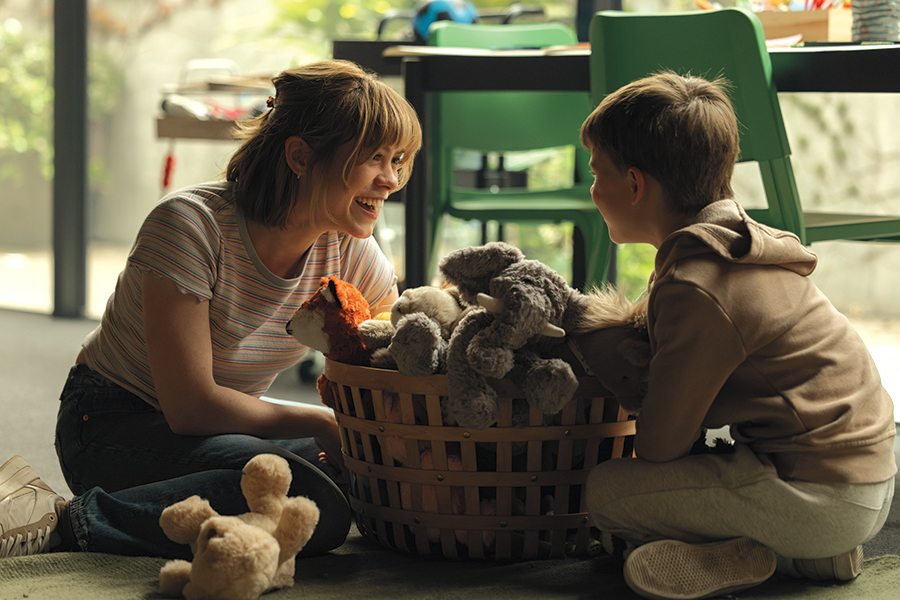
Still, for all its technical sophistication, some of the production’s most detailed storytelling came courtesy of its craftspeople. In an early conversation with costume designer Gypsy Taylor (Our Flag Means Death), Snook told Taylor that she wanted Marissa to look as if she had been deflated after finding out her son is missing. “We start out with this beautiful cashmere coat,” Taylor says, “and then she loses that, and she’s left with a tailored suit jacket. Then she loses that, and she’s left with just a silk shirt, so she looks and feels really vulnerable.” Taylor also chose a warm color palette for Marissa — “so you feel sorry for her.” Conversely, Peter’s wardrobe grows sharper and more structured as the season progresses. And Jenny, by contrast, wears restrictive turtlenecks and leather jackets designed to make her appear emotionally armored and suffocated.
Production designer Rob Harris (The Day of the Jackal), a three-time Emmy nominee, used similarly intentional visual cues, gradually cooling the color palette of the Irvine home as the story darkens. Another motif runs quietly through the costumes and production design: orange, a color subtly associated with Carrie and Milo, both of whom have synesthesia (wherein the stimulation of one sense triggers an involuntary experience in another, like associating a color with sound). You should sense that the color means something, Harris says, and then later understand why. But if viewers think every production detail is a clue, he cautions otherwise, calling the show “a cacophony of red herrings.”
Because the series was filmed in Australia, production faced the added challenge of sourcing distinctly American details — from left-hand-drive vehicles to oversized refrigerators. Smaller touches, too, helped sell the illusion: an outlet’s wall plate, a “No Guns” sticker in a window, the kinds of subliminal markers that evoke Chicago — or, more broadly, America — without requiring every street sign to be swapped, though those were changed as well.
All of that detail served a larger storytelling purpose: maintaining the show’s carefully calibrated atmosphere of suspicion. For director Kate Dennis (an Emmy nominee for The Handmaid’s Tale), who helmed the final four episodes, her task was to make sure the misdirects from the first block of episodes paid off in the second block. “It’s a challenge to get all those microbeats right. The emotional arcs still have to be consistent,” she says. “And flipping audience expectations — that’s always very satisfying.”
All Her Fault is executive-produced by creator-writer Megan Gallagher along with Nigel Marchant, Gareth Neame and Joanna Strevens for Carnival Films, and Sarah Snook, director Minkie Spiro, Christine Sacani and Jennifer Gabler Rawlings. The series is a production of Carnival Films, which is part of Universal International Studios, a division of Universal Studio Group.
The complete version of this article appeared in emmy Magazine, issue #8, 2026, under the title "The Parenting Trap."