
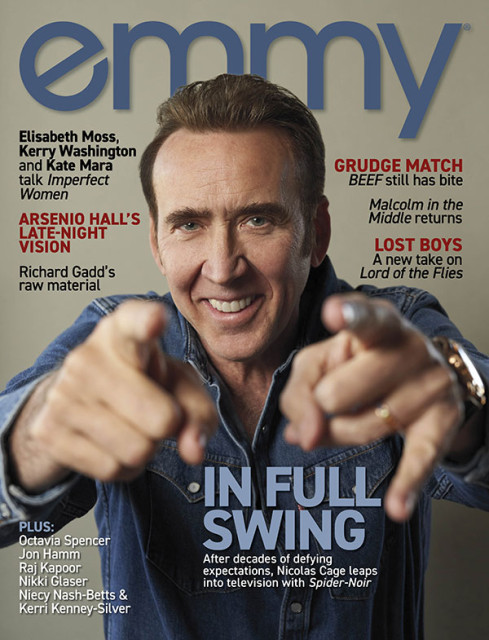
Back in the early 2000s, Nicolas Cage invited director Sam Raimi to his home in Malibu to discuss a movie. Over lunch, Raimi offered Cage a chance to join the nascent cinematic Spider-Verse as the diabolical antagonist Green Goblin. Cage ultimately passed on the tentpole.
“I decided to do another movie, a much smaller noir of sorts, more romantic than tragic noir,” the actor says of his Oscar-nominated turn in Adaptation. “But I remember saying to Sam, ‘I hope whoever you cast [as Spider-Man] really embraces the arachnid body language, at least for one moment. Alone in his apartment, he’s crawling on the ceiling or something.’ They never did that.” Raimi’s version of the webslinger, played by Tobey Maguire, never did creep through a room as Cage imagined, but he did enjoy one iconic upside-down kiss with Kirsten Dunst’s Mary Jane Watson.
More than two decades after Raimi’s pitch in Malibu, Cage got the opportunity to carry out his original vision himself. In 2023, producer Amy Pascal brought Cage Spider-Noir, a Prime Video series that could potentially meld the webslinger’s wiry physicality with Adaptation’s themes of cynicism and moral decay. As the former Sony Pictures movie chief who greenlit both Raimi’s Spider-Man trilogy and Adaptation, Pascal had a handle on what might appeal to the actor: Ben Reilly, a character rooted in pulp and shadows. He’s a burnt-out, washed-up, broken-by-loss private investigator in 1930s New York. Ben Reilly is not Peter Parker, but he has the same abilities and also stands as the city’s one and only superhero.
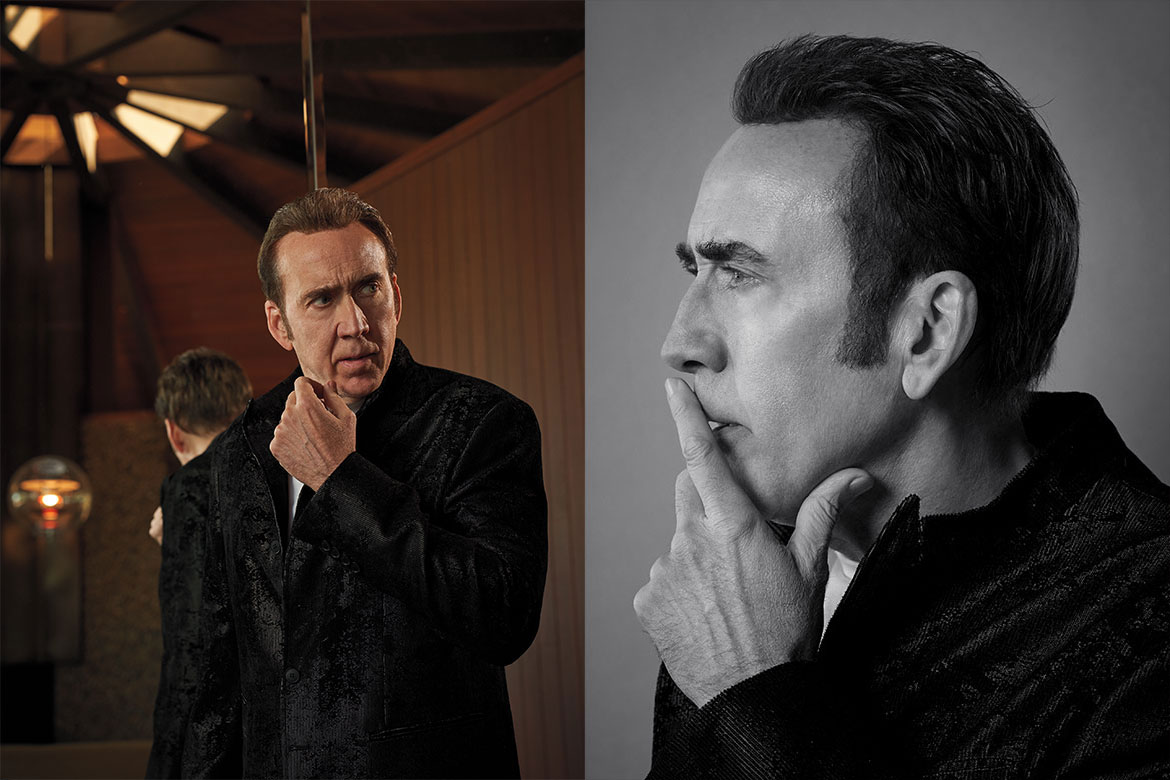
On this mid-winter morning, Cage is keeping to his daily routine at home in Malibu, a different one not far from where he broke bread with Raimi all those years ago. He hit the gym for two and a half hours, mostly working out on the elliptical. He made some scrambled eggs for his 3-year-old daughter, August, and put on some cartoons. She’s not old enough to appreciate something like Spider-Man from the late ’60s, one of Cage’s favorites.
“She doesn’t watch those kinds of cartoons,” he says and starts singing the show’s well-known theme song — “‘Spider-Man, Spider-Man, does whatever a spider can …’” — before returning to the here and now. “More like SuperKitties or Gabby’s Dollhouse.”
“‘Spins a web, any size. Catches thieves just like flies,’” Cage continues the tune. “‘Look out! Here comes the Spider-Man.’”
Indeed.
Watch the exclusive Under the Cover video with Nicolas Cage at his emmy cover shoot.
Spider-Noir will launch domestically on the MGM+ linear broadcast channel on May 25, then globally as a binge release on Prime Video two days later. The eight-episode series is a bold swing, given that audiences will have the opportunity to watch in either black and white or in color.
Cinephiles will detect echoes of such noir classics as Double Indemnity, The Big Sleep and The Maltese Falcon, but with the rapid-fire dialogue of His Girl Friday — and they’ll likely opt for the black-and-white version. Kids jonesing for another webslinger iteration before Spider-Man: Brand New Day hits theaters in July will probably choose color. Fans of the source material, the Marvel comic Spider-Man Noir, will devour both.
“I like characters that have conflict, that are struggling with something. That’s originally why I wanted to be a dramatic actor,” Cage explains. “The characters that learn to surpass or overcome the conflict are the ones that are the most interesting for me. They’re the ones that I like to play and I like to watch.”
Spider-Noir marks the first foray into television for Cage, despite the actor’s impressive 45-year career. But there’s a bit of an asterisk: George Schlatter, creator of the sketch-comedy show Rowan & Martin’s Laugh-In, who’s also credited with discovering Goldie Hawn, gave Cage his first professional job, in the 1981 teen variety show The Best of Times. But ABC passed on the pilot and burned off the episode in a summer slot.
“The pilot wasn’t very good, but what happened was I got into movies pretty quickly,” says Cage, a member of the famed Coppola creative dynasty. (Francis Ford Coppola is his uncle. Eager to make his own way, Cage chose his surname as a nod to both Marvel’s Luke Cage and composer John Cage.)
Those early movies offered an edgy depiction of teen angst. First came Fast Times at Ridgemont High in 1982, then Valley Girl and his uncle’s Rumble Fish the following year. Over the next three and a half decades, Cage accomplished every cinematic feat possible — box-office heavyweight (the National Treasure franchise, The Rock), romantic lead (Raising Arizona, Honeymoon in Vegas) and his pièce de resistance, playing hopeless alcoholic Ben Sanderson in Leaving Las Vegas, for which he won the best actor Oscar.
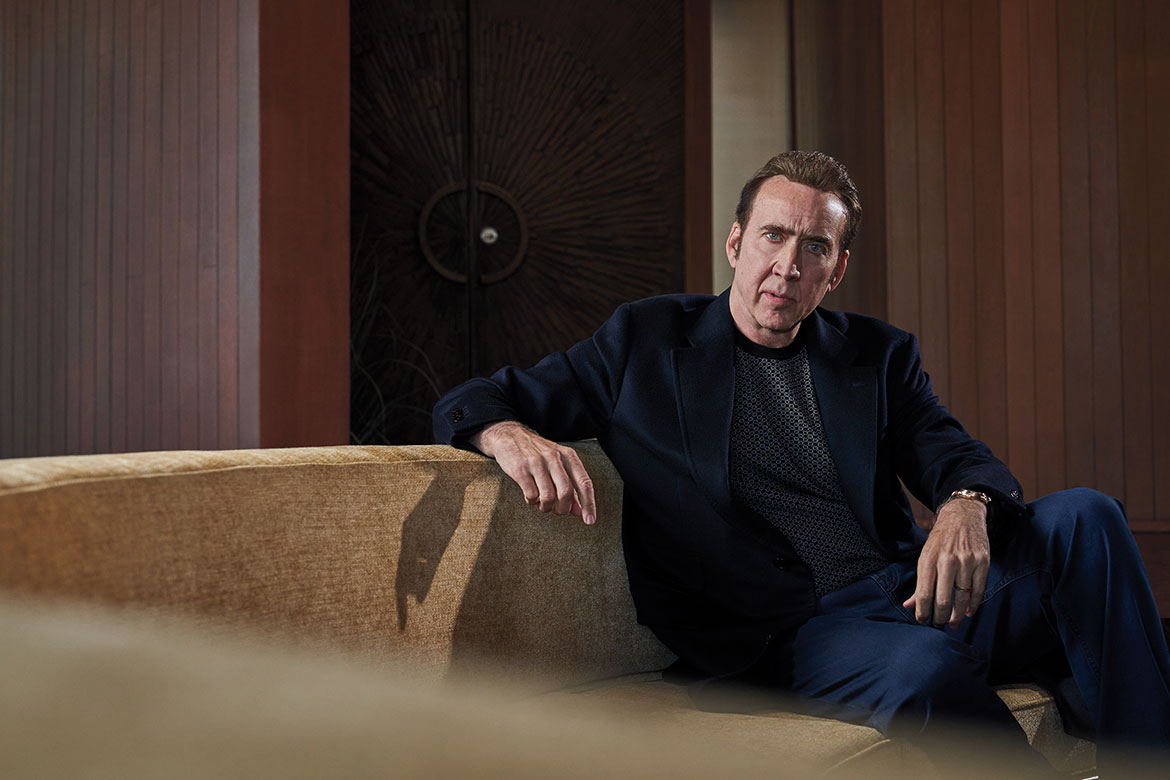
“Movies were really my first love and what I wanted to focus on. But then, after my fourth decade of doing it, I became interested in exploring other ways to express myself as an actor in other formats,” he says.
What exactly changed? During the Covid lockdown, his then-teenage son Kal-El (named after Superman’s Kryptonian moniker) introduced him to Breaking Bad, long after it had ended in 2013.
“I had never seen any of it. I wasn’t aware of any of the television series at that time. I didn’t have a TV,” Cage remembers. “Kal told me, ‘You should check this out.’ He sat me on the couch and watched the first season with me, and I was thoroughly blown away. That put the hook in me. I was interested in what I saw Bryan Cranston do in Breaking Bad. He had more time to plant certain seeds for his character.”
As the world began to reopen post-Covid in 2023, Cage and Pascal met up at a Cheesecake Factory in Pasadena. Cage had already voiced the role of Peter Parker/Spider-Man Noir in the Pascal-produced film Spider-Man: Into the Spider-Verse, which became a surprise box-office hit and won best animated feature at the 2019 Oscars. Though Into the Spider-Verse and Spider-Noir are based on the same comic books, Ben Reilly has a different origin story and exists in a stand-alone universe.
Cage’s first question was, “‘Are you going to shoot it in black and white?’ She said, ‘Yeah,’” he recalls. “I was immensely excited about the black-and-white aspect.”
But the endeavor was fraught with risk. After all, monochromatic series mostly went the way of the dodo bird in the 1960s. So, Cage suggested doing a simultaneous color version, which would make this the first show ever to let viewers toggle between two options, one being so-called “True-Hue Full Color.”
He still had reservations about taking the TV plunge, but it didn’t hurt that Sony Pictures Television, which produced Breaking Bad, was producing this series. Ultimately, he was loath to disappoint Pascal.
To read the rest of the story, pick up a copy of emmy magazine here.
This article originally appeared in its entirety in emmy magazine, issue #6, 2026, under the title "Worth the Swing."