

“It was a life-changing experience.”
Victor Garber mentions that several times when talking about Jack Bristow, his memorable role on ABC’s Alias, the twisty, action-packed family spy drama from J.J. Abrams that made both Garber and his on-screen daughter, Jennifer Garner, household names.
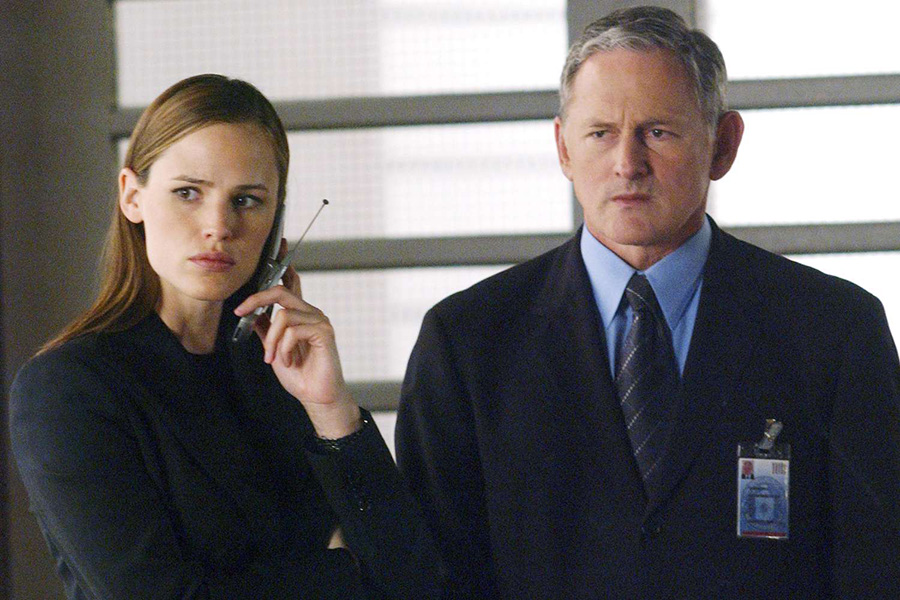
Garner played Sydney Bristow, the very capable and charming super spy whose life as both a full-time college student and international CIA field operative is violently upended when she discovers that her clandestine employer — SD-6 — is not really a division of the CIA. They are, in fact, the very enemy she swore to fight. When that discovery gets Syd’s unsuspecting fiancé, Danny Hecht (Edward Atterton), killed, she famously dyes her hair a shade of Run Lola Run red, goes on the run and becomes a double agent working for the CIA. Her mission? Take down SD-6 and its leader, the sinister Arvin Sloane (Ron Rifkin). In the process, she turns to a man she hardly knows — another double agent for the CIA — for help: her father, Garber’s no-nonsense Jack Bristow.
Told you it was twisty.
But audiences were hooked when Alias aired its feature-length pilot — “Truth Be Told…” — on September 30, 2001. Written and directed by series creator Abrams (who also served as showrunner for the first two seasons), the pilot quickly established the show’s unique tone — one full of big emotional stakes and even bigger, character-first set pieces. Through that, Sydney and Jack would emerge as the show’s beating heart, thanks in large part to the actors’ effortless chemistry and Garber’s compelling take on Jack. (From 2002–04, the role earned Garber three consecutive Emmy nominations for Outstanding Supporting Actor in a Drama). Jack is a veteran spy with resting “Don’t mess with me” face who, despite leading a double life, finds ways to deepen his relationship with the most important person in it.
"Truth Be Told..." aired on September 30, 2001. 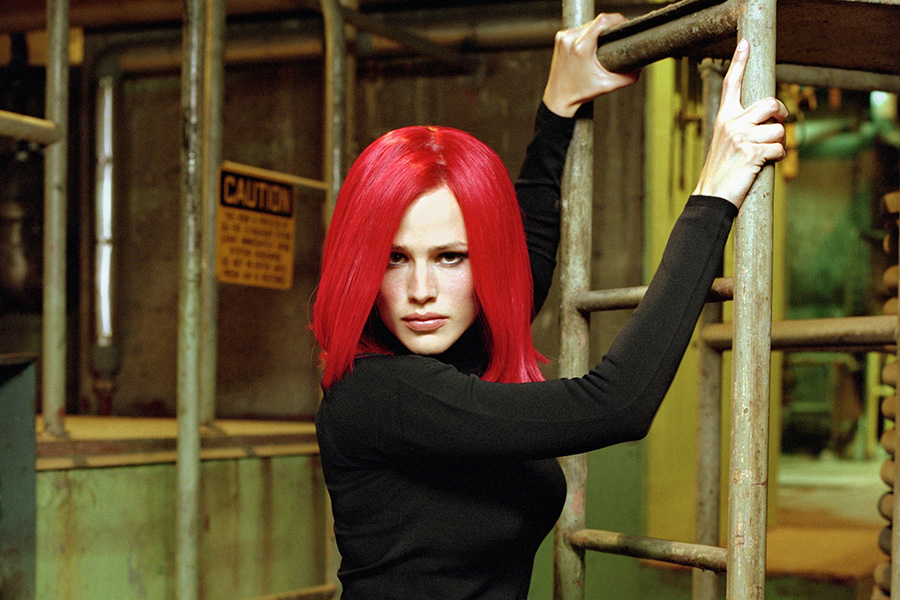
“Truth” also established what would become a signature of the show: Globe-trotting action without ever leaving Los Angeles or Disney’s Burbank lot, where Alias was produced for five seasons. At the time, audiences had never seen a spy show like this before on television — and neither had Garber. In fact, when he screened an early cut of the pilot (on VHS) for some friends 25 years ago, he quickly realized how special Abrams’ intimate epic approach was to delivering James Bond–worthy exploits within the one-hour drama format.
“Watching them watch the show, their reactions… I just knew we had something here that really worked,” Garber tells the Television Academy in an exclusive interview. “No one had done this before on TV— or since, in this exact way, quite frankly. We felt it was special when we were making it, but it literally changed my life.”
To celebrate Alias’ 25th anniversary, Garber reveals his audition process for Jack, what important guidance he gave costar Garner when it came to her on-set transportation and how the L.A.-based production overcame the actor’s inability to drive a car.
Television Academy: Jack has such a memorable introduction in the pilot. When his daughter’s fiancé calls to ask for his blessing, Jack turns this sweet tradition into a darkly comic, mini-interrogation. Do you recall any noteworthy stories shooting that scene?
Victor Garber: I wish I did, but all I remember is that shooting that scene and the pilot — it was a life-changing experience.
How were you engaged for this part?
It was an audition. I don't even think I had a script, but Ron Rifkin and I were both in New York at the time. We were both mystified by this project.
How so?
Well, as I recall, no one really knew what this part or this show really was. It was so hush-hush. But, mostly, we thought we were the most unlikely people to be cast because of our histories and [our work] in the theater at the time. And, like I said, it changed my life. I also remember it was a very challenging pilot and show to shoot. Fortunately, I was much younger, so I had it within me to manage it all. But, wow, it was exhausting. The show and the pilot not only changed my life, but it changed television to a degree.
At the time, there wasn’t a show on television like it.
I agree with that unequivocally. That pilot — I had never read anything quite like that [before] for a television show. And everybody that [watched] it said that they've never seen anything like that on television. I take a lot of pride in that, because it was the beginning of a complete shift in television.
So, did you audition first for the casting director and J.J.?
No, I didn’t know J.J. I auditioned for ABC, for Joanna Merlin. She was a casting person who has been on my mind lately; she passed away several years ago [in July 2023]. So, I auditioned for her and then had to go to ABC. I went to their old offices, when they were on Columbus and 68th Street or 69th Street in New York. It was in person and filmed. I don’t believe J.J. was there guiding it. I read scenes from [the script] and I thought, “Wow, this is an incredible script.”
Once you landed the part, how did you adjust from living in New York to relocating your life to Los Angeles?
My partner and I moved to Los Angeles together. We had not been together that long at the time, and we set up our life there. From that moment on, everything changed. We loved being in L.A. Then, once the pilot shoot was over and I had [shot] a couple of other pilots, I said, “I cannot live here if I'm not working.” [Laughs]
Do you recall the first time you met Jennifer Garner?
It was on set. I think I went to the studio to do a costume fitting and meet with hair and makeup, and we met on a day that she was shooting and I wasn’t. Then, we bonded for life. It was an immediate connection — I completely fell in love with her. Over time, she started to let go of how much of a New York person she was. My friend, Scott Ellis, hired her to do a play that she was understudying. She was very serious about wanting to be a theater actress. But talk about life-changing — for Jennifer, in particular.
How did you adjust to L.A. living, since I assume that you, like most New Yorkers, didn’t drive?
I remember having a discussion with one of the show’s producers at one point, the late Sarah Caplan. [Caplan passed away in April 2026.] We became very close friends, but I had never driven for a movie or a TV show. Never drove myself to and from set. But, she said, “This isn't going to work that you don't drive.” I said, “Well, what do you expect me to do?” She said, “You'll have to find out.” I said, “You'll have to send a car for me, because I'm not driving.” And they did.
This would impact Jennifer in some way, too. She was driving herself to and from set, to all of these various locations, after working 15 hour days. I had Jennifer speak with her manager about it, because even in those days, everybody was cutting costs. I said, “The leading actress in your series is driving herself at 4 in the morning to a new destination that she's never been.” They were still getting things on track, and they eventually got on track and got her a driver.
That’s ironic that you didn’t drive, given that Jack’s first big scene with his daughter in the pilot is when he races to rescue her in a car, in a parking garage, saving her from assassins.
We were being towed, I think. We were on a tow rig for that parking garage scene. We definitely were on one for the scene after, where Jack explains what’s really going on to her. Where he reveals he is also a spy. I remember J.J. was in the back of the car, on the floor, directing us. That was one of the most difficult scenes for me to shoot, because there were so many elements going on. And J.J. kept saying, “Okay, do it again. Do it again. Again, again, again.” And I was like, “I don't know if I'm equipped for this.”
You said that shooting the pilot and the show was a challenge. What specifically was challenging for you, aside from the long hours and location shoots?
The logistics were complicated, obviously, but Jennifer and I had some issues with laughing. We couldn’t stop laughing when we were shooting scenes together. A couple of times, both of us were sent to our trailers like bad children. [Laughs]
For having the giggle fits?
Giggle fits that we couldn't stop. We were doing one scene on the show, where Jennifer said to [director and executive producer] Ken Nolan, “Look, if you don’t have Victor walk towards me, I can do the scene. I just can’t watch him walk towards me, because then I will laugh.”
Wow. So you two really had a serious case of the giggles.
That’s how bad it was, that’s what was going on.
How did you work around that? Syd and Jack share so many scenes together.
If we were planted, just standing or sitting at the start of a scene, we could start the scene and be fine. But, if I had to walk towards her for any reason, it was over. We were on a hill somewhere, shooting a scene, and I had walked off. And production, they wanted a shot that would require me to walk on, and Jennifer — she couldn’t do it. She said, “I won’t be able to do it.” Again, as soon as we stared at each other, we would just start laughing.
Apparently, the gag reels from some of the [season boxset] DVDs are on YouTube. A couple of months ago, I was with Jonathan Groff on an independent movie. We didn't have any scenes together, but he was on set one day convulsing in laughter. He had his earphones in, he was on his phone, and I said, “What are you doing?” He said, “I'm watching the Alias [gag] reel.”
Garner and Ron Rifkin, who played Arvin Sloane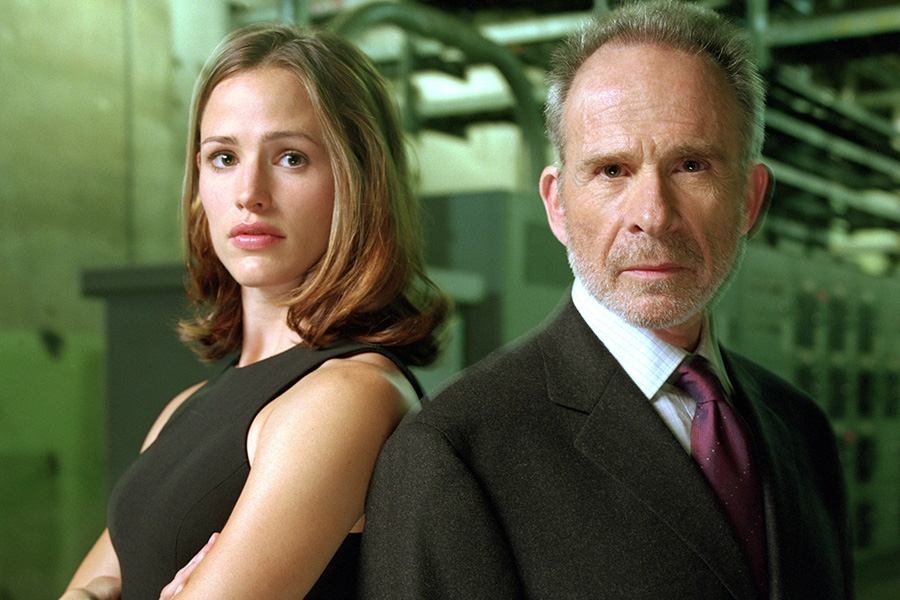
Was laughing on set more or less difficult than filming all of Jack’s heavy exposition scenes? You and Ron had a lot of those to get through in the show.
They were really challenging, but Ron and I — due to our theater training — we were kind of used to that. There were occasions when you didn’t have much time to memorize your lines, but we got through it. Some exposition could be tedious, there were so many angles to get or ways to rehearse the shots. So many test runs before calling “action.” If anything was challenging there, it was the time it took to film more than just the memorization. And the time it took to shoot — after you've done it 45 times or something, it was like, “How do I make this sound like I'm saying it for the first time?” But that's why they call it acting.
Do you recall where you were when you first screened the pilot?
Vividly. I showed it to some friends, a VHS dub of the pilot. I think we were in Washington, D.C., and I had an early cut of the pilot that I played for them. Watching them watch the show, their reactions … I just knew we had something here that really worked. No one had done this before on TV— or since, in this exact way, quite frankly. We felt it was special when we were making it, but it literally changed my life. When I think back about it all, I loved every minute of it. All of us did.
This interview was edited for length and clarity.
Alias is now streaming on Disney+.