

The late Kathryn Joosten never appeared in the opening credits of The West Wing. For that matter, the former governor of the Television Academy's Performers Peer Group only popped up sporadically during its first two seasons.
And yet the actress’s portrayal of Mrs. Dolores Landingham — the loyal and no-nonsense personal secretary to President Josiah "Jed" Bartlet (Martin Sheen) — was so indelible that her unexpected death led to one of the most seminal episodes in the Emmy-winning series’ history.
It’s titled "Two Cathedrals." But 25 years after it first aired on May 16, 2001, the season-two finale is still unofficially known as the installment in which the despondent POTUS unleashes holy anger because of the loss. Grieving the news of the fatal car crash (due to a drunk driver) that took Mrs. Landingham's life, a shaken Bartlet — who’s also weighing a re-election run — flashes back to first meeting her, when he was a student at a boarding school run by his father. After the funeral at the National Cathedral, the devout Roman Catholic stands at the altar and proceeds to rant at God in Latin and English ("You feckless thug") and stub his cigarette into the marble floor. But, with Mrs. Landingham as his inspiration, Bartlet ultimately makes a promising decision about this political future.
"We knew how Earth-shattering the news was going to be for the audience," says Emmy-winning director Thomas Schlamme. "But most of all, we knew how it would be for the president. That was the real reason for doing it."
Kathryn Joosten as Mrs. Landingham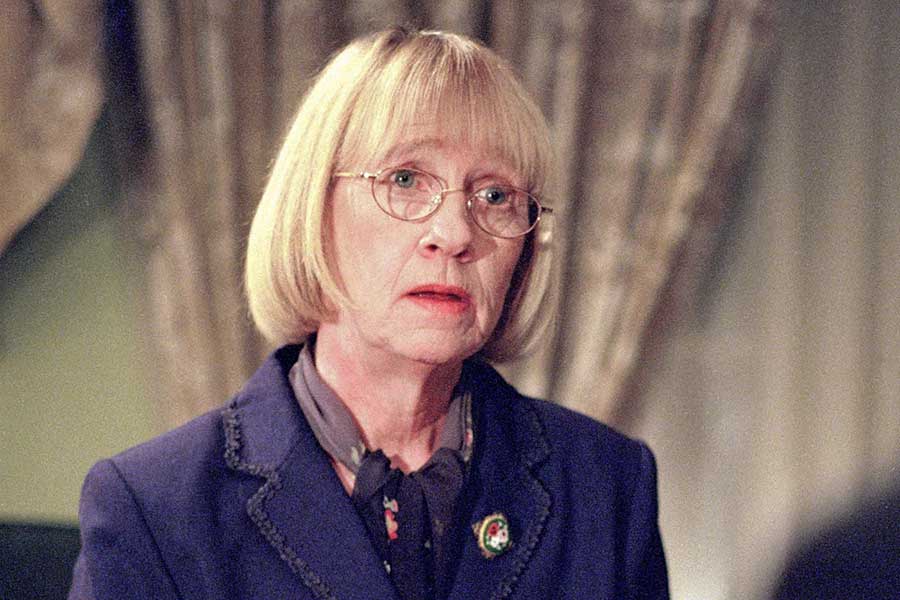
At the time, Schlamme was also an executive producer on the show and had directed many of its episodes, starting with the 1999 pilot (for which he earned one of his nine Emmys). That meant the industry veteran — whose many credits include Spin City, Ally McBeal and ER — worked closely with creator and writer Aaron Sorkin. "I sort of started the show with Aaron, and we set it up like a theater company," he explains. "There were extraordinary directors who came and did brilliant episodes, but I tried to do the first one, the last one and a big one in the middle — because I knew where the story was going. Aaron and I were always talking about the trajectory of the seasons. So I knew early on that I would direct 'Two Cathedrals.'"
While he’s proud of the episode, the director had scarcely revisited it until queuing it up in preparation for his interview with the Television Academy. "I was stunningly impressed with Aaron’s script," he says. What does he specifically remember about it? In honor of the episode’s big anniversary, Schlamme shares all.
Schlamme and Sorkin on the set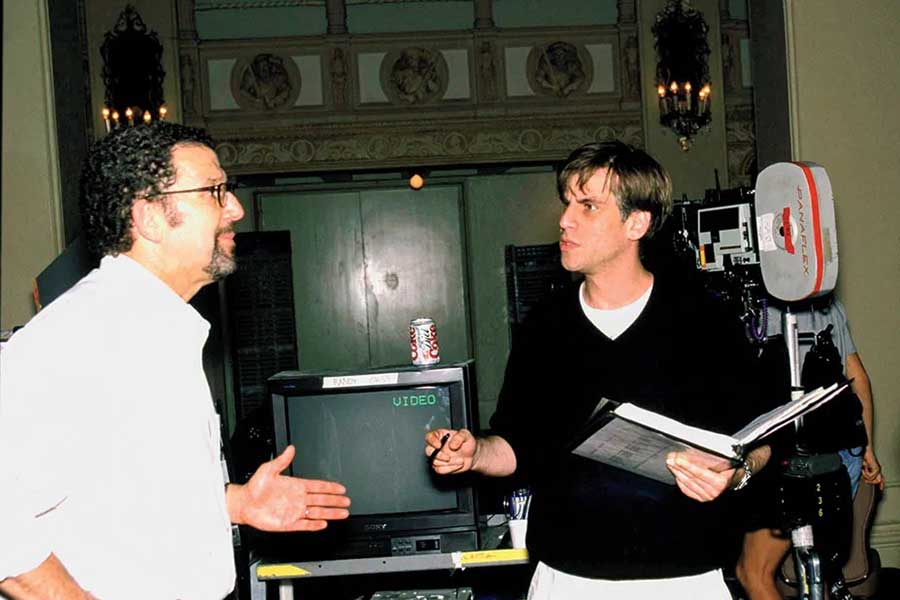
Television Academy: Is it true that you killed off Mrs. Landingham because Kathryn Joosten had landed a part on Joan of Arcadia?
Thomas Schlamme: I think Kathryn asked how much she was going to be in for the next season because she had been asked to do something else. It was the right thing to allow her to be able to do that. But it wasn't, "We're going to kill you" — we just made a very difficult decision a little easier. The amazing thing about Kathryn was that she was just such a memorable character that her enormous talent, and her ability to cut through the story, ended up being the cause of her demise. [Editor's note: Joosten died in 2012.]
Fans may not realize that future news anchor Lawrence O’Donnell plays Barlet’s dad in the flashbacks. How did he get cast in that role?
He was a writer and producer on the show, but he was not raising his hand to act. What happened was that he read for the part at a table read, before we cast the part of this New England patrician character. And not surprisingly, Lawrence was really great. And then we continued to look for an actor, and it was getting harder and harder, and we couldn't find somebody. I finally called up Lawrence and said, "Get on a plane to Washington D.C. I'm sorry — you're going to be playing Bartlet's father. End of discussion, that's what you're doing." I never had a doubt that he could do it.
Lawrence O’Donnell in a scene from "Two Cathedrals" 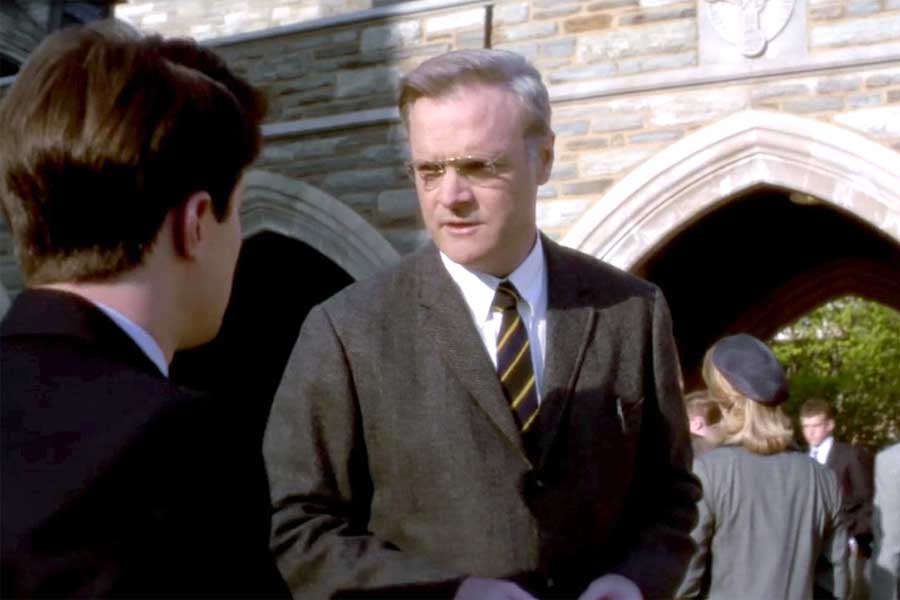
Was it difficult to secure the National Cathedral as the location for the funeral, considering Bartlet’s outburst?
I've never gotten a clear answer from our location guy if [the building managers] ever saw the swearing at God as a problem. But putting out the cigarette? I don't think anyone has shot in the National Cathedral again, and I'm sorry if that cigarette stopped that.
Did Martin Sheen really put out a cigarette butt in that sacred location?
He did. He used to smoke — he didn't smoke anymore, but he used to smoke quite a bit. If you look at his old interviews, he’s constantly smoking. So he lit that cigarette right there, took a few hits and put it out on the ground. At the time, you could still smoke indoors. It seems so weird now.
WATCH: The Foundation's Interview with Thomas Schlamme
What was it like shooting that very emotional scene?
We filmed it at the very end [of the shoot]. It was such a huge scene, and a powerful thing for Martin to go through. He sat in a pew by himself, and I would occasionally, very quietly, come up and talk to him. I knew he had gone to a very deep place in himself because Martin, as a human being, is a very devout Catholic. In the most beautiful way possible. I just knew that it was a very emotional scene for him.
Schlamme speculates that Bartlett putting out a cigarette in the National Cathedral is why no other film or TV has shot there in 25 years.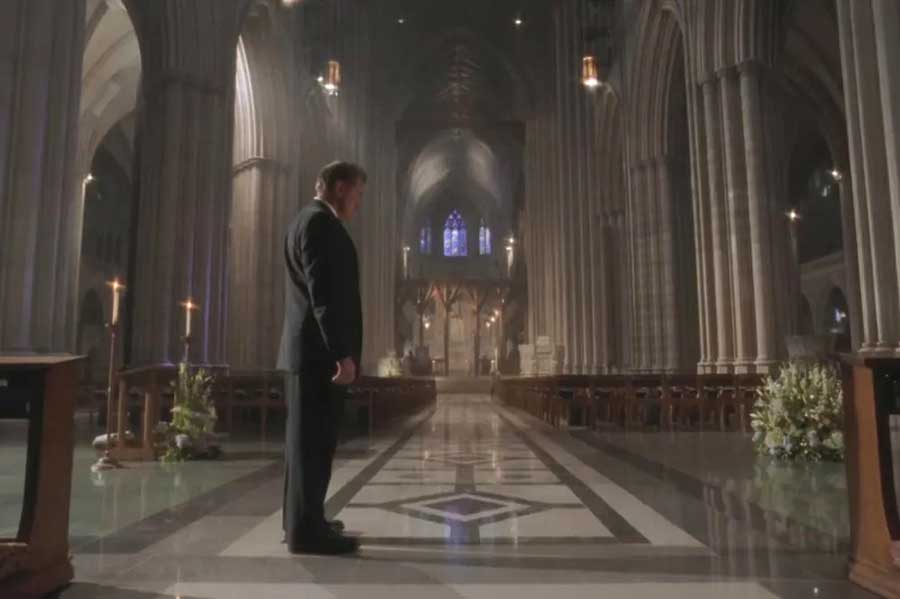
Did you give him any notes?
I mean, he had worked and worked [on the scene]. I wasn't going to say anything about the Latin part — I knew he had spent so much time trying to learn the right pronunciation of Bartlet's dialogue in Latin as if he spoke it. Aaron really wanted it, and Martin did, too. Both of them theorized that if you're going to talk to a God that you believe in, speak in the language that the God would speak in, which is Latin. But I don't remember ever any real powerful direction other than support.
Is there another scene that stands out for you?
One shot stands out dramatically to me more than any other, and that’s the very last shot of the episode [during Bartlet’s press conference about this reelection bid]. The whole episode was just based on a man trying to make a decision: Will he or won't he [seek re-election]? That's it. We had set up this idea in the flashback — Mrs. Landingham tells a young Jed something like, "When you put your hands in your pocket, you turn your head and smile, and that means you're going to do something." So, in the last shot, President Bartlet puts his hands in his pocket, turns away and smiles. As a director, we come behind him. We see this massive press conference of these people waiting for an answer. Then we come back around to him in profile, and what you see out a window — during the thunderstorm — is an American flag. That flag just opened up and filled the whole window.
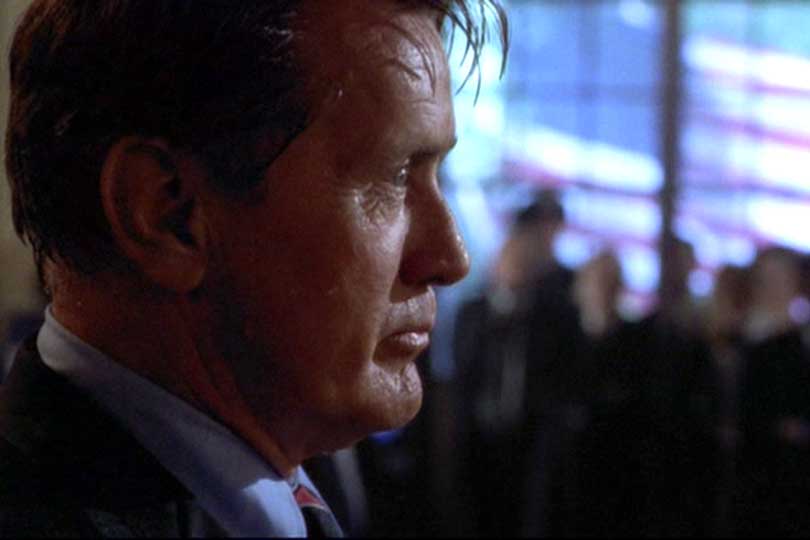
Why is that shot so meaningful to you?
You know, I’ve worked on so many wonderful shows. You don't know everything's going to work. You don't know how the audience is going to respond. I’m not a very religious person, but — for me — that was a moment when I felt I was doing something right. It all worked so perfectly. It wasn’t so much the design of the shot as all the pieces coming together.
Do you consider "Two Cathedrals" to be one of your crowning achievements?
It was a powerful thing for me to be a part of, but I think the episode is one of Aaron's crowning achievements.
My responsibility was to take this beautiful script and then turn it into something. Then, it's the actor's responsibility to let it grow. When I [rewatched] the episode, I was just stunned with how Aaron is building things to get to this crescendo on such a simple story of "will he or won’t he" run again. You’re putting the highest stakes possible on this person and watching him struggle.
This interview was edited for length and clarity.
The West Wing is streaming now on HBO Max.