
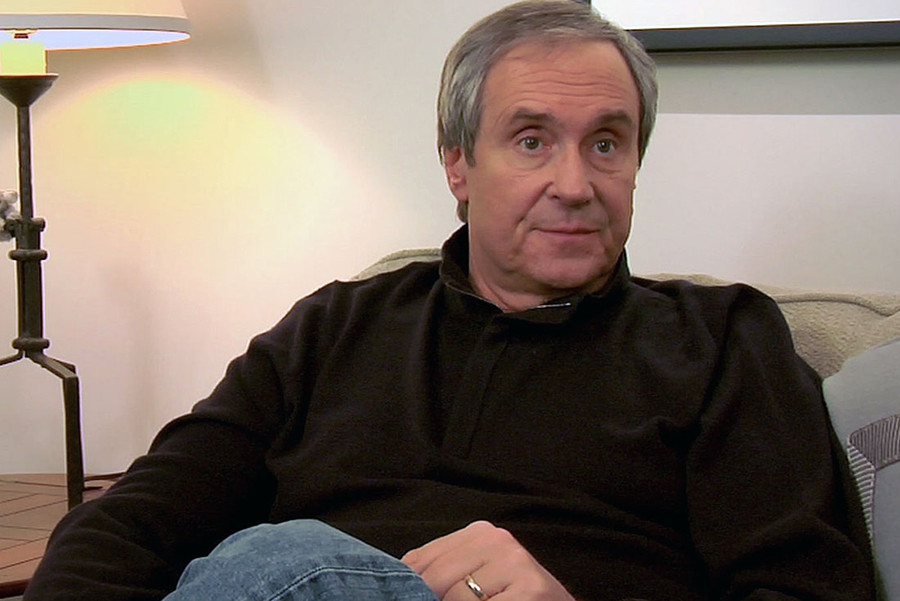
Star Trek executive producer Rick Berman owes a life-changing career decision to one of Hollywood's most storied traditions: lunch.
In 1986, the then-relatively new Paramount vice president of current programming (and former documentarian) dined with Star Trek creator Gene Roddenberry on three consecutive days, as the studio was eager for Roddenberry to bring the voyages of a new starship Enterprise back to television. They were minting money at the box office with that year’s popular feature film, Star Trek IV: The Voyage Home, which featured Captain Kirk (William Shatner) and his original crew. Now, they wanted to replicate that success where Star Trek began.
But there was a catch.
"The studio said Gene was known to be somewhat of a pain in the ass," Berman tells the Television Academy in an exclusive interview. "Roddenberry was going to be producing a new Star Trek series, and they thought: 'Give it to the new guy.' But I had to show Gene that I was on his side and not like the other executives."
Berman and Gene Roddenberry on the set of Star Trek: The Next Generation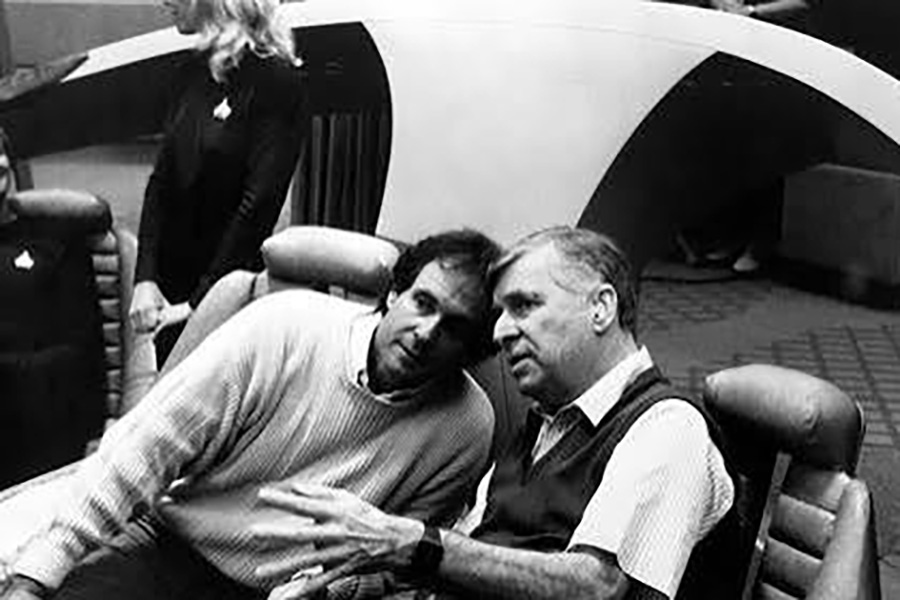
Also difficult was Roddenberry's best friend and lawyer, Leonard Maizlish, who infamously wielded an unusual amount of influence and power over his client's cash cow. Paramount wanted Berman to be what he calls "the studio connection and oversight," a role that would give him responsibility for a new series while acting as intermediary between the studio and the difficult duo they had to partner with. Berman would have to attend several more meetings before those fateful lunches proved to Roddenberry and Maizlish that they found the best person to help energize what would become Star Trek: The Next Generation.
"I got a call from Maizlish saying, 'Do we have your permission to go to the studio and ask them to release you from your contract to come produce the show with us?' It took me about 16 seconds to say yes."
Those 16 seconds set the stage for Berman to shepherd Trek for 18 years.
From 1987 to 2005, on movie and television screens, he helped turn the franchise into what it is today. When Roddenberry passed away in 1991 — the year his creation celebrated its 25th anniversary — Berman would inherit the mantle of the man who hired him to oversee all of Trek.
But his role as executive producer wasn't without challenges. After a rough launch during The Next Generation's first two seasons, Berman helped streamline operations and decrease high turnover among the writing staff by bringing in the late Michael Piller as showrunner and executive producer. With Piller's character-first approach to the "missions of the week" format, which kicked off with TNG's third season, Berman found himself presiding over a then-unprecedented level of success for a first-run syndicated drama — let alone a sequel to a canceled sci-fi show.
The cast of Star Trek: The Next Generation 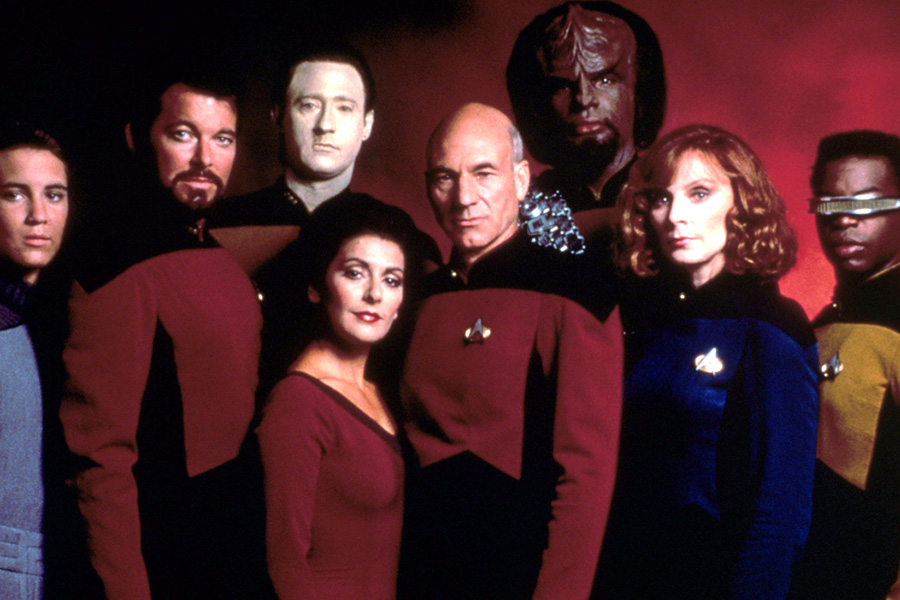
That gamble paid off. Next Generation was a ratings hit and lasted for seven seasons, racking up several Emmy wins and nominations — including a nom for Outstanding Drama for its final season, as well as an Outstanding Performance by a Lead Actor in a Drama nod for Sir Patrick Stewart's noble portrayal of the Enterprise-D's Captain Picard.
Berman's landmark work on TNG spawned a trio of Star Trek spinoffs: 1993's Star Trek: Deep Space Nine, 1995's Star Trek: Voyager and 2001's Star Trek: Enterprise. Berman had a hand in creating all three— the first two for syndication, while the third launched Paramount's fledgling network, UPN. Although none of those series matched the ratings of the mothership, they further established Berman as a load-bearing column for the franchise. (During that time, Paramount also expanded Berman's duties to concurrently include oversight of four feature films starring The Next Generation cast.)
For all of Berman's achievements as a producer — and there were many, especially in casting and post-production — one of his most unsung contributions to Star Trek was his work as a writer.
Across both the films and the series, Berman amassed 53 writing credits — a mix of "Story by" or solo or cowriting credits, with 37 of them on Enterprise alone. His first teleplay was for TNG's "Brothers," a memorable season-four outing which recently turned 35. In that emotional episode, the android Data (Brent Spiner) encounters his long-presumed-dead human creator and father, the elderly Dr. Soong (also played by Spiner).
In honor of Star Trek's 60th anniversary and the 35th anniversary of "Brothers," Berman takes the Television Academy back in time to revisit some of his most memorable work as a writer. He also shares his pre-Trek career origins, how his post-production experience allowed him to turn Star Trek into a lucrative television staple and why those three lunches in '86 were among the most important meals of his life.
Television Academy: In the early days of your role overseeing TNG and the franchise at large, how challenging was it for you to put on your writer's hat while also juggling your producer responsibilities?
Rick Berman: Well, I didn't [write] for a long time. I wrote two episodes of Next Generation. I was very involved in the writing in terms of working with both writers and the [showrunners] on the storylines, and then on the various drafts of the scripts. But, at the time, once we started doing two shows at once — it was a little bit too busy for me. That is, until we got to Enterprise. There, I decided that one of the joys I would get out of this new series was co-writing with [TNG writer and Enterprise cocreator and showrunner] Brannon Braga. We worked together beautifully — starting with the pilot.
What was your writing process like with Brannon? Did you take turns at the keyboard?
We pretty much did everything together. We broke stories sitting in my office, for however long it took. Then we sat at a desktop computer with a television screen above us, and we just hammered [the scripts] out.
You share a story credit with Michael Piller on “Unification,” a two-parter that brought Leonard Nimoy’s Spock to TNG. How similar or different was your process with Piller?
On the story-credit level, it was primarily the same. Michael and I would sit and hammer out a story until we felt right with it. Then he would go off and put it on paper. After that, we would discuss it, and he would go back [to the script] and make changes.
Leonard Nimoy as Ambassador Spock and Brent Spiner as Data in a scene from "Unification, Part II."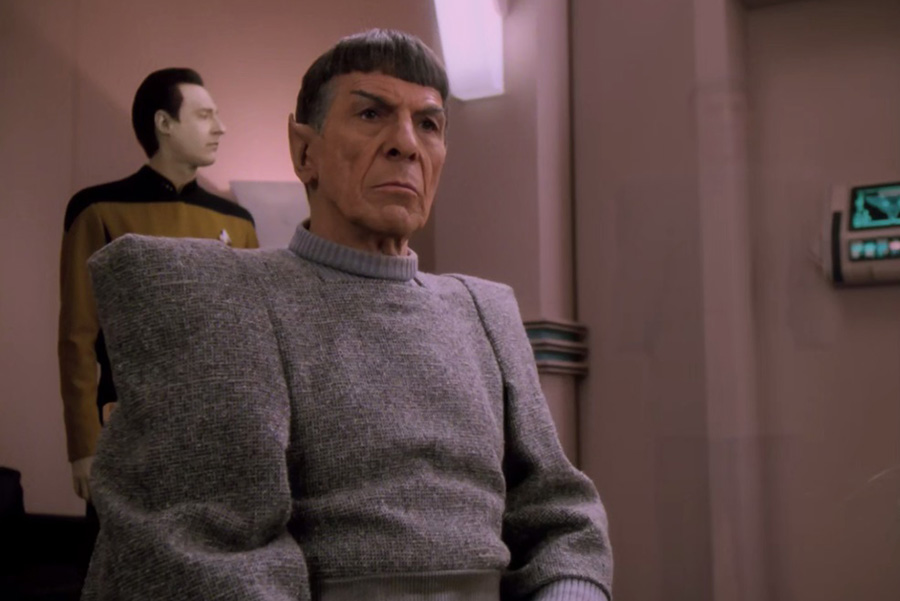
When I worked on the first [two] seasons of Next Generation with [then-showrunner Maurice Hurley], Hurley loved to walk [and break story]. He would talk about a story that he was thinking about — or one that I was thinking about — and we would stroll through the Paramount lot for hours. We would walk around the lot, pitching story ideas back and forth. Saying hi to people that we ran into along the way.
Your first TNG writing credit, “Brothers,” has an interesting dramatic structure in that two young brothers on the Enterprise are dealing with the potentially fatal fallout of a prank gone wrong as Data meets his “father”/creator while confronting his evil android brother, Lore. How did that story develop?
It originated in something that I saw as a child, which had to do with somebody playing a practical joke that backfired and seeing the emotional consequences that came about. I always wanted to do a story like that, an it seemed that the Enterprise was a good venue for it. It was also my first shot [at writing an episode]. Michael Piller was very, very generous in guiding me through that story process. I was very pleased with the final episode.
So did you just one day knock on Michael’s door and say something like, “Hey, I have an idea for an episode that I’d like to write?” Or did Michael come to you to see if you had any ideas?
Michael always wanted me to — he would bug me to write something. He knew that I wanted to write. So, I brought him this idea, and he said, “Let’s run with it.” He worked with me on the story a little bit and on the various drafts. Like I said, he was very generous with his help.
Brent Spiner plays all three roles in the episode: Data, Lore and their father. I assume that was the intention from the beginning.
I don't remember whether that was my idea or not, but since he was already playing both Data and Lore, the feeling was that he would be terrific playing all three parts. We all knew we had the technical ability to do it, to film him doing all three roles. All of that was done in post-production — which was more difficult to achieve back in those days. But [Brent] came to the fore and did a brilliant job.
I know it’s been 35 years, but do you have any memories that stand out from visiting the set of your first writing credit?
I remember seeing [Brent] in the old-age makeup for the very elderly Dr. Soong. When they were testing the makeup, I remember him being brought to my office so I could look at the makeup design.
A scene from TNG's "Brothers"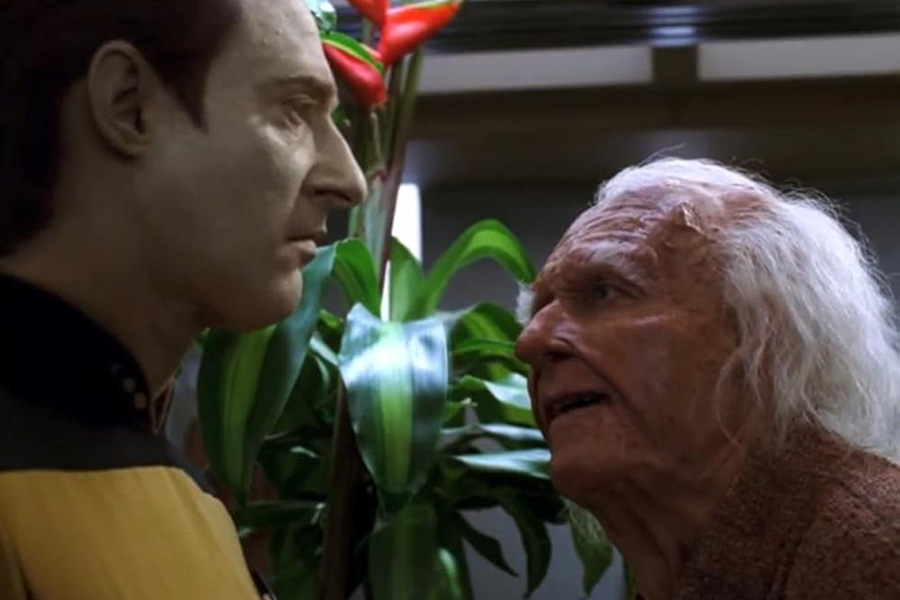
Well, I'll tell you — there's an interesting parallel here. My original story was just the brothers.
Just the brothers on the ship?
Yes. Michael felt that I needed something added. Needed to focus more on the show’s characters — or have ties in some way to one of them, at least. So, we sat down, and it seemed that the most logical thing to do would be to involve Data and his brother. Michael then encouraged me to, at first, make that the “B” story and then it would really emerge as the “A” story. Michael had a lot to do with pushing me to develop [the script] further than just the two [young] brothers.
The interesting parallel [with that] is, when I first got involved with Star Trek: The Next Generation, the [“Encounter at Farpoint”] pilot story did not have Q [John De Lancie) in it. And it was an hour-long episode, not the two-hour pilot that eventually aired. The studio came and had a relatively heated discussion that I was present at; the studio wanted a two-hour pilot for Next Generation.
Roddenberry was advocating for a one-hour pilot?
Roddenberry wanted a one-hour pilot. The studio said, “No, you need two hours.” They were emphatic. So, Gene sat down and wrote what turned out to be the Q story. If the studio hadn't got its way, we would not have had Q. Without Q, you would have had a very different Next Generation, obviously. And a different Star Trek [franchise] altogether.
You were present for some very formative and historic additions to the franchise, like Q. How did you find yourself in this job? Did you seek it out?
Picard (Patrick Stewart) and Q (John de Lancie) in a scene from Star Trek: The Next Generation's "Encounter at Farpoint."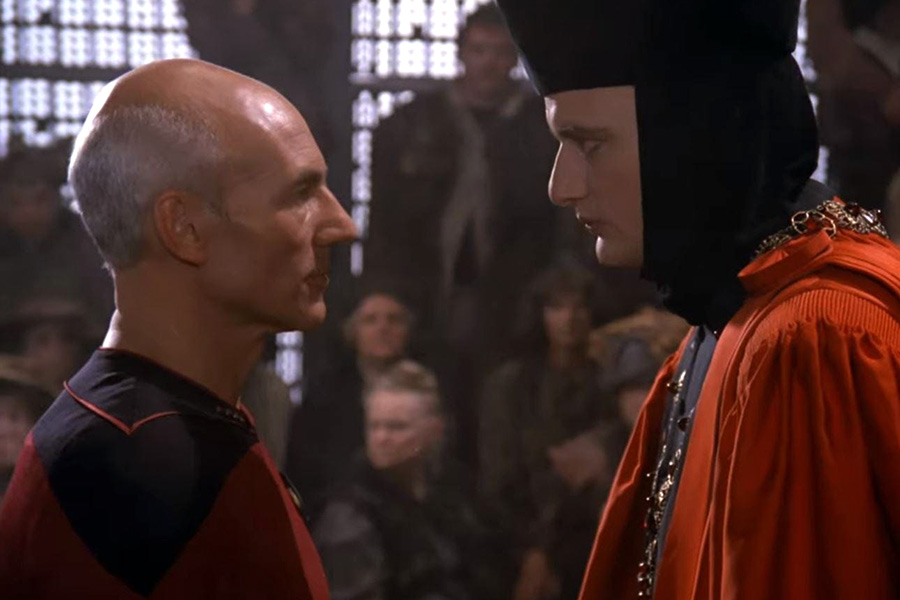
After close to 20 years of being a documentary filmmaker, I came to Los Angeles, and I got a job as a studio executive with Paramount. I was in a strange situation — I was never the executive type, certainly not in that [studio] atmosphere. But I think they made me a vice president, and I was doing current programming in television. Then, all of a sudden, they said that Roddenberry was going to be producing a new Star Trek series, and they thought: “Give it to the new guy.” Because they — I remember the studio said that [Gene] was known to be somewhat of a pain in the ass.
Oh, so they thought “give it to the new guy — he can deal with it now.”
[Laughs] Right. “Give it to the new guy.” So, when I say it was given to me, that means I was the “studio connection” to the oversight of this new series. But I had to show Gene that I was on his side and not like the other executives.
How did you do that?
During the course of a number of meetings — including the one that I just told you about, regarding the length of [the pilot] — Gene's lawyer and best friend, Leonard Maizlish, sort of sensed that I was on their side. That I was not enamored with the other high-level studio executives in the room. So, [Leonard] asked me to lunch, and we had a very nice lunch. The next day, he said that Gene would like to have lunch with me. So, I had lunch with Gene, and we found we had a lot in common.
What did he spark to?
Because of my documentary history, I'd done a great deal of traveling all over the world — which he did, as well. We talked, had a nice lunch and the next day, he asked me out for lunch again. I remember we climbed in his car and went to a restaurant near the lot. And then the third day, he asked me out for lunch again. We started bonding. That afternoon, after the third lunch with Gene, I got a call from Maizlish. He said, “Do we have your permission to go to the studio and ask them to release you from your contract to come produce the show with us?” It took me about 16 seconds to say yes.
But at the time, I had a good job with a contract, a wife and a son. With another son on the way. It was a big gamble.
In part because it was going to be a sci-fi show in syndication?
The show was going to be a sequel, and there were no sequels on television. It was science fiction, and there was no science fiction, really, on television [at the time]. And it was going to be syndicated — not even on a network. All of those things were sort of strikes against it, but I still felt strong enough to get back into production that I said yes.
The late Michael Piller with Berman on the Deep Space Nine set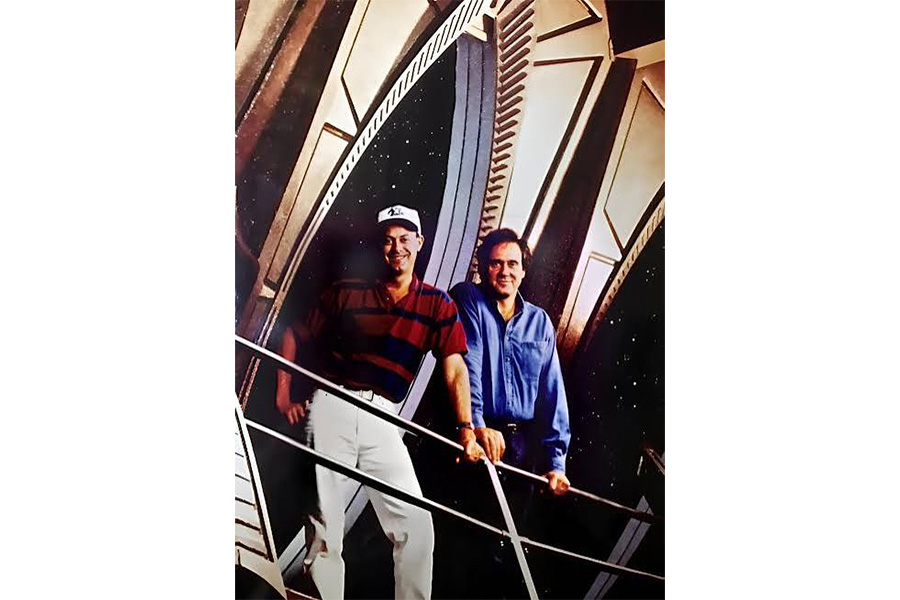
What was the transition like from seasons one and two to season three, with Michael Piller taking over showrunner duties from Maurice Hurley?
Hurley was a very interesting and unique character, and he did some very good work. But he wasn't great at being the leader of a writing staff. When Michael came onboard — not only was he a wonderful writer, but he also had a great strength to make the show character-driven as opposed to plot-driven. He also knew how to work with writers, and he knew how to put a writing staff together. He knew how to have the staff work as a team, which made everything so much easier and better.
Back to your work as a writer on TNG: “Unification” was one of Star Trek’s first crossover events, reuniting the TNG cast with a member of the original series. That sort of thing is more popular now, but it was rare in 1991. How did you convince Leonard Nimoy to play Spock again on television?
We always liked the idea of having him come back. On our first movie [Generations], we wanted both Kirk and Spock. We ended up only getting Kirk, as you know. But with “Unification,” I don't think we were [bringing back Spock] for the publicity or thinking that it would bring in more viewers. It just seemed something that would be fun to do.
But Leonard and I became very good friends afterward. There were discussions about Leonard directing Generations, which sort of went south. I have lots of memories of Leonard being in and not being in things, but “Unification” was a great show to work on.
For Enterprise, you and Brannon developed and wrote what would become the “Broken Bow” pilot for that prequel series —
We had a ball writing that. I remember being very involved with writing that. The opening sequence — with the Klingon running through farmland and corn stalks, and there was this huge explosion — that was just so much fun. James Conway directed that, he and everyone on the crew did an excellent job on that pilot. Which, again, like Next Generation’s, ended up being two hours.
A scene from the Enterprise pilot, "Broken Bow."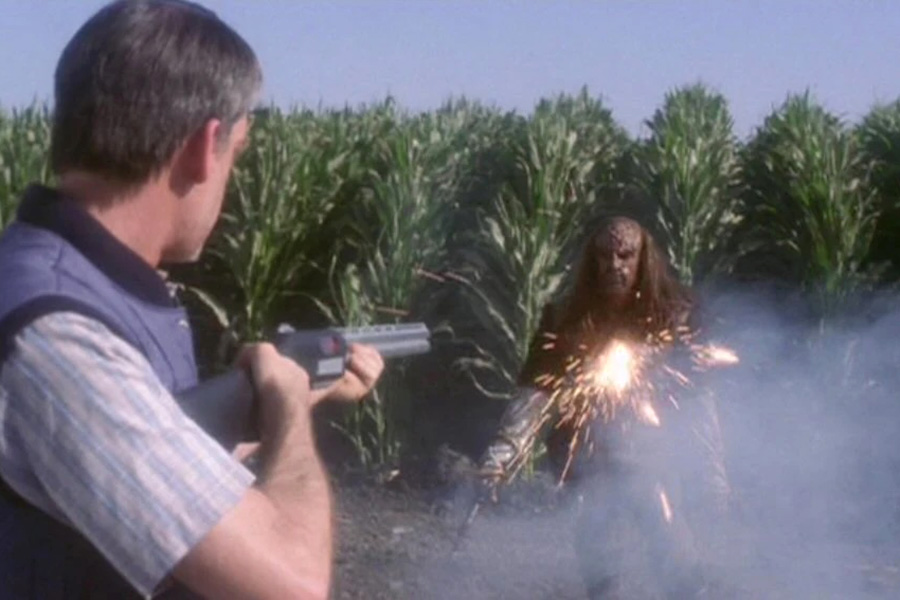
We even went so far as to have some lunch meetings in my office with Kerry McCluggage, who was the chairman of Paramount at the time. He was a fan of Star Trek, and he wanted to get involved in the story with us.
Another fateful lunch — you seem to collect them.
[Laughs].
How was it breaking story with the person who was essentially your boss?
He loved it. He'd take his tie and jacket off, and we would sit, have lunch and talk about the story. And it was great having him, because when you're not working for a network, the studio becomes both the studio and the network for you. So, it's always great to have them on your side early on.
That plus your past success must have helped, too.
It did. During the course of shooting the Next Generation, they learned to trust us. If we would do an episode that was 30% over budget — in most cases, the studio people would flip out [laughs]. But they knew us. We showed them in the first season that, no matter how over budget we would get, we would always find a way to make that up on other episodes. With that, they learned to trust us. We had almost no interference when it came to specific episode budgets.
But all of it, writing those episodes, it was a very fun and special time.