

"The Poseidon Adventure in space."
That's what Star Trek: Strange New Worlds writer Bill Wolkoff pitched in the season-four writers’ room that ultimately became his intense episode “Off-Hour.” Episode six finds various Enterprise crew members separated and struggling to survive a shipboard crisis brought on by (what else?) a dangerous space anomaly.
In a franchise first, “Off-Hour” dials up the tension by taking a page from 24's playbook and employing split screens and an on-screen ticking clock. The plight of two main characters in particular — Nurse Christine Chapel (Jess Bush) and Dr. M'Benga (Babs Olusanmokun) — also raises the episode's stakes considerably when the former is forced to save the life of the latter due to a sickbay lab table pinning him against a wall in a way that threatens to cut the good doctor in half.
Main characters on Star Trek like M’Benga rarely face such peril. And with series regulars expected to survive any danger, the writers were keenly aware that the audience's investment in the story risks would be low. With that in mind, before going to script, Wolkoff was approached by writer–executive producer and coshowrunner, Akiva Goldsman with an important mandate: "I want you to make me believe that M'Benga is going to die in this episode."
Below, in an exclusive interview with the Television Academy, Wolkoff reveals how he honored Goldsman's request, what real-life science inspired "Off-Hour" and which of the episode's funniest moments was improvised on set.
Television Academy: So, who’s the big 24 fan on staff? How did this episode come about?
Bill Wolkoff: [Laughs] It was me. I’m a huge 24 fan. And the episode came out of an idea to do The Poseidon Adventure in space, but the 24 element came a little bit after that.
[Coshowrunner and executive producer] Henry Alonso Myers and Akiva both thought that was an interesting idea, and then they asked me to try to expand on that some more, and I said, “Okay, well, we need a really cool space tidal wave to do that, and it should be something based in science.” Then I went off and did a little research.
What did that entail?
I had listened to the NPR Shortwave podcast about the Deep Underground Neutrino Experiment (D.U.N.E.), which blasts neutrino beams from Illinois to South Dakota — all underground. They’re sent straight through the Earth’s crust, and you have to fire them at least 800 miles away in order to hope to get an interaction between them. Now, billions of neutrinos from our sun go through us all the time — but you need this particle, and these two particle accelerators, to line up and fire them back and forth. Interestingly — and pardon me for the science-y deep dive here for a second — but my 11-year-old son had read the Randall Monroe book called What If, which imagines impossible scenarios. Monroe did a whole [piece] about neutrino radiation and how we have it passing through us all the time. He then set up the parameters for what would have to happen for us to be around a lethal dose of neutrino radiation.
So, I took those two pieces and put them together to devise the anomaly that Enterprise encounters — a slipstream wormhole. This [anomaly] is what happens when a neutrino star collapses and creates a massive wormhole with so many neutrinos, way more than what our sun pelts us with. And that’s where it becomes actually dangerous. That’s obviously something that can’t happen today, in modern time, but in Star Trek? When you have a ship with warp drive? You can get that. So, I thought, “That’s how you can get a space tidal wave. This is really cool. Let’s lean into that.”
As we talked more about it, we found that dealing with this disaster in space would fit really well within a real-time format. So, we let the episode unfold in less than hour, in real time, to really amp up the tension, and we have the shipboard chronometer constantly ticking down to remind us.
Dr. M'Benga (Babs Olusanmokun) in a key scene from "Off-Hour"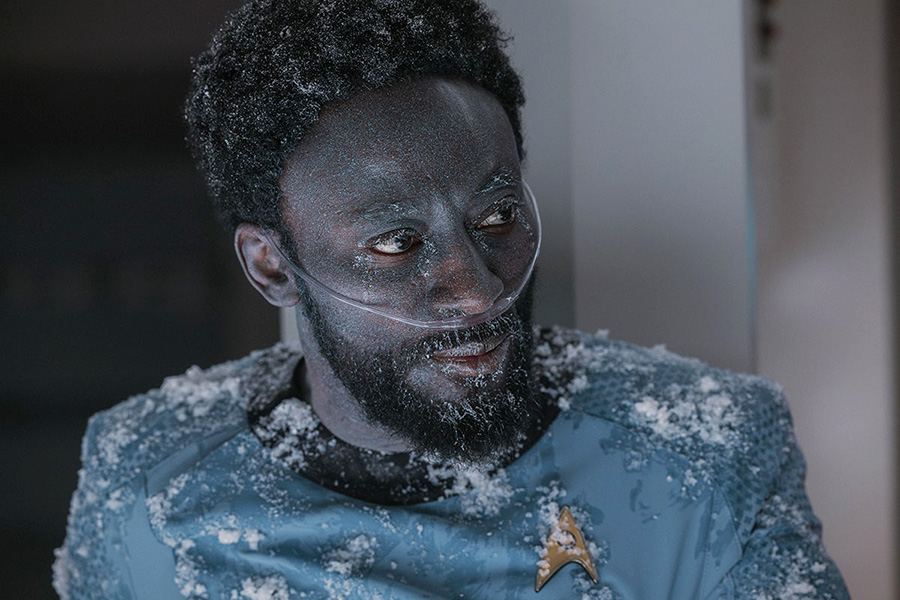
Some 24 scripts would write in where the split screens were to occur. Did you write them into your script, or was it something the editors figured out in post?
I started writing them into the script. And Henry, the guiding light for our whole series, said, “Dude, we’ve gotta let our editor do this. Don't write them into the script. Let the editor do his job. 24 is different. They had a system down. So, write [your script] as our show and we will find how and when to best [use the split screens] in the edit.” So, credit to our great editor, Andrew Coutts. And to the director, Dan Liu. They knew I wanted to bring that element in, and they figured out how to do that in their part of the process. Dan and Andrew really elevated it to a level that I don't think I could have done in the script.
That tidal wave wreaks havoc on the ship, in classic Trek fashion, especially for Chapel and M’Benga. Did your early episode pitch originally have him almost cut in half?
It came later, actually. All of the writers, we break stories as a team [in the room]. So, during the break session, M’Benga was impaled with something [in sickbay] that came out of the ceiling. And it didn’t quite fit the story. It didn't feel like it was enough; like, it had to feel really permanent. And that was when we came up with the idea, “Oh, what if he's crushed by a big piece of equipment that almost cuts him in half?”
A scene from Strange New Worlds' "Off-Hour"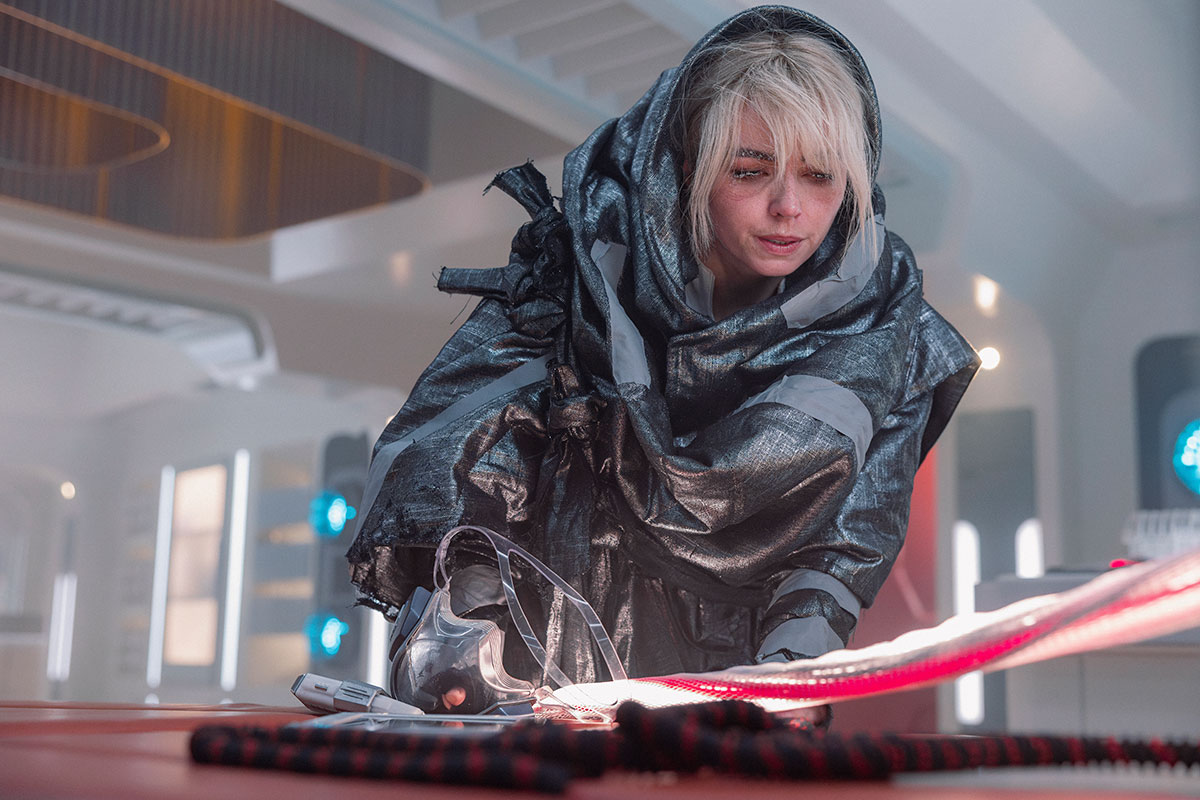
So, from the jump, it seems like the intent here was to center the action on Chapel and M’Benga in sickbay.
We knew we wanted this to be a big Chapel and M’Benga episode. We wanted to build the disaster [movie] element around that. We realized this really lends itself to “What if this happens during an ‘off-hours’ situation, when there’s a shift change happening and not all of the stations are manned, and there’s low staff?” When the disaster happens, it’s really up to Chapel to have to step up and do everything she can to save her colleague’s life in an impossible situation. One that puts him in mortal danger.
In fact, as we were breaking the episode, Akiva Goldsman laid down a challenge for me. He said, “This is a show where we know everybody survives. I want you to make me believe that M’Benga is going to die in this episode.”
The script goes to some bleak places to help sell that, as M’Benga stares down his own mortality.
Thank you. We tried. I will also fully admit that [another inspiration] for [“Off-Hour”] and M’Benga’s situation was this great Homicide episode called “Subway.” It features Vincent D'Onofrio as someone crushed under a subway car, and he doesn’t realize he is dying. But, in his final moments, he starts to realize this is the end, and that unpacks so much drama. So, we took inspiration from that in terms of how M’Benga will deal with his final moments and how he would go through essentially the five stages of grief when facing his own potential demise. Of realizing, “This is it.”
In trying to save M’Benga, Chapel gets maimed a bit. She loses a finger when she accidentally touches a frozen console. That looked like a practical effect.
It was! We definitely wanted that to be a practical effect on set. We also wanted Chapel to have to risk her life to save his and, in the process, she gets hurt. That was kind of our attempt to ratchet up the stakes and make you think these characters are really in danger.
In the language of disaster movies, things go wrong at every step of the way. Part of the challenge for me in writing [this episode] was making sure every scene had obstacles that come up that the audience can’t predict or expect to happen. That we have this amazing crew — Starfleet’s cream of the crop — but it's impossible even for people as skilled as they are to predict or account for every scenario that’s going to be thrown at them. So, in a critical moment for Chapel, she has wrapped herself in mylar — but just one little piece of skin is exposed in a room where it’s almost 300 degrees below zero. And she powers through it.
Scotty (Martin Quinn) in a scene from "Off-Hour"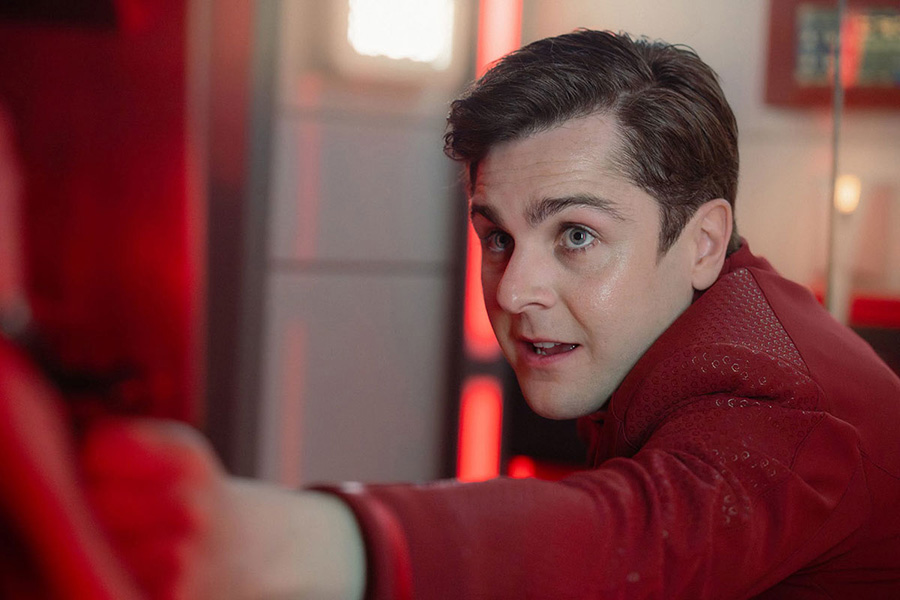
On a lighter note, Scotty (Martin Quinn) gets cut off from his shipmates and the comm panel won’t respond to his voice commands. Thinking it’s because of his Scottish accent, he tries on an American one. Was that beat scripted?
That was all Martin. He improvised that in the moment. When he said it, Dan was like, “That’s really funny.” I thought it was hysterical. That kind of comedy helped relieve the tension in the episode, like you’d find in a disaster movie, so it worked great.
Star Trek: Strange New Worlds is now streaming on Paramount+.